
A little girl named Dorothy steps out of the wreckage with her black dog named Toto, blinking at a sky that doesn’t look quite right, and whispers, “Toto, we’re not in Kansas anymore.”
That’s where silver investors are standing now.
The tornado was 50 years of fiat experimentation, forever wars, debt over 340 trillion, dollar debasement, and runaway tech. On the other side is Oz: AI, robotics, defense, EV batteries and solar devouring silver in structural deficit.
This isn’t 1975, when silver was plentiful, the dollar was unchallenged, and industry was analog. It’s a new landscape—and the old gold-to-silver map no longer applies.
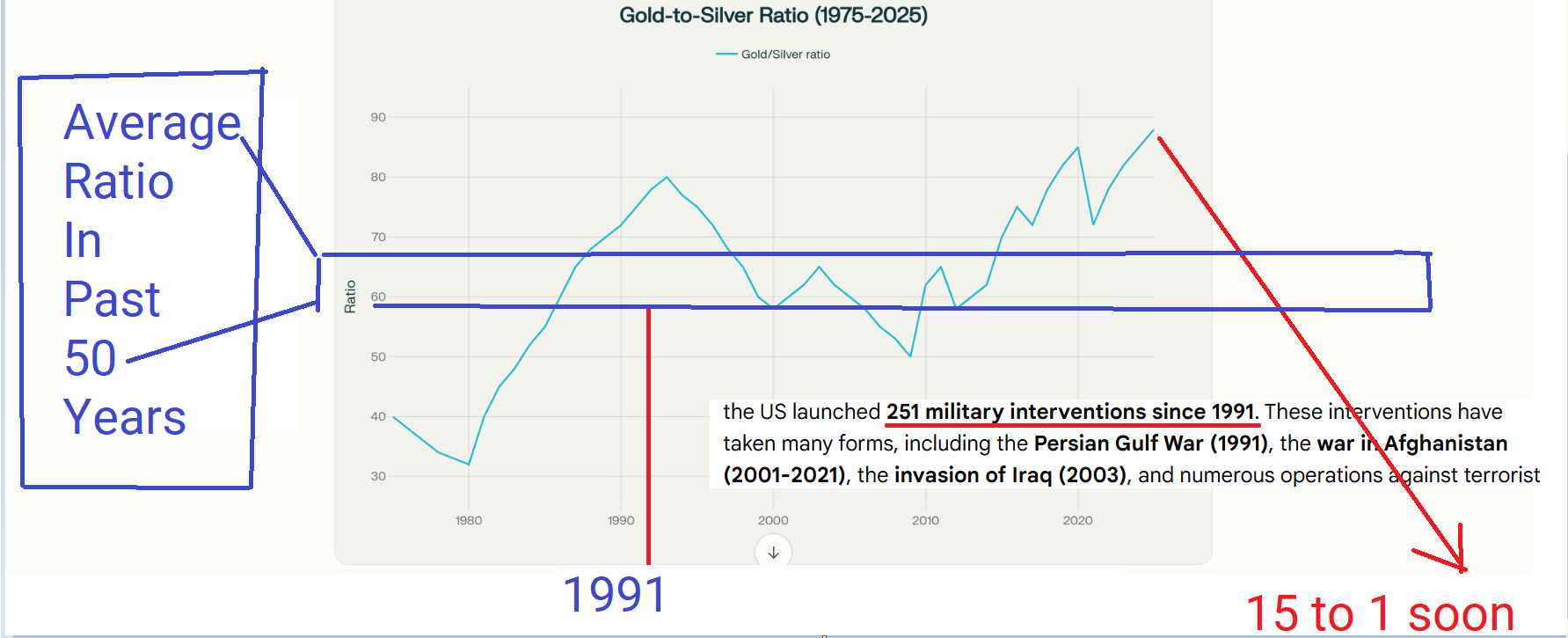
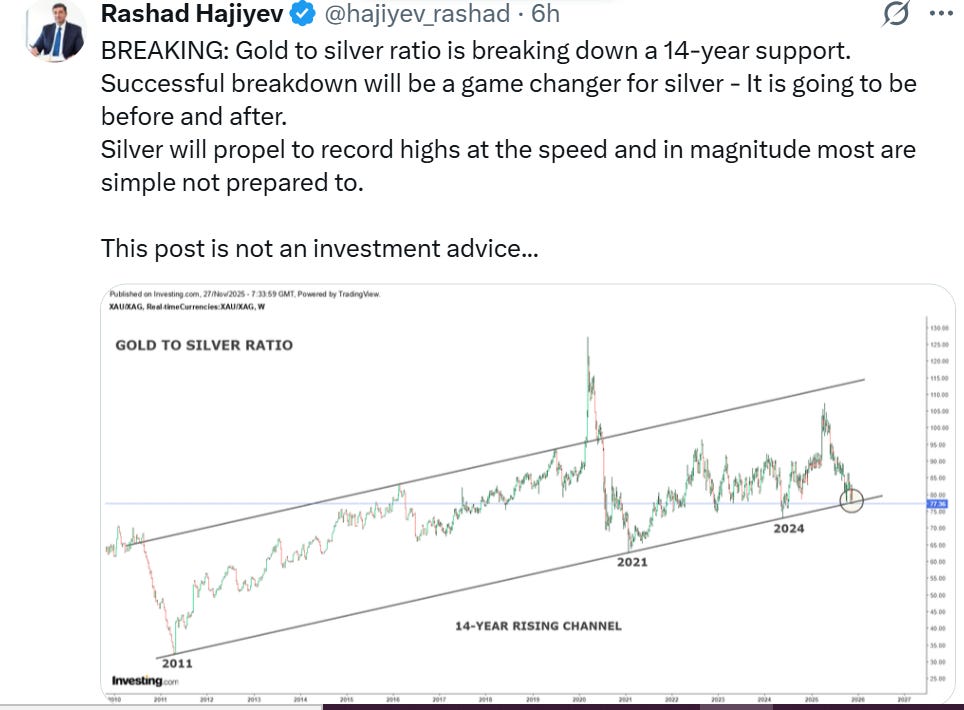
Over the past 50 years (1975–2025), the gold-to-silver ratio has averaged roughly 60–65 ounces of silver per ounce of gold, fluctuating from lows around 30:1 at silver peaks in 1980 and 2011 to highs above 100:1 during stress episodes in the 1990s and 2020. Today’s ratio of approximately 79:1 sits well above that long-run mean, and a simple reversion to 65:1 would be conservative—because history suggests the next cycle may not merely mean-revert, but instead drive silver back toward the 15:1 monetary ratio that prevailed for centuries when both metals served as legal tender.
When silver functioned as money: the 15:1 baseline
For millennia, the gold-to-silver ratio was set by governments and reflected silver’s role as working-man’s coinage and gold’s role as sovereign-level reserves. Rome fixed it at 12:1, the U.S. Coinage Act of 1792 established 15:1, and Congress later adjusted to 16:1 in 1834. These ratios were not arbitrary: they approximated the metals’ natural scarcity in the earth’s crust (roughly 17.5:1) and balanced the needs of large and small transactions. Only after silver was demonetized—culminating in the U.S. Coinage Act of 1873 and the global shift to gold standards—did the ratio float freely and drift higher.
As silver reasserts its monetary function (in a world where dollar hegemony is eroding and central banks seek liquid, portable alternatives to fiat reserves, ) …a retracement toward 15–20:1 becomes structurally plausible rather than speculative.
With BRICS nations accumulating over 16,000 tonnes of gold and India remonetizing silver for 1.4 billion citizens, this shift dwarfs anything the U.S. bimetallic standard achieved during the Coinage Act era. A weakening dollar and coordinated Eastern monetary policy create a structural demand tsunami far beyond 19th-century America’s regional monetary experiment.
Structural industrial deficits that did not exist in 1975
In 1975, silver was not in a persistent structural deficit; supply from mines, refining, and scrap broadly matched demand from photography, basic electronics, and jewelry. Today, the silver market has posted five consecutive years (2021–2025) of deficits totaling nearly 800–820 million ounces—equivalent to roughly ten months of global mine production drained from inventories. These deficits are driven by an unprecedented surge in industrial demand that is fundamentally inelastic: solar photovoltaic cells now consume approximately 20% of global silver supply (over 100 million ounces annually), and that share is rising as renewable-energy mandates accelerate.
Simultaneously, AI data centers, electric vehicles, 5G infrastructure, aerospace electronics, and defense systems require silver’s unmatched electrical and thermal conductivity in applications where substitution is either impossible or economically prohibitive. The AI-and-robotics segment in aerospace and defense alone is projected to grow from roughly $35 billion in 2024 to over $51 billion by the end of the decade, driving a parallel expansion in specialized electronics that embed silver in high-reliability circuits.
None of these demand vectors existed in 1975: solar energy was experimental, AI was academic theory, robotics was confined to research labs, and the defense electronics sector was a fraction of today’s scale. The result is that silver is no longer a discretionary commodity that can be cycled in and out of industrial use when prices rise; it is now a strategic input for the very technologies nations rely on to compete economically and militarily.
The dollar’s reserve erosion and the empire-collapse pattern
In 1975, the U.S. dollar accounted for roughly 70% of global foreign-exchange reserves, and confidence in American monetary dominance was nearly absolute despite the recent abandonment of gold convertibility. Today, the dollar’s share has slipped below 60%, and in the first half of 2025 the DXY index fell more than 10%—its worst six-month performance since 1973—signaling a structural bear cycle that may persist for years.
This decline mirrors a historical sequence documented across Rome, Spain, and Britain: each empire extended military reach globally, ran chronic fiscal deficits to sustain that presence, debased or printed currency to bridge the gap, experienced inflation and loss of monetary trust, and ultimately saw its reserve status collapse. Rome debased the silver denarius over two centuries until hyperinflation destroyed the currency; Spain defaulted four times in 40 years despite possessing the world’s largest silver mines; Britain lost the pound’s reserve role within three decades of the Second World War despite controlling a quarter of the Earth’s surface.
The United States now exhibits five of the seven stages in this pattern: global overextension, unsustainable deficits, large-scale monetary creation, rising inflation, and declining reserve share—leaving only loss of confidence and formal collapse ahead. Crucially, unlike in 1975, rival blocs today can settle energy and commodities in alternative currencies, gold, or bilateral arrangements, so the feedback loop that once forced automatic recycling of dollars into Treasuries has weakened.
Why reversion to 15:1 is rational, not extreme
A move back to the long-run post-1971 average of 62:1 would raise silver to roughly $68 at current gold prices (But gold is headed to $5,000 soon says even the gold haters like Western bankers), Moreover, that outcome assumes the fiat monetary regime and industrial-demand trajectory remain stable.
BUT THE REALITY IS ,the dollar’s reserve role continues to erode—central banks stampeding into gold and silver, (plus sovereign wealth funds, institutional funds, family funds, and retail investors seek tangible stores of value, while industrial users compete for a metal in multi-year deficit—the ratio can compress far beyond the modern average toward the pre-demonetization norm of 15–20:1.
At 15:1, $4,800 gold implies $320 silver, which may sound extreme until one recalls that silver traded near $50 twice in the past half-century (1980, 2011) with far weaker industrial fundamentals, no structural deficit, and a dollar that still commanded credibility. Today, with 800 million ounces of cumulative deficit since 2021, soaring strategic demand from AI, solar, defense, and EVs, and a weakening reserve currency following the empire-collapse playbook, a return to monetary-era ratios is not speculative—it is the logical endpoint of converging structural and monetary forces that simply did not exist in 1975
As U.S. debt races toward $39 trillion and the dollar’s supremacy erodes, SprottMoney.com is positioning clients for what comes next with real metal, not paper IOU promises.
With a rising, gold-linked Chinese yuan challenging Washington’s printing press and geopolitical flashpoints now exceeding even the World War II map in number and complexity, investors are turning to hard assets for refuge.
Meanwhile India’s new banking rules are quietly reintroducing silver as money, not just metal. In this shift, SprottMoney.com stands out for highly rated customer service, deep trust, fast delivery, and secure storage in gold and silver—practical solutions for an unravelling fiat era.
Don’t Buy Black Friday Trinkets & Tomorrow’s Landfill Junk
BUY EVERLASTING WEALTH INSTEAD
This Black Friday, skip the cart full of disposable junk and buy something that outlives every sale flyer. While gadgets break and trends vanish, silver endures—portable, tangible, and outside the debt-soaked financial system. Trade fleeting discounts for lasting value and turn a weekend of spending into a lifetime of real wealth.
BUY SILVER WHILE IT’S STILL WAY UNDER $60 – click on the image below and get started stacking