
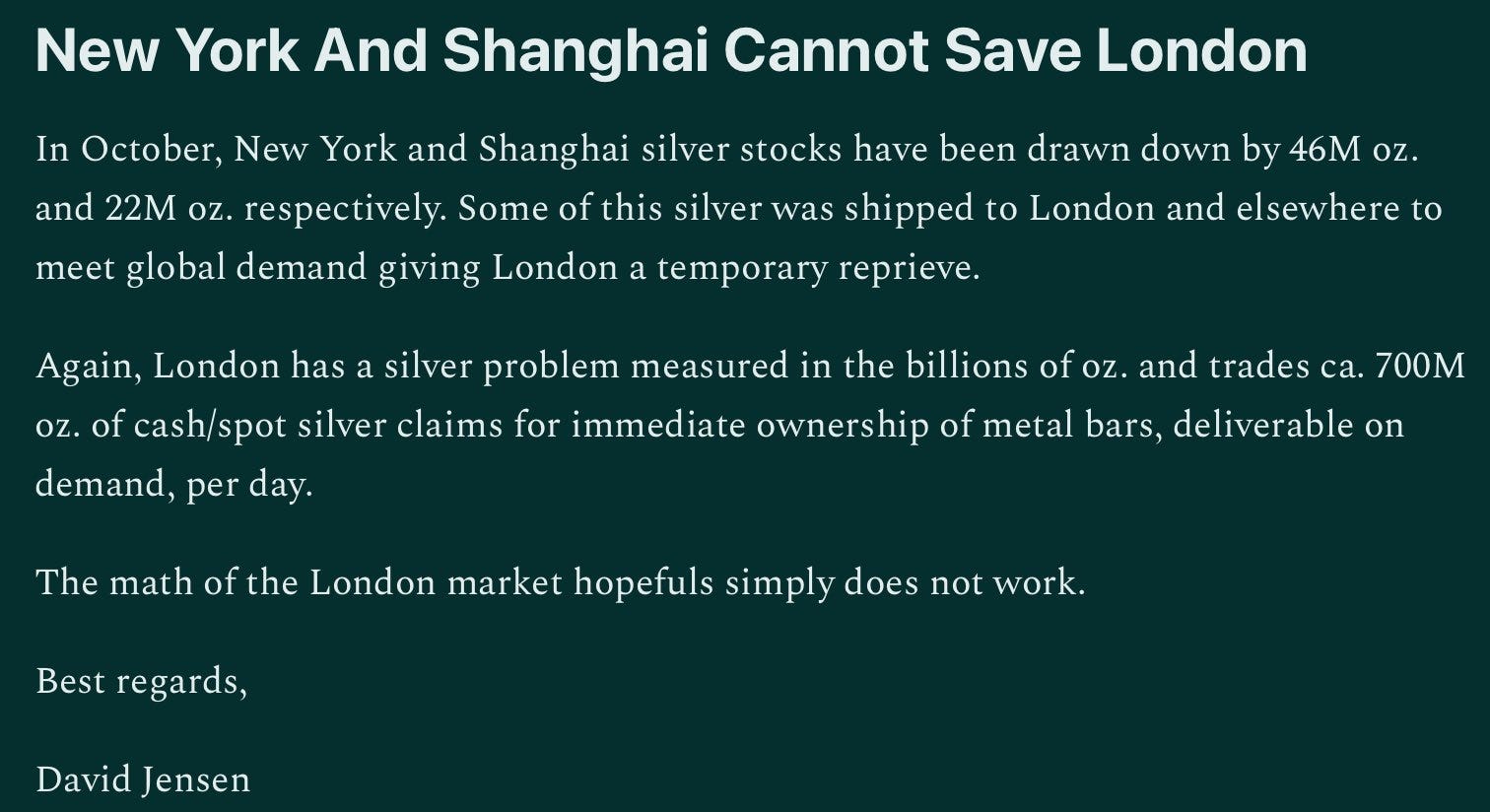
Chinese silver stockpiles have slumped to their lowest level in a decade, sending fresh shockwaves through a global market already grappling with record prices and tariff fears. Data from Shanghai show that exchange‑tracked inventories have been drawn down just as exports surge and industrial demand, especially from the solar sector, ramps higher, leaving the physical market markedly tighter than even a few months ago.
China drains visible stockpiles
Warehouses linked to the Shanghai Futures Exchange are now holding the least silver since 2015, while trading volumes on the Shanghai Gold Exchange have fallen to their weakest level in more than nine years. The drawdown reflects an aggressive export campaign: China shipped more than 660 metric tons of silver in October alone, the highest monthly total on record, much of it headed to London to relieve an intense spot squeeze.
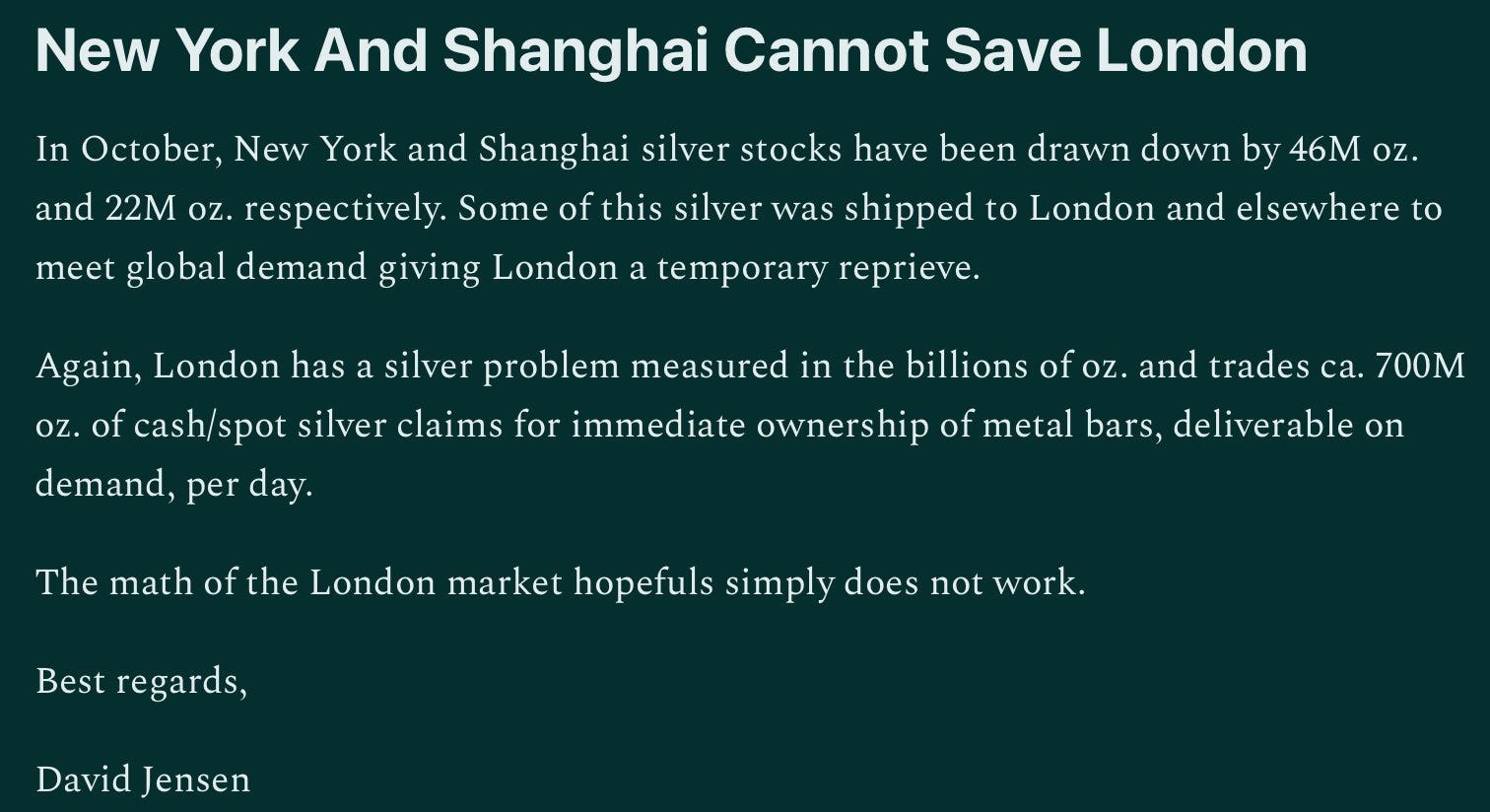
China takes pity on LBMA, but probably for the last time.
China’s record silver shipments to London look like a one‑off. From 2026, stricter state‑trading export controls will curb, not cease, silver exports—making another emergency export surge far less likely
Prices, tariffs, and London squeeze
Silver prices have rallied on the back of this tightening, soaring roughly 70–80% this year to all‑time highs above 52 dollars an ounce and repeatedly outpacing gold’s gains. Traders say the move has been amplified not only by strength in gold but by speculation that the Trump administration could impose or extend tariffs on silver, a risk that has driven pre‑emptive physical buying into the United States and tightened supplies in London.
What is driving the crunch
Analysts in Shanghai attribute the squeeze primarily to heavy exports to London and rising industrial and jewelry demand at home, with Jinrui Futures’ Zijie Wu arguing that the tightness stems from this combination and may begin to ease in a couple of months if flows normalize. In London, record inflows from China and the U.S. have not fully relieved pressure, as strong Indian demand, elevated borrowing costs, and steady holdings in major silver exchange‑traded funds mean there has been no large wave of ETF liquidation to feed the lending pool.
Domestic shifts inside China
The Shanghai silver curve has flipped into backwardation, with near‑term contracts trading above later‑dated ones, a classic sign of immediate physical tightness when inventories are thin and supply is relatively inelastic. Fourth‑quarter photovoltaic demand is another major pillar, with Chinese silver use in solar components rising into the seasonal peak for installations just as stockpiles are most depleted.
Manufacturers Don’t Care about the Price.
THEY ARE PRICE INSENSITIVE
Many of China’s tens of thousands of silver‑using manufacturers treat silver as a non‑negotiable input: they must buy regardless of price, because the metal is a small share of total unit cost and any increase can be passed through to end users.
Jewelry pivot and “invisible” metal
A recent tax overhaul that removed a long‑standing input VAT rebate on certain off‑exchange gold sales has nudged some Chinese retailers to pivot product lines toward silver, a shift visible in Shenzhen’s Shuibei jewelry and metals district as shops experiment with more silver inventory. Strategists also point to large but unquantified “invisible” off‑exchange holdings inside China: backwardation and high spot premiums could eventually coax some of this metal back onto exchanges, but no one knows how big that buffer really is, leaving investors and industrial users to navigate a market where the main visible backstop has already been heavily tapped.
The Coming Age of Chronic Silver Shortage
Silver is quietly slipping into a new role: from “interesting side‑show metal” to the irreplaceable backbone of a strained, high‑tech world. The mining industry is now only producing on the order of 820 million ounces a year, while total demand is pushing beyond 1.2 billion ounces—leaving a structural hole of hundreds of millions of ounces annually. That isn’t a blip; it’s a chronic deficit in a metal that modern industry cannot function without.
How long can a system run a 400‑million‑ounce shortfall before something breaks?
When Every New Technology Needs the Same Metal
Look at where the new demand is coming from. Silver already runs through every circuit of the digital economy, but now it sits at the center of surging applications in AI data centers, robotics, solar photovoltaics, defense systems, aerospace electronics, and dense 5G infrastructure. Each of those sectors is being scaled aggressively and simultaneously, and almost all of them need silver’s unmatched electrical and thermal conductivity to perform at the cutting edge. Engineers can thrift and optimize at the margins, but there is still no true substitute that delivers the same performance envelope, especially where reliability and efficiency are non‑negotiable.
If there’s no substitute and demand keeps compounding, who gets priced out first: consumers, or entire industries?
From Commodity to Strategic Chokepoint
As governments formalize silver’s status on “critical minerals” lists, the stakes rise further. Once a material is labeled critical, it is no longer just a commodity; it becomes a strategic input that policymakers worry about securing in the same way they worry about energy or food. That is where silver is heading: a resource that AI, green energy, and advanced weapons platforms all compete for at the same time. When a metal is simultaneously powering your grid, your data centers, your factories, and your missiles, disruption isn’t an inconvenience—it is a national‑security vulnerability.
If states begin to treat silver like a strategic asset, what does that do to free‑flowing global trade in the metal?
The Metal That Hedges Both Prices and Policy
This is also why silver is regaining prominence as an inflation hedge. It shares the monetary DNA of gold but adds an industrial kicker: when currencies are being diluted and real yields look suspect, silver offers exposure not only to monetary debasement but also to the physical bottlenecks in next‑generation technologies. In an era of relentless fiscal deficits, creeping financial repression, and ballooning sovereign debt, the debasement trade is no longer theoretical; it’s the baseline, and silver’s relatively small market size means that even modest reallocations of capital into the metal or into silver‑backed vehicles can have an outsized impact on price.
If investors decide they want hard‑asset insurance and the go‑to vehicle is a structurally undersupplied metal, how violent can the repricing get?
Silver’s Role in a Post‑Dollar World
Layer on top of that the global drift away from a single reserve‑currency system. As more countries look to diversify away from the dollar—whether through bilateral trade in local currencies, regional arrangements, or greater reliance on tangible reserves—the appeal of scarce, universally needed metals only grows. Gold sits at the top of that list, but silver is increasingly riding in its wake: a monetary metal with industrial teeth, capable of playing a role in dedollarization portfolios that want assets outside the conventional bond‑and‑FX universe. In a multipolar monetary order where trust is fractured, possession of real, indispensable materials becomes a form of power.
If dedollarization is a slow‑motion process of swapping paper claims for real things, where does a chronically scarce, industrially essential, monetary metal ultimately settle in price?
Four Fronts, One Conclusion
Taken together, these strands lead to one conclusion: silver is becoming critical on four fronts at once.
-
It is critical to industry, because existing and next‑generation technologies quite literally will not work without it.
-
It is critical as an inflation hedge, because it ties monetary demand to a hard physical constraint.
-
It is critical in the debasement trade
-
It is critical in the dedollarization trade, because it offers a bridge between monetary defense and strategic, real‑world utility.
The open question isn’t whether silver matters in the next era—it’s who recognizes that early, and who wakes up only after scarcity has already been priced in