by Jon Little intern Niko Moretti
Silver Academy Daily:
Today’s Breakdown: The Global Trust Crisis and Why We’re Still Early in the Gold Bull Run
“Gold drops like a rock when people trust the system. It skyrockets to the moon when they don’t.” — Jon Little
At Silver Academy, today’s analysis cuts through the noise: what’s powering gold is not mere speculation or technical momentum, but the largest collapse in institutional trust seen in generations. This is the dawn of a structural bear market in confidence — and the world is just waking up.
Traditional analysis insists gold looks overheated. But that misses the new reality: this move isn’t about chasing alpha — it’s about fleeing systemic risk.
Western portfolios, asleep on gold for a decade, are only just stirring. Despite monetary chaos and soaring government liabilities, gold holdings across ETFs remain below 2020 highs. The big move has only begun.
In 2022, the Western freeze of $300 billion in Russian sovereign assets shattered assumptions about property rights. For the first time, global reserves became fair game in a political showdown — and the rest of the world took note.
What shocked the world then was just a prelude. Today, the Dutch government’s nationalization of Nexperia, a Chinese-owned tech giant, is Russian Reserves 2.0: a blunt show that in times of stress, property rights across the West mean whatever policymakers say they mean.
With the old order in free fall, boundaries blur. China retaliates with critical mineral export controls, Washington fires back with tariffs, and Europe escalates by confiscating strategic companies — all in the name of “security.” Capital, caught in the crossfire, no longer trusts headlines or legal guarantees.
This year’s record 1,200+ tons of central bank buying is not noise — it’s a siren. Western investors still trade paper claims, but the real action is in state-to-state shifts of actual metal. These are not hot-money flows. They are emergency exits.
We are very early. The bull run in gold is only gathering speed as Western investors awaken.
Central banks are still printing, but now governments are outright seizing assets. From emergency currency controls to outright expropriation, the ground rules have forever changed. Gold’s rise isn’t an accident; it’s a direct repricing of political and legal reality.
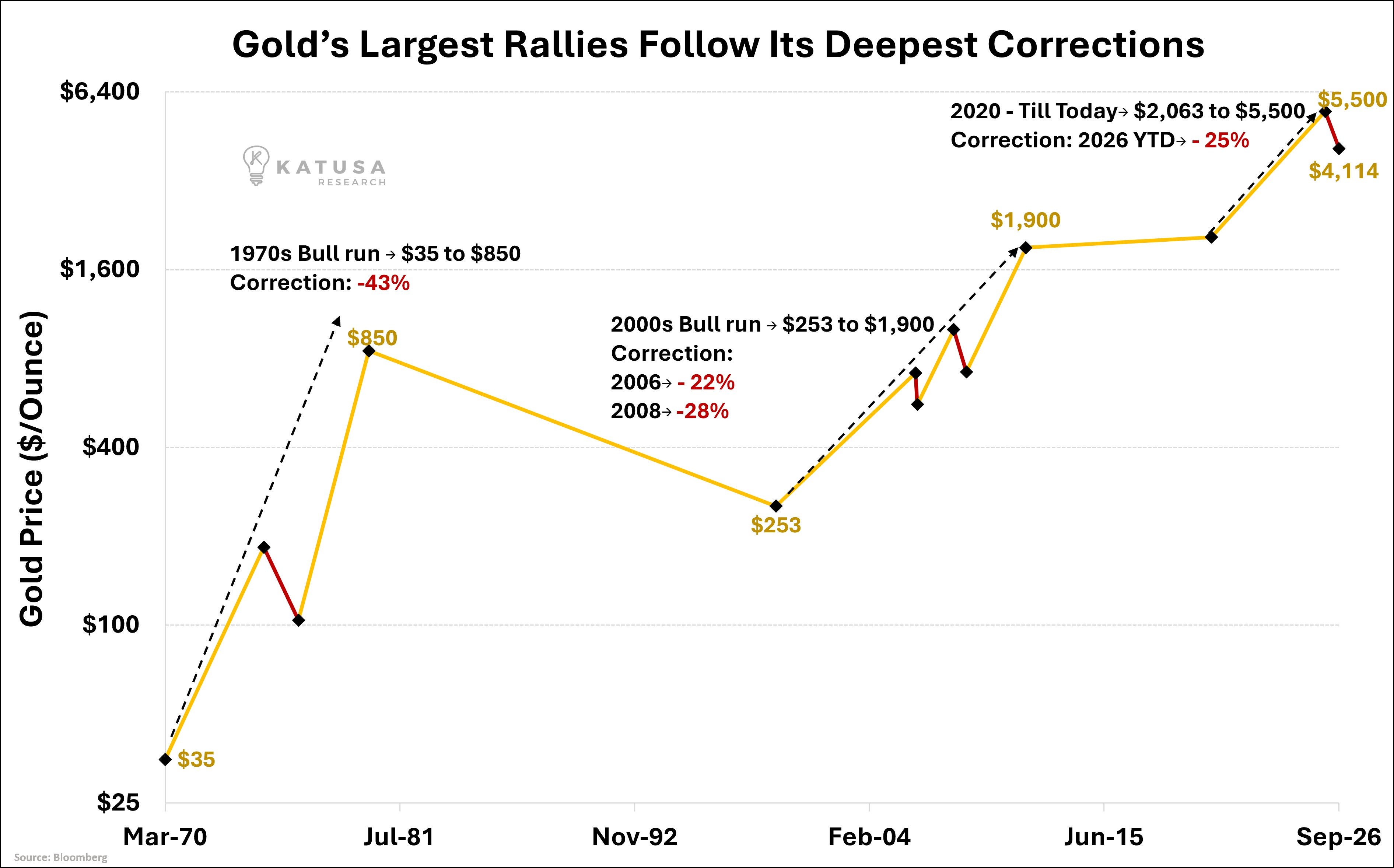
Despite record prices, every historical cycle suggests that this is just the opening stanza. Once global trust enters a secular decline, these super cycles can run for a decade or more.
There is no path to near-term restoration of trust — not in the United States, not in Europe or Japan. The East-versus-West rupture is widening, not healing. What we’re seeing is only the beginning, with another five years (or more) ahead for this gold bull run.
If you thought gold confiscation or capital controls were relics, think again. The impossible becomes likely the moment systemic trust evaporates. Property and safety nets exist only as long as the system does. Now, risk is everywhere — and risk happens fast.
This isn’t about speculation. It’s an exodus from illusion. Gold has become the scoreboard for the world’s loss of faith in the establishment itself.
When trust dies, money seeks shelter. In this storm, only real assets — and the willingness to act early — offers refuge.
BHP’s Quiet Surrender to the Yuan — and What It Signals for Gold and Silver
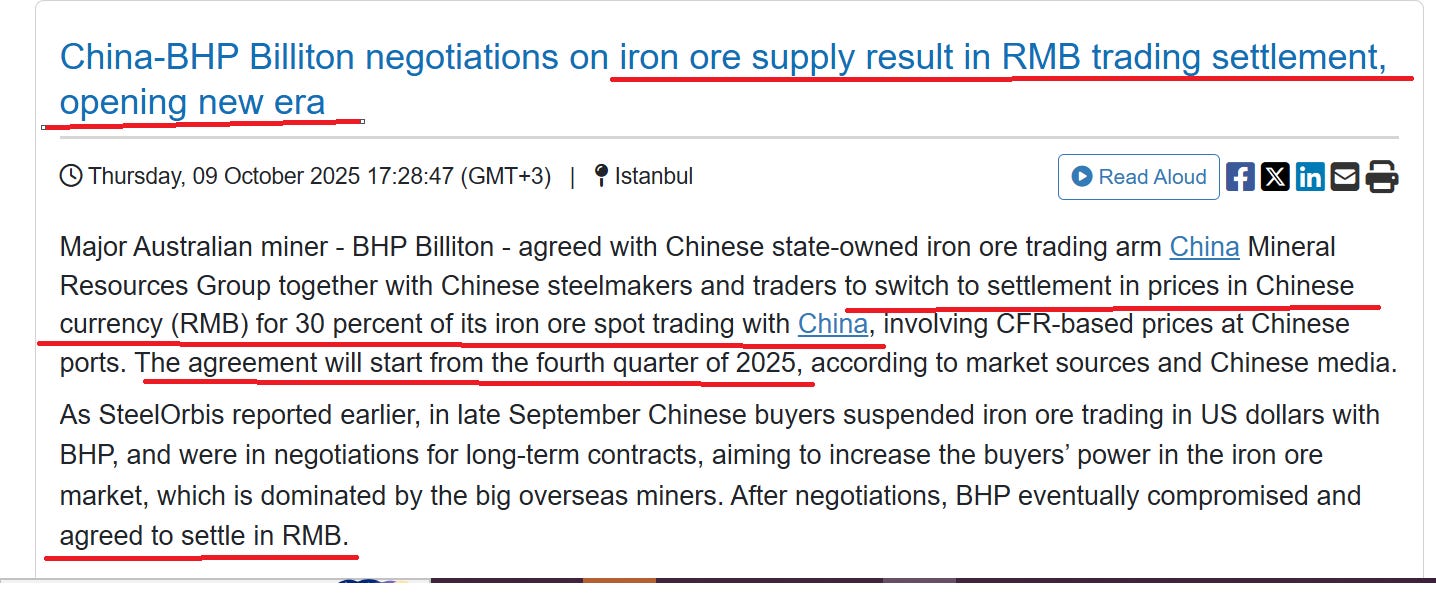
While most investors were shutting down for the weekend, BHP quietly dropped one of the most important monetary signals of the decade. Beginning in the fourth quarter of 2025, the world’s largest miner will settle nearly one-third of its iron ore spot sales to China—not in U.S. dollars, but in Chinese yuan. No press release, no CEO statement, just a brief industry wire.
It’s more than a trade decision—it’s a fracture in the global dollar system.
Fifteen years ago, BHP led the charge that made iron ore dollar-priced and index-linked, anchoring the global commodity trade to the U.S. financial system. Back then, the dollar was unquestioned. Today, the same miner is breaking from that system and accepting China’s currency instead.
Step by step, this is how monetary power shifts: quietly, commercially, and without firing a shot.
China wants what every empire has wanted: the ability to settle its imports in its own currency. BHP just gave it that authority.
This isn’t just a story about iron ore—it’s about the erosion of confidence in fiat money itself. The yuan may be digital and controlled, but at least it’s anchored to a rising trade empire. The U.S. dollar, meanwhile, is being diluted faster than ever. Washington’s trillion-dollar deficits, central bank gold dumping, and political gridlock all point to one thing: endless printing to keep the system afloat.
That’s why gold and silver matter more than ever. They are the antithesis of what’s happening here. You can’t print them. You can’t sanction them. You can’t inflate them away. Every time trade moves from paper to tangible value—whether it’s commodities settled in yuan or countries hoarding bullion—the world gets a little closer to rediscovering why gold and silver were money in the first place.
BHP’s move fits a wider pattern. Saudi Arabia is taking yuan for oil. Russia, Iran, and BRICS states are trading in local currencies or gold-linked systems. Even Western-friendly economies are hedging against the dollar’s decline. The world isn’t waiting for a financial crisis to replace the dollar—it’s replacing it deal by deal.
As trade migrates into alternative currencies, gold and silver naturally rise in strategic importance. They’re the only truly neutral assets in a fragmented world—a form of settlement that no one can manipulate or “freeze.”
For Australia, this marks a turning point. Economically tied to China, but militarily tied to the U.S., the country’s biggest miner just took a political gamble wrapped in a “commercial decision.” Each shipment settled in yuan strengthens Beijing’s monetary hand and weakens Washington’s.
The irony couldn’t be sharper: Australia built its wealth selling commodities into the dollar system. Now, it’s helping accelerate the world’s slow walk away from it.
Every fiat system eventually reaches this stage—when the world’s producers prefer anything but paper promises. BHP’s quiet pivot is a symptom of that decay. The miners are signaling, even if they won’t say it aloud: money backed by nothing can’t buy real things forever.
As the dollar era loosens, tangible wealth—gold, silver, land, and production—will reprice higher. The world’s largest commodity producers already see which way the tide is moving.
Time to hold what can’t be printed. Time to trust what endures.
Stay vigilant, stay informed, and remember: in a bear market for trust, gold is not just a hedge. It’s the last insurance policy left.
“It’s not about being bullish on metal, but bearish on mankind’s track record.” – Jon Little from a recent podcast
The fiasco kicked off with President Biden’s Russian sanctions. By freezing Moscow’s assets and weaponizing the global financial system, Washington didn’t just target Russia—it told every country on Earth that American dollars can disappear on a whim. The message landed: smart money—and nervous governments—ran for the exits and grabbed gold instead.
Enter Trump and his “Big Beautiful Bill,” a bipartisan blowout masquerading as economic renewal. In reality, it was debt as far as the eye could see—and both parties dove in headfirst. The result? Ballooning deficits, asset bubbles, and a shrinking dollar for ordinary Americans. Populism this wasn’t; it was the same old binge spending, just with a new slogan.
“Liberation Day” was supposed to free America from China’s grip, but the real addict was Washington, desperate for cheap Chinese goods. Instead of a trade triumph, tariffs fueled higher inflation at home and taught Beijing the final lesson: never depend on the dollar. In every sense that matters, America handed China exactly what it wanted—motivation to dump Treasuries and trade elsewhere.
Staring down the consequences of decades of reckless leverage, the Fed’s answer—again—was to slash rates and print more money. The ghosts of 2008 weren’t exorcised; they were simply invited back, with bigger appetites. Leverage went unaddressed, and inflation roared. The only lesson learned in Washington? You can always buy a little more time—until you can’t.
Consider the numbers: since the 1990s, the United States has bankrolled 251 wars and armed interventions around the world. These aren’t humanitarian missions—they’re giant funnels moving money offshore. Here’s where the “aid” actually ended up:
-
Israel: More than $300 billion since 1948, including a multibillion-dollar weapons bonanza that’s flattened Gaza with U.S.-supplied firepower.
-
Ukraine: $174 billion and counting since 2022, much of it for advanced weaponry and “economic support” that never seems to reach ordinary Ukrainians.
-
Afghanistan: $2.3 trillion, thousands of armored vehicles and helicopters handed over, a nation left right back under Taliban rule.
This is not “security.” It’s legalized looting with a bipartisan stamp. Every dollar marked for “military assistance” or “reconstruction” flows through a network of contractors, outsourcers, donors, and consultants. The real goal: park U.S. public funds far from scrutiny—where both Democrats and Republicans can gorge themselves without interference.
And just look at the roster running this show:
-
Chuck Schumer: 44 years in Congress, still at the pinnacle.
-
Nancy Pelosi: 36 years representing San Francisco, decades in leadership.
-
Bernie Sanders: Over 33 years in Congress, the Senate’s most senior independent.
-
Chuck Grassley: An astonishing 44 years in the Senate, first elected in 1980.
-
Mitch McConnell: Senator since 1985—four decades of “new ideas”.
-
Ed Markey: Over 48 years between House and Senate.
-
Ron Wyden: 44 years and counting.
And then there’s the White House shuffle: two terms apiece from Clinton, Bush, Obama, Trump—each promising change, each handing off a hotter potato.
So after decades of bipartisan blunder, endless war, and record inflation, this is the team promising to fix everything: career politicians whose greatest skill is holding onto their seats, and presidents who never saw a deficit or a war they didn’t like. The same faces, decade after decade—the very people who built this house of cards, now telling you to trust them to rebuild it.
If you’re waiting for a rescue, you might want to check the exits—because this is Washington’s idea of problem-solving: more wars, more aid, more debt, and a new round of promises from the same hands that broke it all in the first place.
What you should do?
Gold and silver are the ultimate “debasement trade”—a cynical bet that governments will always choose to dilute the currency to pay for wars, bailouts, and political failure.
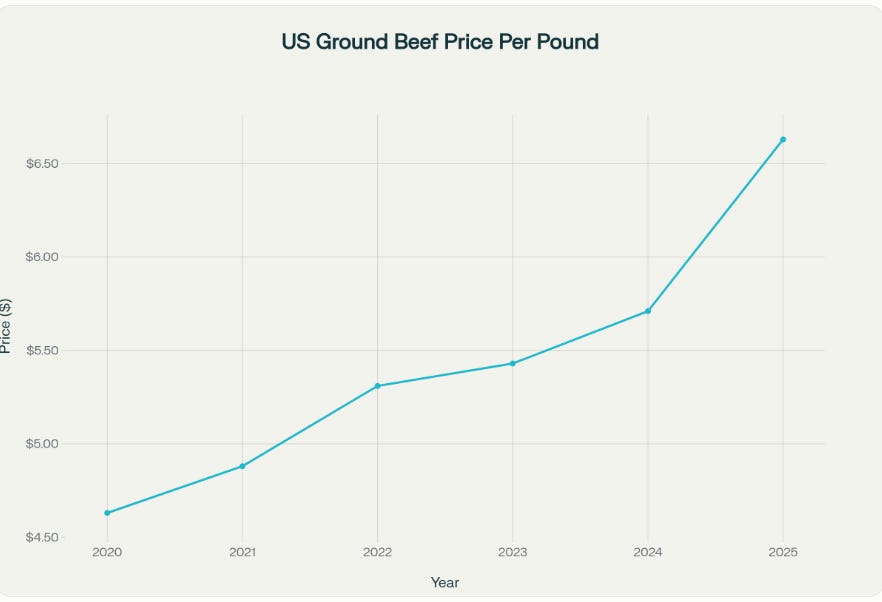
Debasement is when the state silently drains value from every dollar by printing more money, erasing purchasing power instead of raising taxes. Two years ago, a pound of hamburger was $4—today it’s north of $8, while politicians promise stability and deliver inflation. Wars are financed, debt explodes, and your money quietly vanishes. In a rigged system like this, gold and silver aren’t investments—they’re a manifesto: refusal to be robbed by the political class, a hedge against ruin, the last honest money left.
Gold Fixes this
Doug Casey intern Lau Vegys writes
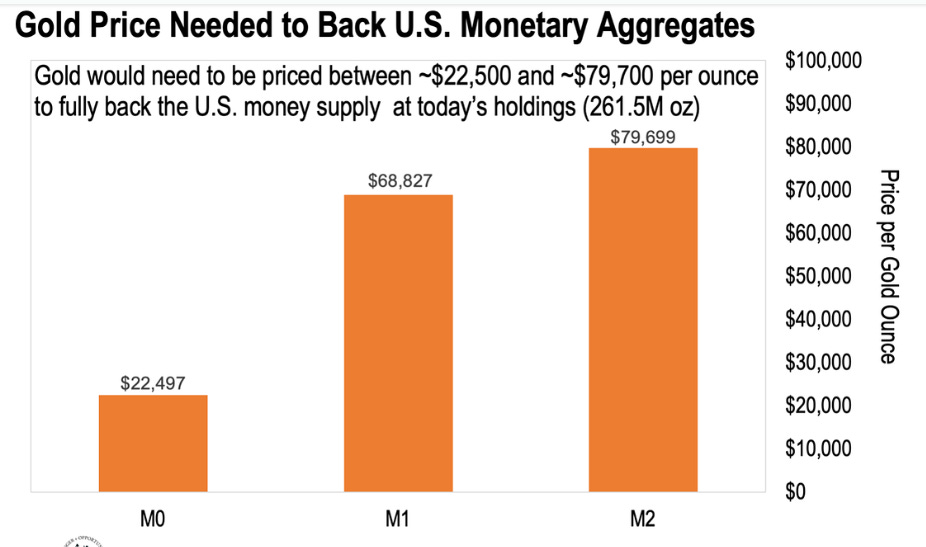
”As you can see, backing just M0—the narrowest measure of money, which includes physical cash in circulation and reserves held by banks at the Fed—could push gold past $22,000 per ounce. M1 would require $68,827, and M2 a staggering $79,699.
This just goes to show that while the final long-term price would depend on the level of backing—say, 20% versus 100%—even a partial move by the U.S. government to restore monetary credibility would send gold prices soaring.
Sounds great, right? Well, sure—if you already own gold. But such a move would almost certainly require a sharp dollar devaluation first.
And yes, this also means anyone not holding gold and other “real assets”—like silver, natural resources, and commodities—would see a sharp drop in their standard of living.
Now, personally, I’m not banking on a full return to the gold standard anytime soon, but I can easily see the U.S. taking incremental steps to stabilize the system and rebuild confidence in a devalued dollar”
Foreword:
India’s bold move to recognize silver as banking collateral at a 10-to-1 gold-silver ratio catapults silver into the monetary spotlight—reshaping global finance and fueling the next era of silver-backed lending, credit access, and industrial expansion
India’s bold financial reforms, effective April 2026, are set to propel silver into a powerful new era—not just as an industrial workhorse, but as a formalized monetary metal anchoring the banking sector. The Reserve Bank of India’s unified gold and silver loan rules mark a paradigm shift and intensify the global rush toward silver-backed banking, with bullish implications for investors and industrial users alike.
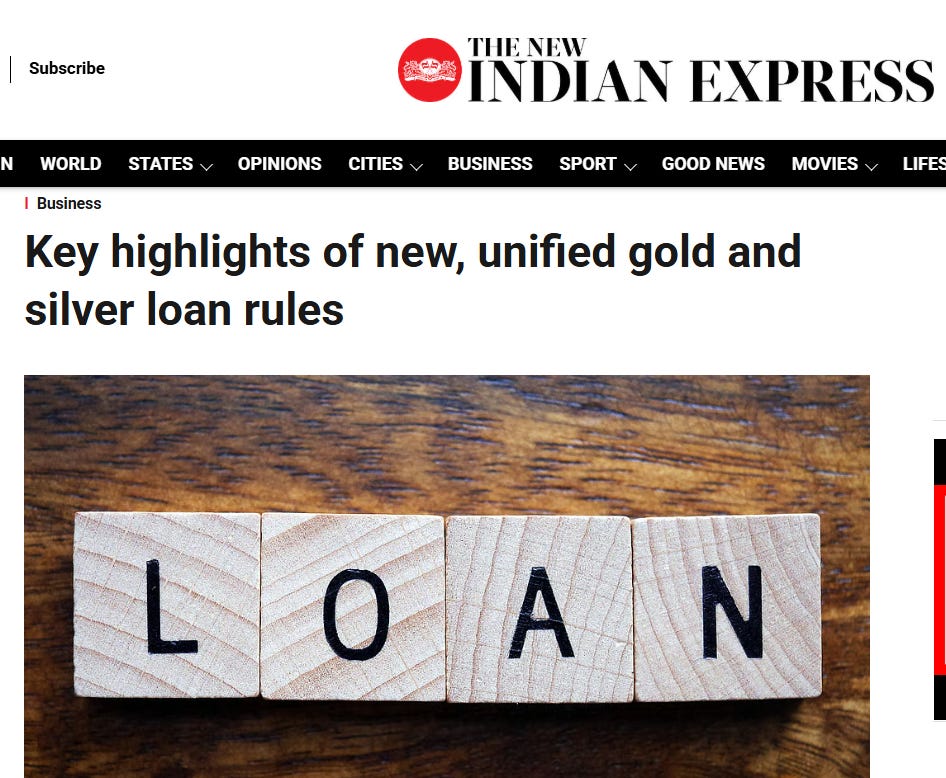
For decades, India’s vast middle class and rural population relied on physical gold as the foundation for household credit and emergency loans. Now, silver is officially joining the ranks. Under RBI’s new regulations, up to 10 kilograms of silver jewelry can be pledged per person as collateral—versus just 1 kilogram for gold—for personal or business loans from banks and Non-Banking Financial Companies (NBFCs). Loans of up to ₹2.5 lakh (about $3,000 USD) can be granted with minimal credit history, making precious metal-backed credit more accessible than ever.
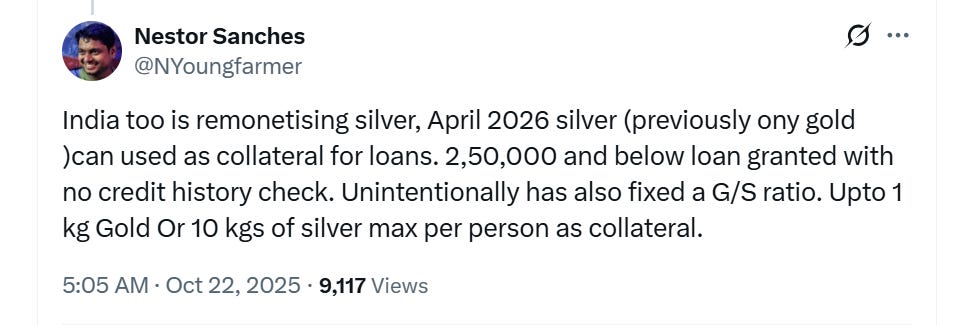
This move essentially “remonetizes” silver in India, echoing global trends of monetary metals gaining credibility amid rising inflation and currency volatility. “India too is remonetising silver,” writes analyst Nestor Sanches. “April 2026 silver (previously only gold) can be used as collateral for loans. 2,50,000 and below loan granted with no credit history check. Up to 1 kg Gold Or 10 kgs of silver max per person as collateral.” Banks and NBFCs—highly respected institutions—now have standardized procedures and close regulatory oversight for these lending practices, providing transparency and safety to borrowers and lenders alike.
India’s silver remonetization comes as industrial demand booms. Silver is a crucial component in solar panels, electric vehicle batteries, advanced electronics, aerospace, and military hardware. The convergence of financial backing and industrial necessity sets silver up for dramatically higher demand and limited supply—a “perfect storm” for price action.
The new rules also mandate a minimum loan-to-value ratio of 85% for small loans, further incentivizing the use of silver as a bridge between household wealth and productive credit. Valuation procedures now require borrower presence and transparent documentation, creating a fair and robust system for silver-backed lending.
India isn’t alone in reigniting silver’s monetary role. In recent weeks, Saudi Arabia purchased 93,000 shares of the iShares Silver Trust (SLV), a clear sign the kingdom sees silver’s upside both as a store-of-value and a strategic commodity. Meanwhile, Russia has added substantial physical silver bullion to its central bank reserves, apparently doubling down as Western nations tighten sanctions and traditional currency reserves become politicized. These state-level decisions can serve as a template for further institutional buying in major emerging markets.
Pertinent Rules
The pertinent RBI guidance in fact sets loan eligibility limits by weight: “No loan against ETFs, bullion: Lenders cannot offer loans against primary gold or silver (bullion, ETFs). One can pledge only up to 1 kg of gold ornaments and 10 kgs of silver ornaments for availing loan. Loans against coins are limited to 50 grams for gold and 500 grams for silver…”
India’s move to formalize silver as banking collateral, and the surge of international institutional purchasing, signals a new era for silver as both a monetary and industrial lynchpin. As supply struggles to meet dual demand from the tech sector and the banking system, long-term bullish pressures continue their ascent.
Silver’s renaissance is not just about jewelry or investment—India’s regulatory overhaul and the global pivot toward sovereign silver stockpiling represent a fundamental change in the way countries and individuals interact with money. With physical silver now woven into the world’s banking fabric, investors would do well to watch policy shifts in Asia, central bank holdings, and stories of household wealth recast in a precious metal that increasingly stands shoulder-to-shoulder with gold.
end of segment
previously we reported (just 2 business days ago)
Five years ago, four industries barely figured in the conversation about silver’s future: (1) AI hyperscale data centers
(2) Advanced robotics and military drones
(3) Samsung’s silver-carbon solid-state batteries
and (4) eVTOLs—the emerging world of flying cars.
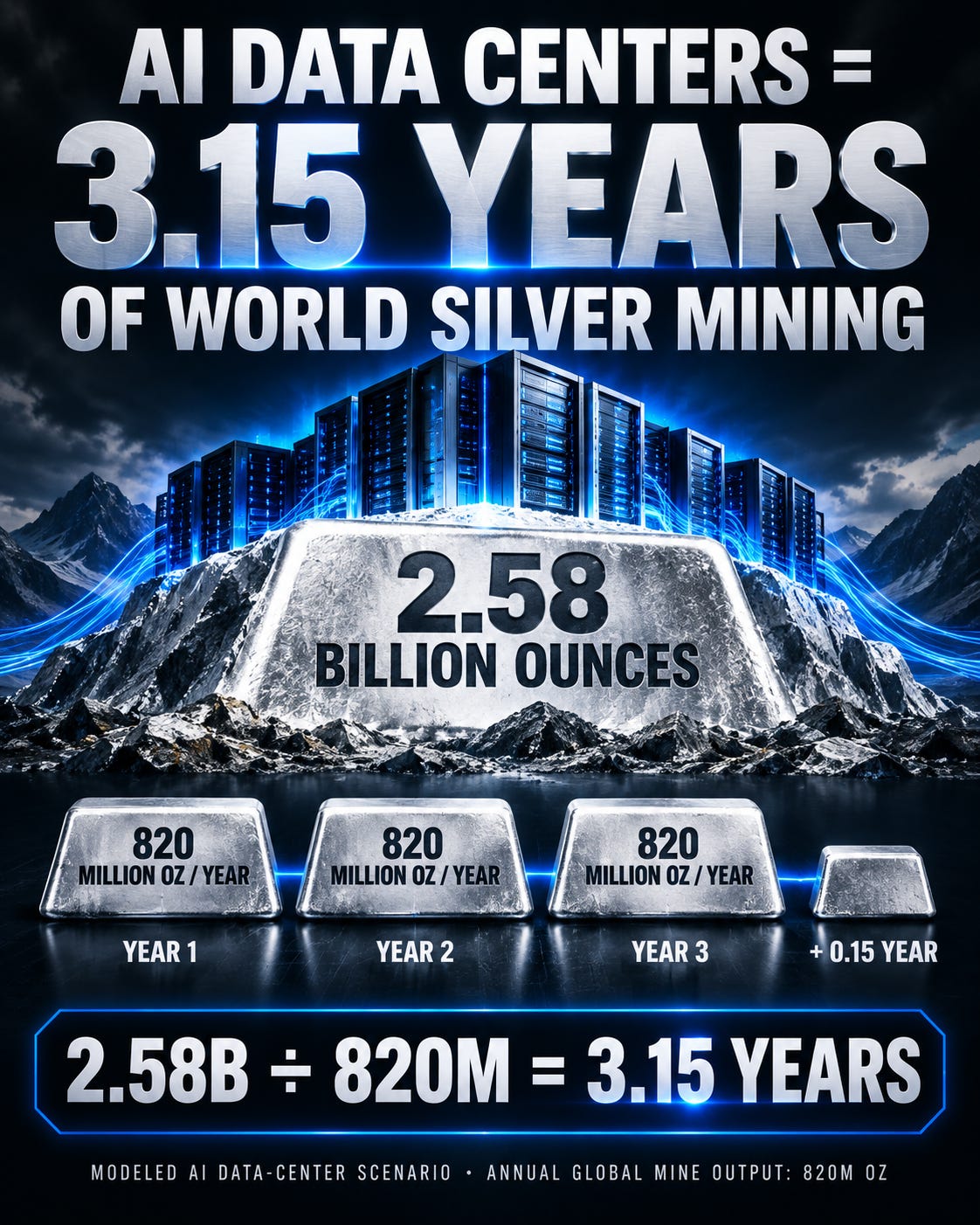
Today, they are opening new fronts in the competition for a metal already stretched between industrial necessity and geological scarcity. Their ambitions are accelerating; silver supply is not. With roughly 820 million ounces mined annually and silver becoming harder to find, tomorrow’s technologies are converging on a resource the mining industry cannot simply produce on command.
Tomorrow’s Technology Is Hunting Silver
The future is arriving in server racks, robotic machines, next-generation batteries and aircraft that rise vertically above city streets. Beneath these seemingly unrelated technologies lies one increasingly important ingredient: silver.
Five years ago, these four industries were not calling on silver the way they are today. Now their ambitions are expanding against a stubborn backdrop: roughly 820 million ounces mined annually, stagnant supply and a metal becoming harder to find.
Technology moves at software speed. Mining moves at geological speed.
A conventional data center handles websites, business applications and digital storage. An AI hyperscaler is a different beast: a sprawling computational engine packed with accelerators, dense circuitry and power infrastructure.
Both consume silver. AI facilities use considerably more. Conventional data centers use about 60 grams per silver and the hyper scaler server use 180 grams per server.
The distinction matters because counting buildings misses the story. The computing inside them is changing. More powerful, densely connected equipment creates additional demand for the silver embedded in electrical contacts and electronic components. The AI revolution does not happen entirely in cyberspace. It requires physical metal.
Robotics is moving beyond factory floors. Drones and autonomous machines are becoming central to military planning, shifting more battlefield functions toward electronically controlled equipment.
Every machine must sense, communicate, process information and manage electrical power. Silver helps make those electrical connections work reliably. Its established applications include contacts and other electronic components.
This is not simply another consumer gadget cycle. It is an expanding category of machines built for environments where failure carries consequences.
Samsung’s silver-carbon solid-state battery introduces a potentially enormous demand multiplier: one kilogram of silver per vehicle.
Consider the scale. Using 23 million annual electric-car sales as a baseline, five years represents 115 million vehicles. At one kilogram each, that would require approximately 3.7 billion ounces—more than four years of mine output at 820 million ounces annually. That is the scale of the opportunity, not an assumption that every EV adopts Samsung’s design.
Even partial adoption could matter enormously.
eVTOLs (flying cars) need the most reliable charge per pound plus silver’s superior conductivity and thermal properties. The stakes are higher (pun intended)
Then come eVTOLs: electric aircraft popularly described as flying cars.
Here, reliable electrical performance becomes nonnegotiable. A disabled car can pull over and call roadside assistance. An aircraft thousands of feet above the ground cannot.
Silver’s conductivity and reliable contact performance make it valuable wherever electrical integrity matters.
Four industries are reaching toward the future. All must confront the same constraint: silver cannot be mined on command.
How to pick a miner?
1. Jurisdiction matters. War and shifting alliances can redraw an investment’s risk overnight. For a strategy prioritizing geopolitical insulation, avoid Mexico and favor jurisdictions with dependable property rights, predictable permitting and secure operations. Political exposure deserves scrutiny before ore grades or production forecasts.
2. Separate primary silver plays from byproduct producers. Buy meaningful silver exposure—not a base metal business wearing a silver label. Check the revenue mix carefully
Learn More: The Top Silver Miners
end of segment
The American empire is not calmly managing a transition. It is lashing out as declining empires do: expanding its coercive reach abroad while tightening control over the narrative and the money at home. The result is a world moving simultaneously toward geopolitical fracture, energy insecurity, electrification, and a renewed contest over what constitutes real money.
Washington’s posture is increasingly naked. Venezuela’s oil is no longer merely an economic asset but a strategic prize openly linked to U.S. power. Iran remains under continuing military pressure, Cuba is being subjected to intensified economic coercion, and the United States has secured expanded strategic access around Greenland. This is not the behavior of a confident system resting on voluntary consent; it is the behavior of an overstretched power trying to preserve a global order built on military reach, dollar settlement, and resource control.nytimes+1
The pattern has deep roots. Iraq’s attempt to sell oil in euros rather than dollars became one piece of a wider story about the petrodollar system and Washington’s willingness to defend its monetary sphere. The broader strategic vision associated with the “Clean Break” era—however one judges its origins or advocates—helped normalize permanent pressure on states seen as obstacles to U.S. and Israeli regional interests. Today, the target list is plainly visible: Iran, Venezuela, Cuba, and strategic territory in the Arctic.
Empire rests on three pillars: military power, information power, and monetary power. America has deployed all three. Its military enforces access and influence. Its corporate-state media complex frames intervention as security, democracy, or humanitarian necessity. And its debt-based Federal Reserve note remains the accounting unit of an empire that must constantly issue more claims on future wealth to maintain the present system.
That model has one fatal weakness: debt cannot produce energy, metals, food, machines, or electrical capacity. It can only issue claims against them.
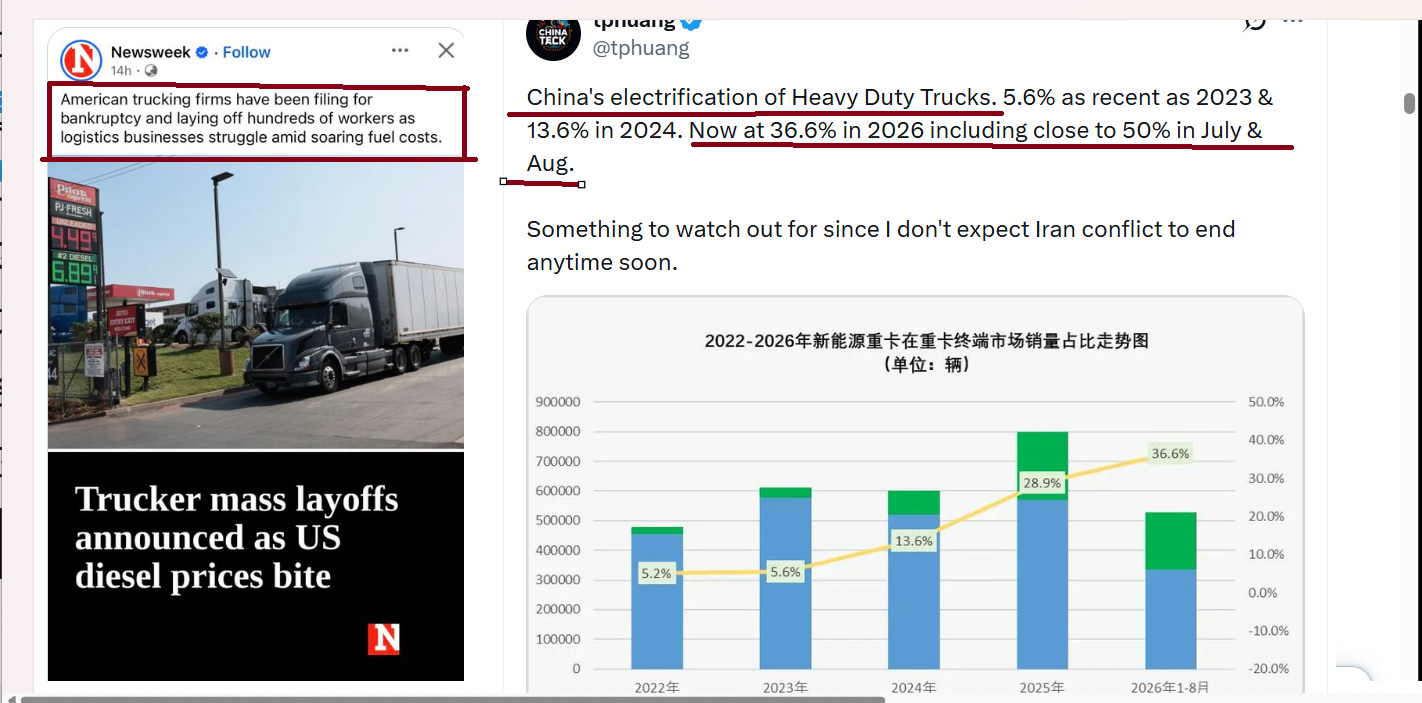
China understands this distinction. While Washington’s comparative advantage remains force projection, China’s is industrial organization: factories, grid capacity, manufacturing supply chains, railways, ports, batteries, solar modules, and electric vehicles. China’s heavy-duty truck electrification illustrates the speed of that change.
The cited figures show electric trucks rising from 5.6% of the market in 2023 to 13.6% in 2024 and 36.6% in 2026, with roughly half of sales reportedly electric in July and August. Even allowing for the need to independently verify those monthly estimates, the direction is unmistakable: the industrial world is electrifying at a pace Washington’s war-and-debt model cannot command.
And electrification means silver.
Silver is the world’s best electrical conductor. Every expansion of solar, EVs, charging systems, data centers, high-performance electronics, grid infrastructure, sensors, and advanced communications pulls on a metal whose supply cannot be increased with a keyboard stroke. Unlike dollars, silver must be mined, refined, transported, fabricated, and physically delivered.
The silver market is already running structural deficits. Industrial fabrication remains enormous—about 657 million ounces in 2025—this doesn’t capture the massive new drivers in addition to military and solar which are:
1. Silver solid state batteries
and
2. AI data centers
3. Silver as a monetary metal.
“That is the key: silver is no longer merely a monetary metal, and it is no longer merely an industrial metal. It is both. Monetary demand rises when confidence in fiat debt erodes. Industrial demand rises when the world builds the electrical infrastructure of the future.” – Jon Forrest Little
The empire may continue printing, threatening, sanctioning, and seizing. But it cannot print conductivity. It cannot bomb a silver mine into existence. And it cannot issue Federal Reserve notes that replace the physical metal required to power the electric age.
end of segment
Silver is still cheap—obscenely, almost comically cheap—and the public is being trained to ignore it because that is what people do at turning points: they stare at the rear-view mirror and call it analysis.
At roughly $65 or below, silver remains:
-
49% below its nominal all-time high of about $120.
-
72% below its CPI-adjusted 1980 high of roughly $217.
-
92% below an M2-money-supply-adjusted equivalent near $774.
And yet investors act as if they have missed the trade because silver moved. Brilliant. The asset can be catastrophically undervalued for decades, then rise a few dollars, and suddenly the herd decides it is “too expensive.” This is not investing. It is financial learned helplessness.
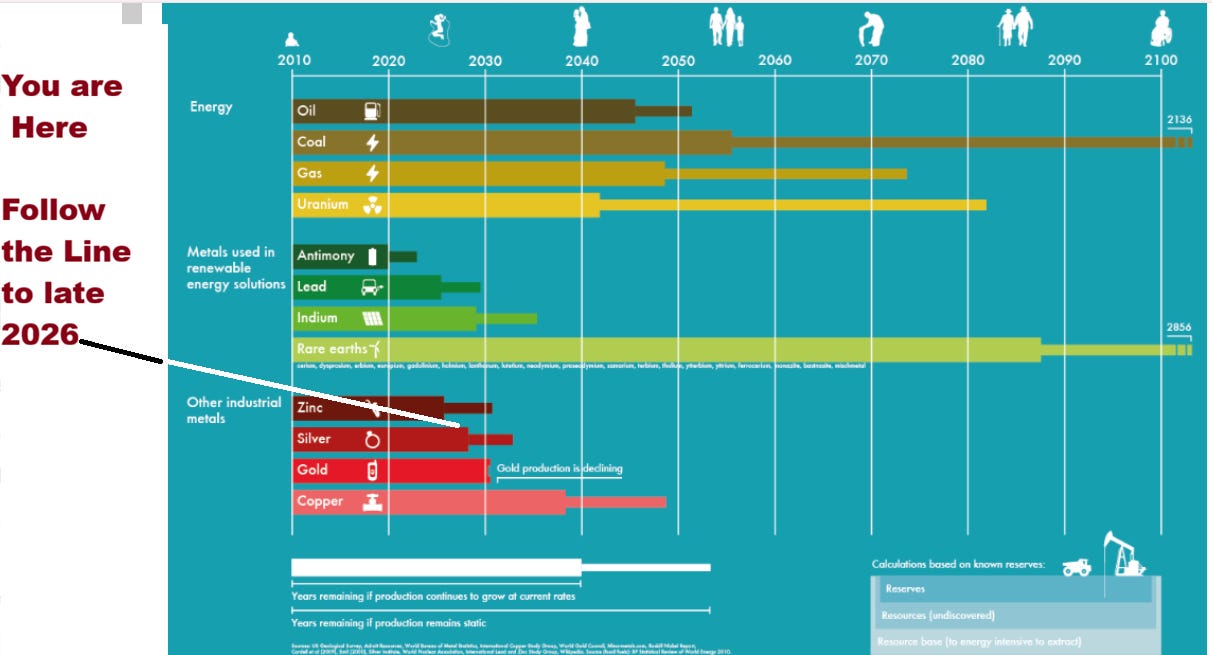
For every ounce of gold mined, the world produces only about eight or nine ounces of silver. Estimates of remaining mineable material similarly put silver at roughly eight to ten times gold’s availability—not 50 times, not 100 times.
But here is the part Wall Street’s spreadsheet cowboys always omit: silver is not primarily mined because miners wake up excited to find silver. Roughly 72% of silver production comes as a by-product of copper, lead, zinc, and gold mining. Only about 28% comes from primary silver mines.
That means higher silver prices do not automatically trigger a giant wave of new silver production. A copper miner does not rebuild a mine plan because silver gets exciting on Twitter. Silver supply is hostage to the economics of other metals.
Now add the energy shock. Washington and the central planners knew perfectly well that a war involving Iran risked disruption around the Strait of Hormuz. They knew energy infrastructure would become a target. And they knew the United States has spent half a century pretending refining capacity can run forever without serious expansion: no new U.S. refinery has been built since 1976.
So oil, diesel, chemicals, transport, explosives, equipment, labor, and processing costs rise. That is not bullish only for silver; it is devastating for marginal mine economics. The industry needs far higher metal prices merely to replace depleted reserves and keep production moving.
The world is positioning for real assets while retail investors debate whether silver is “overbought” at prices still miles below every serious inflation-adjusted benchmark. Tether has become an aggressive physical-gold buyer and is also reported to be storing and trading physical silver through Gold.com’s network.
Silver is monetary metal, strategic material, electrification input, solar input, defense input, and future-energy infrastructure. It is not a relic.
Any physical ounce available below $65 is cheap. Quality silver miners—leveraged claims on a tightening strategic metal—may be cheaper still.
Yesterday we published a list of 4, of these 4 one or more will 10X (or more) during the upcoming 2 years.
The market will not ring a bell. It will simply reprice silver while the complacent explain why it “came out of nowhere.”
The ultimate case for silver is brutally simple: its opposite is the U.S. dollar.
A silver ounce cannot be printed, keystroked into existence, or conjured by a Federal Reserve press conference. The dollar can. It lost formal gold convertibility in 1971, when Washington shut the gold window and finalized the modern fiat system. Since then, its purchasing power has depended on confidence, debt expansion, and the willingness of the rest of the world to keep accepting America’s paper promises.
For decades, oil’s dollar pricing helped support that arrangement. But the system is fragmenting at the margins as countries seek more trade in local currencies and alternatives. The dollar remains dominant—especially in commodity invoicing—but its monopoly is not permanent and its credibility is not infinite.
Do not confuse dollar dominance with dollar invincibility.
Silver has no central banker. No debt ceiling. No bailout committee. No trillion-dollar deficit attached to it.
When confidence in the Federal Reserve debt note finally cracks, capital will not flee into another promise. It will flee into tangible, scarce, unprintable assets.
-
Gold will move first. Silver will move harder.
-
Closing argument, there is more gold above ground than silver
-
Because silver is heavily consumed across key industrial applications—such as solar panels, electronics, medical devices, and military equipment—the vast majority of historical production has been physically dispersed into landfills or lost in unrecoverable quantities.
-
In contrast, gold is treated almost universally as a store of value or monetary asset, meaning over 90% of all gold ever mined remains intact in central bank vaults, private reserves, and jewelry.
-
Additionally, while silver is mined at roughly eight times the volume of gold, its extremely low value per gram historically made commercial recycling cost-prohibitive compared to refining high-value gold scrap.
-
Furthermore, central banks have actively accumulated and hoarded gold for centuries as part of their national monetary reserves, whereas silver was systematically demonetized and liquidated from government stockpiles during the 20th century.
-
Consequently, decades of ongoing industrial destruction of silver alongside continuous vault accumulation of gold have rendered refined, accessible above-ground silver stockpiles surprisingly smaller than total above-ground gold reserves.
-
Silver is on the Brink of Extinction and now it makes sense that it is designated a critical mineral
end of segment
1. our opinions are not our sponsors opinions
2. the editorial department is separate from the promotions department
3. not financial advice
Disclaimer: Silver Academy is an independent precious-metals content aggregator drawing on analysis, commentary, and research from dozens of third-party writers and market observers. Views, facts, forecasts, and opinions remain those of their respective authors and are not independently guaranteed by Silver Academy. Nothing published constitutes investment, legal, or tax advice. Section 230 protections apply to third-party content; no liability is assumed for investment decisions or third-party statements
-
Gold up 23X, 2,200%
-
Silver up 30X, 2,900%
-
Oil up 12X, 1,100%
The latest paper-market slam should not distract investors from the bigger setup: physical silver remains constrained while demand from AI data centers, electrification, solar build-outs, EVs, and advanced battery technology keeps expanding. For investors who understand that volatility is the admission price for leverage, these four companies offer distinct ways to gain torque to a rising silver price.
Aya Gold & Silver (AYA) is a direct producer-leverage play anchored by Morocco’s rare silver-only Zgounder mine. Zgounder produced 1.49 million ounces of silver in the second quarter, up 43% year over year, while the company’s 2026 guidance calls for 5.2–5.8 million ounces. Beyond current production, Boumadine supplies the explosive upside: a large polymetallic project advancing through feasibility work with continuing high-grade drilling results.nasdaq+2
Andean Precious Metals (ANPMF) is a Bolivia-based silver operator rooted in the legendary Potosí district, one of history’s great silver camps. Its San Bartolomé operation processes oxide material acquired through a deep local supply network connected to thousands of artisanal miners. That model offers unusual access to feedstock in a mineral-rich region. If silver keeps rising while global supply stays tight, each processed ounce carries potentially powerful operating leverage.
Kuya Silver (KUYAF) is a high-grade, high-torque silver story centered on the Bethania mine in Peru. This is precisely the type of smaller producer that can move sharply when grades, recoveries, and output exceed market expectations. In a silver-deficit environment, Bethania’s high-grade ounces become increasingly valuable; higher realized prices can flow disproportionately into operating margins, cash flow, exploration budgets, and ultimately valuation.
Silver47 Exploration (AAGAF) offers exploration leverage across three mining-friendly North American jurisdictions: Alaska, Nevada, and New Mexico. Its portfolio includes Alaska’s flagship Red Mountain deposit, Nevada’s Hughes project near Tonopah, and New Mexico’s Mogollon project. The company reports roughly 236 million silver-equivalent ounces in the inferred category plus 10.3 million indicated ounces across its projects, supported by a funded 2026 drilling program. This is not cash-flow leverage—it is discovery, resource-growth, and rerating leverage
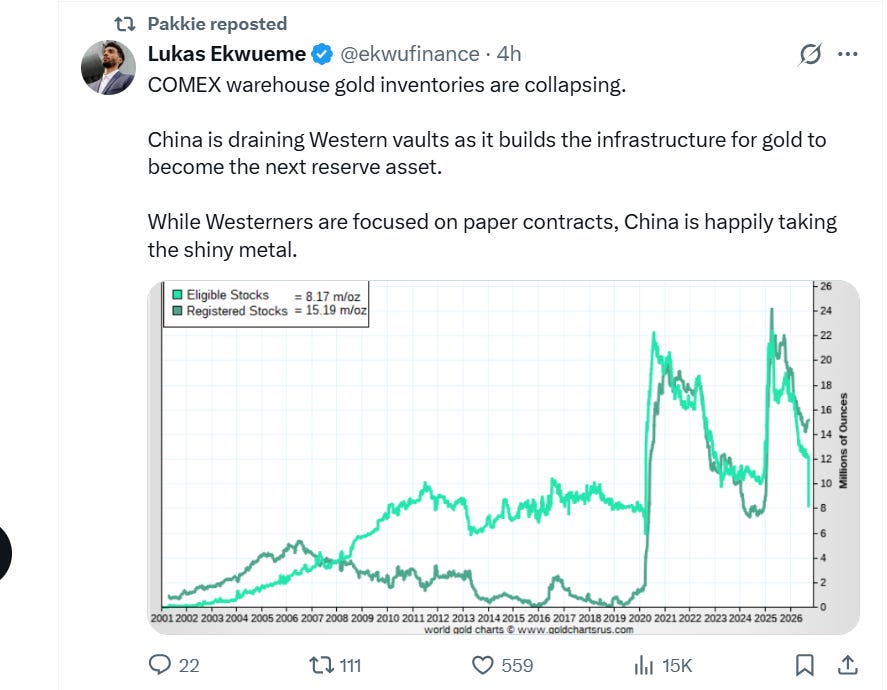
China is not simply buying gold. It is assembling a physical-metal strategy that challenges the paper promises beneath the dollar-based financial order.
The formula is deceptively simple: constrain domestic supply, acquire overseas deposits and producing mines, import large quantities of bullion, build central-bank reserves, and encourage physical ownership beyond the reach of Western futures exchanges. For gold and silver investors, the implication is stark: the world’s largest manufacturing power is positioning for a future in which possession matters more than promises.
China’s domestic raw-gold production fell 14.62% year over year in the first half of 2026, to 152.9 tonnes. Shandong Gold—one of China’s major producers—has also lowered its 2026 mineral-gold output plan from at least 49 tonnes to 36–38 tonnes, potentially a 26.53% reduction. That creates a powerful imbalance: less gold produced at home means more metal must be obtained abroad.
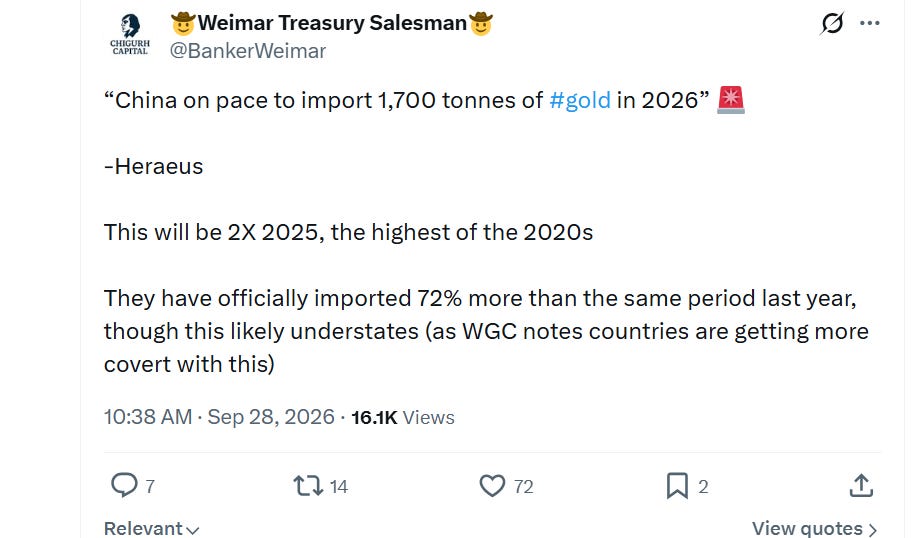
And China is doing exactly that. Through August, the country imported roughly 1,141 tonnes of gold, up 72% from the same period in 2025. Heraeus estimates China could import about 1,700 tonnes in 2026—roughly twice the prior year’s level and the largest total of the decade.
The People’s Bank of China added 650,000 ounces—20.2 tonnes—of gold in August, its largest monthly purchase since October 2023. It was the 22nd straight month of reported additions, lifting official reserves to about 2,387 tonnes.
Central banks do not accumulate bullion for yield. Gold pays no coupon, carries no counterparty promise, and cannot be created with a keystroke. They accumulate it because it remains final settlement when confidence in sovereign debt, currencies, and financial institutions begins to thin.
The United States runs on the opposite model: immense public debt, recurring deficits, and a financial system dependent on ever-expanding credit. Currency debasement is politically easier than fiscal discipline. When foreign buyers become less willing to absorb Treasury issuance, debt must be financed increasingly by domestic institutions—or by policies that suppress interest costs and encourage new money creation.
That is not an automatic hyperinflation forecast. The dollar remains the dominant reserve currency, accounting for 57.13% of disclosed global foreign-exchange reserves in the first quarter of 2026. But reserve diversification, rising gold accumulation, and worsening debt arithmetic reveal a gradual erosion in unquestioned dollar demand.
Then comes the energy shock. Diesel is embedded in nearly every physical good: mining equipment, tractors, railroads, trucks, ports, construction machinery, manufacturing, and ocean freight. Recent diesel-price spikes have raised concern that higher transportation and production costs will spread through the wider economy.
The result is a dangerous convergence: more paper claims chasing constrained physical necessities. Gold is monetary insurance against that convergence. Silver may offer greater upside—and volatility—because it is both monetary metal and an irreplaceable industrial input.
The issue is not whether every paper asset collapses tomorrow. The issue is whether investors own enough assets that cannot be printed, defaulted on, or diluted away.
China appears to be answering that question with gold and silver
RE Silver slam yesterday:
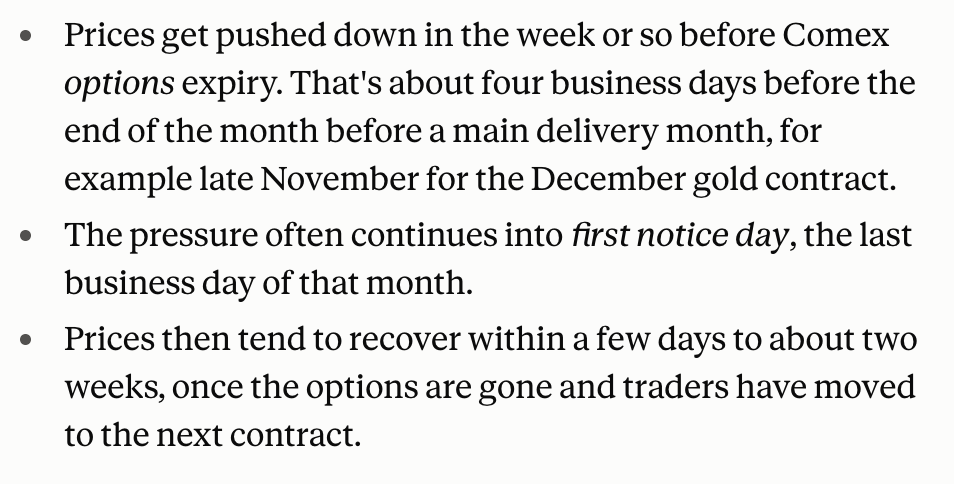
Buy the Dip
Understand the slam is by design, predictable playbook by Crimex
Stay patient and understand the following
The pressure on gold and silver prices often continues into Comex first notice day, which is Weds 30th Sept.
1. our opinions are not our sponsors opinions
2. the editorial department is separate from the promotions department
3. not financial advice
Disclaimer: Silver Academy is an independent precious-metals content aggregator drawing on analysis, commentary, and research from dozens of third-party writers and market observers. Views, facts, forecasts, and opinions remain those of their respective authors and are not independently guaranteed by Silver Academy. Nothing published constitutes investment, legal, or tax advice. Section 230 protections apply to third-party content; no liability is assumed for investment decisions or third-party statements
Washington’s foreign policy is beginning to resemble the old local-newspaper stories about criminals too stupid to escape their own crimes: the genius who chains an ATM to an identifiable pickup truck, rips it through a plate-glass storefront, and drives away with the license plate plainly visible. The crime is real. The loot is real. The stupidity is in believing the haul exceeds the wreckage.
That is where America is headed as it tries to shore up a fading dollar system with military coercion, resource claims, sanctions, threats, and ever-more extravagant displays of imperial muscle. Cuba, Greenland, Venezuela, Iran, Ukraine, the Middle East—the map changes, but the reflex does not. Find something with oil, minerals, shipping lanes, strategic geography, or a government too weak to resist. Then treat it as prospective collateral for Wall Street and proof that the dollar still has an empire behind it.
This is what people mean when they say the dollar is backed by the U.S. military. Not gold. Not fiscal discipline. Not productive savings. Not a balanced industrial economy. A big club—deployed globally to preserve a financial architecture that is increasingly expensive to maintain.
And the return on investment is becoming absurd.
The administration’s proposed FY 2027 national-defense topline is $1.5 trillion: $1.15 trillion in discretionary spending plus another $350 billion intended to move through reconciliation. That would be the largest single-year defense request since World War II. America is not merely spending heavily to defend itself; it is building a financial-security machine so expensive that it must constantly justify new frontiers, new threats, and new assets to seize, police, sanction, or subordinate.
This is not national defense in the ordinary sense. It is a global debt-collection and collateral-acquisition apparatus—one that must continually discover new “strategic” reasons to intervene, threaten, blockade, sanction, intimidate, or dominate.
The empire needs new properties to mortgage because the old financial model is creaking under mountains of debt. As the world reduces its exclusive reliance on dollar-based trade, reserves, and payment systems, Washington’s answer increasingly appears to be coercion: force nations back into the system, secure their commodity flows, and convert their oil, gold, minerals, farmland, ports, and pipelines into potential balance-sheet support for Western finance.
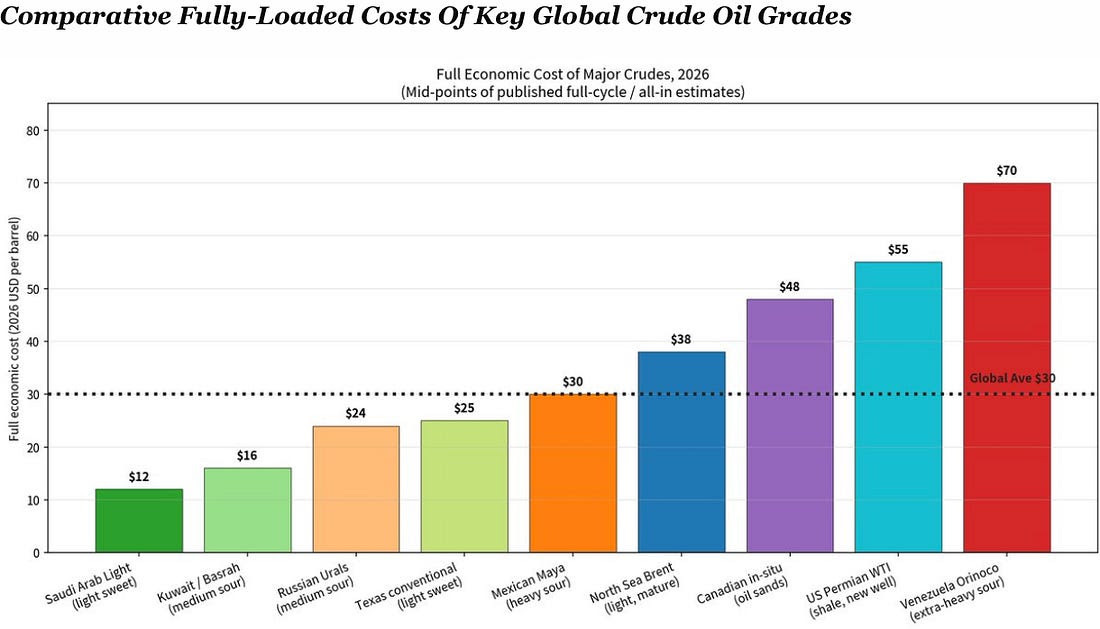
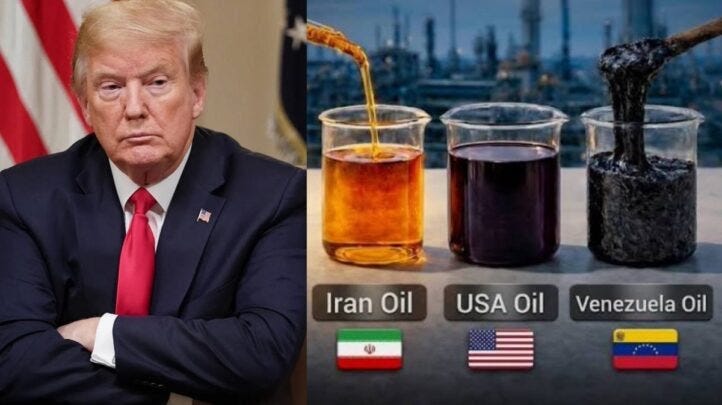
Consider the fantasy of “owning” Venezuelan oil. A barrel in the ground is not a barrel of wealth. Orinoco extra-heavy crude is not Texas light sweet. It is closer to industrial feedstock than ready-to-refine petroleum: viscous, sulfurous, metals-laden, and dependent on diluent, upgrading, specialized transport, complex refining, reliable power, security, and immense capital investment. Heavy oil and bitumen generally require upgrading before they meet normal refinery-feedstock specifications.
Even recent industry estimates put the economic breakeven for Venezuelan extra-heavy crude, once upgrading, diluent, and transport are counted, around $70 to $80 per barrel to be usable.
That estimate does not erase the political-risk premium, the decayed infrastructure, the need for security, or the massive capital outlays required to turn theoretical reserves into dependable production.
So imagine cattle rustlers stealing 100 head worth $2,000 each—only to discover every animal needs $3,000 of veterinary care before anyone will buy it. Or thieves taking 100 Volkswagens from a Denver lot, then learning each needs $10,000 in engine work.
The apparent score becomes a liability.
That is the imperial version of the Venezuela proposition: seize “reserves,” then ask taxpayers, creditors, refiners, insurers, contractors, and soldiers to make them economically real. The U.S. had 46.0 billion barrels of proved crude-oil and lease-condensate reserves at year-end 2024—not the casually repeated 50-billion-barrel figure. But even proved reserves vary radically in value because geology, quality, infrastructure, energy intensity, capital cost, and market price determine whether a barrel is profitable or a money pit.
David Stockman recently wrote
”When it comes to “winning so much you can’t stand it”, the Donald has now truly jumped the shark. We are referring, of course, to his new claim that he has more than doubled America’s current 50 billion barrels of proven oil reserves via a “gift” of 65 billion barrels he obtained from Venezuela’s puppet president, Delcy Rodríguez.
In fact, this was no “gift” at all, but amounts to thievery in form— albeit via one of the dumbest heists in world history. That’s because the economic cost of turning these ultra-high cost reserves into gasoline and jet fuel is likely to far exceed their value on the global petroleum market.
To be specific, we think the junkie, gunky tar oil reserves subject to the Donald’s recently announced concession agreement with Venezuela have a net present value (NPV) after economic costs of, well, negative $84 billion! “
__________________________________________________________________________________________
You read that correctly. The Donald’s heist of Venezuela’s oil is worth NEGATIVE 84 Billion and the news gets worse, now Wall Street will package this worthless oil to back a 100 billion dollar bond product
Suppose it takes $100 billion in new loans, guarantees, and subsidized investment to drag Venezuela’s damaged oil sector back toward meaningful output. Wall Street can then lend against the promise of those future barrels and record the resulting $100 billion in loans as assets on its balance sheets—even if the underlying resource project destroys wealth in economic terms.
Read that again: the Venezuelan oil “prize” could carry an estimated net present value of negative $84 billion. In plain English, it is not an asset. It is a loss waiting to happen: a vast, capital-devouring quantity of heavy crude that requires extraordinary spending to extract, dilute, upgrade, transport, refine, insure, and secure.
But Wall Street does not need the economics to be sound if it can turn the political arrangement into paper. The same negative-value oil concession can be used as collateral for perhaps $100 billion of loans, bonds, guarantees, and structured products. On the banks’ books, the debt appears as an asset. In the real world, the collateral may be worth less than nothing after the full cost of bringing it to market.
That is the scam in its purest form: privatize the paper asset, socialize the development cost, and leave taxpayers holding the military bill when the supposedly strategic oil jackpot proves to be an $84 billion hole in the ground.
A Barrel Is Not a Balance Sheet
The public is being sold a child’s version of resource economics: more barrels equals more wealth; more territory equals more power; more military pressure equals more dollar demand.
But oil is not a number on a map. It is an industrial process. It must be lifted, diluted, moved, upgraded, desulfurized, refined, insured, financed, and sold into a market that may not pay enough to justify the entire exercise. Venezuela’s deposits may be immense by volume, but volume is not value. A mountain of marginal, capital-devouring sludge does not become national wealth merely because a politician points at it on television.
The deeper problem is monetary. As nations diversify trade, reserves, and payments away from exclusive dollar dependence, Washington appears tempted to substitute force for confidence. New resource concessions become collateral. New loans become bank assets. New geopolitical dependencies become alleged support for a weakening system of debt, deficits, and financial privilege.
This is the essence of the new imperial math: take control of an asset, attach a loan to it, book the loan as an asset, then describe the arrangement as “economic leadership.” The commodity producer becomes indebted. The creditor bank gains paper assets. The public absorbs the military and political cost. And the American taxpayer gets told that this is a victory.
But military power cannot repeal arithmetic. You cannot bomb your way to productive capital. You cannot sanction your way to cheap energy. You cannot turn tar into light sweet crude by declaring it a strategic victory. And you cannot preserve a currency’s credibility forever by spending $1.5 trillion annually to demonstrate that dissent carries consequences.
The U.S. can still intimidate weaker countries. It can still control sea lanes, enforce sanctions, freeze reserves, and use its banking system as a weapon. But those powers are not free. They require enormous borrowing, enormous military expenditures, and endless political escalation.
America may still have the largest club. But it is swinging it at increasingly marginal assets, with increasingly borrowed money, while calling the bill prosperity.
That is not an empire at the height of its strength. It is the world’s most powerful bank robber dragging the ATM through the storefront—convinced that the noise, broken glass, and flashing police lights are proof that the plan is working.
end of segment
our opinions are not our sponsors opinions
the editorial department is separate from the promotions department
not financial advice
-
Like it or not, this list clearly shows that Big Tech is our future.
-
One oil company and the remainders are Tech and Defense contractors
-
Tech and Defense both being the largest consumers of silver
This was not merely a ceremonial guest list. It put the leaders of America’s biggest AI, chip, cloud, smartphone, e-commerce, and electric-vehicle companies, defense industry in the same room with the Chinese president at a moment when semiconductor export controls, AI competition, supply-chain security, tariff policy, Taiwan, and access to China’s vast technology market are central to U.S.–China relations.
Recall China refines approximately 70% of the world’s silver and their strict export measures.
Artificial intelligence is transforming the global data-center industry into a faster, denser, and more materials-intensive system—and silver may be one of the overlooked beneficiaries.
The reason is simple: AI is a race for speed. Training and operating large AI models requires massive numbers of GPUs and other accelerators to move data continuously among processors, memory, storage, and networking equipment. Every millisecond matters. So do electrical losses, heat buildup, equipment reliability, and power-delivery efficiency.
Silver has the highest electrical conductivity of any metal. Copper is indispensable across data-center construction and will remain the dominant material for bulk power cables, busbars, and electrical infrastructure. But copper is not a complete replacement for silver in high-performance electronics. Where designers need extremely low resistance, reliable connections, corrosion resistance, and compact high-current components, silver remains uniquely valuable. Copper’s electrical conductivity is exceeded only by silver.
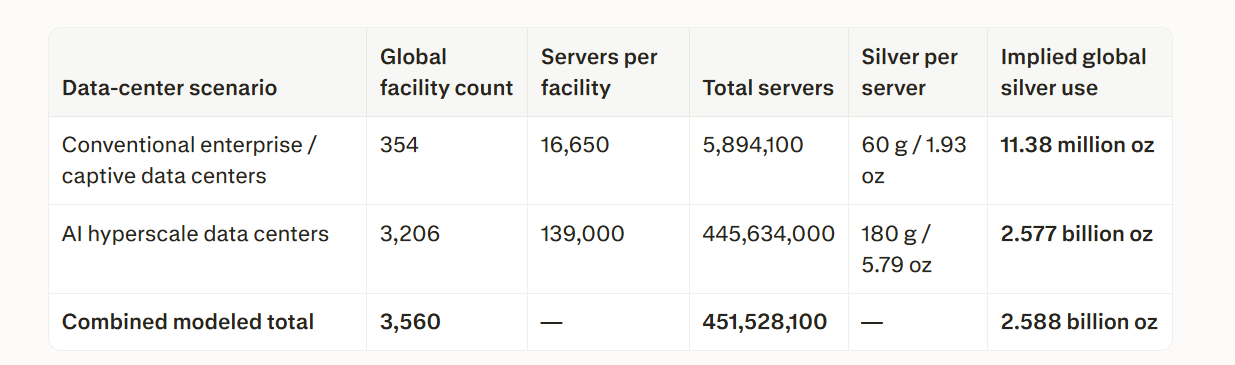
That matters because an AI server can contain roughly 180 grams of silver, or about 5.79 troy ounces—three times the estimated 60 grams, or 1.93 ounces, found in a conventional enterprise server. Silver is used in circuit boards, connectors, contacts, relays, switches, semiconductor packaging, and power-management hardware. AI hardware contains more accelerators, denser memory configurations, more demanding power systems, and faster networking than traditional enterprise computing, all of which raise the intensity of silver-bearing components.
The per-facility implications are substantial. A traditional enterprise data center with approximately 16,650 servers would contain about 32,150 troy ounces of silver at 60 grams per server. An AI-heavy hyperscale facility with roughly 139,000 servers would contain as much as 803,750 ounces, or around 25 metric tonnes, using the 180-gram assumption.
ABI Research projects 8,821 data centers worldwide by the end of 2026, including 354 captive enterprise facilities and 3,206 Tier One and Tier Two hyperscale facilities.
Applying the silver-per-server assumptions across those two categories produces a theoretical requirement of 2.588 billion ounces of silver, equivalent to roughly 80,500 metric tonnes. The conventional segment contributes about 11.4 million ounces, while the AI-hyperscale scenario drives approximately 2.577 billion ounces.
This is an upper-bound scenario, not a literal audited inventory. It assumes every hyperscale facility contains a fully deployed 139,000-server, AI-heavy configuration. Real-world campuses differ sharply in age, capacity, utilization, hardware mix, and the extent to which they are dedicated to AI.
The wider trend remains difficult to dismiss. Hyperscale operators accounted for 48% of worldwide data-center capacity at the end of 2025, and their share continues to rise. As conventional computing gives way to AI-optimized infrastructure, each new build requires greater processing density, faster data movement, more electrical power, and more high-performance components.
Copper will carry the bulk power. But in the critical places where electrical resistance, heat, latency, and connection failure cannot be tolerated, silver is difficult to replace. AI’s demand for speed may therefore create an unexpected new pillar of industrial silver demand.
end of segment
The Case for Neutral Assets: Why Gold and Silver Are Winning the Global Realignment
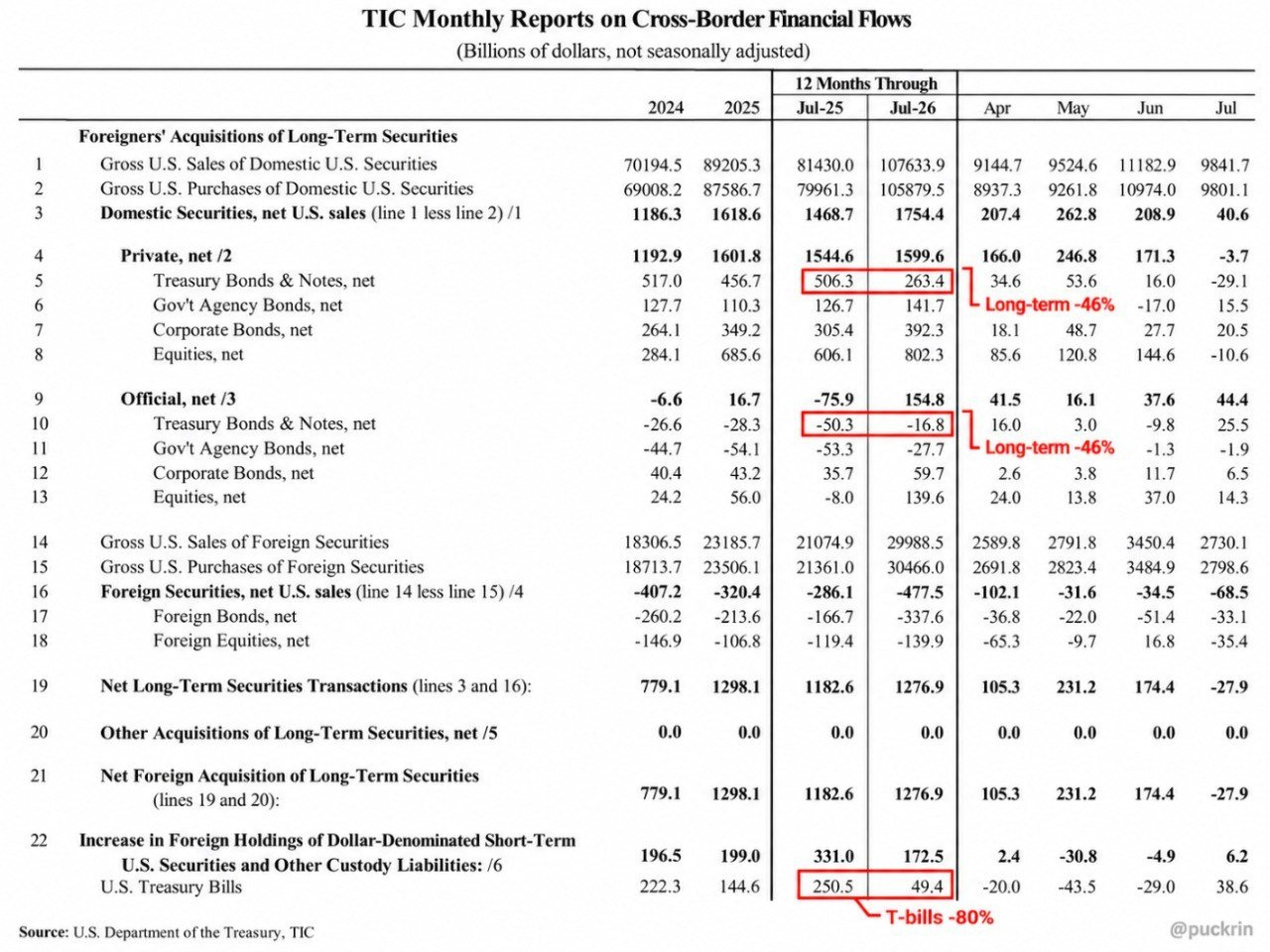
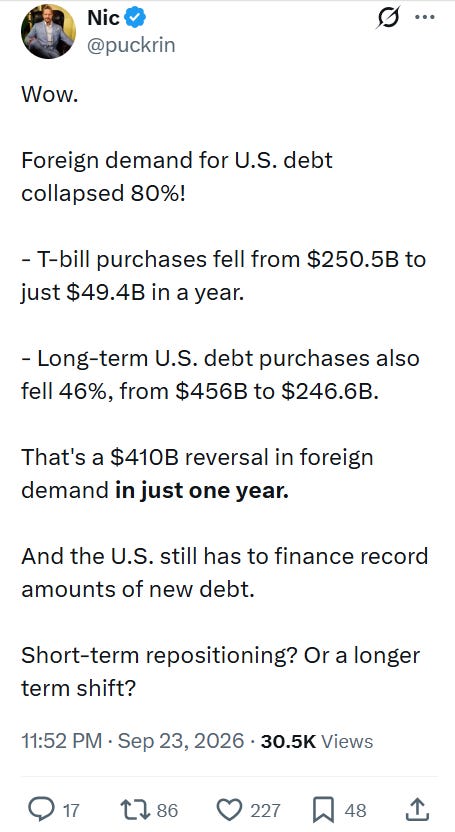
The steep $410 billion collapse in foreign U.S. debt demand is not a routine portfolio rebalancing—it is a structural vote of no confidence. When foreign central banks slashed short-term T-bill purchases by 80% and long-term Treasury buys nearly in half, they sent a clear message: holding paper assets weaponized by Western sanctions carries unacceptable counterparty risk.
Washington’s aggressive balance-sheet confiscation and secondary financial sanctions turned sovereign debt into a political liability. In response, global institutions are accelerating a historic shift away from fiat reserves and toward monetary neutrality.
Gold and silver stand as the ultimate beneficiaries of this fragmentation. They carry zero counterparty risk, cannot be frozen by executive decree, and cannot be devalued by money printing to finance runaway deficits. Gold serves as the foundational reserve for central banks securing un-freezable sovereign balance sheets, while silver offers dual strength as both a monetary hedge and an indispensable, non-sovereign industrial metal.
As Washington relies increasingly on domestic monetary expansion to fund record national debt, physical precious metals remain the only true borderless, neutral, and un-sanctionable stores of value.
end of segment
Timeline of Operational & Policy Obstacles in Mexico
Nationalization of Lithium
April 2022
The Mexican Congress passed amendments to the Mining Law declaring lithium a strategic national asset, establishing state monopolies over exploration and extraction while cancelling or reviewing existing private concessions.
Re-assertion of State Control over Electricity
2023
Morena legislative efforts and regulatory shifts bolstered the state-owned Comisión Federal de Electricidad (CFE), reversing private-market access incentives and prioritizing public grid power over foreign green-energy investments.
PEMEX–Russia Energy Bilateral Collaborations
Early 2024 and ongoing
Seeking to reduce dependence on U.S. natural gas and refined products, Morena backed technology, service, and investment agreements involving Russian entities to boost production for state oil firm PEMEX.
Seizure of the Vulcan Materials Port & Quarry
September 2024
In one of his final actions before stepping down, President AMLO issued a decree declaring the land owned by Alabama-based Vulcan Materials in Quintana Roo a natural protected area, completing the state expropriation of the port and quarry.
President Claudia Sheinbaum Halts New Mining Concessions
October 2024
Upon taking office, President Claudia Sheinbaum Pardo formally reaffirmed that her administration would maintain AMLO’s ban on issuing new open-pit mining concessions to private foreign operators.
The Vizsla Silver Abductions and Fatalities
January 2026
Armed criminal factions intercepted and killed technical workers near Vizsla Silver’s Panuco project in Sinaloa, highlighting severe cartels-related security risks across remote mining districts.
Blockade at Endeavour Silver’s Terranova Site
Early 2026
Local land disputes and protest blockades disrupted developments at Endeavour Silver’s Terranova site, creating operational shutdowns and delay risks for high-grade silver operations.
Federal Action / Armed Intervention at the Indi Mine Sector (Durango)
Early 2026
Federal security forces, military units, and local enforcement carried out targeted seizures of illicit arsenals, chemical precursor processing operations, and unauthorized extraction sites across the mountain corridors of Durango.
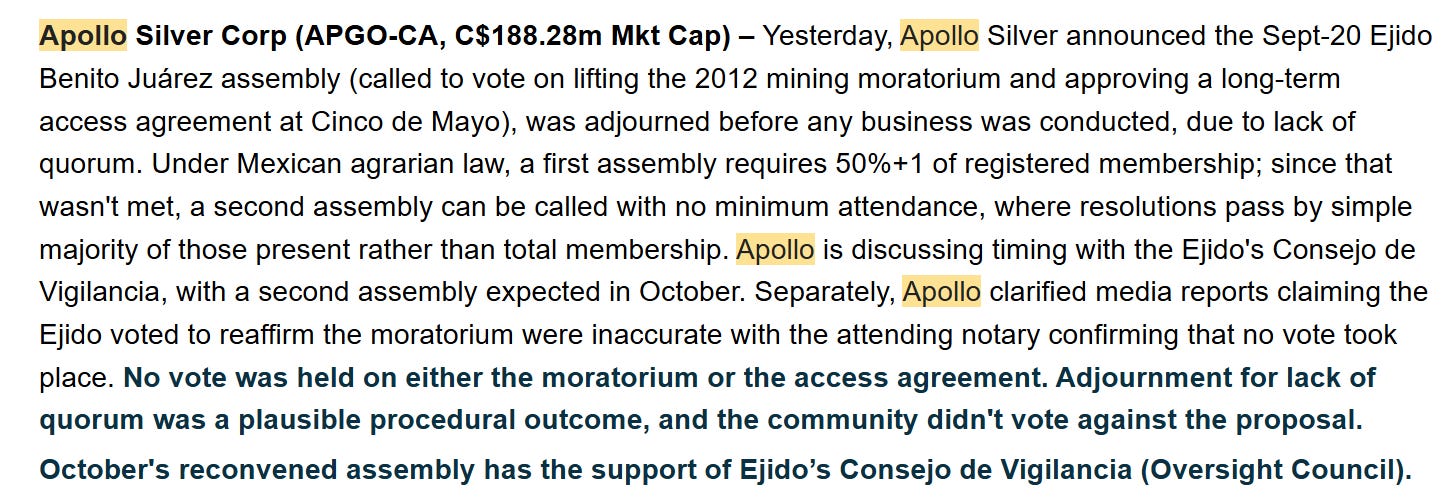
Trouble for Apollo Silver as Key Access Vote Delayed: Lack of Quorum at Ejido Benito Juárez Leaves 14-Year Mining Ban in Place
Persistent Local Opposition: A failed first assembly due to lack of quorum suggests significant anti-mining sentiment or organized boycotts within Ejido Benito Juárez, indicating community consensus remains far from secured.
-
14-Year Surface Access Deadlock: The 2012 mining moratorium remains legally active, keeping Apollo Silver blocked from advancing exploration or development work on the Cinco de Mayo project.
-
Elevated Social and Operational Risk: Relying on a second assembly’s simple-majority rule to bypass broader membership risks sparking future local protests, blockades, or social backlash if a large portion of the community opposes the decision.
-
Media Noise and Local Friction: Conflicting local reporting surrounding whether a moratorium vote took place highlights significant community tension, legal ambiguity, and a challenging local public relations environment.
-
Project Schedule Slippage: Timeline delays around organizing a second meeting stall exploration progress, pushing back project catalysts while ongoing overhead costs continue to burn capital.
-
SELL SILVER MINING EQUITIES IF THEY HAVE OPERATIONS IN MEXICO
our opinions are not our sponsors opinions
the editorial department is separate from the promotions department
not financial advice