
BHP Dumps Dollar for Yuan—Global Trust Crisis Sends Gold Soaring in the New “No Trust” Bull Run
Analysts and market strategists emphasize that these de-dollarization moves have ignited a stampede into gold as the only asset with enduring trust and value

by Jon Little intern Niko Moretti
Silver Academy Daily:
Today’s Breakdown: The Global Trust Crisis and Why We’re Still Early in the Gold Bull Run
Trust on Empty: Gold’s Signal in a Fractured World
“Gold drops like a rock when people trust the system. It skyrockets to the moon when they don’t.” — Jon Little
At Silver Academy, today’s analysis cuts through the noise: what’s powering gold is not mere speculation or technical momentum, but the largest collapse in institutional trust seen in generations. This is the dawn of a structural bear market in confidence — and the world is just waking up.
When the System Becomes the Risk
Traditional analysis insists gold looks overheated. But that misses the new reality: this move isn’t about chasing alpha — it’s about fleeing systemic risk.
Western portfolios, asleep on gold for a decade, are only just stirring. Despite monetary chaos and soaring government liabilities, gold holdings across ETFs remain below 2020 highs. The big move has only begun.
Russian Reserves Freeze: The Original Shockwave
In 2022, the Western freeze of $300 billion in Russian sovereign assets shattered assumptions about property rights. For the first time, global reserves became fair game in a political showdown — and the rest of the world took note.
What shocked the world then was just a prelude. Today, the Dutch government’s nationalization of Nexperia, a Chinese-owned tech giant, is Russian Reserves 2.0: a blunt show that in times of stress, property rights across the West mean whatever policymakers say they mean.
Property Rights, Now Optional
With the old order in free fall, boundaries blur. China retaliates with critical mineral export controls, Washington fires back with tariffs, and Europe escalates by confiscating strategic companies — all in the name of “security.” Capital, caught in the crossfire, no longer trusts headlines or legal guarantees.
Central Banks: The Silent Accumulators
This year’s record 1,200+ tons of central bank buying is not noise — it’s a siren. Western investors still trade paper claims, but the real action is in state-to-state shifts of actual metal. These are not hot-money flows. They are emergency exits.
We are very early. The bull run in gold is only gathering speed as Western investors awaken.
Quantitative Easing, Quantitative Seizing
Central banks are still printing, but now governments are outright seizing assets. From emergency currency controls to outright expropriation, the ground rules have forever changed. Gold’s rise isn’t an accident; it’s a direct repricing of political and legal reality.
The Next Five Years: No Restoration, Only Acceleration
Despite record prices, every historical cycle suggests that this is just the opening stanza. Once global trust enters a secular decline, these super cycles can run for a decade or more.
There is no path to near-term restoration of trust — not in the United States, not in Europe or Japan. The East-versus-West rupture is widening, not healing. What we’re seeing is only the beginning, with another five years (or more) ahead for this gold bull run.
Extreme Policies Are Back on the Table
If you thought gold confiscation or capital controls were relics, think again. The impossible becomes likely the moment systemic trust evaporates. Property and safety nets exist only as long as the system does. Now, risk is everywhere — and risk happens fast.
The New Gold Rush Is About Trust
This isn’t about speculation. It’s an exodus from illusion. Gold has become the scoreboard for the world’s loss of faith in the establishment itself.
When trust dies, money seeks shelter. In this storm, only real assets — and the willingness to act early — offers refuge.
Meanwhile in China
BHP’s Quiet Surrender to the Yuan — and What It Signals for Gold and Silver
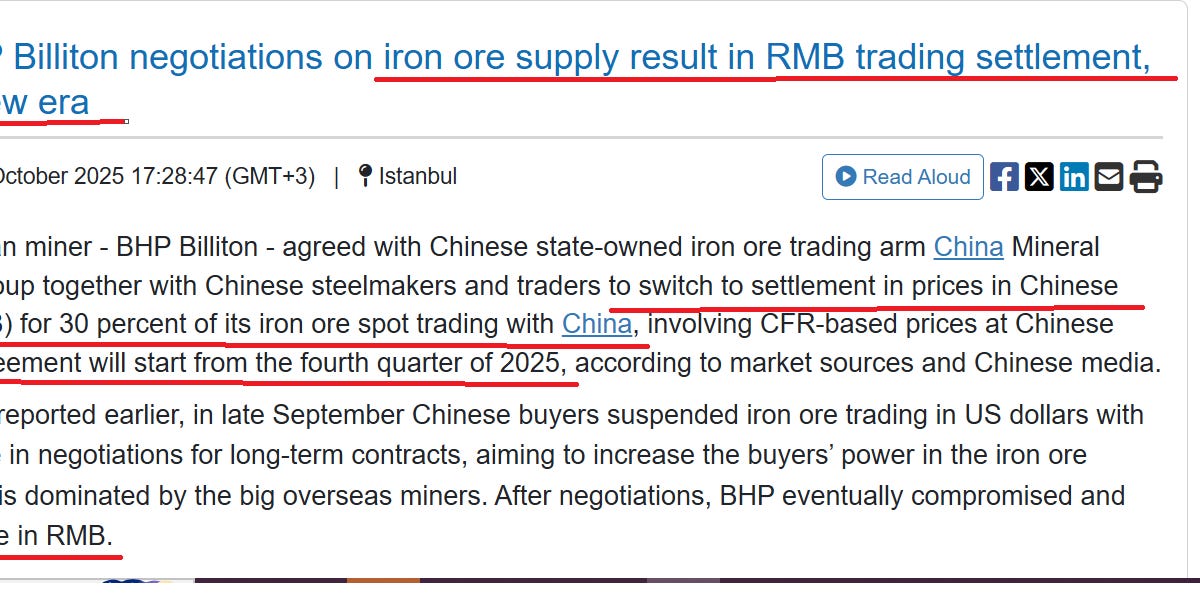
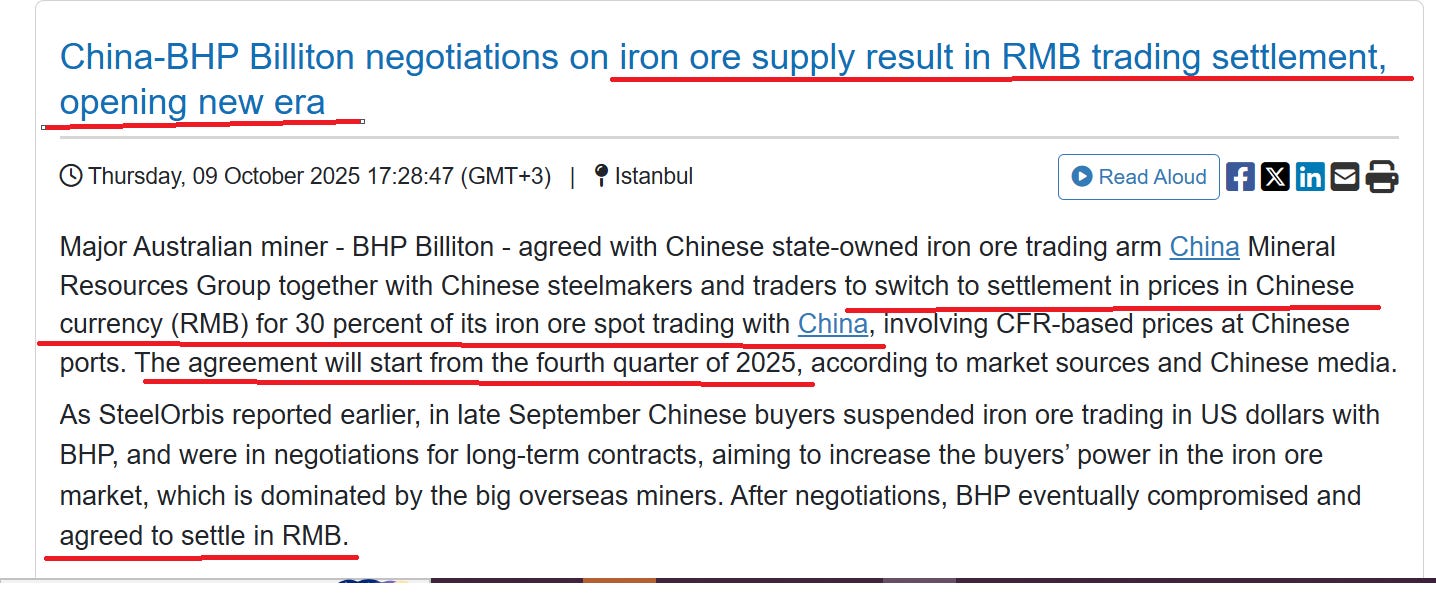
While most investors were shutting down for the weekend, BHP quietly dropped one of the most important monetary signals of the decade. Beginning in the fourth quarter of 2025, the world’s largest miner will settle nearly one-third of its iron ore spot sales to China—not in U.S. dollars, but in Chinese yuan. No press release, no CEO statement, just a brief industry wire.
It’s more than a trade decision—it’s a fracture in the global dollar system.
The Dollar’s Iron Grip Begins to Slip
Fifteen years ago, BHP led the charge that made iron ore dollar-priced and index-linked, anchoring the global commodity trade to the U.S. financial system. Back then, the dollar was unquestioned. Today, the same miner is breaking from that system and accepting China’s currency instead.
Step by step, this is how monetary power shifts: quietly, commercially, and without firing a shot.
China wants what every empire has wanted: the ability to settle its imports in its own currency. BHP just gave it that authority.
When Paper Money Loses Trust
This isn’t just a story about iron ore—it’s about the erosion of confidence in fiat money itself. The yuan may be digital and controlled, but at least it’s anchored to a rising trade empire. The U.S. dollar, meanwhile, is being diluted faster than ever. Washington’s trillion-dollar deficits, central bank gold dumping, and political gridlock all point to one thing: endless printing to keep the system afloat.
That’s why gold and silver matter more than ever. They are the antithesis of what’s happening here. You can’t print them. You can’t sanction them. You can’t inflate them away. Every time trade moves from paper to tangible value—whether it’s commodities settled in yuan or countries hoarding bullion—the world gets a little closer to rediscovering why gold and silver were money in the first place.
The Real Reserve Assets Are Shifting
BHP’s move fits a wider pattern. Saudi Arabia is taking yuan for oil. Russia, Iran, and BRICS states are trading in local currencies or gold-linked systems. Even Western-friendly economies are hedging against the dollar’s decline. The world isn’t waiting for a financial crisis to replace the dollar—it’s replacing it deal by deal.
As trade migrates into alternative currencies, gold and silver naturally rise in strategic importance. They’re the only truly neutral assets in a fragmented world—a form of settlement that no one can manipulate or “freeze.”
Australia’s Split Personality
For Australia, this marks a turning point. Economically tied to China, but militarily tied to the U.S., the country’s biggest miner just took a political gamble wrapped in a “commercial decision.” Each shipment settled in yuan strengthens Beijing’s monetary hand and weakens Washington’s.
The irony couldn’t be sharper: Australia built its wealth selling commodities into the dollar system. Now, it’s helping accelerate the world’s slow walk away from it.
Gold, Silver, and the Endgame
Every fiat system eventually reaches this stage—when the world’s producers prefer anything but paper promises. BHP’s quiet pivot is a symptom of that decay. The miners are signaling, even if they won’t say it aloud: money backed by nothing can’t buy real things forever.
As the dollar era loosens, tangible wealth—gold, silver, land, and production—will reprice higher. The world’s largest commodity producers already see which way the tide is moving.
Time to hold what can’t be printed. Time to trust what endures.
Stay vigilant, stay informed, and remember: in a bear market for trust, gold is not just a hedge. It’s the last insurance policy left.
“It’s not about being bullish on metal, but bearish on mankind’s track record.” – Jon Little from a recent podcast