
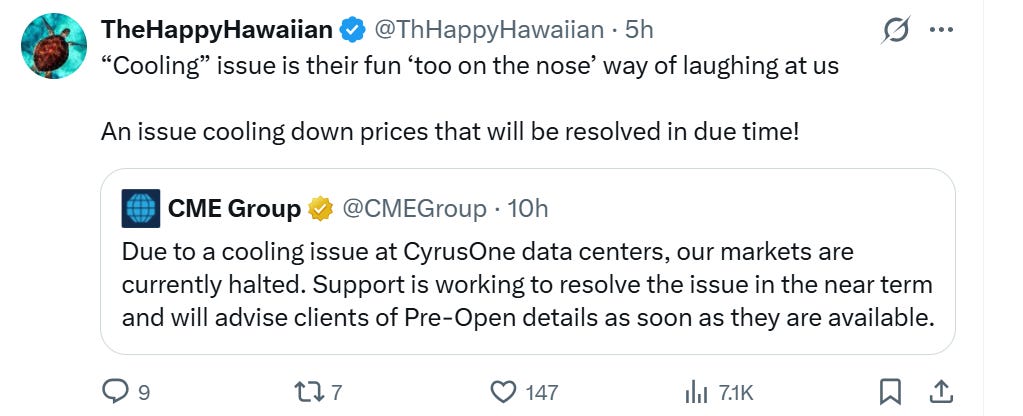
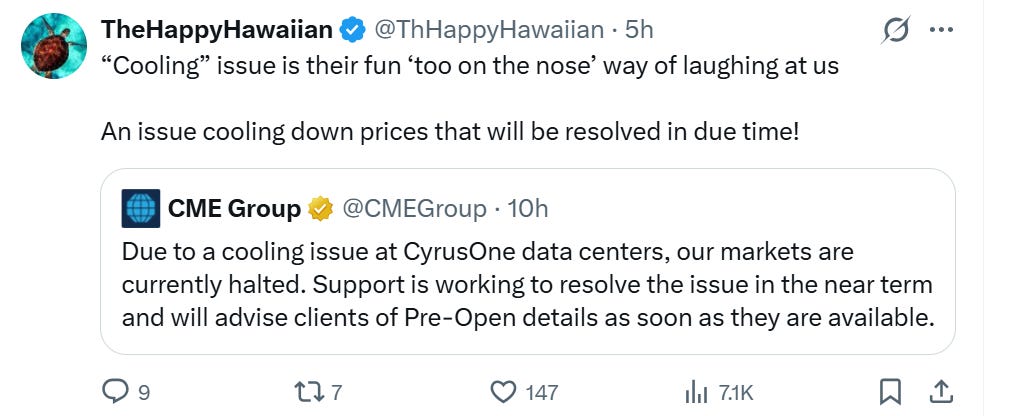
Silver’s Moment of Truth: When the Screen Went Dark and 400 Million Ounces Knocked
The moment the screen went dark, every silver trader on the planet knew something had snapped. Silver futures had been grinding higher for months, each dip devoured faster than the last, but that night the tape stopped behaving like a market and started behaving like an escape attempt. Asian buying bled into London, London bled into New York pre-market, and the chart turned into a near-vertical line as bids chased price and offers simply stopped showing up. What was supposed to be a risk-management tool had become the eye of the storm. Then, at the precise tick where a new all-time high printed, the feed froze. No quotes. No trades. Just a bright, clean nothing where a liquidity inferno had been seconds before.
“Glitch” Or Fire Alarm?
In those first minutes, it felt less like a glitch and more like someone had walked into the global pricing room and slapped the master breaker. Traders who had sat up all night nursing positions were left staring at dead ladders and error messages, while broker chats filled with the same question: was this a technical problem, or did someone just pull the fire alarm on purpose? Whatever line the press releases would later sell, everyone understood what had actually been interrupted. A runaway breakout—one that threatened to trap deeply short players in a no-offer vacuum—had been cut off mid-stride. The possibility that tens of thousands of contracts would be forced to cover into air vanished the moment the screen went black.
The 400 Million Ounce Ultimatum
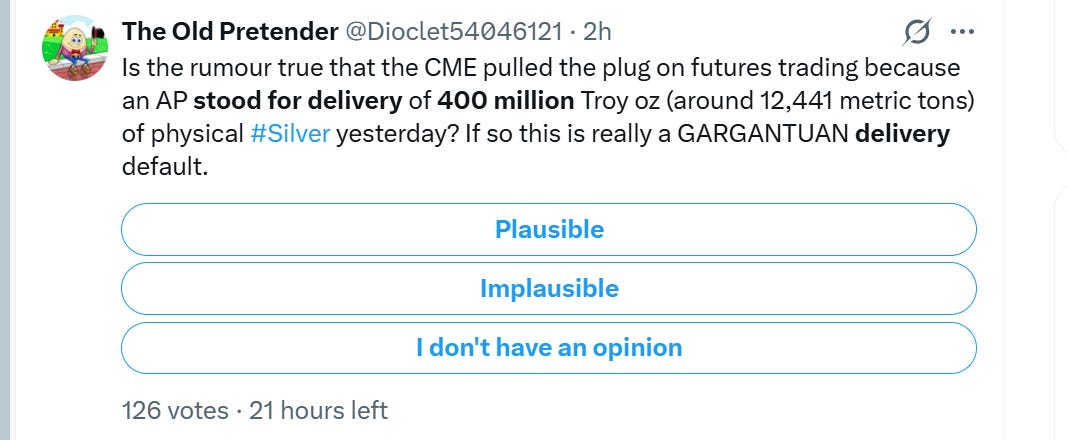

The backdrop made the timing even more radioactive. Behind that vertical candle sat the now-confirmed story: an Authorized Participant, tied into Chinese flows, had stood for delivery of roughly 400 million ounces of silver—about 12,441 metric tons—in a system that, in reality, did not have that kind of unencumbered metal to spare. The request was bigger than London’s true free float, bigger than what COMEX could comfortably shuffle from “registered” to “deliverable” with its usual games. This wasn’t some chatroom fantasy; it was a sophisticated player effectively calling the market’s bluff and asking, in size, “Show me the bars.” Faced with the hard arithmetic of inventory versus obligation, the bullion banks and their sponsors had two choices: admit a default, or “pull the plug” and buy time, absorbing enormous off-screen losses rather than letting the failure play out in the open.
How The Halt Saved Them – For Now
In the very short term, the halt did exactly what it needed to do for the people most exposed. It stopped a textbook blow-off move that was seconds away from becoming a disorderly melt-up. It gave clearing members and large shorts a crucial window to triage margin calls, scramble for collateral, and quietly roll or reduce positions at prices that were merely ugly instead of career-ending. When the venue eventually flickered back to life, it did so under new “guardrails”: altered collars, heavier margins, and a re-framed narrative about “orderly markets” and “technical issues.” On the surface, it looked prudent. The vertical was capped, the reopened tape looked less hysterical, and mainstream headlines dutifully treated it as a temporary disruption in a modern, well-managed marketplace.
The Promise COMEX Just Broke
But underneath, something far more important had been broken. A futures exchange is not just a price feed; it is a promise—continuous trading when it matters, equal rules for both sides of the trade, and a rulebook that does not magically bend when the wrong players are in trouble. Halting trading at the precise moment of maximum upside stress made that promise look conditional. Retail traders and small funds had seen this movie before: when the wreckage is on the downside, it is “the market”; when the damage threatens systemically short institutions, it suddenly becomes a “stability event” that justifies pulling the plug. Fair or not, the perception hardened instantly: the system blinked when the pressure turned from the little guy to the house. That image of a frozen candle at the very top is the kind of scar that doesn’t fade with a few FAQs and a risk-management webinar.
Paper Silence, Physical Noise
Most damning of all, paper stopped but physical didn’t. While the official benchmark went mute, dealers’ phones kept ringing. Bullion sites kept ratcheting premiums. Miners, refiners, and industrial buyers kept haggling in back channels over real ounces that still had to move, regardless of what some frozen contract said. The divide between “price” and “reality” stopped being an abstract internet argument and became something traders could feel in their gut: when the futures venue became too revealing, it was the mechanism that was shut down, not the underlying demand. The 400 million ounce AP demand was proof of concept. Somebody large enough and plugged-in enough had finally tested how far the paper tower could be pushed before something snapped, and the answer turned out to be: not nearly as far as the official narrative claimed.
December 31, 2025: The Deadline No One Can Trade Around
That is where December 31, 2025 looms like a silent deadline behind every tick. Year-end is when positions crystalize into audited reality, when derivative exposures and “temporary” workarounds stop being rumors and start becoming numbers on balance sheets, regulatory filings, and risk reports. Between now and that date, banks, exchanges, and regulators have to decide how much of this to bury and how much to reprice. Any off-book metal borrow, any emergency swap line, any side-letter solution used to muddle through a 400 million ounce call must either be normalized, refinanced, or confessed. For large players, year-end is also the last plausible moment to exit over-levered short structures before new capital rules, new scrutiny, and a new base price for silver close the door.
You Can Halt The Screen, Not The Squeeze
So the story that emerges when you merge the trading halt with the AP’s 400 million ounce demand is not a glitch story at all. It is the story of a system that finally hit the limit of how far it could stretch the lie that “there is always metal.” The screen going dark at the high was not a random coincidence; it was the visual expression of that limit being reached. You can delay the public squeeze by halting the venue, by rewriting margin, by leaning on narratives about “technical issues.” You cannot halt a repricing driven by physical scarcity, sovereign and industrial demand, and a player base that now knows the bars are finite and the promises are not. The clock is now running toward December 31, 2025, and everyone who understands what just happened has to decide, before that date arrives, whether they want to be long contracts—or long metal.
end of segment