
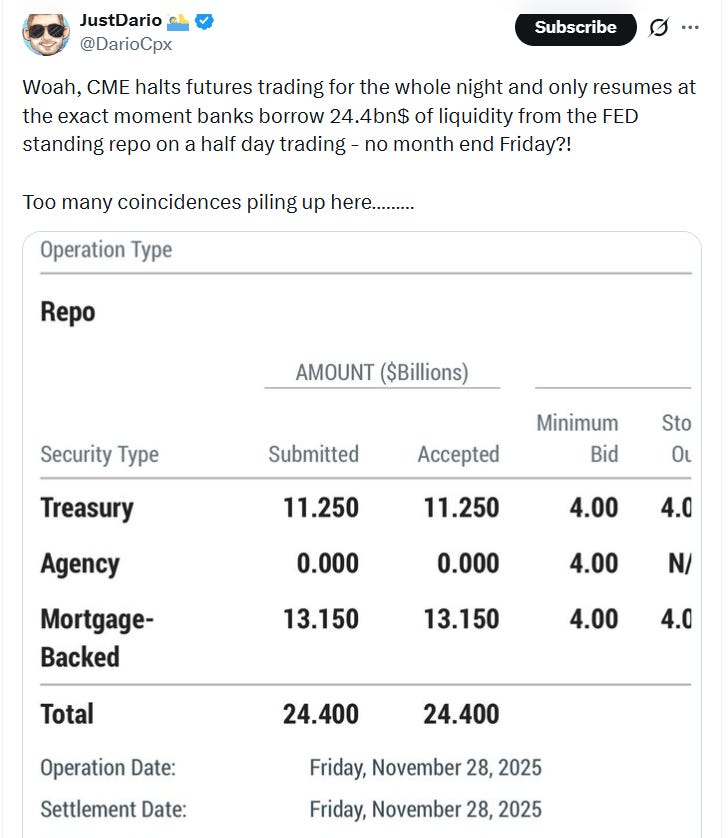
This is not an accident. CME Group brought the entire futures universe to a standstill just as banks tapped a staggering $24.4 billion from the Federal Reserve’s Standing Repo Facility—all during a thin, half-day holiday session when the real action should have been months away from typical quarter-end stress. The shutdown spanned FX, Treasuries, equity indexes, and crucial metals contracts like silver, locking out traders everywhere while price discovery went dark.
Coincidence? Not a Chance
CME’s excuse—a “cooling issue” at a state-of-the-art CyrusOne data center near Chicago—doesn’t hold up to scrutiny. These are Tier-III facilities created for redundancy, with failover chillers, backup power, and ‘free cooling’ using frigid outdoor air well below freezing in late November. Such cooling failures are engineering blasphemy in this business, especially in weather conditions that actively support heat removal. The odds that every backup system would fumble at once, during low traffic, on Black Friday, is less likely than a paper futures contract settling for an ounce of unicorn dust.
The Cheating Is Baked In
What’s even more damning is the timing: CME’s market freeze lasted precisely until the second the banking system finished borrowing $24.4 billion in repo liquidity. Trading only resumed once risk books were backstopped and the system’s largest players had re-positioned safely, out of view. In those hours, order books for silver were so thin, a confident hand could have printed prices that would have forever shattered the illusion of calm, deep liquidity—so the tape simply disappeared. Once the liquidity IV drip was secure, the lights came back on, as if nothing happened.
Investigative Reality: Protecting the Insiders
Experienced headend engineers and market veterans are calling foul. It’s routine for these data centers to have layers of redundant equipment—redundant chillers, power, air handlers, and emergency HVAC. If a server rack overheats, it’s not a cooling mystery, it’s sabotage or deliberate operator action. In fact, data from the area confirmed that ambient temperatures were ideal for ‘free cooling,’ making the outage claim so laughable it’s an insult to all market participants.
Silver Futures: Where the Real Price Was About To Be Exposed
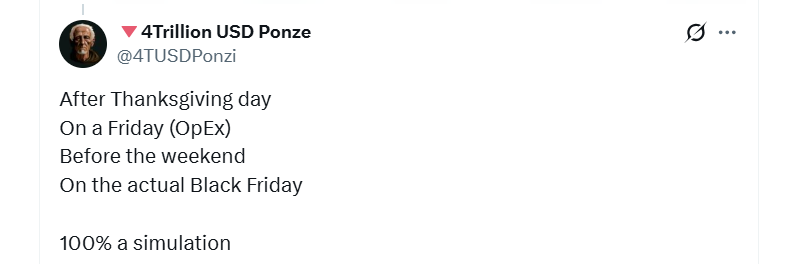
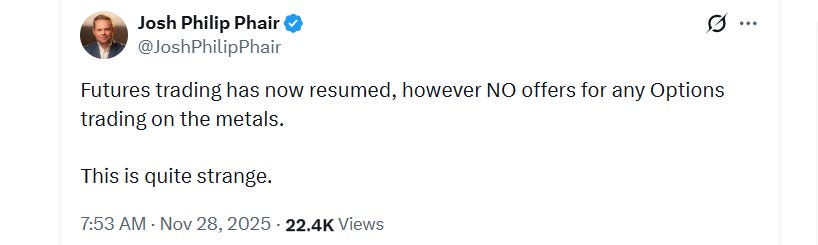
In the moments before the halt, silver futures were hanging by a thread; the offer side was wiped clear, primed for a trade that could have sent prices “off the charts,” exposing just how little actual liquidity sat behind the facade. Instead, with screens frozen, market-makers were given time to reshuffle, fill the books, and protect the illusion of control. When the curtain finally lifted, the rigged system was safe again—at least until the next accident conveniently lines up with the needs of insiders.
The Verdict
This isn’t about cooling failures or bad luck. It’s a damning exposé of coordinated, cynical, system-wide cheating—a deliberate blackout to prevent honest price prints when the system was most vulnerable. The only surprise is how openly the scam was run and how brazen the timing was. Silver holders should take note: every “glitch” is a confession. When the price discovery process is this fragile, physical ownership stands as the only true anchor. The banking system’s addiction to emergency liquidity and narrative control only proves how desperate the paper game has become.
end of segment