
Foreword
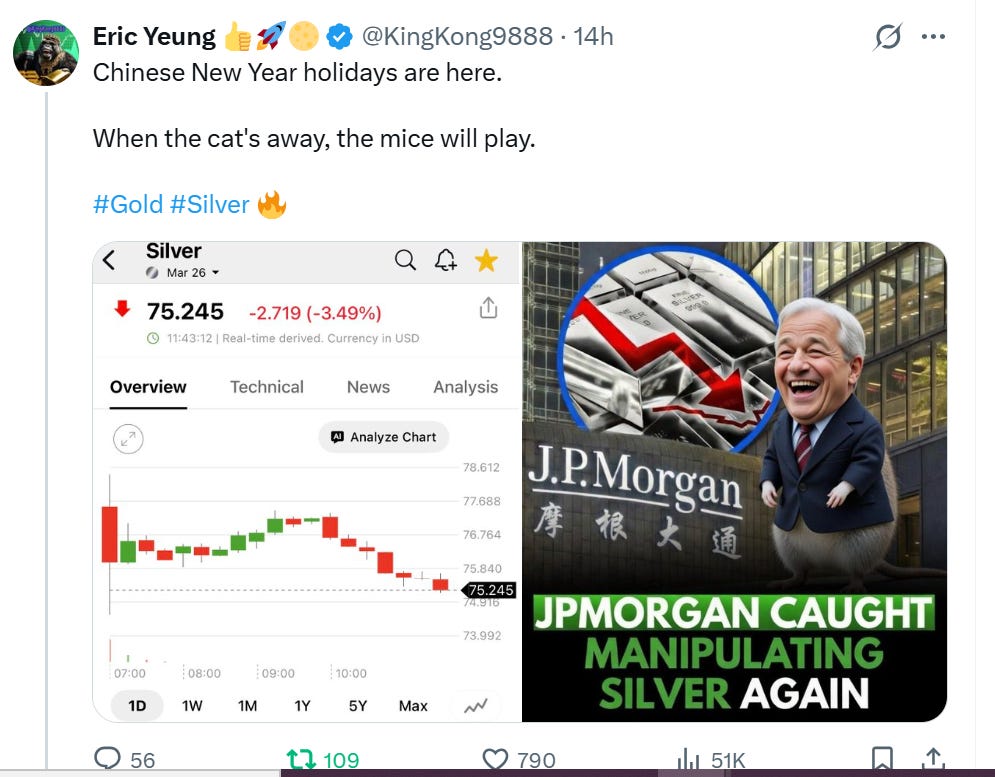
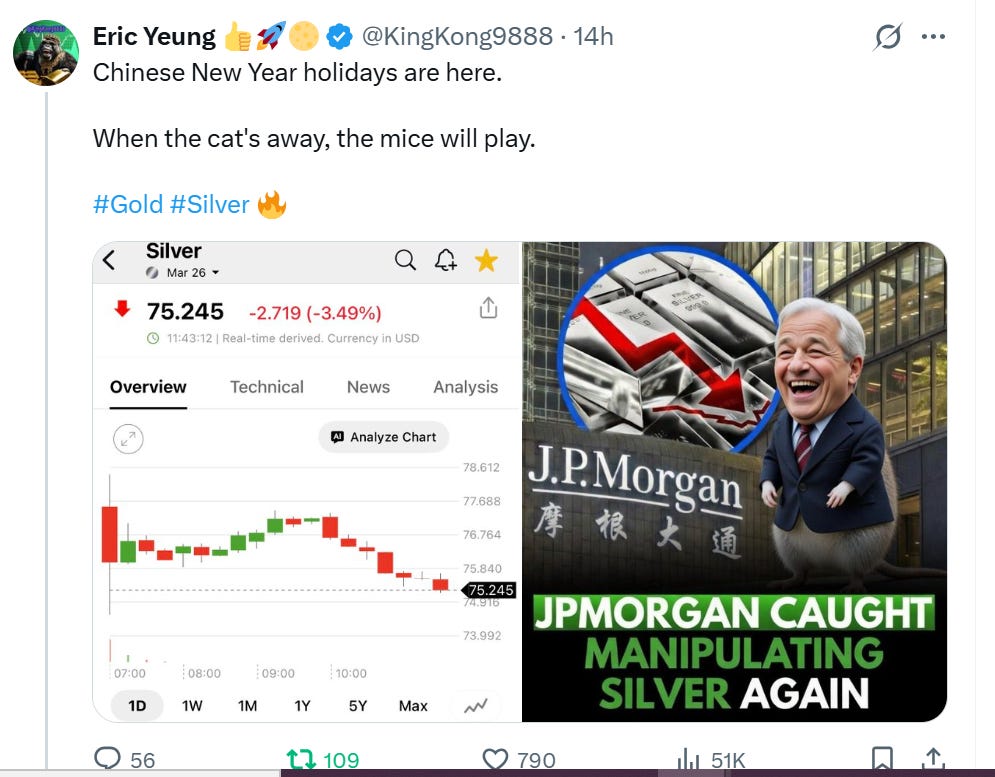
This meme is calling out the same old Western paper‑silver circus. While Shanghai’s physical market is offline for Chinese New Year, the futures cowboys in New York and London get a free hand to lean on price, no Eastern bid to slap them back. Stitch those Western sessions together and silver would “price” under $5—if you believed the paper. The JP Morgan thumbnail screams repeat manipulation, while the caption “When the cat’s away, the mice will play” says it plainly: shut the real market, and the mice in suits go to work on the chart.
Silver has just printed the most explosive bull run in living memory, screaming into triple digits before a violent, 26% overnight ambush on January 30th tried—and failed—to put the genie back in the bottle. We are now consolidating around the $80 per ounce area, and despite the theatrics, the core story has never been clearer: the physical silver market is structurally broken, the paper market is openly malfunctioning, and the era of cheap, abundant silver is permanently over.
Inelastic supply meets unstoppable demand
Silver mine supply is inelastic. Unlike copper or gold, the bulk of global silver production comes as a by‑product of other metals—lead, zinc, copper, gold—where the mine plan is driven by those primary metals, not by the silver price itself. You cannot “turn on” silver production just because the price doubled in six months. It takes years of permitting, billions of capex, and cooperation from host governments that are increasingly hostile, nationalistic, or both. That is why even at today’s elevated prices, the Silver Institute still projects a sixth consecutive market deficit in 2026.
On the demand side, two great forces are colliding. Industrially, silver is the irreplaceable metal for solar, AI, power electronics, and high‑end communications. In photovoltaics, its unmatched conductivity and reliability have made it the default choice on every gigawatt‑scale production line; engineers are desperately trying to thrift, but they cannot eliminate it without sacrificing efficiency. In AI and data‑center build‑outs, the same physics applies: these systems live and die on conductivity and latency, and silver simply outperforms copper on both fronts, with lower resistance and higher speed. There is no scalable substitute that doesn’t degrade performance when every nanosecond counts.
Monetarily, silver is being dragged back into its 4,000‑year role as money. In Asia, households and institutions are accumulating silver not as a speculative ticker, but as a monetary asset that sits outside the banking system—nobody else’s liability. India, China, and the broader BRICS bloc are openly pivoting toward hard collateral, while Western savers rediscover silver as the anti‑fiat hedge in an era of debt‑soaked, negative‑real‑yield currencies.
Six years of deficit, vaults bleeding out
This is not a narrative deficit; it is a measured one. The Silver Institute now expects 2026 to mark the sixth straight year where total demand exceeds total supply, even after scrap rises and mine supply ticks higher at the margin. Consultancy estimates and bank research point to annual shortfalls that require systematic drawdowns of above‑ground inventories just to keep the market functioning.
Those inventories are now visibly cracking. COMEX registered silver—the metal actually available for delivery—has plunged below the psychologically critical 100‑million‑ounce threshold after a blistering multi‑month drain. Shanghai’s visible stocks have fallen even faster, dropping roughly 90% from 2020 levels, with single‑day drawdowns as high as 8% as industrial users and investors yank metal out of the exchange vaults. Arbitrage pressure is fierce: Shanghai spot has been trading at a persistent multi‑dollar premium to Western prices, creating a powerful incentive to ship metal East until Western vaults are stripped to the bone.
UBS and other banks now quietly talk about a multi‑hundred‑million‑ounce imbalance in a roughly 1–1.1‑billion‑ounce annual market—numbers that simply cannot be reconciled without a far higher clearing price. This is why the drawdown cadence is accelerating, not slowing, even after a sharp price correction.
January 30th: the day the mask slipped
Which brings us to the infamous January 30th smash, when silver was bludgeoned 26% lower in a single New York session after foreign markets had closed. In less than an hour, prices were slammed 17–18% lower on a surge of futures volume on CME’s COMEX platform—exactly the kind of disorderly move that the exchange’s own Dynamic Circuit Breakers (DCBs) are supposed to halt.
Under CME Rule 589, silver futures employ DCBs that trigger when prices move more than 10% from a rolling reference price calculated over the prior hour. When tripped, they are supposed to kick the market into a two‑minute pause—no trading, just time for order books to refill and for panic or algorithmic cascades to cool down. On January 30th, that visible halt never arrived. There was no two‑minute “pre‑open” pause, no public announcement, and no obvious sign that the guardrails ever engaged as the price knifed lower in a textbook cascade of stop‑loss triggers and forced liquidations.
When pressed, CME officials invoked a different mechanism: “Velocity Logic” (VL). VL events are ultra‑short‑term checks triggered by tiny but ultra‑fast price jumps—a 20‑cent move in a single millisecond (narrow), or a 60‑cent move within one second (wide). When VL triggers, CME applies a hidden five‑second hold, then resets the DCB reference band around the new, lower price. In practice, this means high‑frequency traders can repeatedly jab the price down just hard and fast enough to trigger VL, wipe out the previous DCB reference band, and re‑anchor those “protections” at progressively lower levels.
The result is devastatingly simple: the very tools advertised as investor protections become programmable trapdoors. Each micro‑smash resets the tripwire, allowing a cascading 17–26% decline without ever hitting the highly visible two‑minute circuit‑breaker halt that retail and slower‑moving participants are told to rely on. In other words, circuit breakers exist in name only if the largest, fastest players can continually neutralize them in real time.
A broken paper mirror, a hard re‑pricing ahead
This is the heart of the scandal: a futures market that claims to “discover” the price of silver has designed its own safety mechanisms so they can be sidestepped by the very high‑frequency flows most capable of inducing panic. At the same time, the underlying physical market is in its sixth consecutive deficit, visible exchange inventories are collapsing, and Eastern buyers are paying fat premiums to secure real metal.
In a world where silver is mined largely as a by‑product, supply cannot elastically respond to price or policy shocks. Industrial users tied to solar, AI, and electrification cannot substitute away without crippling performance. Households and institutions across Asia and the West are re‑monetizing silver as a safe‑haven asset in the teeth of an emerging currency and bond crisis.
The January 30th plunge did not “fix” anything. It simply exposed how fragile, and how easily gamed, the digital price mirror has become just as the real‑world metal is vanishing. The conflagration of inelastic supply, surging industrial demand, and a global monetary reset is still in its early innings— and it will require silver prices at multiples of today’s levels to restore balance between fantasy paper claims and the dwindling, indispensable metal that actually makes the modern world run.
end of segment
-
our opinions are not our sponsors opinions
-
the editorial department is separate from the promotions department
-
not financial advice