
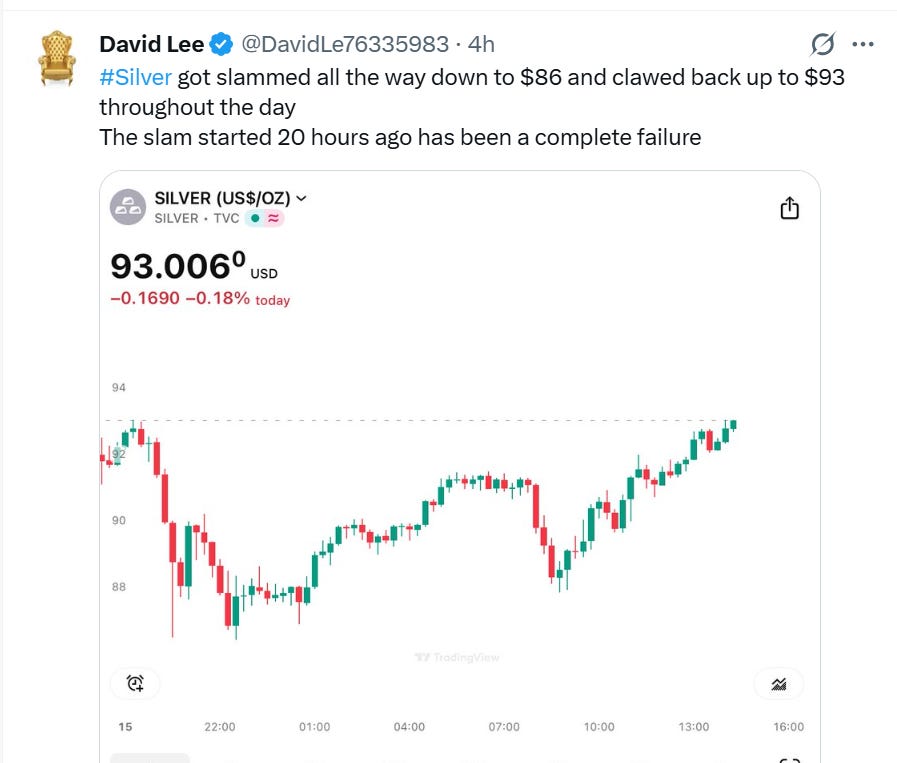
Michael Oliver argues silver can reach over $200 by Q2 2026 because multiple long‑term momentum structures have already broken. Gold has decisively broken out versus the S&P 500, signaling a structural capital rotation out of equities and into monetary metals. Silver has now broken out relative to gold and out of a multi‑year base, historically the setup preceding violent “catch‑up” repricings. In his framework, silver is not simply rallying; it is exiting a 50‑year ceiling and hunting for an entirely new reality zone where $200 is a baseline, not a blow‑off
Eric Sprott is Right: Bankers have finally lost control over suppressing the Silver market
Paper silver’s golden age of manipulation is over. The silver slams are failing in real time, the physical squeeze is undeniable, and the old gatekeepers are rapidly losing control of the most strategically important metal on earth.
How COMEX Silver Slams Actually Work
For years, the playbook was simple: dump massive paper futures into thin liquidity on COMEX, usually during off‑hours, to smash the quoted price without moving any meaningful volume of real bars. The cascade would trip stops, trigger algos, spook specs, and paint a fake picture of “selling pressure” even though almost no physical silver changed hands at all. In the past, this tactic could keep silver suppressed for days or even weeks because physical demand was slower, inventories looked “comfortable,” and most participants still believed the paper price.
Why The Slams Are Failing Now
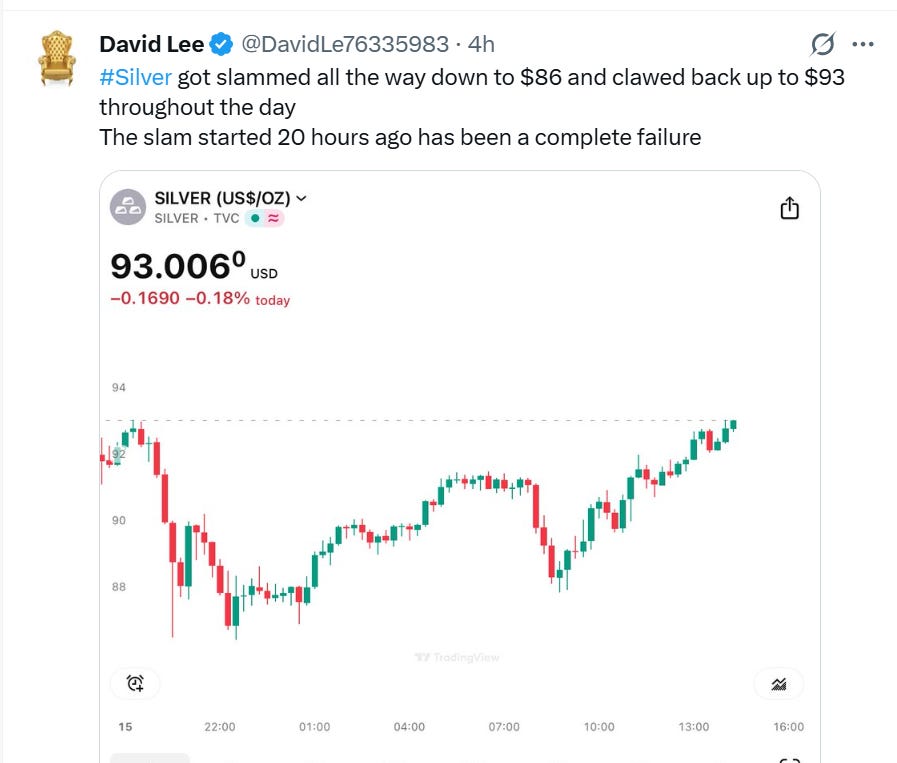
Today, that script is breaking down in spectacular fashion. COMEX registered stocks have been drained by more than 70% since 2020, while leverage between paper claims and available metal sits in the hundreds‑to‑one range, meaning the vast majority of “silver” is just contractual smoke. Over the last 90 days, every violent futures raid has been met with aggressive dip‑buying, with sharp intraday dumps reversing into powerful rebounds as real demand steps in. Moves where silver gets slammed down into the mid‑80s and claws back toward the 90s within hours are becoming the rule, not the exception; what used to be a multi‑day beatdown now burns out in a single trading session.
The slam that began roughly 20 hours ago is a textbook example: heavy paper pressure drove price sharply lower, but structurally motivated buyers treated it as a gift, not a warning. The result: a raid that would once have broken sentiment instead exposed how little real selling exists when price is artificially smashed into a wall of physical demand.
The New Buyer Hierarchy
Three dominant buyer blocs are now turning every orchestrated “smash” into a subsidized accumulation event.
-
Industrial Asia: Major industrial users—especially across China—are prioritizing secure silver supply for solar, electronics, defense, and AI‑adjacent applications, with Shanghai often trading at a premium to Western benchmarks. Export restrictions, long‑term offtake contracts, and regional tightness mean that every Western price raid invites tonnage to flow East, not inventories to refill.
-
India’s quasi‑monetary bid: Regulatory shifts and banking channels in India are normalizing silver as a savings, collateral, and quasi‑monetary asset, supporting rising formal imports and financialized silver holdings. This is a structurally sticky bid: it is not hot money, it is balance‑sheet policy.
-
Global monetary hedgers: Family offices, funds, and high‑net‑worth investors are increasingly treating silver as high‑beta monetary insurance in a world of geopolitical shocks, fiscal recklessness, and inflation risk. For these players, algorithmic slams are not warnings; they are automated entry signals.
Together, these forces have shortened the half‑life of every COMEX hit job. Slams that once suppressed price for weeks now barely last a trading day before physical and long‑horizon capital erase the move and often push price higher than before.
The Physical Squeeze Is Not A Theory
The ongoing squeeze in above‑ground, globally refined physical silver is very real and increasingly visible to anyone not trapped in paper‑only narratives. It is not being driven by retail stackers; in macro terms, retail flows are background noise compared to sovereign, quasi‑sovereign, and strategic industrial accumulation. Available, deliverable stockpiles are being tightly hoarded by nation‑states and their proxies—state‑aligned enterprises, reserve managers, and industrial champions locking in future supply under the cover of “commodity management.”
What remains is the leftovers: retail and smaller non‑critical industrials are forced to fight over whatever units escape into visible channels—coins, small bars, and sporadic commercial lots not already spoken for by larger balance sheets. Chronic premiums, perpetual “out of stock” windows, and widening gaps between spot quotes and real‑world offers are not anomalies; they are the tells of a market where physical has quietly decoupled from paper theatrics.
No More Neutrality: Choose Your Side
In this environment, pretending that silver is plentiful, that COMEX paper defines reality, or that retail selling can neutralize sovereign and industrial hoarding is not a “different opinion”—it is a hallucination. The evidence of structural scarcity, failed slams, and relentless accumulation by serious players is now too large, too frequent, and too global to ignore.
Anyone who still denies the squeeze in refined, above‑ground physical silver is signaling one of five things: ignorance, intellectual laziness, gullibility, deliberate dishonesty, or service to controlled‑opposition narratives designed to keep the public docile while the real game plays out off‑exchange. In this phase of the cycle, feigned “agnosticism” on silver’s physical reality does not make someone sophisticated; it disqualifies them from serious monetary and commodity conversation.
The paper slams are failing. The physical is disappearing into stronger hands. And silver is quietly reclaiming its role as the most mispriced and strategically explosive asset in the global financial system.
Roughly 62 million ounces of silver stood for delivery on COMEX in December 2025, corresponding to about 12,500 contracts at 5,000 ounces each.
Over roughly the last 90 days, COMEX has looked like a crime scene where the culprit keeps coming back and leaving less and less metal behind.
-
Oct 3, 2025: Eligible silver peaks near 342 Moz; this marks the recent high‑water mark for warehouse stocks.
-
Nov 6, 2025: Silver hits record levels amid a fifth consecutive structural deficit; backwardation and delivery demand start quietly draining inventories.
-
Late Nov–Dec 23, 2025: Price rips from about the low‑40s to above $70 while total COMEX open interest in silver actually falls by ~156k contracts, a classic sign of short covering and physical‑led strength, not frothy speculation.
-
Dec 30, 2025 – Jan 1, 2026: “Paper vs physical” decoupling event: physical trades at up to an 80% premium over futures as more traders stand for delivery instead of rolling.
-
Dec 31, 2025: Registered inventory sits around 128 Moz, lowest since Feb 2025; eligible has already slipped ~6% from the October high to ~321 Moz.
-
First week Jan 2026: Index‑rebalancing “slams” hit—billions in forced futures selling predicted—yet price shrugs, with silver holding in the 70s and then 80s as buyers absorb the flow.
-
Jan 4–9, 2026: Commentary notes COMEX registered stocks have collapsed over 70% from 2020 levels; futures curve stays tight and often backwardated, confirming real‑world scarcity.
-
Jan 12–13, 2026: Silver breaks into the 90s; Citi and others openly target $100+, framing the move as driven by an acute shortage of deliverable metal.
-
Jan 13–14, 2026: Fresh slam attempt drives quotes into the mid‑80s, but intraday rebounds toward the 90s show raids now last hours, not weeks, as physical and strategic buyers step in.
-
Jan 13–14, 2026 (warehouse data): Daily CME stock reports show continued churning with no meaningful rebuild; each delivery cycle chips away at registered while eligible inches lower from its October peak.
In this 90‑day window, the pattern is unmistakable: inventories grind down, slams shorten, and every orchestrated hit becomes another entry in a growing forensic record of a market being drained, not refilled
Today, COMEX silver slams tend to burn out in hours, whereas a year ago they typically persisted for days.
Approximate duration change
-
Now: Many raids reverse within 4–12 hours, with price often reclaiming most of the dump the same session or by the next open.
-
A year ago: Similar percentage slams commonly suppressed price for 2–5 trading days before recovering.
Percentage comparison
-
Taking midpoints (now ~8 hours vs. then ~3 days ≈ 72 hours), average slam duration has shrunk by roughly 80–90% in time.
-
In other words, what once held silver down for several days now often fails within a single trading day as physical and structural buyers step in much faster
end of segment