
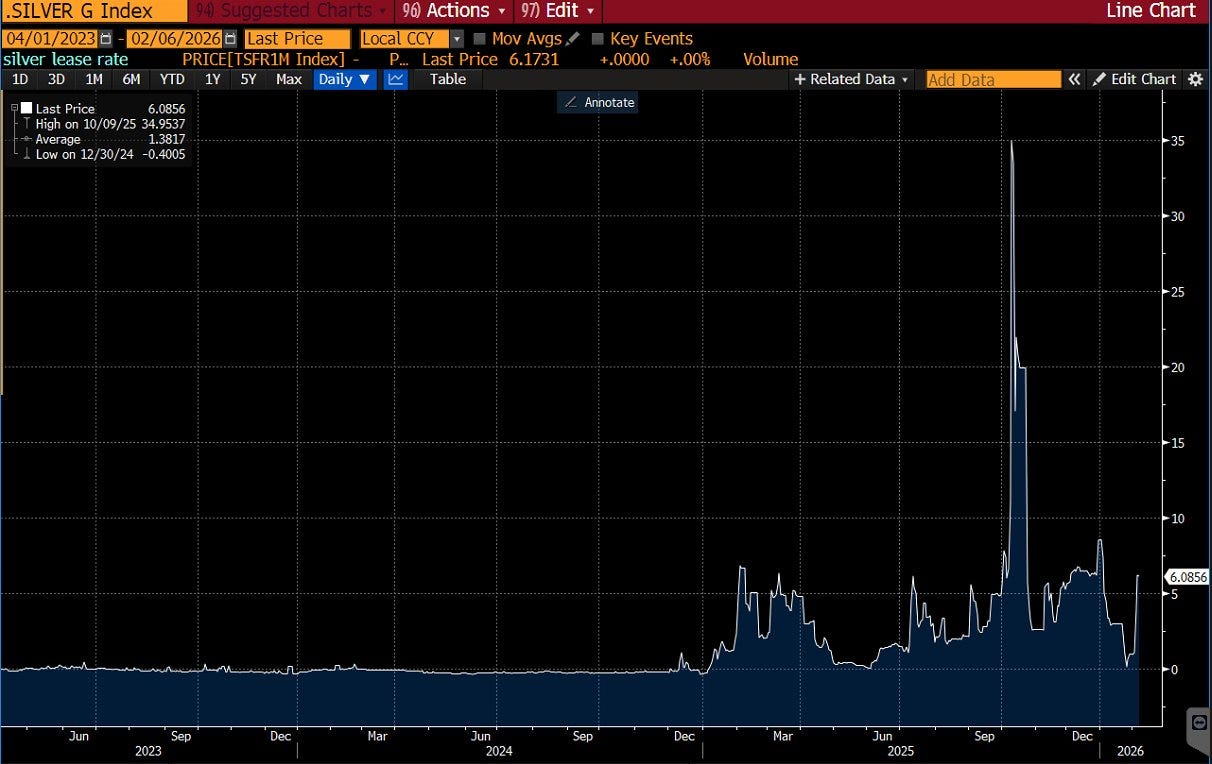
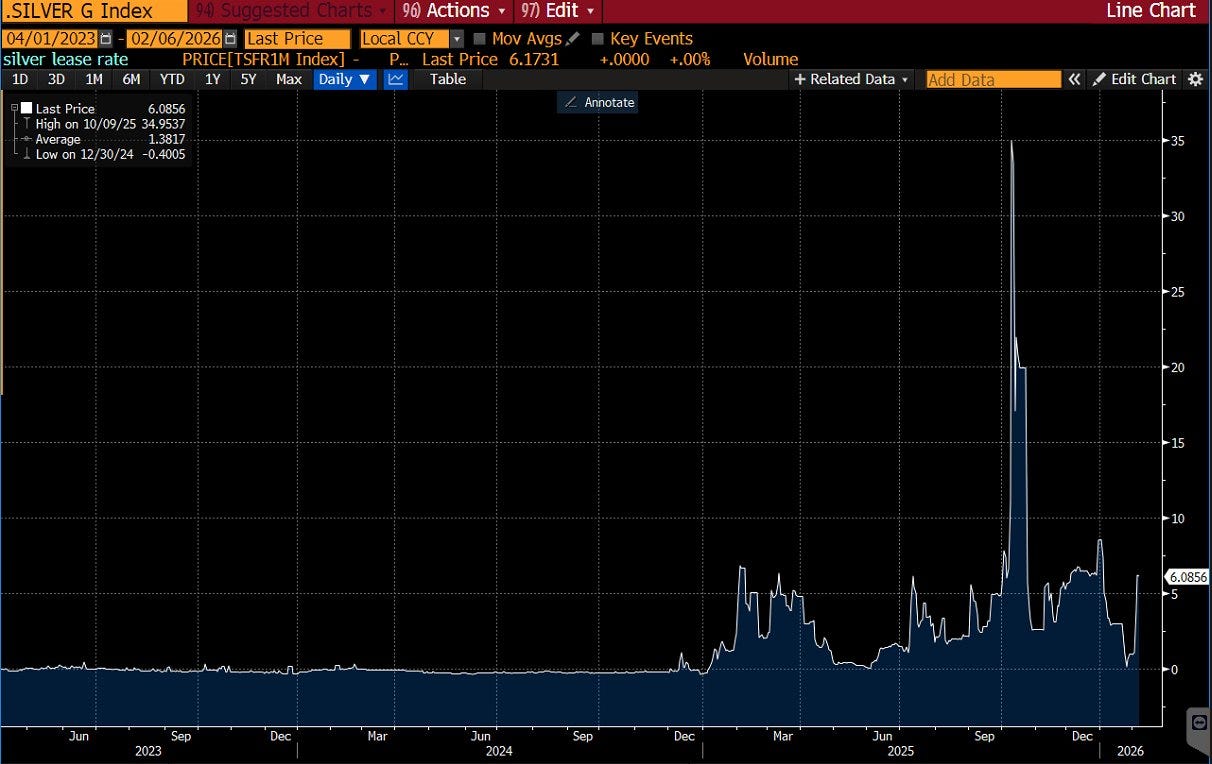
Topic: Silver lease rate in London jumps to 6.1% for one month
Precious metals analyst Karel Mercx states, ”That tells you everything about the recent crash. This was leverage in paper getting flushed, not a collapse in physical demand. If supply were loose, professionals wouldn’t be paying top dollar to borrow silver right now”
The Smoking Gun: Silver’s Tight Supply Exposed
London just flashed the truth the charts can’t hide. The one‑month silver lease rate has jumped to 6.1%, the highest in years. That single number says everything about what’s really happening—paper silver is getting flushed, but physical demand is stronger than ever.
If silver were plentiful, professionals wouldn’t be paying premium rates to borrow it. Yet they are—because real metal is vanishing from circulation. The Perth Mint has sold out of its Kangaroo coins. Major bullion dealers in the U.S. and U.K. report empty shelves on kilogram bars and rising premiums across the board.
This isn’t a price crash—it’s a liquidity squeeze in disguise. Digital leverage is burning off while the world scrambles for metal that no longer sits idle. The lease market is screaming what the price won’t admit: there’s not enough silver to go around.
Physical Metal vs Paper Promises
The COMEX’s own data now shows an unprecedented physical depletion. Month after month, more than 60 million ounces have been leaving vaults—demanded for delivery, not rolled over on paper. In 2025, total COMEX deliveries hit 474.4 million ounces, more than double the 2024 tally of 202.7 million. Every single month saw higher deliveries year-over-year. That’s not a coincidence. It’s a migration—from faith in paper to the security of owning metal.
January 2026 was never supposed to matter. It’s traditionally a quiet month in the silver calendar. Instead, it detonated into 49.4 million ounces of deliveries—an all-time record for a “minor” month. Why? Because participants are front-running the March chaos out of fear: they’re worried the metal won’t be there when the real delivery wave hits.
February is proving them right. In just its opening days, nearly 19 million ounces have already been delivered—almost matching all of last February—and a stunning 100% of open interest is standing for delivery. This isn’t a futures market anymore. It’s a physical grab. And March, the big contract month, looms like a storm on the horizon.
With open interest currently around 429 million ounces, even a 25% delivery demand would require 100 million ounces. At 50%, the figure jumps to 214 million. At 70%, the market would need over 300 million ounces—against total registered COMEX inventories of barely 103 million today.
The Inventory Meltdown
Let that sink in. Registered silver—the metal actually deliverable—has collapsed from 167 million ounces in October 2025 to around 103 million now, draining at roughly 785,000 ounces per day. At that rate, available supply could fall to 85 million ounces by the March delivery start. The rest of the COMEX “eligible” category remains untouched, because owners refuse to part with their metal at current suppressed prices. When people who own silver won’t sell it to the exchange meant to trade it, it’s not a functioning market. It’s a countdown.
If March mirrors last year’s 80-million-ounce delivery, the tank will already be near empty. If it exceeds that, the system faces a choice: cash settlement, forced default, or public unraveling. Either way, confidence breaks. Because no one can credibly price metal using a market that can’t deliver it.
Why Real Silver Matters
This is why the COMEX “price” is now little more than theater. The true value of silver is not in a futures peg. It lives in its properties—its unmatched performance in both industry and money. Silver is ductile, malleable, reflective, thermally efficient, and conducts electricity and heat better than almost any other element. It kills bacteria, enhances solar conversion, and connects every circuit that enables modern civilization.
Strip away the financial façades, and silver becomes something astounding: it’s the metal that makes the future work. Every AI data center, every electric vehicle, every advanced battery, every robot, every 5G node, every satellite—all of it quietly depends on silver. There is no substitute. In an energy-starved world, where solar installations are being scaled faster than the mining industry can supply them, silver’s role is existential.
Today, electronics and photovoltaics account for roughly half of silver’s annual demand. That figure rises each year as industrial applications multiply. What doesn’t rise—fast enough—is mine supply. After years of underinvestment and depletion, global silver production looks incapable of meeting the new industrial era’s exponential appetite.
The Inevitable Repricing
When the exchange system can no longer deliver real metal, the illusion of “price discovery” collapses. The market begins to seek truth—not in a paper quote, but in the physical world where users need silver to function. The industrial bid will ultimately overwhelm the derivative short game. That’s when silver stops being sold cheap to speculators and starts being hoarded by corporations, nations, and individuals who realize they cannot operate without it.
So ignore the COMEX and LBMA screens. They tell you what traders wish silver cost. But walk into a refinery, call a mint, or source industrial-grade metal, and you begin to see the emerging two-tier world: one for paper silver, one for real silver.
In the end, the market always hunts for honesty. And honesty lives where atoms meet demand—not where contracts meet settlement. Silver’s true price is forming there already. The paper empire is cracking. By the time most wake up to it, the revaluation will already be underway.
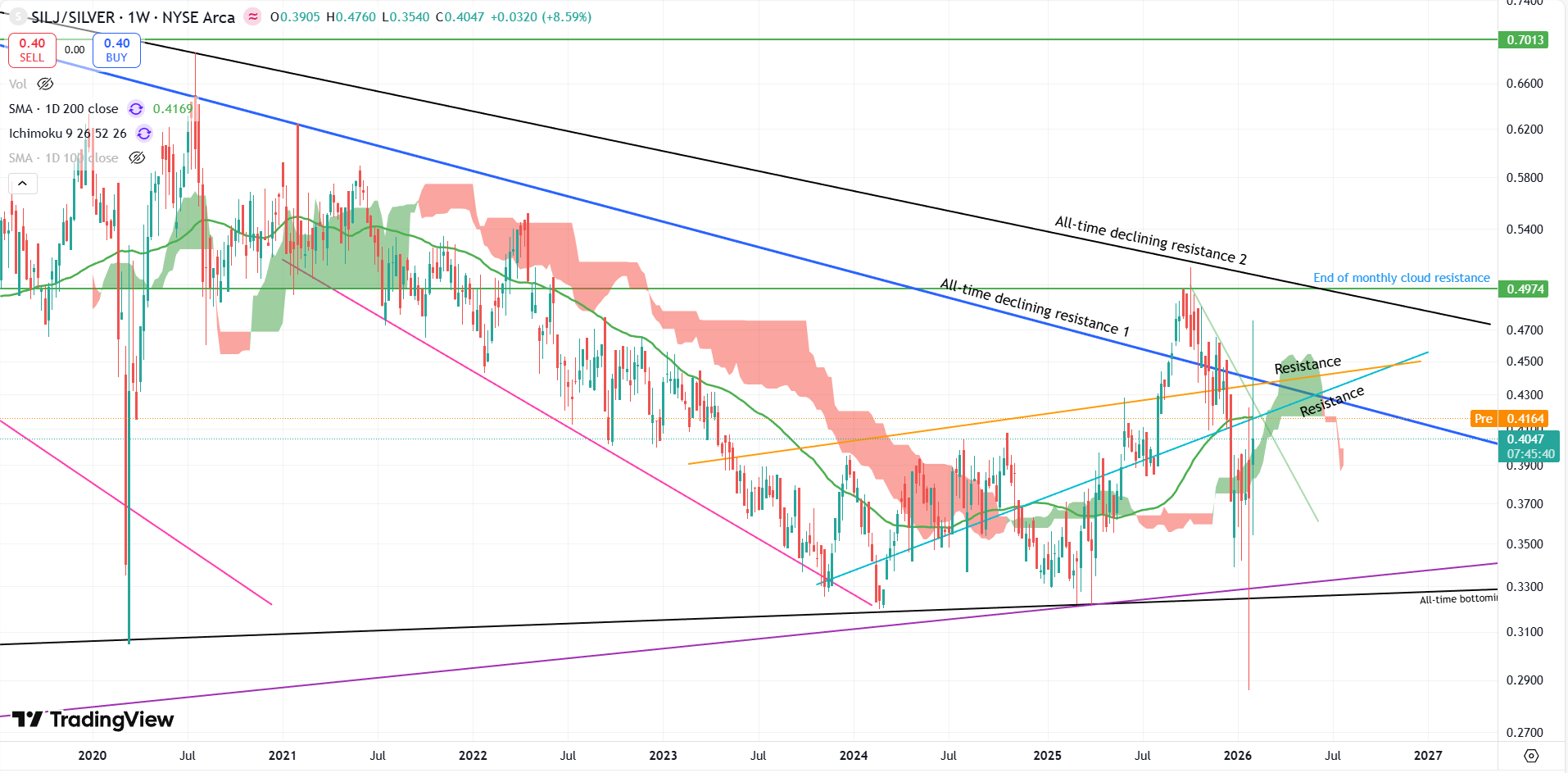
Miners are still ridiculously cheap here, even after two separate crash events that wiped out weak hands and two CME margin hikes that shook out leverage rather than changing the underlying story. SILJ versus silver is finally starting to behave, and there’s a real shot this thing actually finishes the week back on the right side of the trend for the first time since the big break.
To me, that’s the market whispering that the miners are going to lead on the upside once silver itself stops bleeding and actually turns. The ratio probably won’t punch through the obvious ceiling levels until the metal joins the party, but when that happens, the move in these beaten‑up miners could be explosive.
Three Pure Silver Plays that follows the best practice of silver investing.
When I look at a silver miner, I want a tier‑1 jurisdiction, proven metallurgy, and serious engineering behind the flowsheet. I care about ore grade, how clean and consistent it is, and the sheer volume of ounces in the ground with room to grow. Above everything, I want strong, aligned management that knows how to convert rock into free cash flow, not just slides.
Aya Gold & Silver (OTC: AYASF) is the emerging flagship of this new silver regime. Its Zgounder mine in Morocco just posted record 2025 production of about 4.83 million ounces of silver, nearly triple 2024, capped by a monster Q4 with 1.37 million ounces and a record 545,491‑ounce December as the expanded plant ran above nameplate capacity. With Boumadine advancing behind it and a supportive mining jurisdiction, Aya is quietly transforming into a multi‑asset primary silver producer feeding a market where physical is already clearing at three‑digit prices in the East.
Andean Precious Metals (OTC: ANPMF) offers a very different but equally powerful angle: it operates the San Bartolomé plant in Bolivia, the country’s dominant silver oxide processing hub, sourcing ore from a vast network of artisanal and cooperative miners instead of relying on a single nationalization‑risk deposit. Its sliding‑scale payment model means feed costs flex with metal prices, crushing downside margin risk while preserving enormous upside torque when silver rips higher, and Bolivia’s prior nationalizations actually entrench Andean as the indispensable mid‑stream processor for the district’s remaining silver inventory.
Kuya Silver (OTC: KUYAF) is the high‑beta newcomer ramping into this squeeze. The company has brought the historic Bethania mine in Peru back into production, reporting record concentrate sales in 2025 as throughput, grades, and recoveries improved quarter after quarter. In Q3‑2025, Bethania generated roughly 16,983 ounces of silver (over 21,000 oz silver‑equivalent) with recoveries above 91% and about 79% of revenue coming from silver, and management is targeting higher tonnage and further optimization through 2026 as new infrastructure and drilling unlock more of the vein system.
The key takeaway in the Kuya Silver story is that the company is only just getting started. Kuya is advancing its deposit from a discovery phase into full production—and is on track to increase its quarterly silver output by 20x before the end of this year.
end of segment
Disclaimer & Declaration of Independence
The views expressed here belong entirely to The Silver Academy and its editorial team — not to our sponsors, partners, or advertisers. Our words are our own.
The editorial department operates independently of the promotions side. That wall of separation is sacred — because truth and integrity cost something, and we won’t sell ours.
Nothing in this publication constitutes financial advice. We’re researchers, not your financial planner. Always do your own due diligence before acting on any market analysis or commentary shared herein.
The Silver Academy now boasts 7+ part-time staff writers, making us one of the fastest-growing underground media forces in precious metals journalism. We run lean, we run honest, and every ounce of support helps keep this machine running.
If you believe in independent research — free from corporate influence or government messaging — support our work. This project lives and breathes because readers like you insist the truth still matters.