
THE SHANGHAI SILVER SLAUGHTER — AND THE END OF PAPER
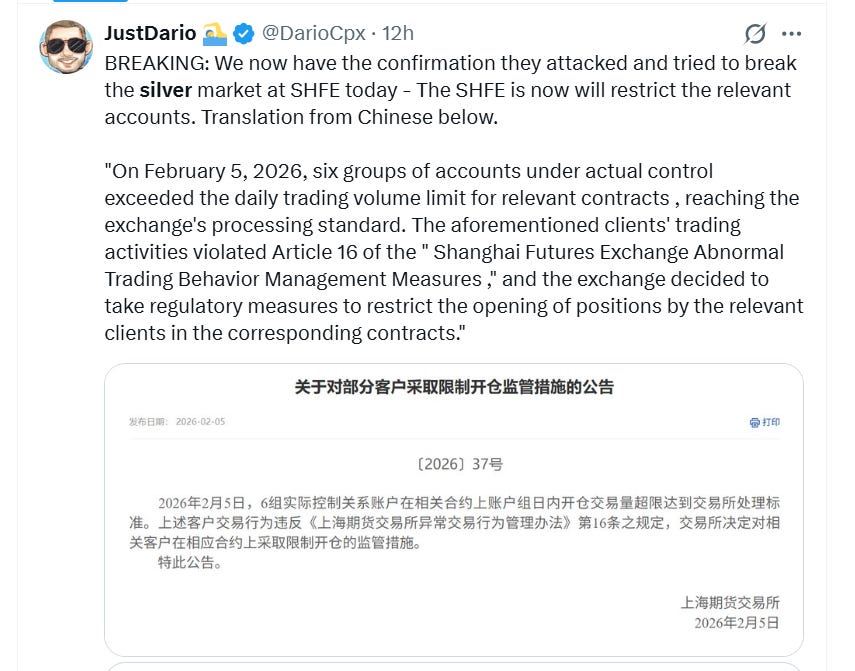
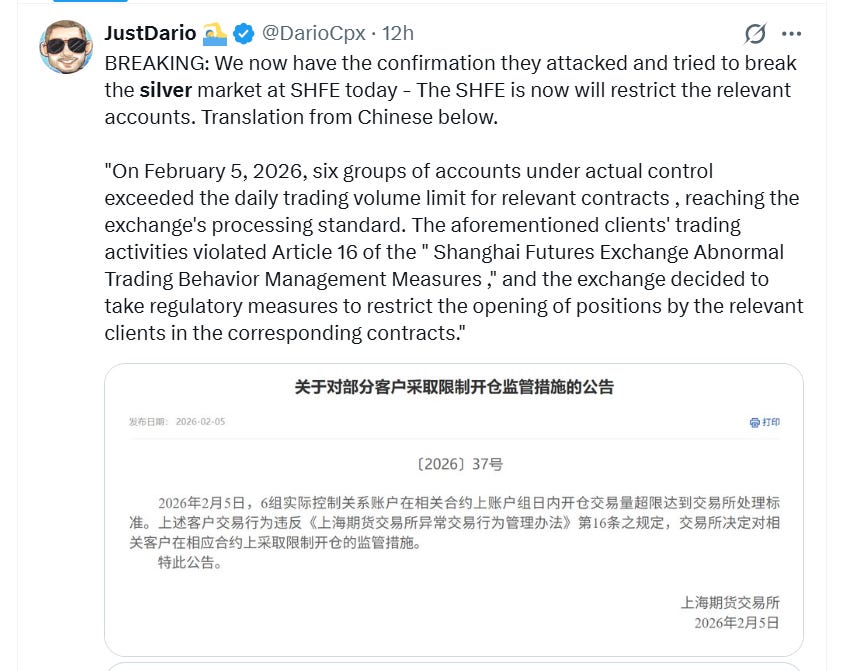
February 5, 2026, will go down in precious metals history as the day the paper façade cracked. What unfolded on the Shanghai Futures Exchange wasn’t a market correction—it was an act of financial warfare. A 17% collapse in hours, an avalanche of synthetic silver traded into oblivion, and the fingerprints of coordinated short-selling plastered all over the tape.
They called it volatility. Don’t believe it. This was the Shanghai Paper Hammer.
Over 1.3 billion ounces changed hands on the sell side—more than the entire annual global mine supply. That’s not trading; that’s a tactical strike. Price collapsed 22% in a two-hour flash—from near $90 an ounce back to the mid-$70s—but only in paper. In the physical world, nothing broke. Dealers from Shenzhen to Zurich didn’t lower prices; they ran out of silver. This isn’t speculative froth blowing off—it’s the suppression machine throwing its final tantrum before the gears seize.
Not Retail—Institutional Warfare
This wasn’t meme-stock hysteria or TikTok traders piling in. Retail wasn’t dumping physical—they were buying every coin they could get their hands on. The real war was institutional. COMEX registered silver has evaporated to roughly 104 million ounces, against an open interest big enough to theoretically “own” the entire world’s mine supply several times over.
Shanghai’s inventories? Under 40 million ounces. Yet somehow, billions of virtual ounces were “sold.” It’s a neat trick of modern finance—selling something that doesn’t exist. And now, like every confidence game, the mark is catching on.
Physical Reality vs. Paper Fiction
In the real world—where metal has weight—silver is disappearing. Industrial users are begging for supply at any price. In Asia, one-kilogram bars trade at $20 premiums over “spot.” Mints are sold out, refiners booked out, and electronics manufacturers are starting to panic. A temporary dip on a futures screen doesn’t change a decade-long shortage—it makes it worse.
Backwardation—where near-term delivery trades at a premium—has ripped back through COMEX and the LBMA. That’s not just unusual; it’s a five-alarm signal. When buyers will pay more to have metal now rather than later, it means one thing: they don’t believe the paper contracts anymore. They want the metal itself. The digital illusion is falling apart.
The System’s Breaking Point
For decades, the paper system inflated supply artificially. Hundreds of phantom ounces trade for every real one—300 ounces of promises for every ounce in vaults. It worked as long as no one asked for delivery. Now they are. That’s the breaking point.
Every margin hike, every trading halt, every frantic “risk warning” from an exchange is a tell. The institutions are scared—not of volatility, but of exposure. They can print contracts, but they can’t print silver.
Gold and Silver: One and the Same
Call it silver, call it gold—it’s the same rebellion. These metals aren’t investments; they’re truth meters in a world awash in deceit. When real money rises, governments panic and bankers reach for the levers. They smash price to protect the illusion that debt-backed fiat still rules the global stage. But the manipulation that worked at $20 silver is suicidal at $80. Momentum has shifted; suppression now only accelerates the inevitable blowback.
The Bottom Line
The February 5 selloff didn’t change the fundamentals—it exposed them. The market screamed in paper; the physical world yawned and kept stacking. Every ounce pulled out of COMEX, every Chinese investor demanding delivery, every refinery backlog—all of it points to one truth: the paper game is ending.
When this dam finally bursts, silver won’t rise—it will reprice. The paper pushers have already lost control; the only question is how loud the snap back will be when the world’s oldest money stops taking instructions from digital fiction.
We’re not watching silver crash. We’re watching paper die.
end of ssegment
Update
Day 13 of Terror: Ten Vizsla Mine Workers Still Missing in Sinaloa
THE HOSTAGE MARKET: WHEN GEOLOGY MEETS GUNMEN
The Vizsla Silver kidnapping isn’t an isolated tragedy—it is the flashing red siren that Mexico is no longer an investable jurisdiction for silver equities. Ten to fourteen mining professionals abducted at gunpoint from a project tied to a Canadian-listed silver company in Sinaloa, with no resolution, no accountability, and near-total corporate silence, is not “country risk.” It is a breakdown of the basic conditions needed for capital to function.
MEXICO’S “FOURTH TRANSFORMATION” INTO A NO‑GO ZONE
For years, the warning signs have been piling up. Mexico’s “Fourth Transformation” has openly reclassified subsoil wealth as a strategic asset of the state, not shareholders. The Morena machine has already slammed the door on new mining concessions, turning exploration upside down and putting every existing operation under a slow‑motion review designed to squeeze more control, more tax, and, ultimately, more ownership away from foreign companies. That was the first step. The second is what you’re seeing now: a jurisdiction where engineers can vanish on a Friday night and the national conversation barely blinks.
CAUGHT IN THE CROSSFIRE: FROM NATIONALIZATION TO “LAND STRIKES”
Layer on top of that Trump’s “land‑strike” doctrine against Mexico—open talk of cross‑border attacks in cartel‑influenced states—and you have the perfect pincer. On one side, a resource‑nationalist Mexican state tightening the screws on silver as a strategic trophy. On the other, a U.S. president openly threatening to turn northern Mexico into a live military laboratory under the pretext of “cartel warfare.” In that world, a silver mine isn’t a business; it’s a future target—either for expropriation, sanctions, or “collateral damage.”
WHEN HIGH‑GRADE BECOMES HIGH‑RISK
The Vizsla abduction is the human face of what you’ve been documenting for months: Mexico’s jurisdictional risk turning from “yellow” to deep red. When a high‑grade, world‑class silver district like Panuco has to suspend work because its people were dragged out of their beds at gunpoint, the message to investors is brutal and simple: your balance sheet is hostage to forces you do not control—cartels, security services, and politicians on both sides of the border.
SELL MEXICAN SILVER MINERS BEFORE THEY “DISAPPEAR” TOO
Silver itself has never been more compelling. But owning silver is not the same as owning Mexican silver miners. In a world where Washington treats Mexico as a potential strike zone and Mexico treats silver as a national trophy, equities operating there are not “leveraged plays”—they are jurisdictional landmines. The Vizsla kidnapping is your warning shot. If your capital is still parked in Mexican silver miners, the risk isn’t that you’ll miss the upside. The risk is that, one morning, the stock is halted—and your capital has effectively been nationalized, criminalized, or simply disappeared along with the men who went missing in Sinaloa
Ten Vizsla Silver workers remain missing in Sinaloa nearly two weeks after being abducted from company housing near the Panuco silver‑gold project, underscoring the extreme jurisdictional risk facing Mexican mine investors. Armed men reportedly entered the La Clementina housing complex around dawn on January 23 and forcibly removed engineers, a geologist, security personnel, and administrative staff, most of whom are Mexican nationals. Authorities classify the case as an ongoing kidnapping investigation and have deployed roughly 1,190 personnel, including army troops, special forces, National Guard, helicopters and aircraft, to search rugged terrain in the Concordia mountains. Officials link the crime to a “Chapitos” Sinaloa cartel cell operating in a contested zone wracked by inter‑cartel conflict and displaced families. Vizsla has suspended or curtailed operations, highlighting how quickly violence can paralyze a flagship asset, derail cash flow, and leave shareholders exposed to opaque local security dyna
Disclaimer & Declaration of Independence
The views expressed here belong entirely to The Silver Academy and its editorial team — not to our sponsors, partners, or advertisers. Our words are our own.
The editorial department operates independently of the promotions side. That wall of separation is sacred — because truth and integrity cost something, and we won’t sell ours.
Nothing in this publication constitutes financial advice. We’re researchers, not your financial planner. Always do your own due diligence before acting on any market analysis or commentary shared herein.
The Silver Academy now boasts 7+ part-time staff writers, making us one of the fastest-growing underground media forces in precious metals journalism. We run lean, we run honest, and every ounce of support helps keep this machine running.
If you believe in independent research — free from corporate influence or government messaging — support our work. This project lives and breathes because readers like you insist the truth still matters.