
COMEX Silver Inventories Face March Reckoning as Delivery Demand Surges to Historic Levels
Systematic drainage of registered silver raises questions about exchange’s ability to meet unprecedented physical demand
The COMEX silver market stands just three weeks away from what could become its most consequential delivery month in modern history, as official exchange data reveals an accelerating drain on physical inventories that threatens the integrity of the world’s primary silver futures exchange.
The numbers tell an extraordinary story. In 2025, total silver deliveries through COMEX reached 474.4 million ounces—more than double the 202.7 million ounces delivered in 2024. This wasn’t a one-time anomaly. Every single month of 2025 saw higher deliveries than the corresponding month in 2024, indicating a fundamental shift in how market participants are using the exchange. Rather than rolling contracts forward or settling in cash, traders are increasingly demanding physical metal.
The January 2026 delivery data suggests this trend is accelerating dangerously. In what is traditionally a minor delivery month, COMEX processed 49.4 million ounces of deliveries—up from 11.8 million ounces in January 2025 and just 6.8 million ounces in January 2024. This sevenfold increase in a non-major month indicates something unprecedented: market participants are front-running the March delivery period, unwilling to wait for the traditional major delivery month because they doubt sufficient silver will be available.
February’s data provides what can only be described as the smoking gun. Through just the first four days of the month, 18.72 million ounces have already been delivered against an open interest that stood at just 19.11 million ounces on January 9th. This represents a nearly 98% delivery rate—far above the 5-10% typical of a normally functioning futures market, and well beyond even the 15-20% seen in stressed conditions. At current trajectory, February will see virtually every open contract stand for delivery. This isn’t a futures market; it’s a physical allocation mechanism operating under extreme stress.
The mathematics become problematic when projecting to March. As of February 4th, March open interest stands at 429 million ounces—down from 580 million ounces in early January as some contracts rolled forward to May and others took early delivery in January and February. If March simply matches last year’s delivery of 80.75 million ounces, COMEX should manage. But last year’s March delivery represented roughly 14% of open interest. If this year’s February delivery rate of 98% holds, or even if March sees a more moderate 50% delivery rate, the exchange would face demand for 214 million ounces—far exceeding available supply.
Here’s where the crisis becomes acute. COMEX registered silver—the metal available for delivery against futures contracts—has fallen from 167 million ounces in October 2025 to just 103 million ounces as of February 4th. That’s a 38% decline in three months, with the pace accelerating. Over the past 26 days alone, 20.4 million ounces have drained from registered inventory at a rate of 785,000 ounces per day. If this rate continues, by the time March delivery begins on February 27th, only approximately 85 million ounces will remain available.
Under a conservative scenario where just 25% of March’s 429 million ounce open interest stands for delivery, demand would reach 107 million ounces against approximately 85 million available—creating a shortfall. Under higher stress scenarios consistent with February’s delivery intensity, the deficit becomes catastrophic.
The 294.5 million ounces of “eligible” silver stored in COMEX warehouses offers no solution. This metal belongs to private owners who are merely using COMEX facilities for storage. For it to become deliverable, owners would need to voluntarily convert it to registered status. But if these owners believe a delivery crisis is imminent and silver prices are heading dramatically higher, why would they make their metal available at current prices? The rational response is to hold and wait.
The March delivery period begins in three weeks. Either a massive percentage of contracts will roll forward to May—merely deferring the problem—or COMEX will face demand it mathematically cannot satisfy from current registered inventory. The second outcome has never occurred in COMEX silver history. If it does, confidence in paper silver pricing mechanisms will be fundamentally compromised, potentially forcing a complete reassessment of how the global silver market functions.
The data is clear. The trend is accelerating. The countdown has begun.
Meanwhile in China
-
The drain on silver vaults in China is accelerating as physical metal is pulled out of exchange storage and into private hands.
-
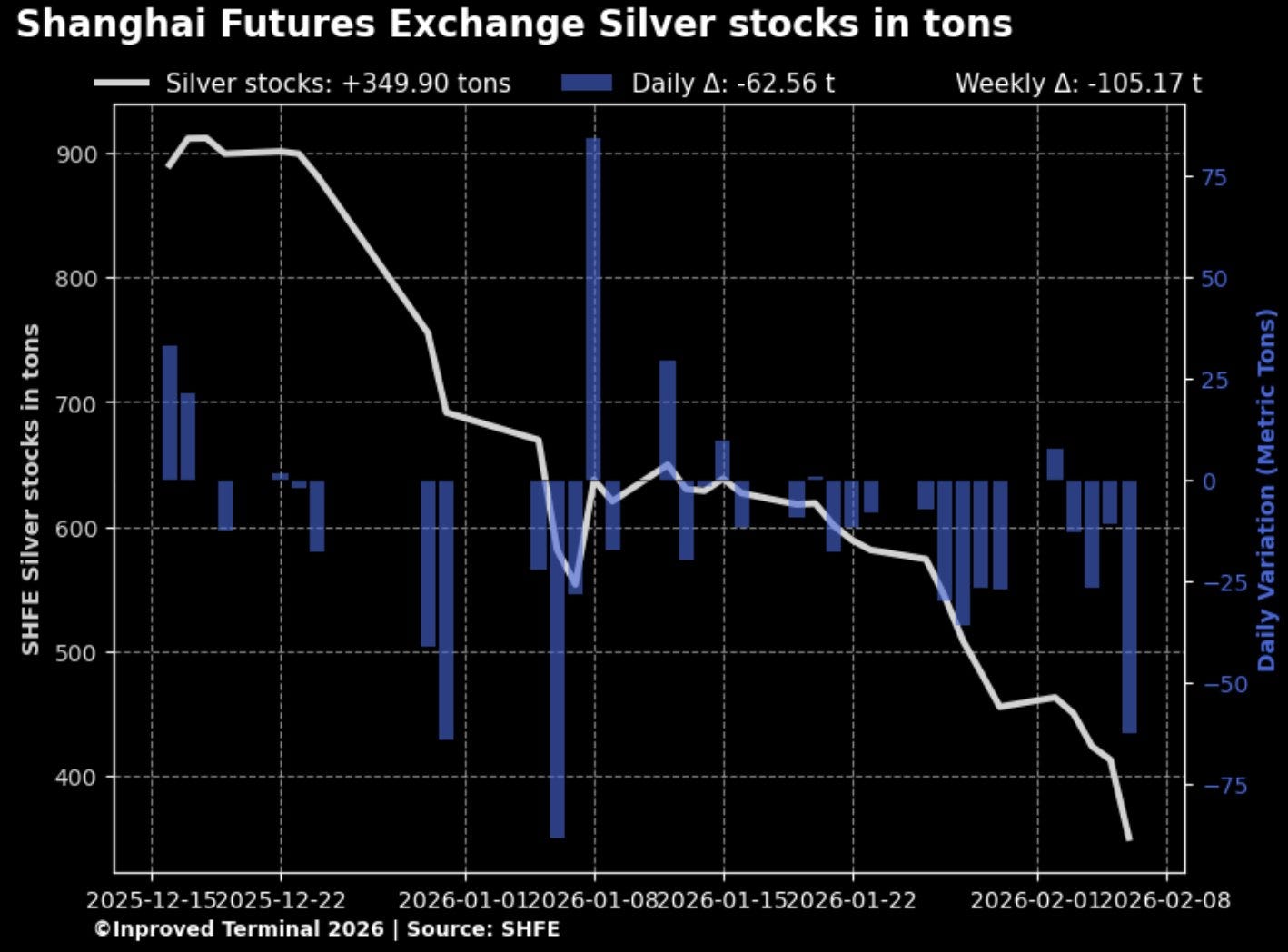
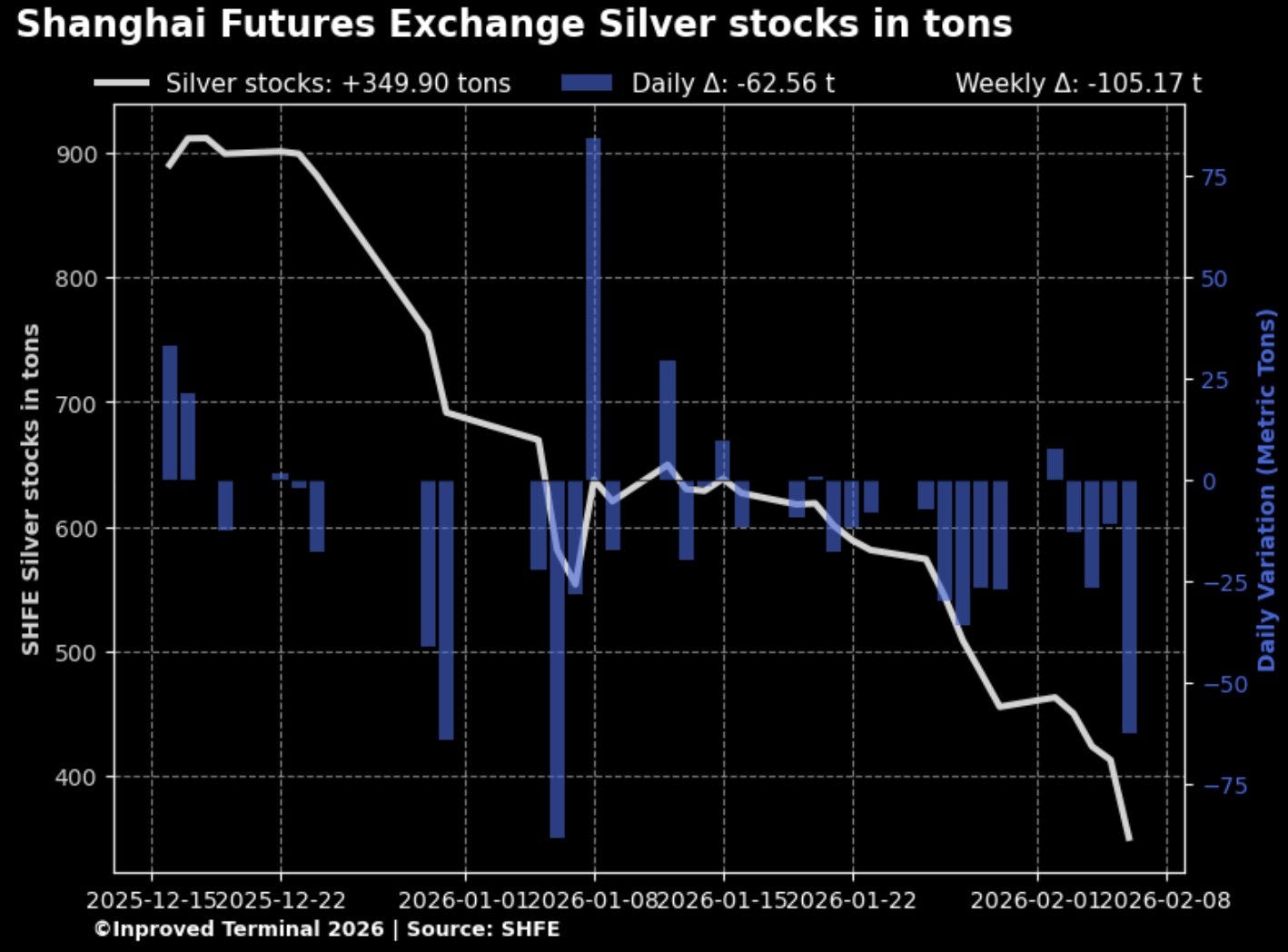
The Shanghai Futures Exchange (SHFE) is now facing its tightest physical conditions in roughly a decade, with total silver warehouse stocks sliding well below the 400-ton threshold.
-
Latest CEIC data show SHFE silver inventories down 23.1% week-on-week to just 350 tons, equivalent to about 11.2 million ounces remaining in exchange vaults.
-
On a daily basis, stocks are collapsing at a rate of roughly 62.5 tons per day, underscoring the urgency of the physical drawdown.
-
Over the past week alone, SHFE silver inventories have fallen by approximately 105 tons, marking one of the steepest weekly declines in years and signaling intense, sustained physical demand rather than a one-off move
end of segment
Update
Day 14 of Terror: Ten Vizsla Mine Workers Still Missing in Sinaloa
Ten Vizsla Silver workers remain missing in Sinaloa nearly two weeks after being abducted from company housing near the Panuco silver‑gold project, and the case has become a stark illustration of how fast jurisdictional risk in Mexico can turn lethal for both people and capital. Armed men reportedly entered the La Clementina housing complex around dawn on January 23, forcing engineers, a geologist, security staff, and administrative personnel—mostly Mexican nationals—into vehicles before disappearing into the Concordia mountains, a zone long scarred by cartel conflict and displaced families.
Local authorities opened a kidnapping/disappearance investigation after a 911 call on January 24, and the response on the ground has escalated into a full‑scale security operation: roughly 1,190 personnel have been deployed, including around 800 army troops, 270 special‑forces elements, 100 National Guard members, plus three armed helicopters and two T6C‑Texan aircraft combing rugged terrain for any trace of the missing miners. Officials and local media link the crime to a cell tied to the “Chapitos” faction of the Sinaloa cartel, operating in a contested corridor where rival Sinaloa groups have been fighting for control since at least 2024.
Vizsla has suspended or curtailed operations at Panuco, emphasizing that its priority is the safety and wellbeing of those abducted, but relatives say they are receiving almost no concrete information about the men’s condition or whereabouts, and there has been no public confirmation of any ransom demand, negotiations, or proof of life. For investors, the incident is a brutal reminder that in parts of Mexico, a flagship silver asset can be partially shut down overnight by violence that instantly obliterates cash flow assumptions, stretches management into crisis mode, and leaves shareholder capital hostage to local security dynamics that no feasibility study can fully quantify.
Why this incident is so terrifying
In more than a century of industrial conflict, from the Great Railroad Strike that set Pittsburgh ablaze in 1877 to the Ludlow Massacre in Colorado’s coal fields, mining‑adjacent violence has usually played out in the open—workers facing militias, Pinkertons and National Guard troops in brutal but visible confrontations over wages and conditions.
What makes the Vizsla Silver abductions in Sinaloa so chilling is that this time there is no picket line, no strike camp, no bargaining table—just ten unarmed miners disappearing at gunpoint into cartel‑controlled mountains, with families and investors alike left in the dark and hoping the bodies don’t turn up first.
In historical labor wars, violence was at least nominally tethered to industrial disputes; here, organized crime treats a silver project as a revenue stream and its workers as expendable hostages, weaponizing terror in a way that goes beyond even the worst Pinkerton raids or tent‑colony burnings. For the modern silver industry, this is not just another “security incident”—it is a jurisdictional shock event that instantly reprices risk, turns a flagship district into a potential no‑go zone for capital, and reminds the entire sector that in 2026, the real existential threat is not ESG rhetoric in conference halls, but the cold fact that in parts of Mexico, a silver mine sits on the front line of a low‑grade war
Where to find the location
Public technical descriptions place the Panuco silver‑gold project in the Panuco‑Copala mining district of the Concordia municipality, in southern Sinaloa near Mazatlán, with access via Highway 40/40D from Villa Unión.
To see it on a map:
-
Open Google Maps (or similar).
-
Search for:
Pánuco Copala SinaloaorDistrito Minero Pánuco Copala, Concordia, Sinaloa. -
Zoom in along Highway 40/40D east of Villa Unión toward Concordia; the project area and nearby mine camps sit along that corridor.
That view will show you the approximate area where any company housing “near the Panuco silver‑gold project” would be located
end of segment
Disclaimer & Declaration of Independence
The views expressed here belong entirely to The Silver Academy and its editorial team — not to our sponsors, partners, or advertisers. Our words are our own.
The editorial department operates independently of the promotions side. That wall of separation is sacred — because truth and integrity cost something, and we won’t sell ours.
Nothing in this publication constitutes financial advice. We’re researchers, not your financial planner. Always do your own due diligence before acting on any market analysis or commentary shared herein.
The Silver Academy now boasts 7+ part-time staff writers, making us one of the fastest-growing underground media forces in precious metals journalism. We run lean, we run honest, and every ounce of support helps keep this machine running.
If you believe in independent research — free from corporate influence or government messaging — support our work. This project lives and breathes because readers like you insist the truth still matters.