
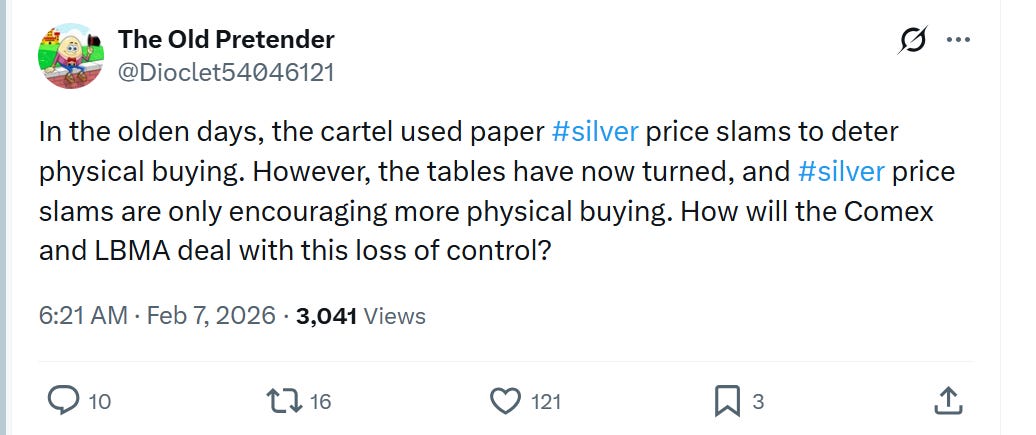
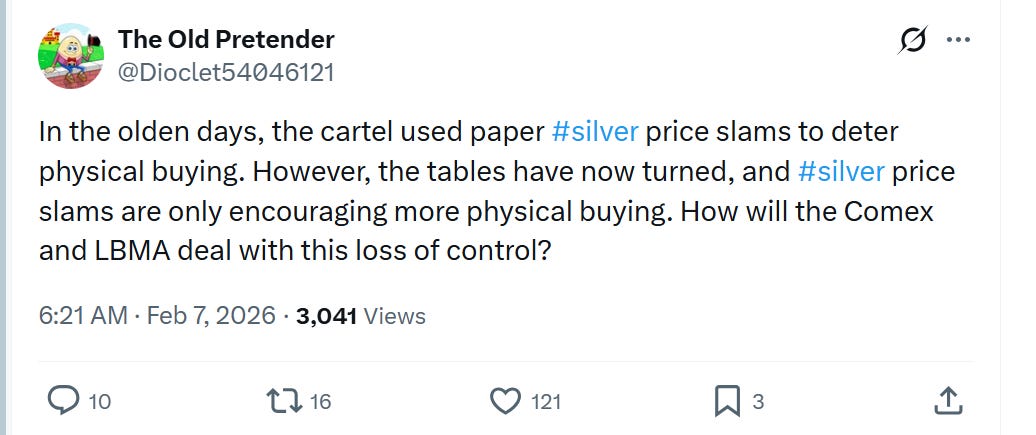
Silver Cartel Panic: Every Price Smash Now Sparks a Buying Riot They Can’t Contain
by Niko Moretti
COMEX Silver Depository Report source,
-
Another 3.5 million ounces removed from COMEX silver vaults on Thursday
-
1,244,595 oz withdrawn from Asahi
-
458,859 oz adjusted OUT of Asahi Registered
-
601,622 oz received by BRINKS
-
771,965 oz withdrawn from CNT
-
383,865 oz adjusted OUT of CNT Registered
-
452,653 oz withdrawn from HSBC
-
1,507,866 oz withdrawn from MTB
-
122,590 oz withdrawn from STONEX
-
141,470 oz adjusted OUT of STONEX Registered
-
Total Registered silver: down 984,000 oz to 102,547,549 oz
-
Total COMEX silver: down 3.5 million oz to 394,511,408 oz
end of segment
Summary of Today’s news
Why this reporting uses cautious language about “local power structures” and “disruptors” instead of explicit labels.
-
Historical examples of Mexican journalists murdered for exposing political–criminal networks around resources.
-
Tipoff and document trail: how a reader alerted us to an alleged December 5, 2025 seizure of the Minera Inde de Durango silver mine.
-
ECI president Robert John Harrington’s letter: “the mine, the mill and critical infrastructure are no longer available to us.”
-
Why no Mexican outlet covered the Durango seizure and what that silence reveals about risk, taboo, and self‑censorship.
-
Don Durrett’s public skepticism, Keith Neumeyer’s DM calling the story “fake,” and Jon Little’s 1,000‑ounce silver wager that drew no response.
-
Supporting documents and shareholder letters, including issuer‑bid circulars and corporate communications linked in this report.
-
Still no word from Sinaloa: Day 14 of the missing Vizsla Silver workers, with no ransom, no proof of life, and operations curtailed.
-
The “Four Transformations” of Mexico and how Morena’s 4T resource nationalism collides with fragmented, contested sovereignty.
-
How “no ransom” changes the risk calculus: from one‑off extortion to long‑term control over assets, timelines, and cash flows.
Journalists who cover organized violence around Mexico’s extractive industries have often paid with their lives.
Miroslava Breach, who exposed political–criminal collusion in Chihuahua, was murdered in 2017.
Javier Valdez, a veteran reporter on drug‑linked power structures in Sinaloa, was gunned down that same year. In light of this lethal reality, this writer or this publication will not use explicit terms such as “cartel,” “Chapitos,” or “narco war” in future reports, and will instead refer to “local power structures” or “disruptors.”
The work will remain fearless in substance, but language and framing must be disciplined, calculated, and smart enough to stay alive.
Fast forward to December 5, 2025
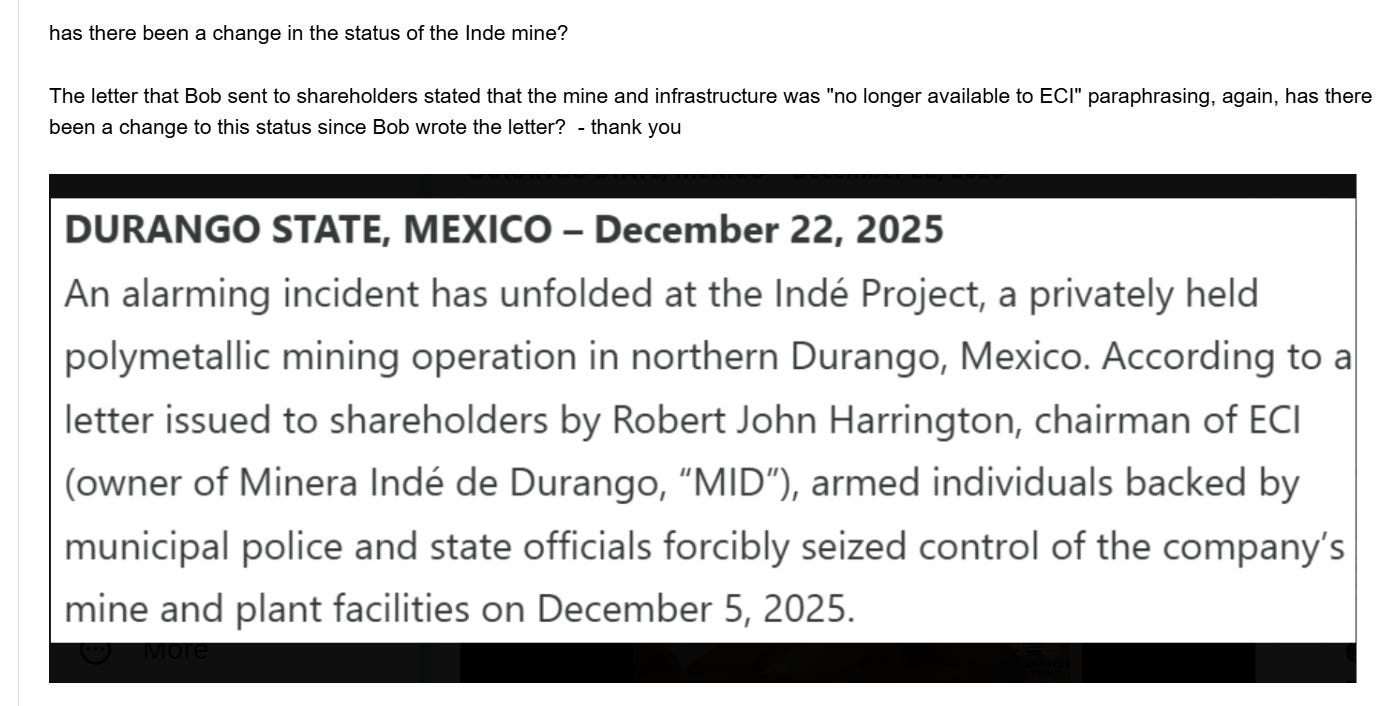
On December 22, 2025, we received a reader tip that a silver mine in Durango had been seized earlier that month.
The tip alleged that on December 5, 2025, armed individuals, accompanied by municipal police and state officials, took control of the INDE silver mine.
Three attachments for your review are provided below including a letter from ECI president Robert John Harrington describing the incident.
In the letter, Harrington stated that armed actors, backed by local and state authorities, had assumed control of the site. The key point to make here is that this isn’t a band of criminals. THIS IS ENDORSED BY THE MEXICAN GOVERNMENT
Robert Harrington wrote that “the mine, the mill and critical infrastructure are no longer available to us,” signaling a total loss of operational control.
We published the story the same day, laying out the allegation that state‑aligned forces had effectively dispossessed a private operator of a producing asset.
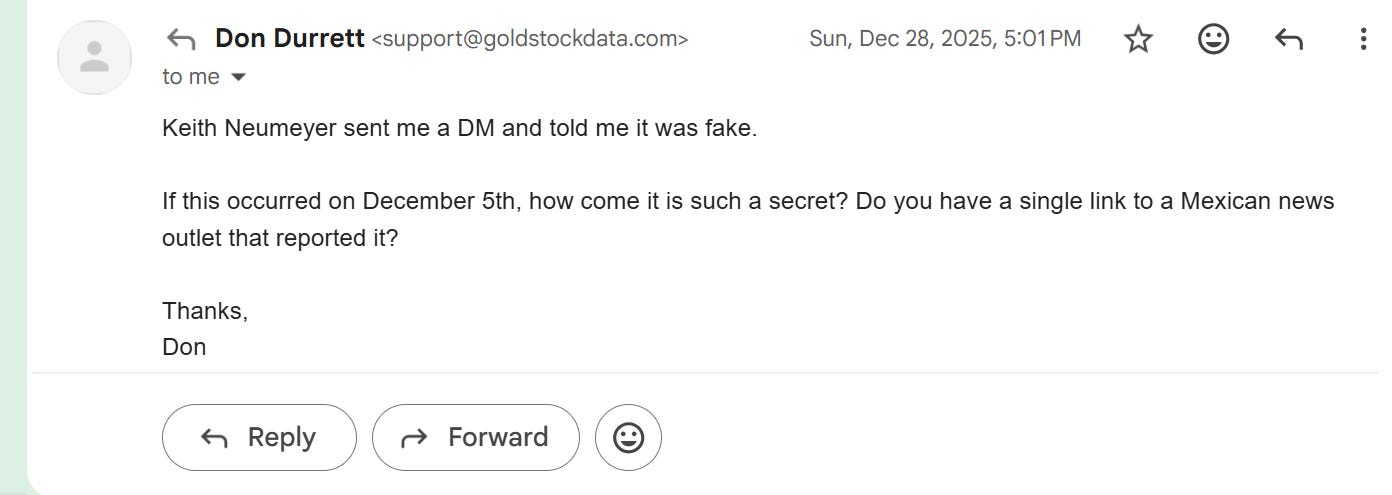
Veteran mining analyst Don Durrett publicly expressed skepticism about the report, not because the scenario was impossible, but because no Mexican press outlet had corroborated or even mentioned the incident.
We want to emphasize that this newsletter has enormous respect for Mr. Durrett and that his point “no other media outlet” reported the Durango mine incident is a rational point to be made. We have answered this question by what is written previously (precisely that it is dangerous or can be dangerous to report on these matters)
Moreover, beyond ensuring our reporting is accurate, it reflects poorly on First Majestic’s Neumeyer to take the time to send direct messages conveniently dismissing our work as “fake.”
Neumeyer’s hasty attempt to label the report “fake” only reinforces the sense that he’s uneasy about the truth spreading—that Mexican officials can seize mining operations.
We tried to explain over a twitter exchange and still explaining that the nature of the incident is very sensitive and no other news outlet
-
Following publication of the Durango INDE mine seizure story, mining analyst Don Durrett reported that he received a direct message from First Majestic’s CEO, Keith Neumeyer, asserting that our coverage was “fake” and should not be trusted.
-
His caution underscores a brutal reality: in Mexico’s current climate of resource conflict, it is often considered taboo—and genuinely dangerous—for local journalists to document seizures, forced takeovers, or violent interference in mining operations.
-
I had offered this as an explanation as to why our publication remains the only one to report on the incident with the Inde mine in Durango (Minera Inde de Durango),
-
We are the only ones brave enough to do so
-
Silver Academy publisher told Don Durrett to state to the doubters (including Neumeyer and Mani Alkhafaji) that Jon Little will bet them 1000 ounces of silver his reporting is accurate and then everyone went quiet. (video below)
-
This silence does not imply nothing happened; it reflects the lethal pressure placed on domestic reporters who attempt to trace the intersection of politics, local power, and high‑value assets.
-
From drugs to gold, silver, and oil in places like Venezuela, history is soaked in blood where resource control is at stake—and silver, as an increasingly strategic monetary and industrial metal, clearly fits this pattern
Segment from a video first aired by Robert Smallbone (Contrarian Capitalist), in which SA publisher Jon Little publicly offers to bet either Keith Neumeyer or Mani Alkhafaji 1,000 ounces of silver that our reporting on the Durango silver‑mine seizure is accurate—not “fake,” as Neumeyer claimed. After that wager challenge, both men went silent. It appears Little had the facts.
Still No Word
Day 14 of Terror: Ten Vizsla Mine Workers Still Missing in Sinaloa
Mexico’s ruling Morena movement insists that “Mexico’s resources belong to the people of Mexico” and pledges to “secure its energy sovereignty.” The kidnapping of ten Vizsla Silver workers in Sinaloa—now stretching beyond two weeks without a ransom demand, confirmed communication, or proof of life—shows what that slogan means when it collides with contested territory and foreign‑funded mines.
The four transformations of Mexico
Morena presents its project as the “Fourth Transformation,” in direct continuity with three earlier moments when Mexico attempted to break structures of domination and redefine who owns the country’s wealth:
-
First Transformation – War of Independence (1810–1821): Overthrew Spanish colonial rule and asserted Mexico’s right to exist as a sovereign nation, ending metropolitan control over territory, trade, and subsoil riches.
-
Second Transformation – La Reforma (1855–1863): Dismantled clerical privilege and military fueros, secularized church property, and subordinated powerful corporations to a modern republican state.
-
Third Transformation – Mexican Revolution (1910–1917): Toppled Porfirian dictatorship, enshrined land reform and labor rights, and established the principle that the nation—not foreign capital—owns subsoil wealth.
The Fourth Transformation claims to be the 21st‑century continuation of this arc: nationalizing lithium, re‑empowering the public utility in electricity, reinforcing Pemex, and reorienting foreign policy to assert that critical minerals and energy infrastructure will no longer be left to external interests or domestic intermediaries who serve them.
Sovereignty meets the gun
But the Pánuco‑Copala corridor tells a harsher truth: sovereignty has not been neatly reclaimed from foreign actors and consolidated in a republican state. It has been fractured. On the ground, real power over life, death, and cash flow is partially held by local disruptors who treat workers, engineers, and geologists as expendable instruments in a struggle to capture silver‑linked income. When ten unarmed mine employees can be taken at dawn from company housing and vanish into remote mountains, the effective “resource controller” in that zone is not a ministry in Mexico City, but a local structure capable of imposing its will by force.
No ransom, no “business as usual”
In older paradigms of mining‑adjacent violence, conflict followed a legible, transactional script: a strike, a blockade, a ransom, a negotiation. If armed groups wanted money, they seized hostages, issued demands, took payment, and allowed production to resume under an ugly but clear understanding that the mine could keep operating as long as tribute flowed. That model, perverse as it was, still assumed that “business as usual” would be restored once the right price was paid.
The Vizsla case breaks that script. Weeks have passed with no public confirmation of a ransom demand, no credible lead, and no proof of life—only increasingly desperate families, a company that has curtailed operations, and a large security deployment combing rugged terrain. This is not the logic of crude extortion. It is the logic of strategic leverage, where key mine staff can be held—or eliminated—not to extract a one‑off payoff, but to reshape who ultimately controls the economic rent from the silver district. If the disruptors are not chasing quick ransom cash, the only coherent “monetization” is long‑term influence: pressure on ownership, pressure on future profit‑sharing, and a de facto veto over project timelines and capital allocation.
Resource nationalism without a monopoly on force
Morena claims its energy and mineral policies are instruments to end an era of foreign privilege and neoliberal privatization, ensuring that lithium, electricity, oil, and metals serve Mexican development first. The rhetoric is clear: the state, as representative of “the people,” will recover the commanding heights of the economy. Yet sovereignty is not a speech, it is the ability to enforce decisions uniformly throughout national territory. In parts of Sinaloa and Durango, that monopoly on force does not belong exclusively to the Mexican state. It is contested by local actors who can walk into a mine camp, abduct a geologist and engineers, and disappear, turning federal search efforts into a stage for powerlessness.
The Fourth Transformation can nationalize lithium and proclaim energy self‑sufficiency, but if disruptive local forces can halt, tax, or co‑opt silver and gold operations at gunpoint, then de facto control over resources is being privatized to non‑state hands even as it is formally renationalized on paper.
The end of the old North American mining bargain
For North American miners, the absence of a ransom demand is not reassuring; it is a warning. A conventional kidnapping, followed by payment and release, would signal that “business as usual” remains possible, albeit at a higher extortion premium and under heavier security. Management could tell investors it had survived a horrific incident and would now operate within a brutal but intelligible risk framework.
Instead, silence rules. No demands. No proof of life. No credible negotiation channel. Just a partially frozen flagship silver‑gold project, families trapped between hope and dread, and a market that must now price in the possibility that highly skilled mine staff can be removed indefinitely—not as negotiable hostages, but as pressure points in a deeper struggle over territorial control and long‑term revenue streams. The Vizsla abductions, like the earlier episode in Durango involving a private mine under a domestic corporation, point in the same direction: the Mexican people, including powerful local structures, intend to play a far more direct and forceful role in determining who operates, who profits, and on what terms.
Morena’s Fourth Transformation asserts that subsoil wealth belongs to the nation, not foreign investors. The unresolved disappearances in Sinaloa and beyond expose a harsher corollary: if the Republic cannot secure its own miners, then the silver does not truly belong to “the people” either—it belongs to whoever is prepared to enforce their claim in the hills, far from the conference halls where “energy sovereignty” is proclaimed.
The absence of a ransom demand 14 days into the Vizsla abductions is a signal that the old model of “mine, pay, move on” in Mexican silver and gold camps may be gone for good. In the classic kidnapping‑for‑profit script, criminals make contact, set terms, get paid, and return workers to keep the revenue machine running; the mine is shaken, but “business as usual” ultimately resumes, just at a higher security and extortion cost. Here, there is still no confirmed communication, no ransom, no proof of life—only families left in limbo and a government whose public statements have been minimal despite deploying more than a thousand personnel into cartel‑controlled mountains.
That silence hints at something darker than crude cash extraction: a shift toward treating skilled mine staff as long‑term leverage over the asset itself, or simply as expendable collateral in a wider territorial war where silver profits, not wages, are the real prize. If the kidnappers’ goal was a one‑off payout, the fastest path would be to prove the men are alive and start negotiating; instead, they have frozen a flagship district, suspended operations, and demonstrated that they can erase a project’s human core without even entering a bargaining phase. That is not the logic of industrial dispute or routine extortion—it is the logic of a hostage market, where control of geology now runs through whoever can seize and hold the people who make the ore body real.
end of segment
-
our opinions are our own
-
editorial separate from promotions
-
not financial advice