
America’s Dumbest Bank Robbery
The ATM-Heist Theory of Empire
Washington’s foreign policy is beginning to resemble the old local-newspaper stories about criminals too stupid to escape their own crimes: the genius who chains an ATM to an identifiable pickup truck, rips it through a plate-glass storefront, and drives away with the license plate plainly visible. The crime is real. The loot is real. The stupidity is in believing the haul exceeds the wreckage.
That is where America is headed as it tries to shore up a fading dollar system with military coercion, resource claims, sanctions, threats, and ever-more extravagant displays of imperial muscle. Cuba, Greenland, Venezuela, Iran, Ukraine, the Middle East—the map changes, but the reflex does not. Find something with oil, minerals, shipping lanes, strategic geography, or a government too weak to resist. Then treat it as prospective collateral for Wall Street and proof that the dollar still has an empire behind it.
The Dollar’s Real Gold Standard: Force
This is what people mean when they say the dollar is backed by the U.S. military. Not gold. Not fiscal discipline. Not productive savings. Not a balanced industrial economy. A big club—deployed globally to preserve a financial architecture that is increasingly expensive to maintain.
And the return on investment is becoming absurd.
The administration’s proposed FY 2027 national-defense topline is $1.5 trillion: $1.15 trillion in discretionary spending plus another $350 billion intended to move through reconciliation. That would be the largest single-year defense request since World War II. America is not merely spending heavily to defend itself; it is building a financial-security machine so expensive that it must constantly justify new frontiers, new threats, and new assets to seize, police, sanction, or subordinate.
The $1.5 Trillion Collection Agency
This is not national defense in the ordinary sense. It is a global debt-collection and collateral-acquisition apparatus—one that must continually discover new “strategic” reasons to intervene, threaten, blockade, sanction, intimidate, or dominate.
The empire needs new properties to mortgage because the old financial model is creaking under mountains of debt. As the world reduces its exclusive reliance on dollar-based trade, reserves, and payment systems, Washington’s answer increasingly appears to be coercion: force nations back into the system, secure their commodity flows, and convert their oil, gold, minerals, farmland, ports, and pipelines into potential balance-sheet support for Western finance.
Venezuela: The World’s Most Expensive “Gift”
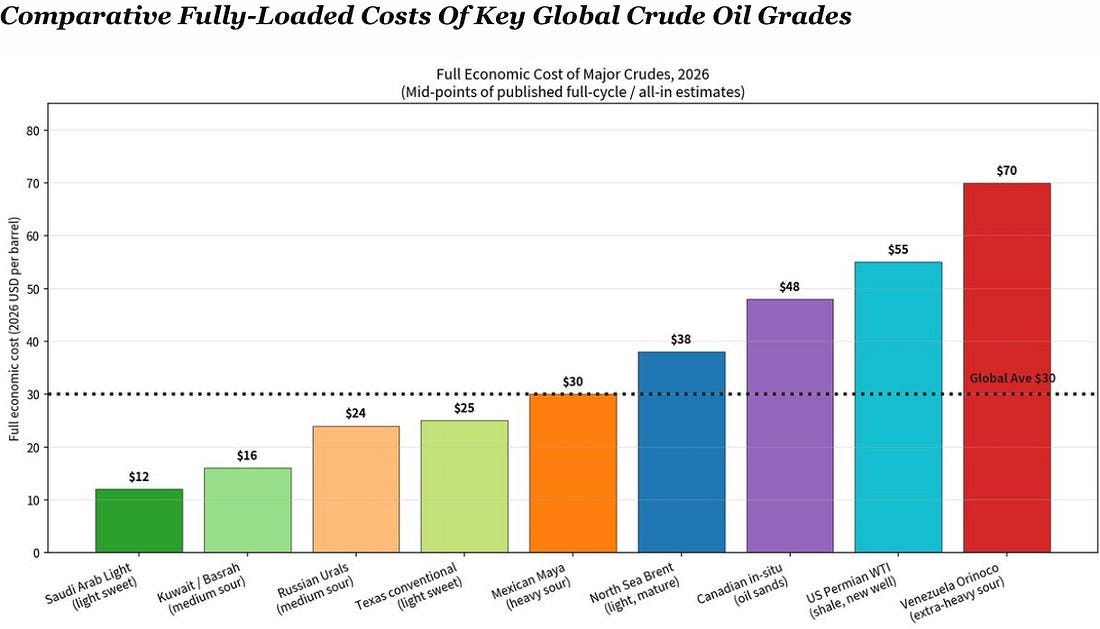
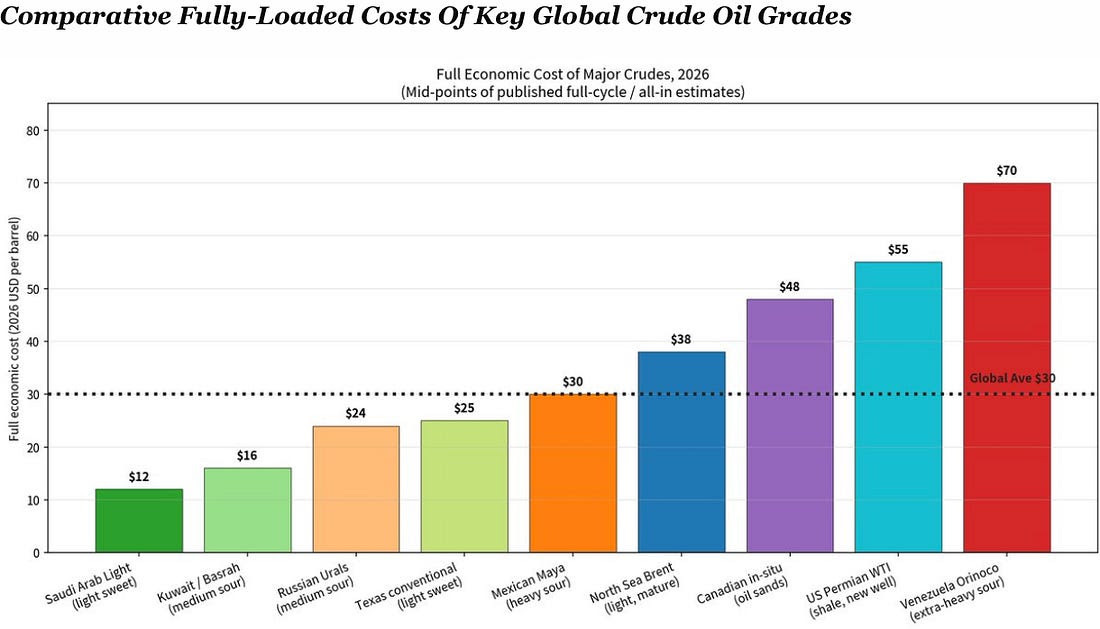
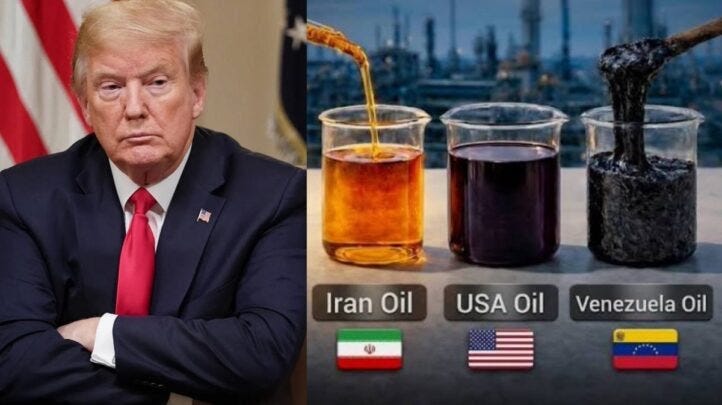
Consider the fantasy of “owning” Venezuelan oil. A barrel in the ground is not a barrel of wealth. Orinoco extra-heavy crude is not Texas light sweet. It is closer to industrial feedstock than ready-to-refine petroleum: viscous, sulfurous, metals-laden, and dependent on diluent, upgrading, specialized transport, complex refining, reliable power, security, and immense capital investment. Heavy oil and bitumen generally require upgrading before they meet normal refinery-feedstock specifications.
Even recent industry estimates put the economic breakeven for Venezuelan extra-heavy crude, once upgrading, diluent, and transport are counted, around $70 to $80 per barrel to be usable.
That estimate does not erase the political-risk premium, the decayed infrastructure, the need for security, or the massive capital outlays required to turn theoretical reserves into dependable production.
When Cattle Rustling Loses Money
So imagine cattle rustlers stealing 100 head worth $2,000 each—only to discover every animal needs $3,000 of veterinary care before anyone will buy it. Or thieves taking 100 Volkswagens from a Denver lot, then learning each needs $10,000 in engine work.
The apparent score becomes a liability.
That is the imperial version of the Venezuela proposition: seize “reserves,” then ask taxpayers, creditors, refiners, insurers, contractors, and soldiers to make them economically real. The U.S. had 46.0 billion barrels of proved crude-oil and lease-condensate reserves at year-end 2024—not the casually repeated 50-billion-barrel figure. But even proved reserves vary radically in value because geology, quality, infrastructure, energy intensity, capital cost, and market price determine whether a barrel is profitable or a money pit.
David Stockman recently wrote
”When it comes to “winning so much you can’t stand it”, the Donald has now truly jumped the shark. We are referring, of course, to his new claim that he has more than doubled America’s current 50 billion barrels of proven oil reserves via a “gift” of 65 billion barrels he obtained from Venezuela’s puppet president, Delcy Rodríguez.
In fact, this was no “gift” at all, but amounts to thievery in form— albeit via one of the dumbest heists in world history. That’s because the economic cost of turning these ultra-high cost reserves into gasoline and jet fuel is likely to far exceed their value on the global petroleum market.
To be specific, we think the junkie, gunky tar oil reserves subject to the Donald’s recently announced concession agreement with Venezuela have a net present value (NPV) after economic costs of, well, negative $84 billion! “
__________________________________________________________________________________________
You read that correctly. The Donald’s heist of Venezuela’s oil is worth NEGATIVE 84 Billion and the news gets worse, now Wall Street will package this worthless oil to back a 100 billion dollar bond product
Suppose it takes $100 billion in new loans, guarantees, and subsidized investment to drag Venezuela’s damaged oil sector back toward meaningful output. Wall Street can then lend against the promise of those future barrels and record the resulting $100 billion in loans as assets on its balance sheets—even if the underlying resource project destroys wealth in economic terms.
Read that again: the Venezuelan oil “prize” could carry an estimated net present value of negative $84 billion. In plain English, it is not an asset. It is a loss waiting to happen: a vast, capital-devouring quantity of heavy crude that requires extraordinary spending to extract, dilute, upgrade, transport, refine, insure, and secure.
But Wall Street does not need the economics to be sound if it can turn the political arrangement into paper. The same negative-value oil concession can be used as collateral for perhaps $100 billion of loans, bonds, guarantees, and structured products. On the banks’ books, the debt appears as an asset. In the real world, the collateral may be worth less than nothing after the full cost of bringing it to market.
That is the scam in its purest form: privatize the paper asset, socialize the development cost, and leave taxpayers holding the military bill when the supposedly strategic oil jackpot proves to be an $84 billion hole in the ground.
A Barrel Is Not a Balance Sheet
The public is being sold a child’s version of resource economics: more barrels equals more wealth; more territory equals more power; more military pressure equals more dollar demand.
But oil is not a number on a map. It is an industrial process. It must be lifted, diluted, moved, upgraded, desulfurized, refined, insured, financed, and sold into a market that may not pay enough to justify the entire exercise. Venezuela’s deposits may be immense by volume, but volume is not value. A mountain of marginal, capital-devouring sludge does not become national wealth merely because a politician points at it on television.
Collateral at Gunpoint
The deeper problem is monetary. As nations diversify trade, reserves, and payments away from exclusive dollar dependence, Washington appears tempted to substitute force for confidence. New resource concessions become collateral. New loans become bank assets. New geopolitical dependencies become alleged support for a weakening system of debt, deficits, and financial privilege.
This is the essence of the new imperial math: take control of an asset, attach a loan to it, book the loan as an asset, then describe the arrangement as “economic leadership.” The commodity producer becomes indebted. The creditor bank gains paper assets. The public absorbs the military and political cost. And the American taxpayer gets told that this is a victory.
The Empire That Eats Its Own Capital
But military power cannot repeal arithmetic. You cannot bomb your way to productive capital. You cannot sanction your way to cheap energy. You cannot turn tar into light sweet crude by declaring it a strategic victory. And you cannot preserve a currency’s credibility forever by spending $1.5 trillion annually to demonstrate that dissent carries consequences.
The U.S. can still intimidate weaker countries. It can still control sea lanes, enforce sanctions, freeze reserves, and use its banking system as a weapon. But those powers are not free. They require enormous borrowing, enormous military expenditures, and endless political escalation.
The Big Club, the Empty Till
America may still have the largest club. But it is swinging it at increasingly marginal assets, with increasingly borrowed money, while calling the bill prosperity.
That is not an empire at the height of its strength. It is the world’s most powerful bank robber dragging the ATM through the storefront—convinced that the noise, broken glass, and flashing police lights are proof that the plan is working.
end of segment
our opinions are not our sponsors opinions
the editorial department is separate from the promotions department
not financial advice