

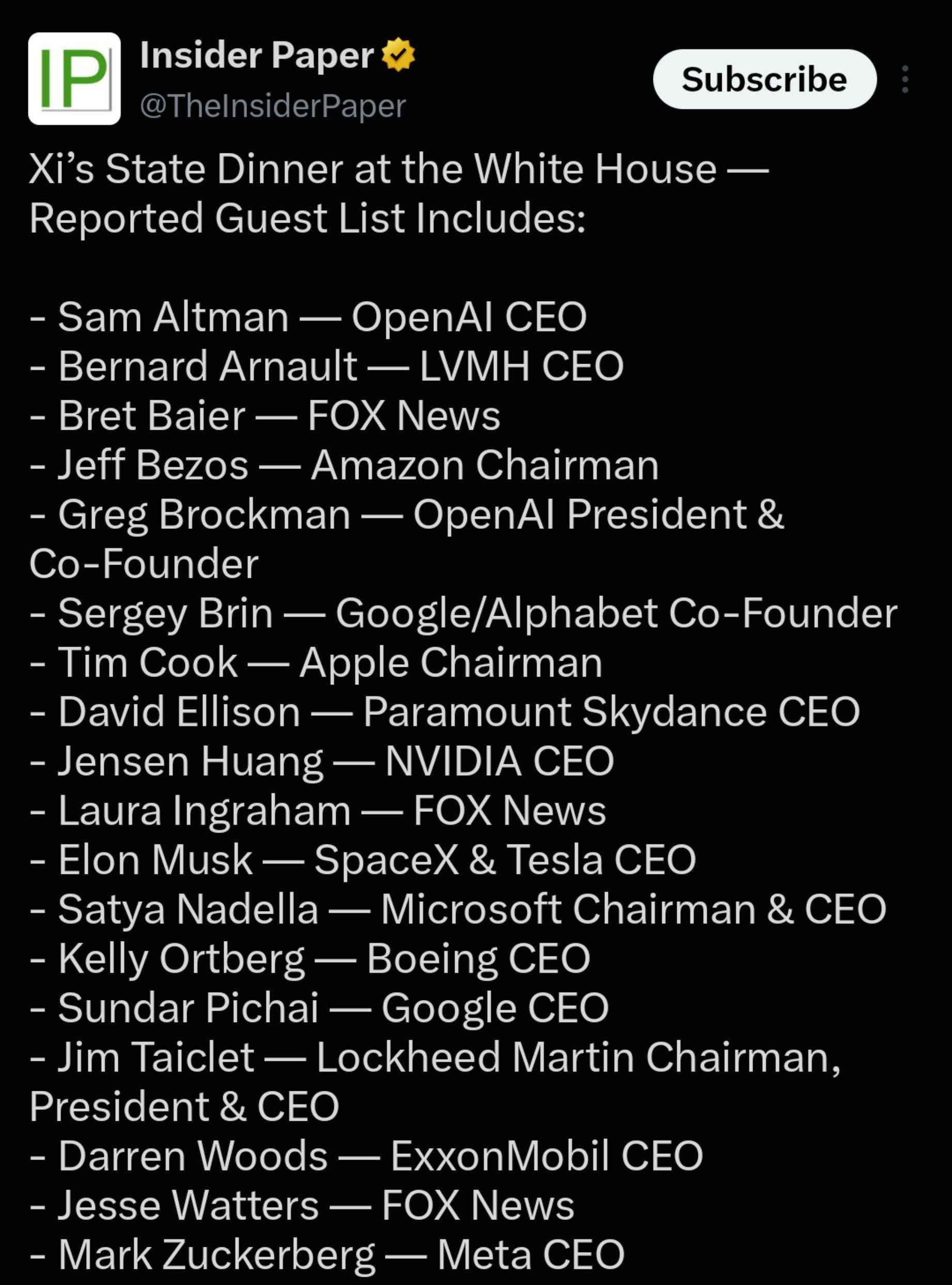
-
Like it or not, this list clearly shows that Big Tech is our future.
-
One oil company and the remainders are Tech and Defense contractors
-
Tech and Defense both being the largest consumers of silver
This was not merely a ceremonial guest list. It put the leaders of America’s biggest AI, chip, cloud, smartphone, e-commerce, and electric-vehicle companies, defense industry in the same room with the Chinese president at a moment when semiconductor export controls, AI competition, supply-chain security, tariff policy, Taiwan, and access to China’s vast technology market are central to U.S.–China relations.
Recall China refines approximately 70% of the world’s silver and their strict export measures.
AI Data Centers Become a Major New Source of Silver Demand
The Metal Behind the Machine
Artificial intelligence is transforming the global data-center industry into a faster, denser, and more materials-intensive system—and silver may be one of the overlooked beneficiaries.
The reason is simple: AI is a race for speed. Training and operating large AI models requires massive numbers of GPUs and other accelerators to move data continuously among processors, memory, storage, and networking equipment. Every millisecond matters. So do electrical losses, heat buildup, equipment reliability, and power-delivery efficiency.
Speed Has a Silver Price
Silver has the highest electrical conductivity of any metal. Copper is indispensable across data-center construction and will remain the dominant material for bulk power cables, busbars, and electrical infrastructure. But copper is not a complete replacement for silver in high-performance electronics. Where designers need extremely low resistance, reliable connections, corrosion resistance, and compact high-current components, silver remains uniquely valuable. Copper’s electrical conductivity is exceeded only by silver.
Three Times the Silver
That matters because an AI server can contain roughly 180 grams of silver, or about 5.79 troy ounces—three times the estimated 60 grams, or 1.93 ounces, found in a conventional enterprise server. Silver is used in circuit boards, connectors, contacts, relays, switches, semiconductor packaging, and power-management hardware. AI hardware contains more accelerators, denser memory configurations, more demanding power systems, and faster networking than traditional enterprise computing, all of which raise the intensity of silver-bearing components.
From Servers to Millions of Ounces
The per-facility implications are substantial. A traditional enterprise data center with approximately 16,650 servers would contain about 32,150 troy ounces of silver at 60 grams per server. An AI-heavy hyperscale facility with roughly 139,000 servers would contain as much as 803,750 ounces, or around 25 metric tonnes, using the 180-gram assumption.
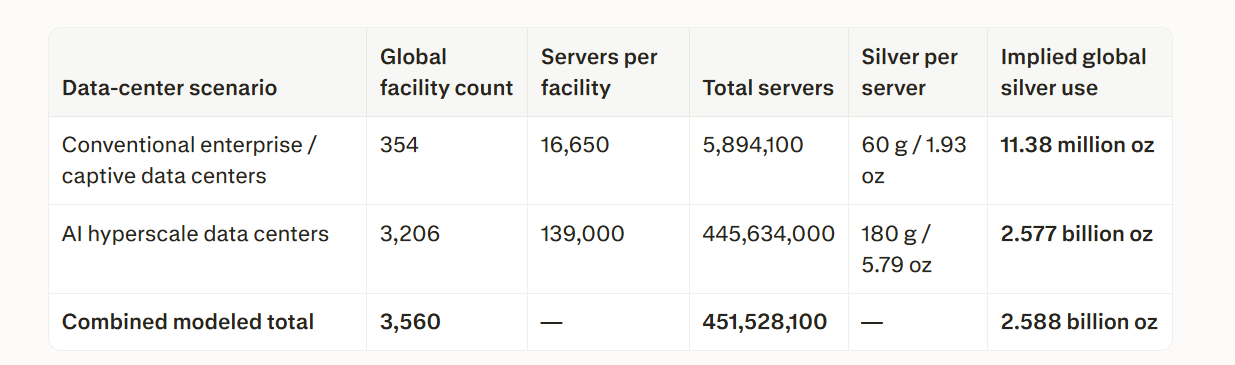
ABI Research projects 8,821 data centers worldwide by the end of 2026, including 354 captive enterprise facilities and 3,206 Tier One and Tier Two hyperscale facilities.
A 2.6-Billion-Ounce Thought Experiment
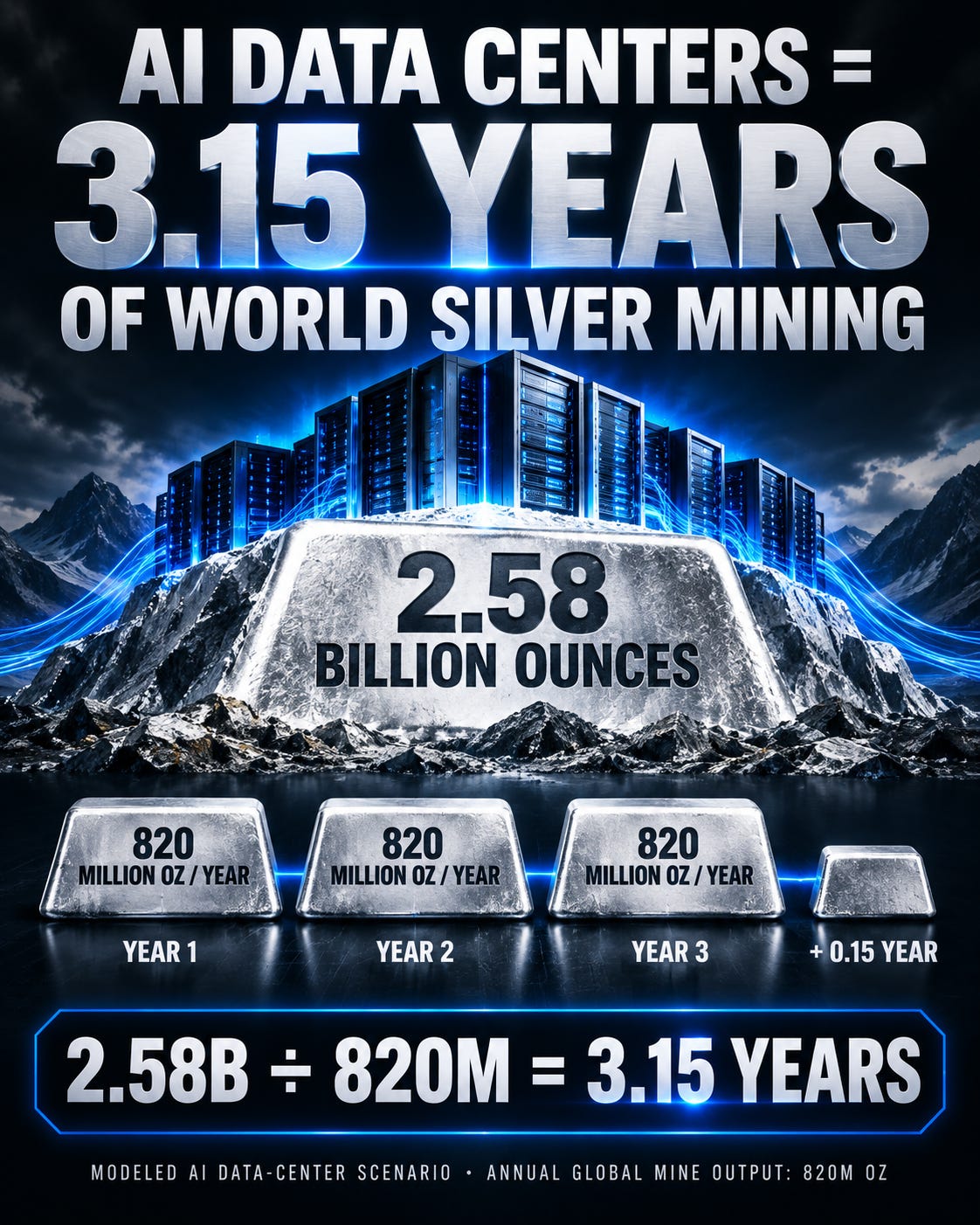
Applying the silver-per-server assumptions across those two categories produces a theoretical requirement of 2.588 billion ounces of silver, equivalent to roughly 80,500 metric tonnes. The conventional segment contributes about 11.4 million ounces, while the AI-hyperscale scenario drives approximately 2.577 billion ounces.
This is an upper-bound scenario, not a literal audited inventory. It assumes every hyperscale facility contains a fully deployed 139,000-server, AI-heavy configuration. Real-world campuses differ sharply in age, capacity, utilization, hardware mix, and the extent to which they are dedicated to AI.
The New Demand Shock
The wider trend remains difficult to dismiss. Hyperscale operators accounted for 48% of worldwide data-center capacity at the end of 2025, and their share continues to rise. As conventional computing gives way to AI-optimized infrastructure, each new build requires greater processing density, faster data movement, more electrical power, and more high-performance components.
Copper will carry the bulk power. But in the critical places where electrical resistance, heat, latency, and connection failure cannot be tolerated, silver is difficult to replace. AI’s demand for speed may therefore create an unexpected new pillar of industrial silver demand.
end of segment