
The S&P 500 isn’t a market anymore; it’s a hostage situation. A third of the index is now chained to seven AI-flavored mega caps—Apple, Microsoft, Nvidia, Amazon, Alphabet, Meta, and Tesla—whose gravity distorts everything from portfolio theory to reality itself. Strip those names out and the “great American bull market” looks more like a weak, overbought sideshow propped up by passive flows and marketing slogans.
AI as life support
The AI story is no longer innovation—it’s life support for a dying index structure. In 2024–2025 the so‑called “Magnificent 7” swelled to roughly one‑third of the entire S&P 500’s market cap and generated over half of its gains, meaning the other 493 companies are basically window dressing. The herd has piled into the same narrow trade, mistaking crowd size for safety while concentration risk quietly goes vertical.
Nvidia and Palantir have become the twin mascots of this mania, with AI slapped onto every earnings call, slide deck, and product line like a cheap sticker on an old appliance. Their valuations aren’t just rich; they assume an infinite runway of capex and hype in a world running out of cheap energy, cheap credit, and geopolitical stability.
Burry versus the machine
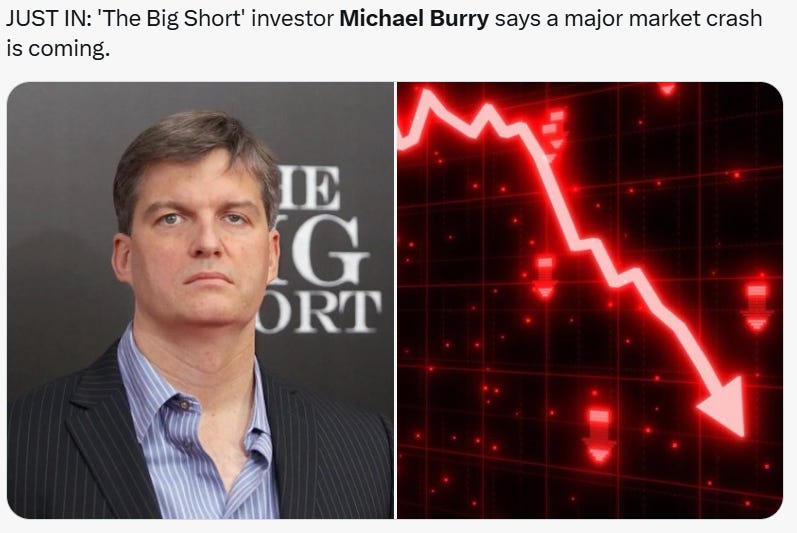
Michael Burry, the guy who had to invent subprime credit default swaps to bet against the last great insanity, is now shorting Nvidia and Palantir via long‑dated put options, positions that 13F filings show dominating Scion’s reported exposure. The financial media turned that into clickbait “billion‑dollar shorts,” confusing notional exposure with actual premium at risk—exactly the kind of surface‑level thinking Burry has been exploiting his entire career.
He’s not betting a week or a quarter; he’s betting that AI’s capex bubble rhymes with the dot‑com and telecom build‑out, where investment and narrative kept ramping long after the market peak, and the supposed “must‑own” infrastructure names spent a decade bleeding out. His core thesis is simple: when over half the index’s gains come from one story and that story is being sold to terrified boards as “adopt AI or die,” the real risk is not missing upside—it’s being trapped underneath when the floor gives way.
From steel to server farms
America used to measure strength in things you could drop on your foot—steel rolled in Pittsburgh, cars stamped in Detroit, tires cured in Akron, coal hauled out of Kentucky. Those industries weren’t perfect, but they anchored communities, built a middle class, and produced exports that mattered on a hostile planet.
Then came the holy trinity of the American establishment: globalization, financialization, and currency overvaluation—policy choices that helped vaporize over five million manufacturing jobs and nearly 70,000 factories, replacing union wages with offshore labor and domestic debt. The same class that cheered cheap imports and asset bubbles now points to a handful of AI charts and insists this is “the new economy,” as if you can run an empire on streaming, ad impressions, and predictive policing.
Commercials of a collapsing empire
You can track the decline in something as banal as TV commercials. Once upon a time, an NFL break meant Chevrolet, Ford, John Deere, Gillette, the brands of a country that actually built things and fed itself. Now the ad blocks pitch video games, Pixar spin‑offs, food delivery apps, and buy‑now‑pay‑later schemes—middlemen skimming a collapsing real economy rather than expanding it. The culture stopped selling tools and started selling distractions, and then pretended the pivot was “progress.”
Jon Little of Silver Academy put it bluntly: the moment the core ad inventory flipped from trucks, tractors, and razors to subscription content and gig‑economy apps was the moment it became obvious America had moved from production to sedation. What passes for growth now is just new ways to monetize boredom, loneliness, and convenience, all ultimately routed through the same handful of bloated tech platforms.
Hollow empire, glowing screens
The Rust Belt wasn’t an accident; it was a business plan. Globalists swapped Pittsburgh steelworkers and Detroit line workers for foreign supply chains and margin expansion, then used the stock market as the scoreboard to declare victory. Today that scoreboard is dominated by AI‑themed mega caps and surveillance software while the physical backbone that once made the U.S. a serious industrial power decays underneath.
So when Michael Burry quietly lines up put options against Nvidia and Palantir, he’s not just making a trade on overvalued tickers; he’s placing a bet against an entire era of delusion. The S&P 500 is being dangled from a handful of chips and data‑mining firms in a country that no longer makes enough of anything that matters—and when that rope finally snaps, it won’t just be a bubble popping, it will be an indictment of everything this market chose to worship
Whips in the Temple of AI
The Roman Empire did not fall in a day. It decayed from the inside—addicted to war, drowning in debt, and numbing its people with cheapened currency. The denarius was clipped, diluted, and debased until the silver was mostly gone and only the stamp of Caesar remained, a hollow promise from a state that had chosen conquest over justice. Rome financed its legions with bad money, and the cost was paid in social misery, crushed provinces, and a people who could no longer trust the very coins in their hands.
Occupied By Empire
Into that world walked Jesus—born under occupation, speaking to people taxed by a foreign empire and ruled by a local elite that had learned to get comfortable in Rome’s shadow. The money of the day was not just metal; it was theology. Caesar’s face on the coin said, (paraphrased) “This is who you serve.” The empire’s violence and its currency were welded together, and both were enforced at the point of a spear.
Where Faith Met the Balance Sheet
The wealth of that system was stored in temples. Gold and silver piled up where religion and power intersected, guarded by priests who had grown very good at turning faith into a revenue stream. When Jesus walked into the Temple and saw the tables of the money changers—fees, spreads, and commissions on every sacrifice—he didn’t sermonize. He picked up a whip. He overturned the tables. He drove out the traders who had turned a house of prayer into a financial racket. That was not “niceness.” That was resistance.
Nasdaq As New Jerusalem
Now look around. Our temples do not sit on hills in Jerusalem; they trade on the Nasdaq. We are told to bow before overvalued fortresses of data like Palantir and Nvidia, where the faithful bring their savings as offerings to the altar of “AI,” and the high priests of code and capex promise salvation in the cloud. The system says: trust these platforms, trust this market, trust this story. Just don’t look too closely at the foundation.
The Tools of Your Captors
The ruling class still has its two favorite tools of control. First is its currency—federal reserve notes conjured and diluted at will, tokens of a debt system that exists to keep you dependent and always slightly afraid. Second is its media—an endless stream of noise, 99% of television, internet, and radio synchronized to repeat the same narratives: the market is fine, the institutions are wise, the experts are in control, and resistance is either pointless or insane.
Overturning Tables In Our Time
The lesson of Jesus in the Temple is not “be polite.” It is: do not accept the terms of a corrupt game. Do not worship in their temples. Do not measure your worth in their currency. Do not let their media catechize your mind. Real resistance starts when you stop adopting the tools of the ruling class as if they were neutral.
– Choose your own store of value.
– Build your own circles of trust.
– Speak your own truth, even if it means overturning tables in the only economy you’ve ever known.
RESIST the RULERS
Silver stackers wear their resistance on their balance sheet. Silver is not just a metal; it is a refusal to live at the mercy of a printer and a promise from liars. In every cycle, money printing starts as “stimulus” and ends as social misery—higher rents, shrinking wages, empty pensions, and a quiet explosion of crime and despair in the streets while the indexes still look “healthy.”
The Cantillon effect is the scam in plain sight: those closest to the spigot—banks, governments, megacorps—get the new money first, at full purchasing power, and use it to buy real assets before prices rise. Everyone else receives weaker dollars later and pays the bill. That same unconstrained paper system financed endless war and neo‑colonialism—funding invasions, regime change, and resource seizures from Iraq’s oil and gold to the new financial war on Venezuela’s commodities. Silver is a hard “no” to that architecture: a small, heavy act of rebellion that says, “Your debt is not my savings, and your empire is not my future.”
end of segment
-
our opinions are not our sponsors opinions
-
editorial department is separate from promotions department
-
not financial advice