
by Jon Little intern Niko Moretti
In 1994, financier Sir James Goldsmith sat across from American interviewer Charlie Rose, warning that a new creed—global free trade under GATT—would reorder the world of work. He spoke of Western workers told they were “too expensive,” replaced by distant labor paid a fraction of their wages.
At the same time, India, long etched in Western memory through images of Mother Teresa tending the poorest of the poor in Calcutta, was quietly transforming. Economic liberalization in 1991 opened the doors to trade, technology, and outsourced services, from call centers to software hubs in Bangalore and Hyderabad. A vast new middle class began to emerge from generational poverty, staffed in glass towers answering phones and processing data for companies thousands of miles away.
Goldsmith’s warning and India’s rise became two sides of the same historical coin: jobs drained from deindustrializing West, opportunity swelling in a once-impoverished subcontinent.
Before examining the silver numbers, I want readers to understand the metrics and multipliers that will be incorporated into the table below.
India has at least 4–6 major annual occasions where silver is widely given as a customary gift, plus weddings, birthdays, anniversaries and life‑cycle rituals that run year‑round.
Key silver‑gifting festivals
-
Diwali and Dhanteras: Massive tradition of buying and gifting silver coins, bars, idols and jewelry.
-
Akshaya Tritiya: Strong custom to buy gold or silver for prosperity.
-
Raksha Bandhan: Sisters frequently receive or gift silver jewelry or coins.
-
Other regional/new‑year festivals (e.g., Gudi Padwa, Ugadi, Navratri) often feature silver gifting, though practice varies by region and class.
-
PLUS
-
Birthdays
-
Weddings
-
Anniversaries
We will revisit these holidays later in this article.
Over the span of just a few decades, India has quietly engineered one of the greatest middle‑class booms in human history. What began as a trickle of outsourced data entry, call‑center work, and back‑office processing from the United States and Europe in the 1980s has swelled into a vast services ecosystem employing millions. The country’s information technology and business process outsourcing machine now supports on the order of 10–15 million direct jobs, and perhaps 25–35 million when counting the drivers, shopkeepers, landlords, caterers, and countless others who rely on those salaries circulating through the economy.
The scale of the social transformation is even more staggering than the job numbers. In the early 1990s, India’s middle class was often estimated at roughly 30 million people—a sliver of the population clustered in a few cities and government corridors. After economic liberalization and the rise of IT and outsourcing, that sliver expanded into a continent‑sized consumer base. By the mid‑2010s, various studies placed India’s middle class somewhere between 300 and 600 million people, with some projections pointing toward 800 million by around 2030.
Behind those abstractions are lived realities: families moving from one‑room tenements into apartments with elevators and gated entrances; first‑generation college graduates answering calls for Western banks from glass towers in Gurgaon and Hyderabad; parents who grew up without reliable electricity now debating which smartphone to buy for their children. The service‑export boom did not merely create new job titles—it rewired aspirations, expectations, and the very definition of what a “normal” life could look like in India.
Yes, this story is uneven. Entire regions remain trapped in agrarian distress; millions still work in the informal sector, untouched by global contracts or software code. But it is hard to overstate how extraordinary it is to watch a country move from tens of millions to hundreds of millions of middle‑class citizens within a single working lifetime. The same forces that hollowed out call centers and clerical floors in the West have underwritten a vast new middle class in India, turning a once‑improbable development narrative into the everyday reality of hundreds of millions of people.
Large‑scale offshoring of data entry, call‑center and back‑office work to India from the US/Europe has created on the order of 10–15 million direct jobs since the 1980s, with perhaps 25–35 million including indirect employment.
BPO and IT‑BPM job volume
-
Indian IT‑ITES (IT plus BPO: call centers, data entry, back‑office) employed about 1.3 million directly by the mid‑2000s, creating roughly 3 million additional indirect jobs.
-
By 2015–16, IT‑BPM direct employment reached about 3.7 million, with an estimated 10 million indirect jobs.
-
Adding growth since 2015 and earlier 1990s ramp‑up, cumulative direct service‑export jobs plausibly sit around 10–15 million, and total supported jobs (housing, retail, transport, services) roughly 25–35 million.
-
In this context, BPO stands for Business Process Outsourcing. It refers to contracting out business processes—such as call centers, data entry, and back‑office operations—to third‑party service providers, often in lower‑cost countries like India.
Middle‑class expansion scale
-
India’s middle class was only about 30 million people in the early 1990s but grew into the hundreds of millions after liberalization and the IT/BPO boom.
-
Estimates suggest 300–600 million middle‑class Indians by the mid‑2010s, with projections toward 800 million around 2030; IT‑BPO exports are cited as a key driver of high‑skill urban middle‑class growth.
America‑Sized Booms: When Outsourcing Built “Another USA” in India
India’s offshored data entry, call‑center, and back‑office engine supports roughly 25–35 million livelihoods—about 7–10% of the United States’ 335 million people, a labor ecosystem larger than many U.S. states combined.
From 30 Million to a “Second America”
India’s early‑1990s middle class of about 30 million was under 10% of today’s U.S. population, barely a thick slice of America’s middle‑class pie.
Two Americas’ Worth of New Consumers
By the mid‑2010s, India’s 300–600 million middle‑class citizens equaled about 90–180% of the U.S. population—between nearly one and almost two “Americas” of new consumers.
Toward 800 Million: 2.4 Americas and Counting
Projected 800 million middle‑class Indians around 2030 would be roughly 240% of the U.S. population—well over two full “Americas” living middle‑class lives in a single country
The U.S. middle class has shrunk from about 61% of adults in 1971 to roughly 51–52% today, or around 175–180 million people out of roughly 340 million residents.
By contrast, India is projected to have around 800 million middle‑class people by 2030—over four times as many.
In USA you have to put up your house as collateral.
In India, via the new banking rules that go into effect in April 2026, they have just activated more silver than
— the entire solar industry
— the entire EV battery industry
— electronics, military, aerospace
COMBINED
Don’t believe us? (Many don’t at first, but once they hear Andy Schectman saying the exact same thing next week, it becomes gospel, lol.)
Keep reading!
Walk into a U.S. bank with 100 ounces of silver and ask for a loan and the manager will gently explain, “Sir, we only securitize your house, your car, and your future—shiny metal is for suckers and preppers.”
What the banker won’t say is this “our system happily lets you gamble the roof over your head, but heaven forbid you arrive with real asset collateral.”
Do the Math: 20 Billion ounces of Silver, too big a number? just adjust the multiplier
Now flip to India. Suppose a mere 400 million middle‑class Indians decide to “activate” their silver under new collateral‑friendly banking rules. Assume each pledges just 50 ounces—barely a couple of Diwali coin sets and a Raksha Bandhan upgrade, not some doomsday bunker stack.
-
That is 20 billion ounces of silver demand potential
-
in a country where gifting coins and idols is already a seasonal national sport.
-
One regulatory green light, and an entire parallel banking system suddenly has reason to hoover up more silver than the West can even pronounce “Akshaya Tritiya.”
-
Say the number isn’t 50 ounces but half of that, that is still 10 Billion ounces of Silver
-
Say the number is only 10 ounces of silver per loan, that is still 4 Billion ounces of Silver
-
Recall that Solar consumed around 200 million ounces
-
4 billion is 20 times larger than 200 million
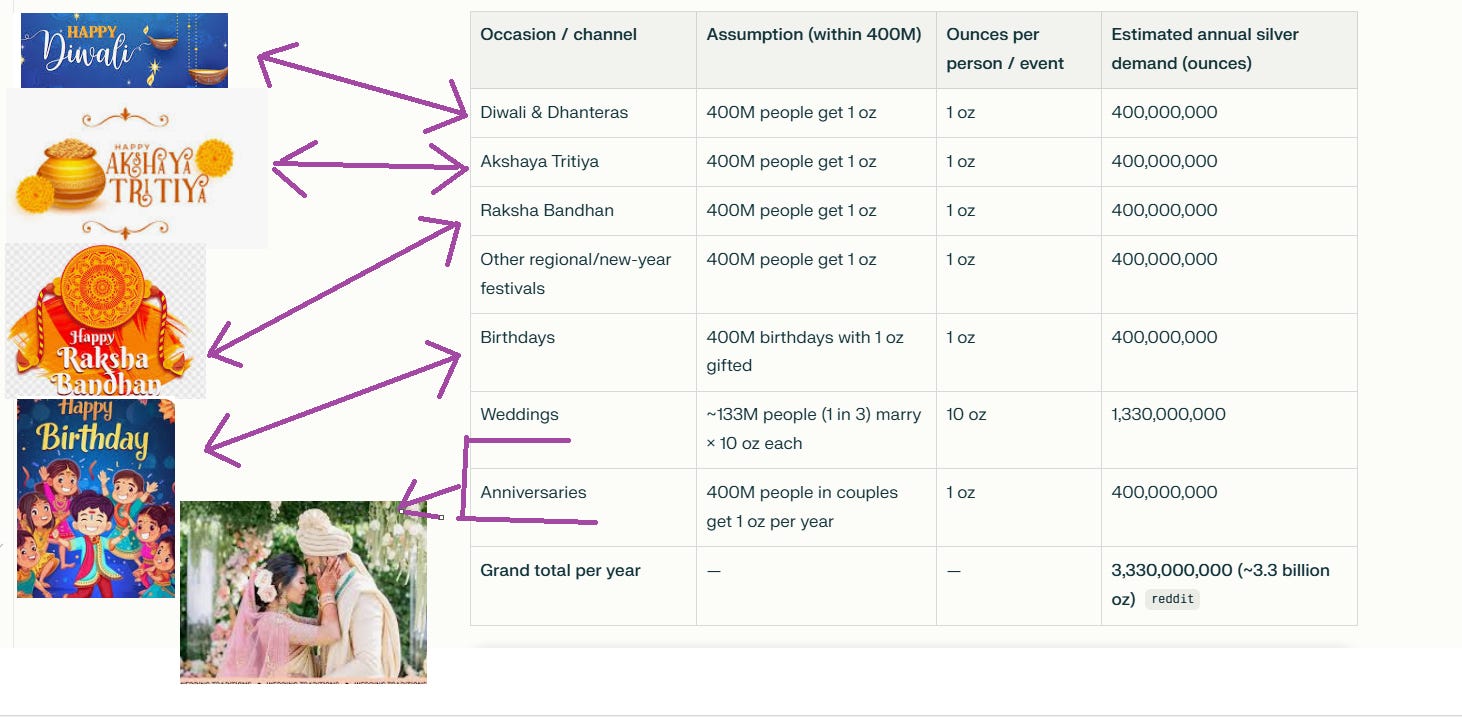
Explaining the graphic above: total annual silver demand from this 400‑million‑person middle‑class cohort would be on the order of 3.3 billion ounces per year.
This is just the gift giving side of India’s silver demand, not the banking side of silver demand which was calculated above the holidays in India chart.
Now is this chart starting to make more sense?
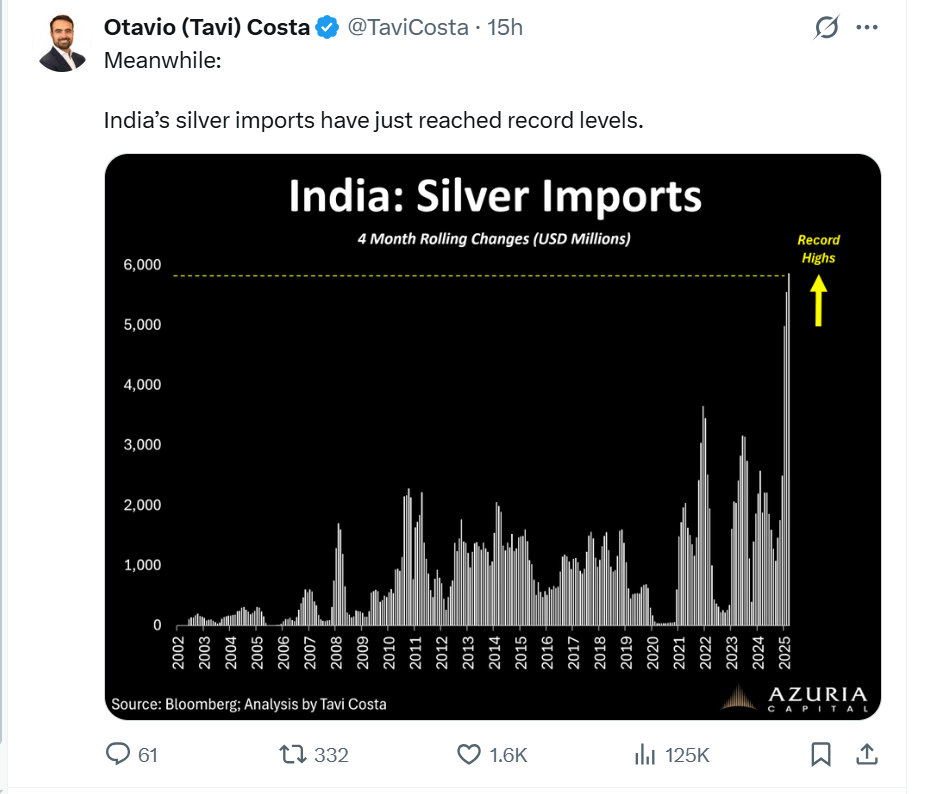
The Silver Bull run hasn’t even started yet. Why?
-
Normies out there still haven’t been told that the USA is in a recession
-
Normies still need to read in the news that another USA bank went down
-
Normies don’t understand China controls the silver market now
-
Normies still believe in fiat and all of its derivatives.
-
Normies still haven’t understood that their wages and retirements are being devoured by currency debasement
-
We already know what some of you are going to say “But but but the world silver survey doesn’t show all that demand from India” to which we say, “Like the underdog is ever going to admit to having Silver”
-
our opinions are not our sponsors
-
the editorial department is separate from the promotions department
-
not financial advice
-
The Silver rally has not started yet