
SILVER RIOT: HOW THE FORGOTTEN METAL BECAME THE CENTER OF THE STORM
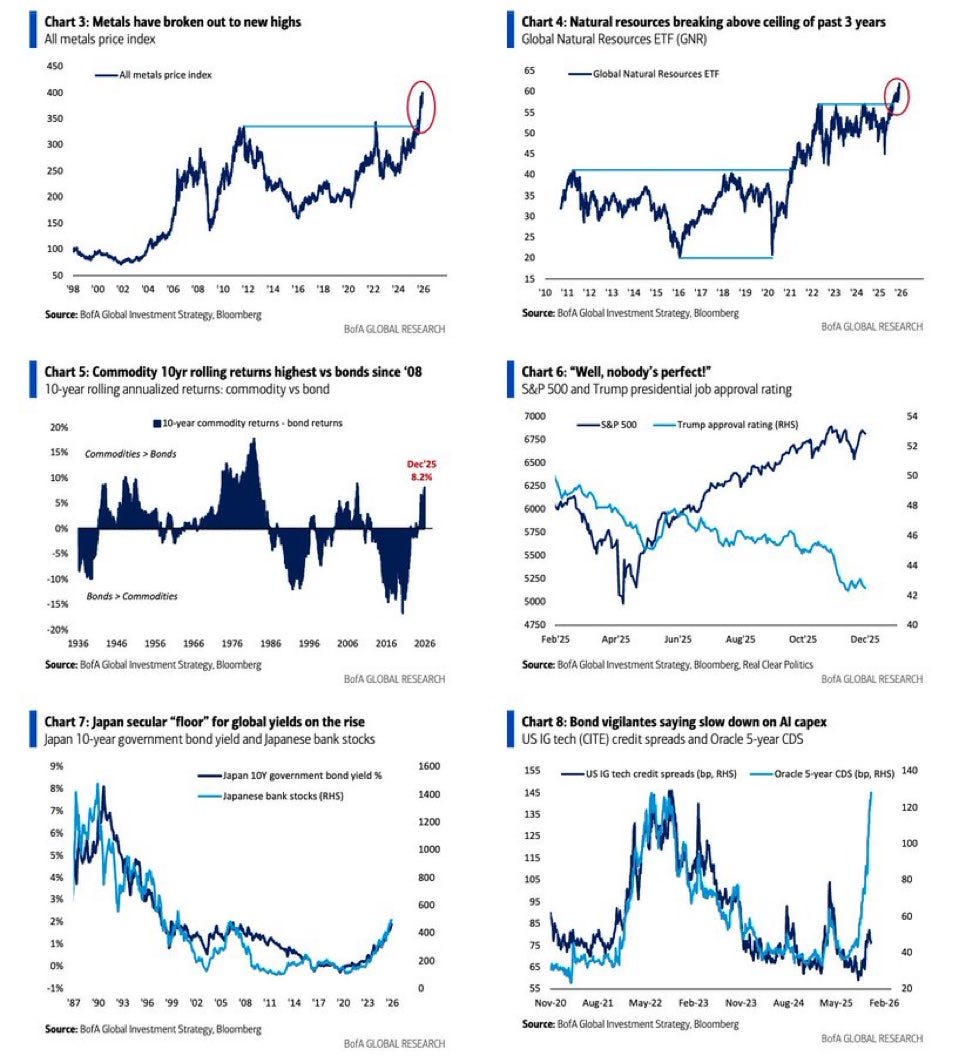
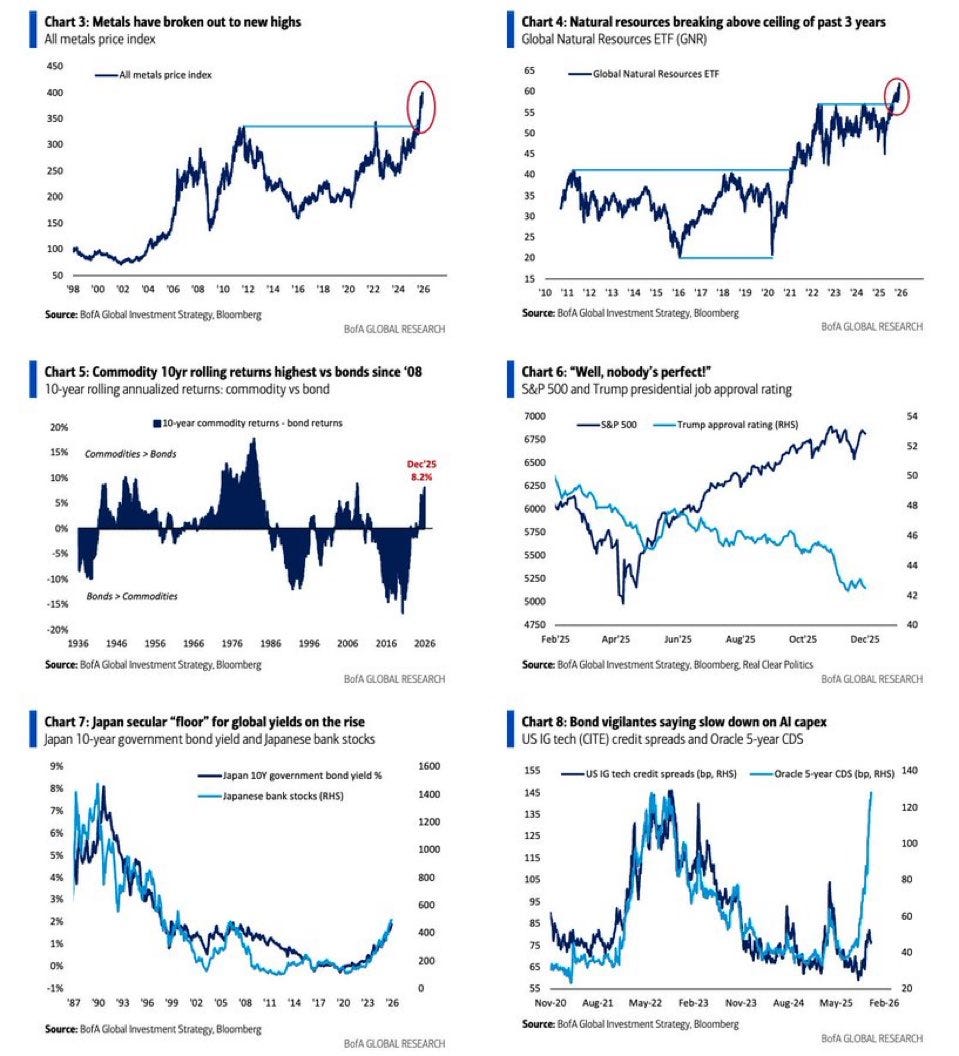
BofA’s Michael Hartnett is out saying “soon all the commodity charts will look like GOLD.”
The party in megacap tech is starting to sound like the 3 a.m. DJ set: too loud, too crowded, and one fire alarm away from total chaos. While the crowd screams for “AI to the moon,” the exits are quietly filling with people clutching oil, copper, uranium – and increasingly, silver. Bank of America’s Michael Hartnett is flat-out saying it: “Soon all the commodity charts will look like gold,” and his top trades into 2026 are commodities and especially oil in a “run-it-hot” world where bonds get torched as yields grind higher.
Michael Burry has already walked out of the AI chapel, filing massive short positions against marquee AI darlings like Nvidia and Palantir – a generational contrarian calling time on the cult of code and reminding everyone that narratives don’t mine copper, drill oil, or pull silver out of the ground. The smart money is exiting the simulation and heading for the stuff civilization can’t fake.
THE LITTLE SISTER WITH BRASS KNUCKLES
Silver is the punk kid in a family of classical musicians. Gold gets the gala invites and central bank love; silver works the night shift in solar panels, EVs, data centers, and defense hardware – and still doubles as money. The total silver market is roughly a fraction of gold’s – about one-tenth by value – yet investors increasingly treat them as a pair, “sister metals” that rise and fall together in the public mind. When capital sloshes from gold ETFs, commodity indices, and macro funds into the “other” monetary metal, a market that small does not gently reprice; it erupts.
That’s the dynamic now: a world rediscovering gold as a monetary anchor in an age of de-dollarization and institutional doubt is inevitably forced to notice the higher-beta twin standing right next to it. When gold is already at nosebleed highs and central banks hoard it like it’s 1979, the hungry capital looking for leverage to the same thesis goes to silver. It’s the same story, on a tighter float and a shorter fuse.
DEGLOBALIZATION: EVERY NATION FOR ITSELF, EVERY OUNCE FOR HOME
The globalization era built a religion around “just-in-time” everything. That religion died somewhere between Wuhan and Kyiv. What replaced it is a paranoid, inward-looking world where governments talk about “supply chain resilience” while quietly stockpiling raw materials like it’s 1938.
The U.S. has now moved silver onto its official Critical Minerals List, explicitly tying it to national security, electrification, and the clean energy build-out, alongside uranium and copper. This is the state admitting, in writing, that silver is not just a trinket metal – it’s infrastructure. China, meanwhile, has pulled a geopolitical fire alarm by announcing fresh restrictions on silver exports from 2026 onward, forcing would-be buyers to navigate state licenses and effectively turning silver flows into a political decision. India is gorging on silver, with imports and ETF inflows spiking as investors and fabricators race to rebuild inventories into higher prices.
This is not a market; it’s an arms race in metal form. Silver is crossing a psychological line from “commodity” to “strategic asset.” Once that happens, you don’t get calm, efficient pricing; you get hoarding, shortages, and violent upside breaks.
RUN IT HOT: WHEN GOLD BECOMES THE TEMPLATE
Hartnett’s “run-it-hot” thesis is brutally simple: fiscal excess, structural inflation, and a White House that prefers growth at any cost mean commodities “smoke bonds” as yields stay high and real assets reprice to a new regime. If gold is already the poster child for this shift – new highs, relentless central bank buying, relentless distrust of paper – then silver is the sequel with more explosions and a smaller stage.
Layer on Burry’s open skepticism toward the AI bubble, plus ten-year commodity returns already beating bonds, and you get a backdrop where every disillusioned tech bull, every burned bond investor, every sovereign worried about sanctions is hunting for exposure to tangible, hard collateral. Gold can absorb that slowly. Silver can’t. It spikes.
THE FINAL ACT: WHEN THE SIDE CHARACTER STEALS THE MOVIE
History doesn’t repeat, but it loves reruns. In the late 1970s, a crisis of monetary credibility and geopolitical tension drove gold up several-fold in just a few years. The smaller, more volatile silver market went berserk. Today, the script has new actors – deglobalization, critical mineral policy, export bans, AI froth, de-dollarization – but the climax is the same: capital fleeing abstractions and converging on finite reality.
Gold will get the headlines. Silver will get the rage move. In a world rearming, relocalizing, and running the economy hot, silver isn’t just a metal in the shadows of tech. It’s the house band playing while the old financial architecture burns – and this time, the crowd is finally starting to listen.
Other Silver Facts
– Only 5 Banks Remain Short Silver (This has NEVER Happened!)
– China begins export controls on Silver in two weeks, You think things are tight now!
Silver’s price is entering a vertical, parabolic liftoff phase. The speed is going insane.
-
$20→$30: 145 days
-
$30→$40: 145 days
-
$40→$50: 39 days
-
$50→ $60: 12 days
-
The fuse is burning faster with every $10 move. This is a classic blow‑off parabolic pattern.
-
Technical analysis is now irrelevant.
-
As Ed Steer says: “We’ve been in a managed market for 50 years… you can throw that stuff all out the window.”
-
This isn’t a normal chart pattern; it’s the endgame of a 50‑year price control regime.
-
Forget moving averages. The only things that matter now:
-
Physical supply
-
COMEX vault withdrawals
-
Big trader positioning
-
-
-
U.S. bullion banks have effectively surrendered.
-
The latest Bank Participation Report shows the 5 big U.S. bullion banks at their lowest silver short position in recorded history.
-
They’ve been quietly covering for months.
-
Translation: The very players who capped silver for decades have stepped out of the way while JP Morgan (yes that JP Morgan) is now long silver!
-
-
The wall has cracked—and now it’s breaking.
-
Since October 1, roughly 92 million ounces have vanished from COMEX.
-
A physical shortage is colliding with a paper short-covering panic.
-
This setup is potentially the “silver version of the London Gold Pool collapse”—the kind of event that rewrites price history overnight.
-
-
Investment takeaway
-
Physical silver first—before anything. If this continues, the metal itself could turn into “unobtainium” at any sane price.
-
After locking in physical, load broad exposure to silver miners.
-
Silver is up 109% YTD, while miners are up 146%—a tiny move compared to their upside as silver launches.
-
Position NOW (read about Aya Gold and Silver below)
-
Why miners you ask?
Miners are coiled springs, massively lagging the metal and poised for explosive catch‑up—this is the window where entry points still exist before the real mania begins.
-
-
Bottom line: You are running out of time.
-
The 50‑year machinery that sat on silver is breaking down in real time.
-
When a managed market finally snaps, prices don’t drift higher—they detonate.
-
If you don’t already have silver in hand before the next leg of this move, you may end up chasing a runaway market with no offers.
-
Why We Endorse Aya Gold and Silver
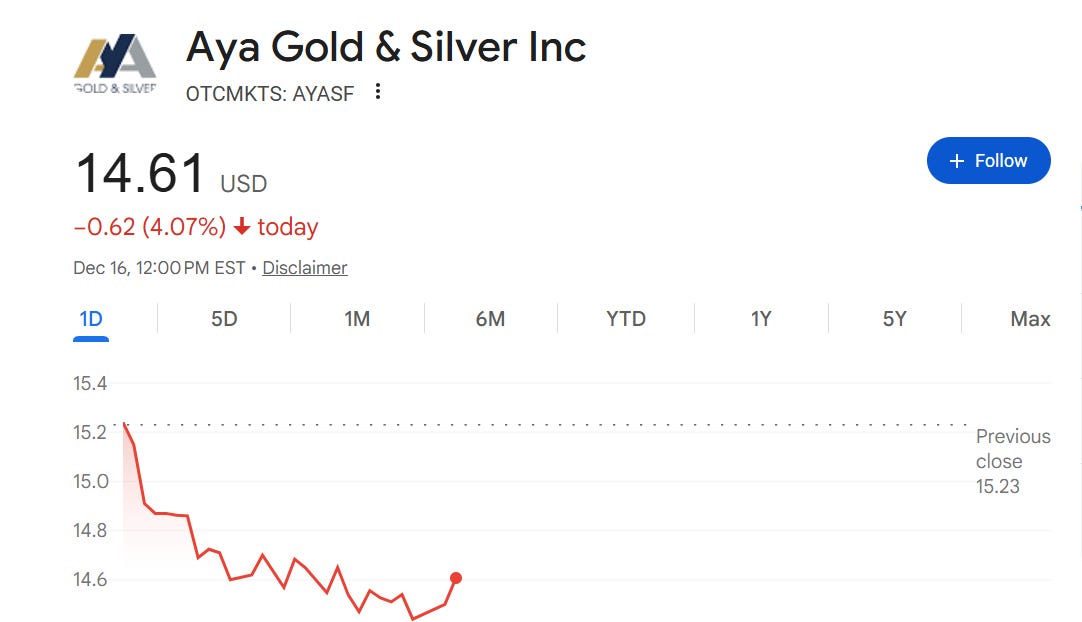
BUY THIS DIP and Prepare for it to snap back today or tomorrow (I don’t have a crystal ball and all investments have risk but this is a solid tip)
Recall they are operating in Tier 1 Jurisdiction and this is a pure silver play (not silver as by product)
From the Aya Gold & Silver newsroom (OTC: AYASF)
”We’ve filed an updated NI 43-101 for Zgounder that reinforces just how conservative the base case is — and how much upside remains.
The new mine plan takes Zgounder to 66M oz over 11 years at ~$50/oz margin—up from the 2022 plan’s 53M oz at about a $15/oz margin.
It’s capped at 600 g/t to be very conservative — excluding the many zones at +2000 g/t.
We will continue to increase throughput meaningfully in the coming quarters to take advantage of rising silver prices.”
Key takeaways:
-
Built on low silver price assumptions ($26/oz reserves; $28/oz resources) with a highly competitive cost structure (~$16/oz cash costs).
-
Conservatively ~6 Moz Ag per year for 11 years, extending mine life to 2036, with clear potential to grow well beyond 11 years.
-
Operational flexibility to increase throughput near term and add ounces, and bulk mine in a +$65 silver environment.
-
Reserves and resources continue to grow net of depletion, supported by ~275 km of drilling since 2021.
-
Significant exploration upside remains to the west and northeast that could further extend mine life.
With the ramp-up complete, Zgounder is very profitable at current prices — and highly leveraged to higher silver.
This is the baseline US$300-$350 Cash Flow machine (or $3.5B cumulative Cash Flow) that was built for $135M. Boumadine will be 5x this annual Cash Flow at current spot prices.
end of segment
-
our opinions are not our sponsors opinions
-
editorial is separate from promotions
-
not financial advice