
by Jon Forrest Little
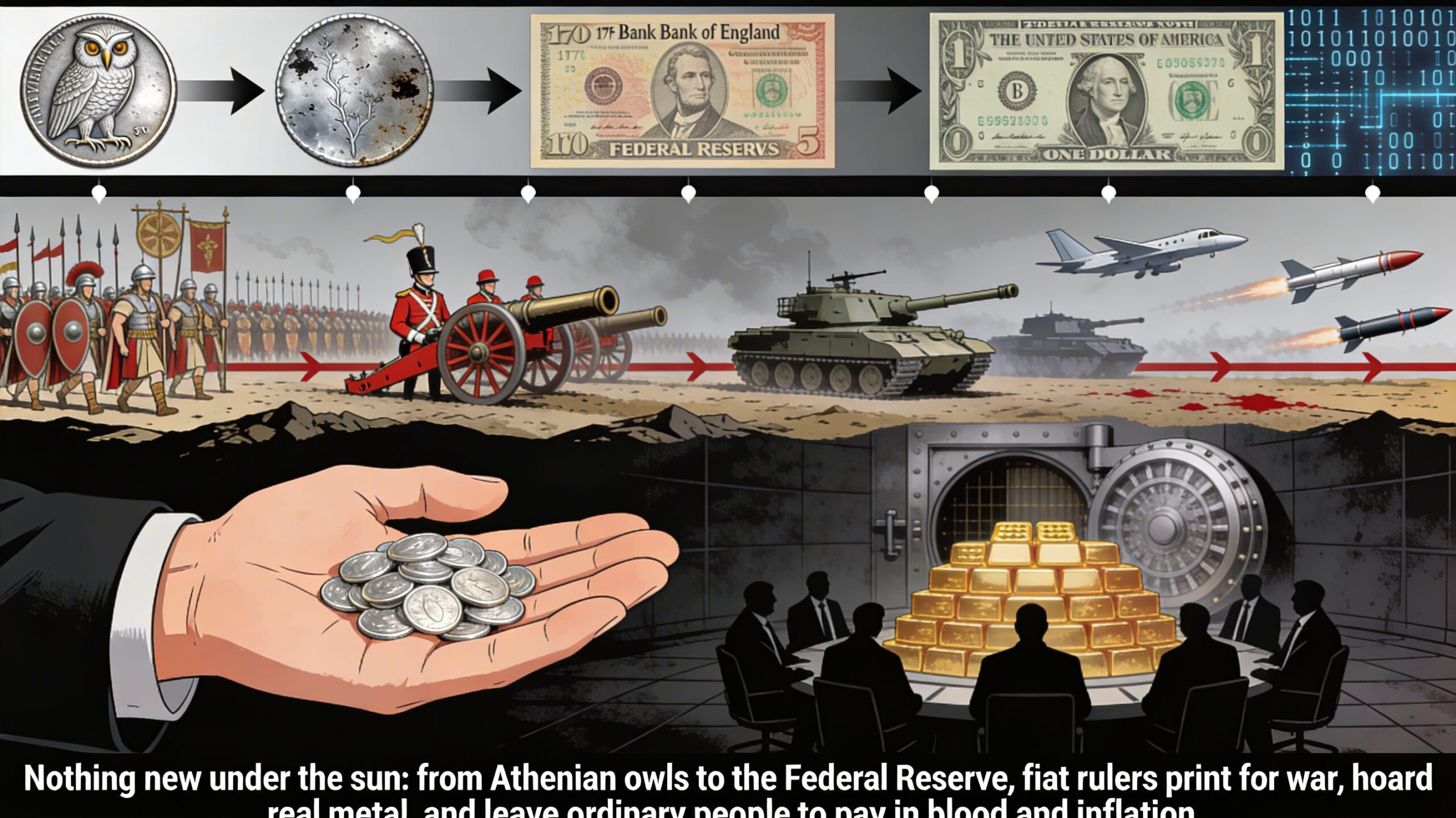
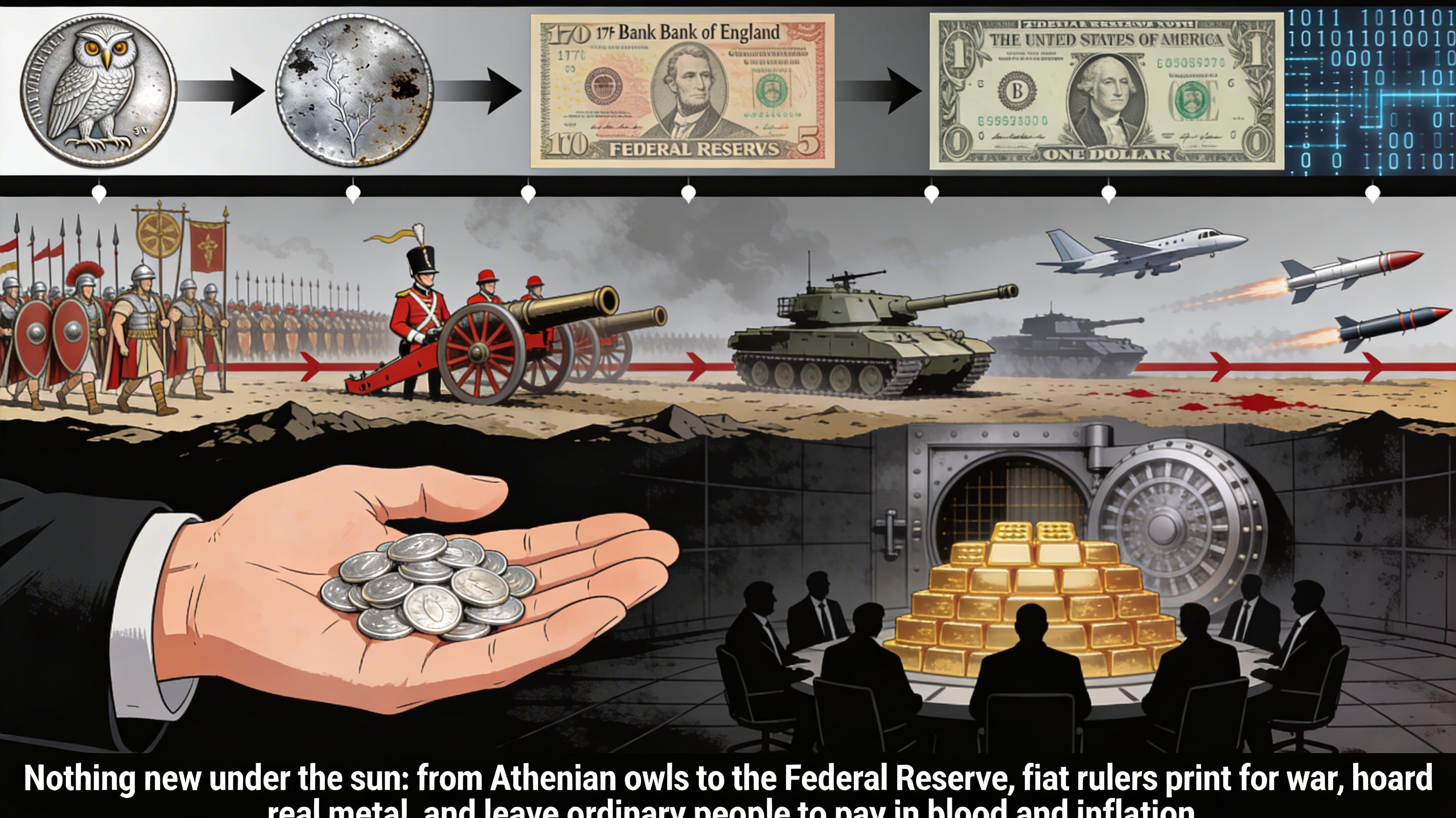
Nothing new under the sun: from Athenian owls to the Federal Reserve, fiat rulers print for war, hoard real metal, and leave ordinary people to pay in blood and inflation.
5th c. BCE – Athens, Sparta, and the monetization of war
-
I broke into the silver newsletter business a few years ago when I wrote my paper on “Precious Metals Warfare Theory” which argues that Athenian silver coinage during the Peloponnesian War was first and foremost a tool to pay soldiers, not a neutral upgrade from cumbersome barter.
-
My thesis was a revolutionary school of thought because every historian before me claimed that gold and silver coin emerged as a tool to replace barter yet no one can find any evidence of that in the archaeological / historical record.
-
Athens drew on the Laurion silver mines to mint standardized owl coins, then used those coins to compensate large fleets and armies, allowing troops to buy their own provisions—wine, food, clothing, and entertainment—wherever they were stationed.
-
Archaeological finds show silver coins clustering near military camps and garrisons, consistent with the idea that wherever soldiers were paid in silver, markets sprang up around them, followed by officials to regulate trade and extract taxes.
-
In this reading, silver is “monetized” primarily as war finance: the state mints metal from Laurion, pays troops, markets form to serve them, and government claims its share via taxation and control of standards.
-
So as long can be prolonged the ruling class thrives
-
As war dragged on for decades, financial pressure emerged in the coinage itself—her coin went from 95% purity down to just being silver plated.
-
Athens resorted to altered and emergency issues, a familiar early sign that monetary systems born to fund war are stressed by prolonged conflict.
-
Athens is weakened to the point that she is conquered
1st c. BCE–3rd c. CE – Rome’s long wars and systematic debasement
-
Rome adopted and expanded the same logic: silver coinage, especially the denarius, became the backbone for paying professional legions stationed across a vast frontier.
-
Under Augustus, the denarius was high‑silver (around the mid‑90s percent range), but successive emperors facing persistent military commitments diluted weight and fineness to stretch revenues and meet rising soldier pay.
-
By the third‑century crisis, the antoninianus—a higher‑value silver coin introduced earlier—had been debased to a few percent silver, effectively bronze with a thin silver wash that quickly exposed the base metal beneath.
-
The monetary record tracks Rome’s strategic priorities: “pay the soldiers first,” as later summarized in Severus’s maxim, even if that meant systematically degrading the coinage that underpinned civilian commerce.
European empires, bullion extraction, and paper claims
-
Early modern Spain, France, and the Dutch Republic financed imperial wars through bullion streams (notably American silver in Spain’s case) and increasingly complex debt structures, tying conquest, resource extraction, and money creation together.
-
As conflicts lengthened and outlays surged, governments and privileged banks layered bills of exchange, notes, and ledger money on top of gold and silver stocks, multiplying claims on metal and importing inflationary pressure into domestic economies.
-
This era sees the early outline of a pattern emphasized in Precious Metals Warfare Theory: elites vault bullion while issuing paper substitutes to the wider population, shifting wartime strain into currency quality and purchasing power.
-
Spain issued “juros” France issued “rentes” – both were war bonds that infected the working class with inflation
-
England would follow with the same playbook
1694 – The Bank of England: war loan and monetary franchise
-
In 1694, amid war with France, a syndicate of merchants and financiers subscribed a £1.2 million loan to the English crown, largely to fund naval operations and the broader war effort.
-
In return, they obtained a royal charter for the Bank of England, empowered to manage state debt and issue transferable banknotes—paper claims that circulated alongside gold and silver coin.
-
From the start, the Bank’s business model fused war finance with monetary control: those who organized credit for the crown also shaped the structure of the currency, prefiguring later concerns over who effectively “controls” a nation’s money.
Late 18th–19th c. – Rothschild networks and the consolidation of war finance
-
Mayer Amschel Rothschild began in Frankfurt as a dealer in coins, medals, and bills of exchange, then advanced to court factor, ultimately coordinating large‑scale finance for princely clients.
-
Rothschild orchestrated “bills of exchange” which effectively functioned as paper claims on underlying metal or bank money, circulating as credit instruments.
-
His sons established Rothschild houses in major European capitals, specializing in cross‑border government loans and war‑related financing, particularly during and after the Napoleonic conflicts when states urgently needed centralized, mobile credit.
-
Rothschild stated, “ I care not who writes a nation’s laws but who controls its money” emphasizing it was HIM
1910–1913 – Jekyll Island, the Warburgs, and the Federal Reserve
-
In 1910, leading U.S. bankers and policymakers met secretly at Jekyll Island to draft a central‑banking framework aimed at stabilizing credit and managing crises in an economy increasingly exposed to large‑scale industrial and, soon, wartime finance.
-
Paul Warburg, a German‑born American banker, was a driving force behind the design; the Federal Reserve Act of 1913 created a system of regional reserve banks under central oversight, formalizing a lender‑of‑last‑resort for government and the financial system.
-
The broader Warburg family had members embedded in both American and German finance; during the First World War, relatives served as advisors on opposite sides, illustrating how globally networked bankers could fund both sides (rival war economies at the same time.)
-
This is the business model.
-
ALL WARS ARE BANKERS WARS
20th–21st c. – Fiat money, bullion markets, and leveraged paper claims
-
Over the 20th century, major currencies severed formal ties to gold and silver, culminating in the end of the Bretton Woods gold‑dollar link in 1971 and the consolidation of purely fiat monetary regimes.
-
In this environment, state power, tax capacity, and military reach—rather than metal reserves—anchor confidence in leading currencies, even as central banks and treasuries expand balance sheets and war‑related outlays through debt issuance.
-
Modern bullion systems, including futures exchanges and unallocated accounts in the gold and silver markets, routinely create multiple paper claims per ounce of physical metal, extending credit and liquidity but embedding systemic leverage that becomes critical when many holders demand delivery.
Across these periods, the through‑line is empirical: from Athenian owls at Laurion to Roman denarii, from early modern war chests to the Bank of England and the Federal Reserve, monetary innovations repeatedly emerge as tools to fund organized violence; control over those tools increasingly concentrates in institutions and families positioned at the intersection of state power and credit creation
U.S. power is now so unmoored from metal that it can throw a carrier group at any problem and send the bill to the bond market.
Since the end of the Cold War, Washington has launched or backed an almost uninterrupted sequence of interventions, regime‑change efforts, and proxy wars—from Iraq and the Balkans to Libya, Syria, Ukraine, Venezuela, and now a full‑scale confrontation with Iran—funded not by explicit war taxes but by deficits, QE, and the quiet dilution of every existing dollar. Under a gold‑silver constraint, each new front would have to compete for finite bullion; under fiat, it competes only for narrative and votes.
The current Iran war makes the logic unmistakable. Analysts openly frame it in terms of oil flows, energy markets, and the durability of the dollar‑centric system, not just nuclear dossiers and human rights communiqués. Every missile strike that threatens the Strait of Hormuz also threatens the petrodollar channel that has recycled oil revenues into U.S. assets for fifty years. A system this leveraged cannot admit weakness; it must prove, again and again, that the world still clears its energy and settles its contracts in dollars—or pay a staggering price if that belief cracks.
Israel, for its part, operates from a different but rhyming playbook: a small, militarized state underwritten by external finance and strategic sponsorship, punching far above its demographic weight because the flows of money, weapons, and diplomacy all converge in its favor. In that sense, it resembles the classic Rothschild‑era pattern: a nodal ally at the intersection of finance and force, indispensable enough that its wars become everyone else’s problem.
What backs the dollar in this configuration is not a promise to redeem notes in bullion, but a demonstrated willingness to project violence on behalf of those notes’ status. When the currency is built on war, the temptation is always to fight one more “necessary” war to save it. That is what makes the present escalation so dangerous: a monetary order bought time for decades by exporting inflation and risk now reaches for the oldest tool it has left—shock and awe—against a country sitting on chokepoints and hydrocarbons the system cannot easily replace.
History’s verdict on this model is consistent. When money becomes pure decree and empire becomes its only collateral, the war machine runs until either the currency, the polity, or both finally break. The only unresolved question is which fails first.
end of segment
-
our opinions are not our sponsors opinions
-
the editorial department is separate from the promotions department
-
not financial advice