
In October 1973, as the Yom Kippur War raged, the Arab members of OAPEC turned oil into a weapon, announcing an embargo that ultimately choked off roughly 7% of global consumption and slashed Middle East exports to the West by about 60–70% within weeks.
Production cuts drove output in some cases down toward a quarter of prior levels, and the price of oil exploded from around 3 dollars a barrel to nearly 12 by early 1974, a near‑quadrupling that ripped through every American gas station and factory floor. The immediate incident was visible in the long, angry fuel lines, “No gas today” signs, and emergency measures from Washington as the Nixon administration scrambled to ration supplies and cap prices.
But the outcome was a far longer economic shadow: the shock helped tip the United States into a decade‑scale struggle with stagflation—high inflation, weak growth, and repeated recessions—that took deep structural shifts in energy use, efficiency, and policy through the early 1980s to truly unwind. In the annals of economic history, the 1973–74 oil crisis reads like the opening chapter of modern energy geopolitics, when a few percentage points of withheld crude were enough to redraw the trajectory of the U.S. economy for years
Before the Iran war lit up the tape, oil was limping along at about 72 dollars a barrel; a 1970s‑style “quadrupling” puts you in the neighborhood of 288. So if history even half‑rhymes, we’re not talking about a bad year—we’re talking about a multi‑year tax on everything that moves, eats, ships, or turns on a light switch. And yes, markets will act shocked and outraged the entire way up, as if nobody could have possibly seen the math coming.
33 Other Things Related to this illegal, immoral and unwise war
Trump Pushed to War by Benjamin Netanyahu (rumored to be dead) Jared Kushner, Lindsey Graham, Marco Rubio and Steven Witkoff
-
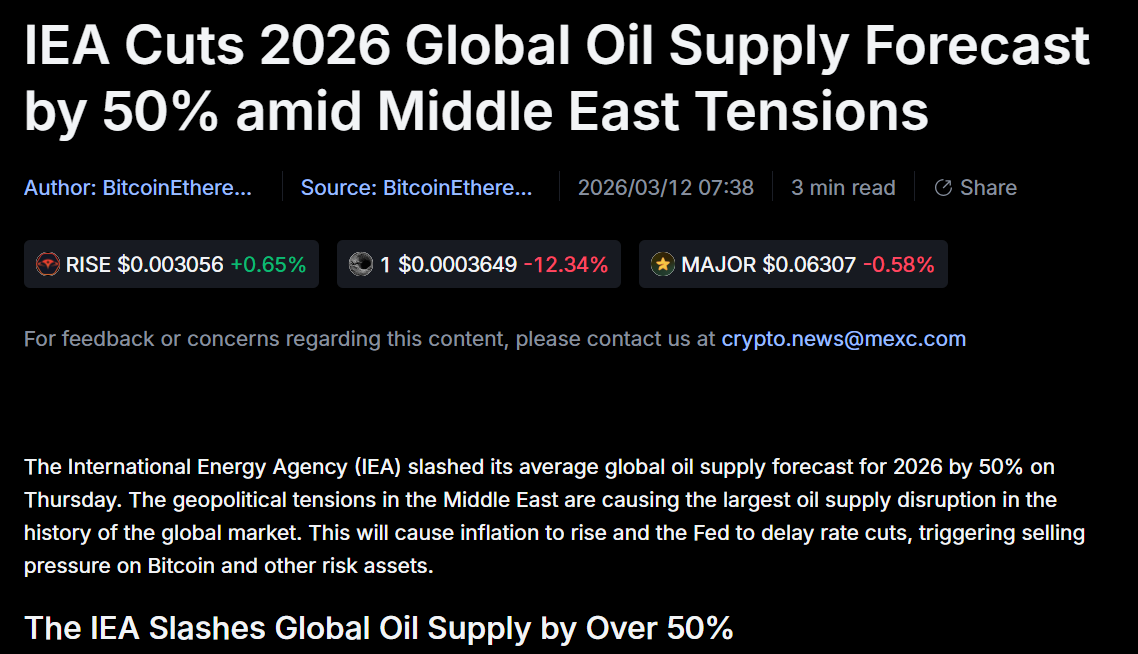
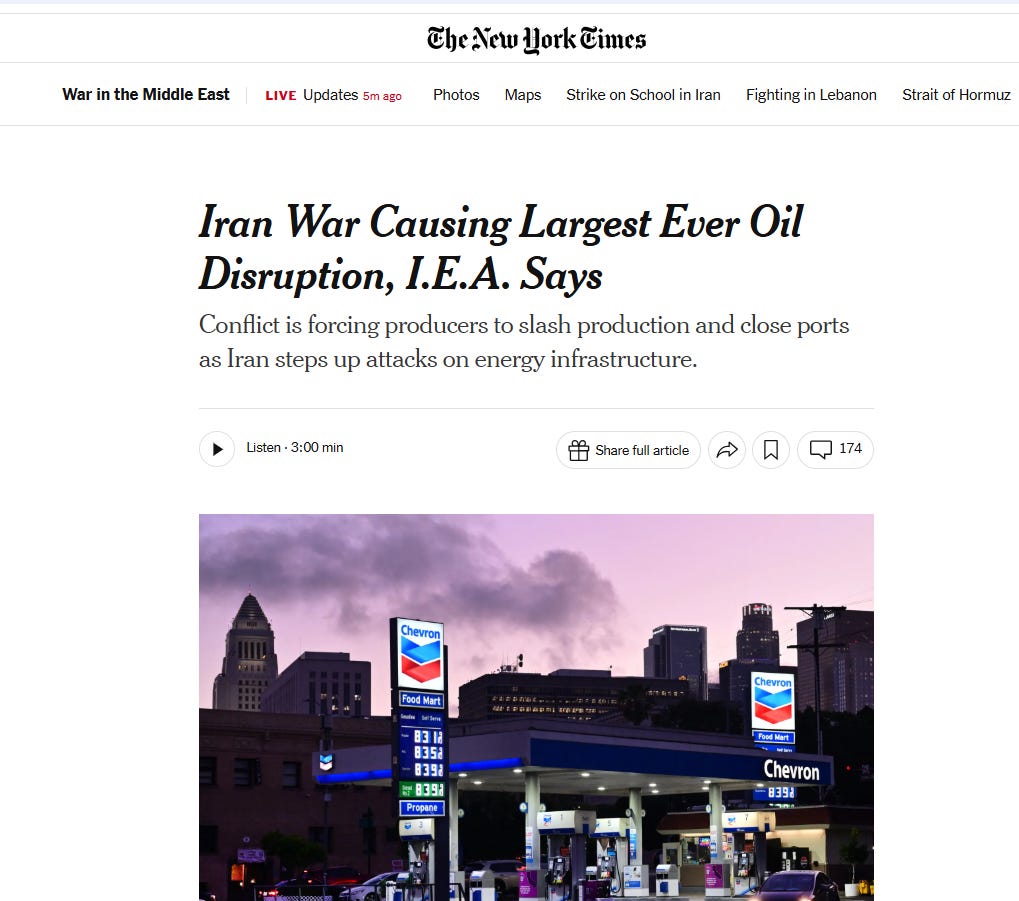
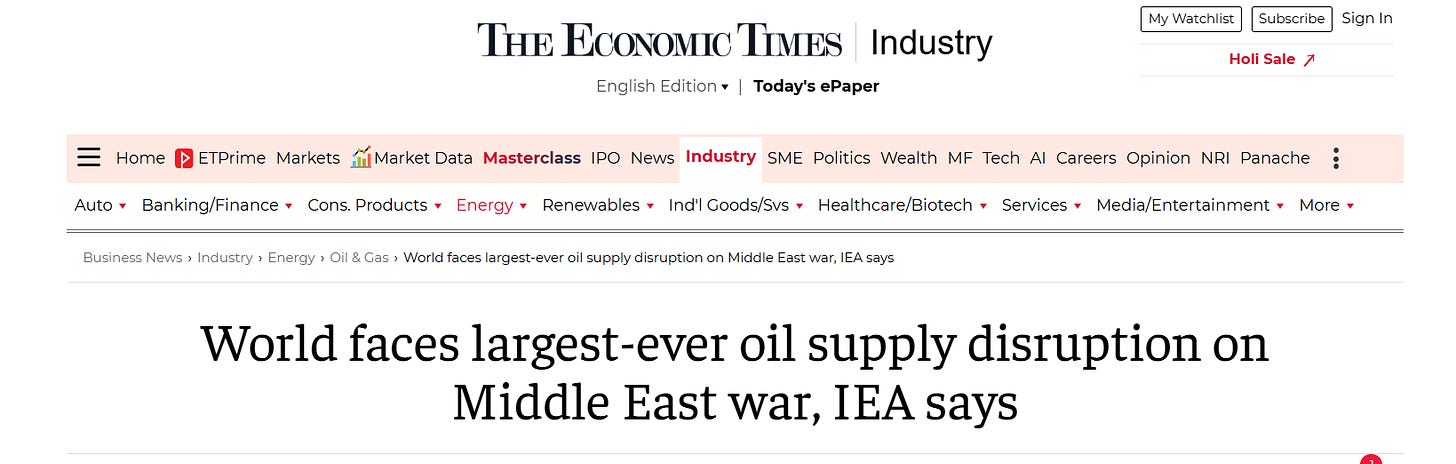
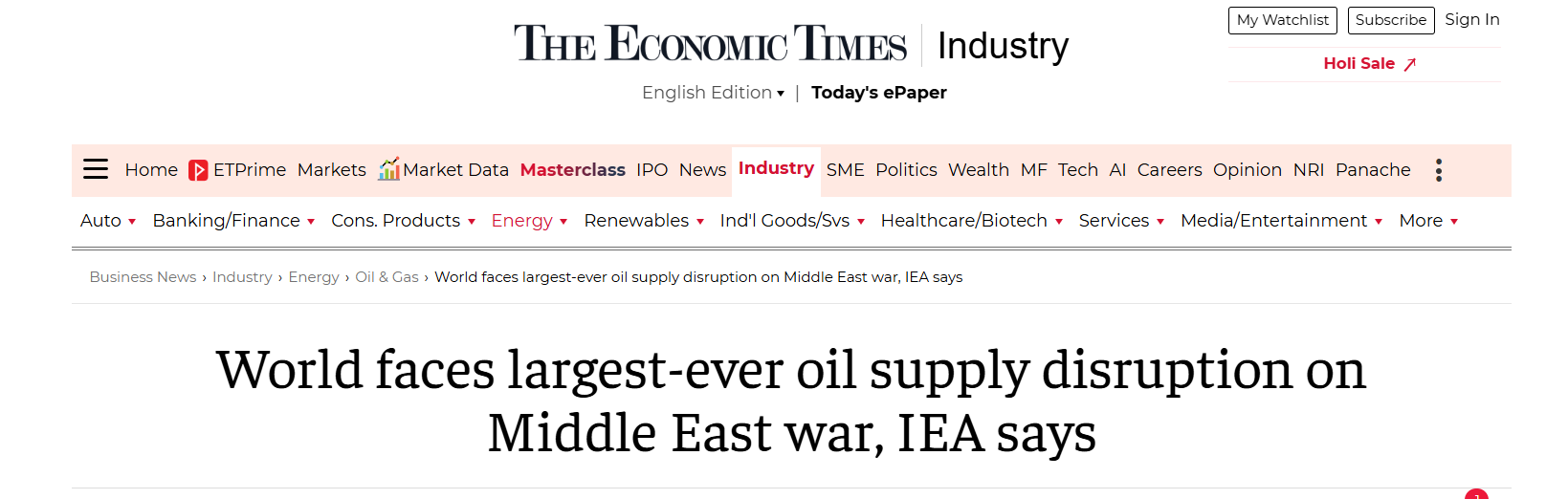
The Middle East war has triggered the largest oil‑supply disruption in global market history, exceeding all previous shocks.
-
The IEA Slashes Global Oil Supply by Over 50%. The Strait of Hormuz is effectively shut, erasing almost all traffic through the world’s key oil artery and forcing Gulf producers to slash output by millions of barrels a day.
-
The IEA calls it the largest oil supply disruption ever, not a mere market fluctuation
-
Flows of roughly 20 million barrels per day through the Strait of Hormuz have dropped to a near‑trickle, crippling the main artery of global oil trade.
-
Gulf producers have cut around 10 million barrels per day
-
Global supply expected to fall by roughly 8 million barrels per day this month.
-
Several million barrels per day of regional refining capacity are offline due to attacks and export disruptions.
-
The International Energy Agency has launched the largest‑ever emergency release of strategic reserves, totaling around 400 million barrels.
-
Strategic stockpiles are only delaying, not cancelling, the impact of a prolonged shipping disruption; they cannot fully offset a long‑lasting supply shock.
-
The severity of the economic and market impact now depends primarily on how long the Strait of Hormuz remains impaired.
-
Oil prices are set to remain structurally elevated even if emergency stock draws temporarily cap extreme spikes.
-
Higher oil prices are feeding into broader inflation via rising transport, energy, and input costs across the economy.
-
Major central banks are being forced into a “higher‑for‑longer” stance, delaying or reducing planned interest‑rate cuts.
-
The combination of persistent inflation, slower growth, and tighter financial conditions is creating a stagflation‑like backdrop.
-
Risk assets such as equities, high‑beta commodities, and speculative crypto are coming under pressure from this mix of higher rates and geopolitical risk.
-
Capital is rotating toward perceived safe havens and real‑asset hedges, including precious metals.
-
Silver is increasingly acting as a monetary metal, benefiting from concerns about inflation and currency debasement alongside gold.
-
Silver is simultaneously gaining as a technology and industrial metal tied to green energy, solar, EVs, and electronics demand.
-
Structural underinvestment and geopolitical risk on the mining side are limiting the ability of global silver supply to respond quickly, increasing the likelihood of deficits.
-
Silver is exhibiting higher beta than gold, with the potential to outperform once the macro environment turns decisively favorable for precious metals.
-
Silver’s upside is becoming tightly linked to real interest rates, with negative or very low real yields providing a powerful tailwind.
-
Expansive fiscal and monetary responses to crises, plus sanctions and financial‑system weaponization, are reinforcing a global currency‑debasement narrative.
-
Central banks’ growing preference for hard assets is indirectly supporting silver by lifting the broader precious‑metals complex.
-
Deepening geopolitical fragmentation and persistent conflict in the Middle East are increasing demand for self‑insurance and physical stores of value.
-
Reserve diversification away from the dollar bloc is encouraging more interest in gold and, by extension, silver as alternative stores of value.
-
Silver remains under‑owned relative to gold by both retail and institutional investors, leaving substantial room for catch‑up flows.
-
Silver‑mining equities and related funds are serving as leveraged plays on rising silver prices, amplifying both gains and losses.
-
Elevated volatility across energy and financial markets is creating tactical opportunities to accumulate silver during pullbacks.
-
A disciplined, long‑term approach is becoming essential, with panic selling in volatility increasingly penalized.
-
Systematic, data‑driven frameworks and historical analogues are gaining importance for timing entries and exits in silver.
-
Silver is undergoing a structural transition from being treated mainly as an industrial metal to being viewed as a strategic monetary asset.
-
Oil, inflation, interest‑rate policy, equities, bonds, crypto, and precious metals are now tightly interlinked, with silver occupying a central role in this macro chain.
-
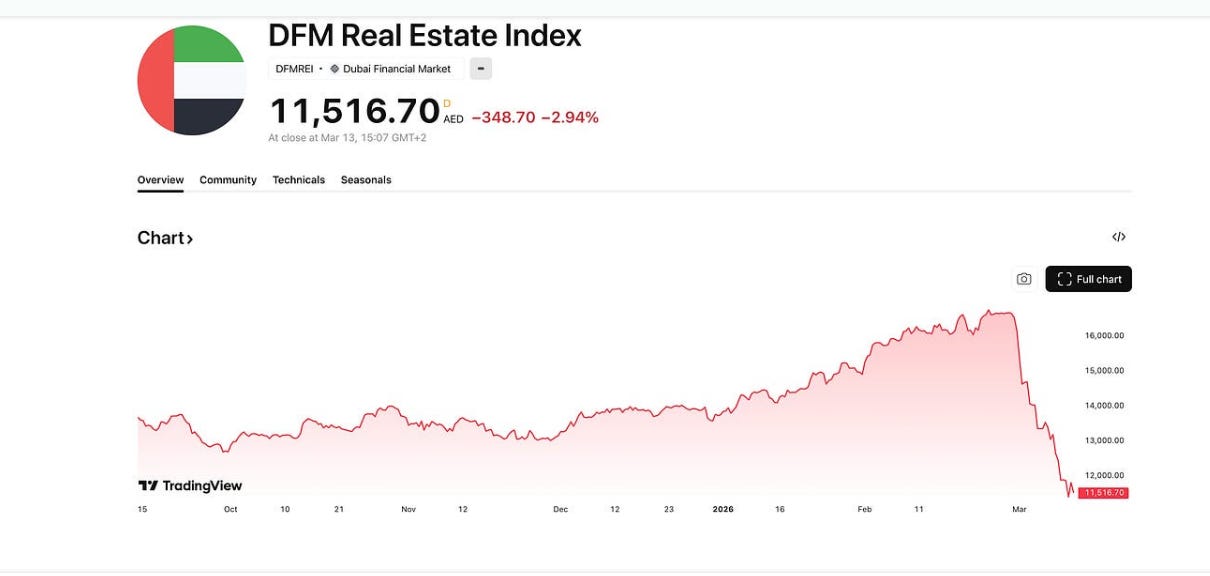
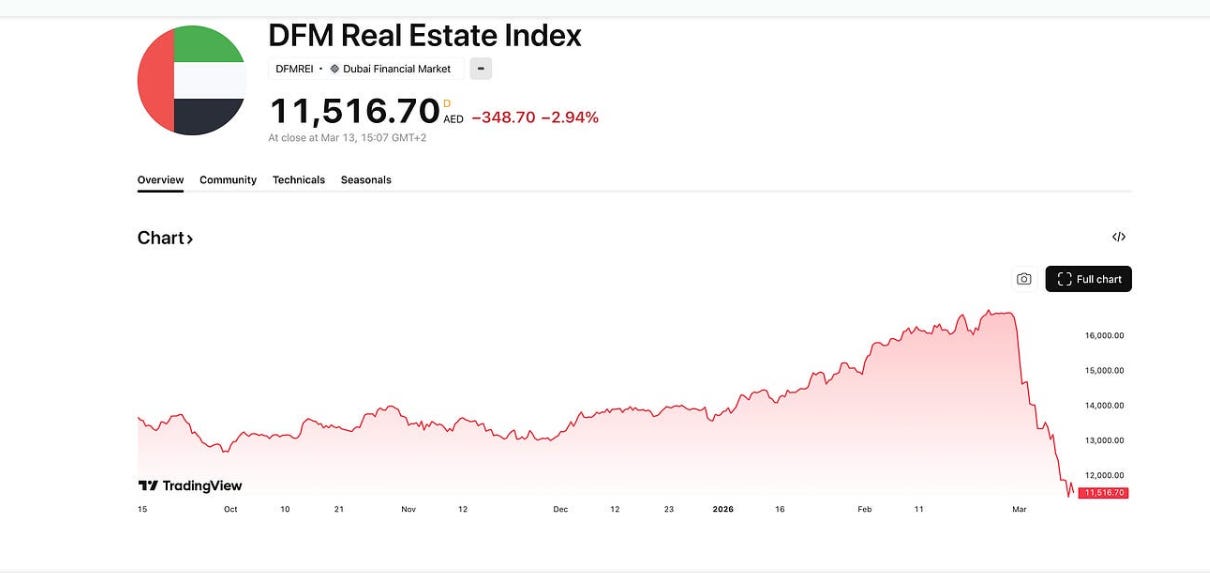
The World’s most Luxurious Real Estate Market is CRASHING. This isn’t temporary, this is beyond repair. The DFM Real Estate Index tracks the market value of publicly traded real estate companies in Dubai—it’s a reliable gauge of investor sentiment and what’s actually happening on the ground.
A policy mistake—keeping monetary policy too tight for too long in response to oil‑driven inflation—would risk a deeper recession followed by an even more explosive pro‑silver response once easing resumes.
Silver is the new Oil
10 related keys
-
Silver is emerging as a core monetary hedge in the current oil‑shock–driven stagflation environment, with investors seeking protection from currency debasement and negative real yields.
-
Silver’s historical higher beta to gold means that once macro conditions firmly favor precious metals, silver is positioned to outperform as capital rotates from risk assets into hard money.
-
Structural constraints on mine supply, chronic underinvestment, and geopolitical risk in key producing regions limit silver’s ability to respond to rising demand, increasing the probability and severity of market deficits.
-
Silver’s industrial role in solar, EVs, grid infrastructure, military and electronics links it directly to any accelerated energy‑transition spending that follows the oil disruption, giving it a dual monetary‑plus‑industrial demand tailwind.
-
India’s new banking rules that ease gold and precious‑metal related products, along with SEBI’s moves to formalize and expand permissible precious‑metal allocations for pension and retirement funds, open a large, sticky pool of potential silver‑linked demand over time.
-
As Indian pension and institutional portfolios gradually incorporate regulated precious‑metal exposures under SEBI guidance, silver stands to benefit as a natural extension of gold allocations, especially via multi‑metal or basket products.
-
Under‑ownership of silver relative to gold by both Western institutions and Asian savers, combined with these new Indian regulatory channels, sets the stage for mean‑reversion flows into silver once price momentum confirms the macro thesis.
-
In a prolonged high‑oil, high‑inflation scenario, any central‑bank policy mistake—staying too tight for too long and then being forced into aggressive easing—would likely catalyze a powerful upside break in silver.
-
For positioning, physical silver and fully allocated products provide core long‑term exposure, while quality silver‑mining equities and ETFs offer leveraged upside but require tolerance for drawdowns and volatility.
-
Overall, the 2026 oil shock is transforming silver from a neglected industrial by‑product into a strategic macro asset, with Indian regulatory shifts and global stagflation risks acting as key accelerators of that re‑rating
The largest oil supply disruption in history is doing more than choking off crude flows through the Strait of Hormuz; it is accelerating a regime change in how global capital views silver.
As oil‑driven inflation collides with “higher‑for‑longer” interest rates and rising geopolitical fracture lines, investors are quietly rediscovering silver’s dual role as both monetary insurance and critical energy‑transition metal. At the same time, India is opening entirely new demand channels, with banking reforms and SEBI’s evolving rules on precious‑metal allocations for pension money laying the groundwork for long‑dated, regulated flows into gold and, increasingly, silver.
Put simply, the world is walking into a stagflationary shock with an under‑owned, under‑supplied monetary metal that also sits at the heart of solar, EV, and grid build‑out. In this issue, we’ll connect the dots between the IEA’s historic oil warning, India’s quiet rule changes, and why they may mark the opening chapter of silver’s next major repricing
-
our opinions are not our sponsors opinions
-
the editorial department is separate from the promotions department
-
not financial advice