
The Silver Racket: Why the Price Is a Lie
The silver market today is not “tight” or “volatile.” It is structurally broken by design.
Global mine supply limps along around the 800‑million‑ounce mark, while total annual demand—industrial, investment, jewelry, solar, EVs, medical, defense—has roared past 1.2–1.3 billion ounces. Recycling adds a bit of relief, but the math refuses to lie: we have a deep, chronic shortfall that has chewed through hundreds of millions of ounces of above‑ground stock in just a few years.
In any honest market, that kind of hole would explode the price into orbit. In silver, the paper casino has delayed the verdict. Not erased it. Delayed it.
The Mafia in Suits: How Your Money Gets Laundered
If you have not figured it out by now, you are not living in a country—you are living inside a racket.
The people who sermonize about “democracy,” “rules‑based order,” and “shared sacrifice” have built the most sophisticated money‑laundering machine in human history. Foreign aid, “security assistance,” reconstruction, endless “emergency” spending—it is the same closed loop every time: your taxes go out under a flag and a slogan, and they come back laundered into consulting fees, defense contracts, think‑tank sinecures, speaking gigs, and foundations.
They are not incompetent. They are not confused. They are not “trying their best.” They are a cartel. And that cartel needs three things to keep the scam running: a currency they can print, a permanent state of war to justify the printing, and a population too exhausted or numbed to connect the dots.
War, Waste, and the Weapon Called Fiat
Every crisis is just the next invoice.
Pandemic? Spend. Proxy war? Spend. “Climate emergency”? Spend. Banking “instability”? Spend. The same beneficiaries line up, the same names get the contracts, and the same working and middle classes are told to “tighten belts” while their real wages get vaporized.
Fiat is not money; it is a permission slip. It exists at their pleasure, not yours. They dilute your labor with every bailout, every “stimulus,” every off‑balance‑sheet facility designed to rescue the financial class from the consequences of its own leverage. Your grocery bill doubles; their portfolios hit all‑time highs. Then they blame “supply shocks” and move on.
Your suffering is not a policy failure. It is the fuel. Desperate people are easier to herd, easier to bribe with crumbs, easier to silence.
The Remonetization Nobody Voted On
While the average investor still treats silver like a crank’s obsession, sovereign players are quietly rewriting the script.
Russia has begun adding silver to its reserve strategy, treating it as a strategic monetary metal, not a mere byproduct of base metals. India has effectively re‑monetized silver at the household level by allowing it as significant loan collateral, turning necklaces, bars, and coins into high‑velocity banking assets. China is tightening exports and paying a premium for real metal at home, signaling that paper prices in the West are a quaint fiction, not a reference.
Meanwhile, the U.S. is scrambling with “strategic stockpile” programs and critical‑minerals initiatives that admit the obvious: the West let its supply chains go, and now it is trying to hoard the very metals it allowed others to control.
These are not random policy quirks. This is the early phase of a global repricing of what constitutes “real reserves.”
The Coming Break: When Fiction Meets Inventory
You cannot run a perpetual structural deficit in a metal that is both industrially indispensable and monetarily rediscoverable.
Industrial users cannot simply “opt out” of silver. Solar, EVs, telecommunications, advanced electronics, defense systems—none of them function properly without it. At the same time, as fiat credibility decays and geopolitical risk spikes, investors and states are re‑learning a lesson their ancestors understood instinctively: real money is metal, not promises.
That collision—between hard physical scarcity and soft political lies—is where things break.
When physical premiums in one part of the world trade 10, 15, 20 dollars above the “official” price, you are not looking at noise. You are looking at a system whose reference price has lost meaning. When central banks and governments move from mocking silver to quietly accumulating or collateralizing it, you are watching the end of the paper era in slow motion.
Silver as Refusal: Opting Out of Their Game
That is why silver—and gold, and productive real assets—are no longer just “investments” in this cycle. They are acts of refusal.
Refusal to store your life’s work in a digital IOU that can be inflated away, frozen, “bailed in,” or conveniently redefined in the next crisis. Refusal to let a class of professional looters dictate what is “safe” while they front‑run you into every bubble and then socialize the losses. Refusal to accept that the only role you are allowed to play in this grand experiment is the last, broke bagholder.
They all hate you and could not care less if you suffer and die horrible deaths, as long as they got rich. They have told you this, not in speeches, but in budgets, in policies, in the cold arithmetic of who gets saved and who gets sacrificed.
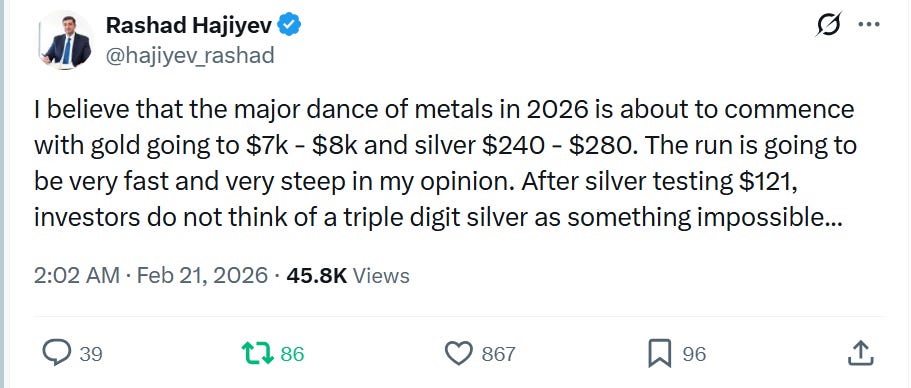
So the question is not whether $100, $240, or $1,000 silver is “too high.” The question is: how much longer are you willing to let a proven mafia be your counterparty?
Because the structural setup for silver is not just bullish. It is a verdict. And when it is finally delivered, you will either own real metal—or a fading IOU from people who have already explained, in excruciating detail, exactly what your life is worth to them.
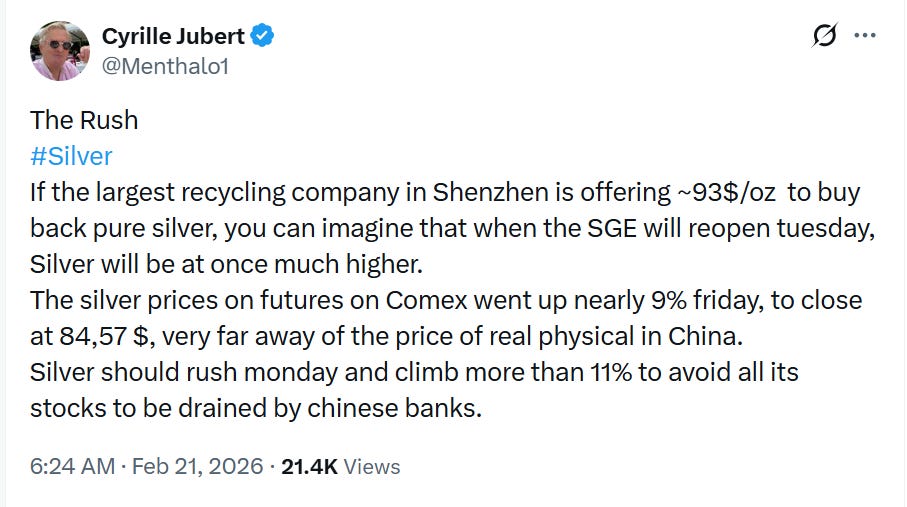
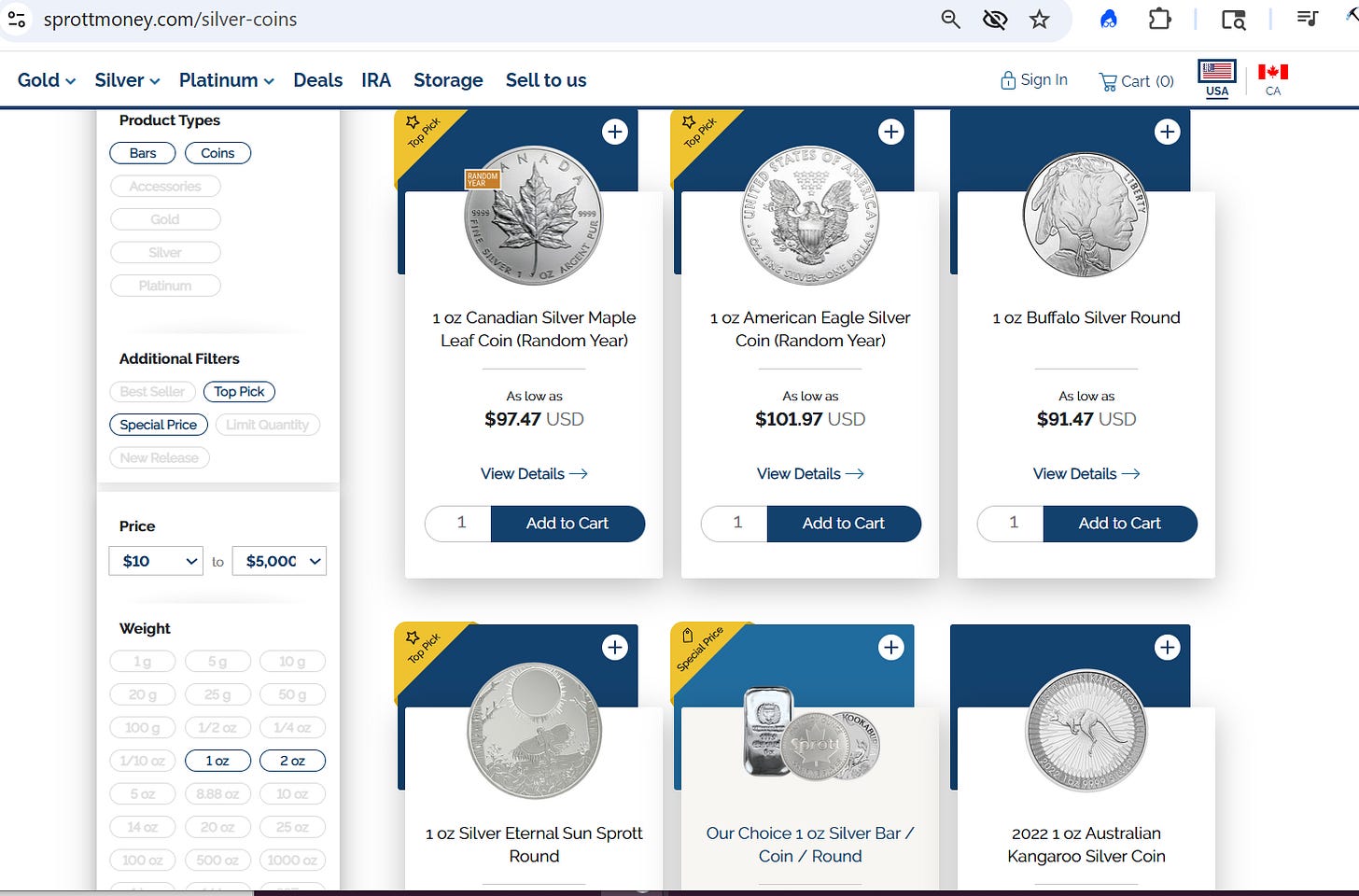
Meanwhile, in Canada, SprottMoney.com is quietly offering physical silver at around $91 dollars an ounce while the real global clearing price is blowing past it. In Shenzhen, China’s largest recycler is reportedly paying around $93 dollars per ounce just to buy back pure silver, a premium that screams shortage, not comfort. COMEX futures just ripped nearly 9% on Friday to close around $84.57 dollars, still miles below what Chinese buyers are willing to pay for actual metal. If silver does not gap higher by double digits on Monday, Chinese banks will simply drain whatever Western inventory is foolish enough to remain mispriced.
end of segment
-
our opinions are not our sponsors opinions
-
the editorial department is separate from the promotions department
-
not financial advice