
by Niko Moretti
The topic is the relationship between U.S. gold reserves and outstanding U.S. debt.
It’s an area we’ve explored in depth over the past three years.
At the end of this piece, I’ll highlight five of the roughly eleven articles we’ve devoted to this subject. This way if folks want to dig deeper they may.
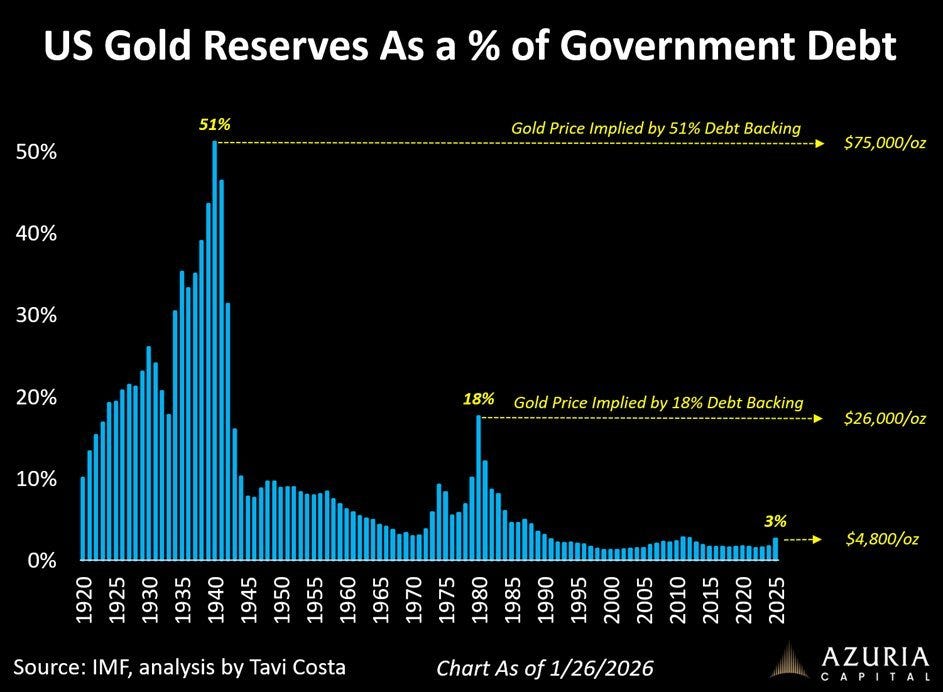
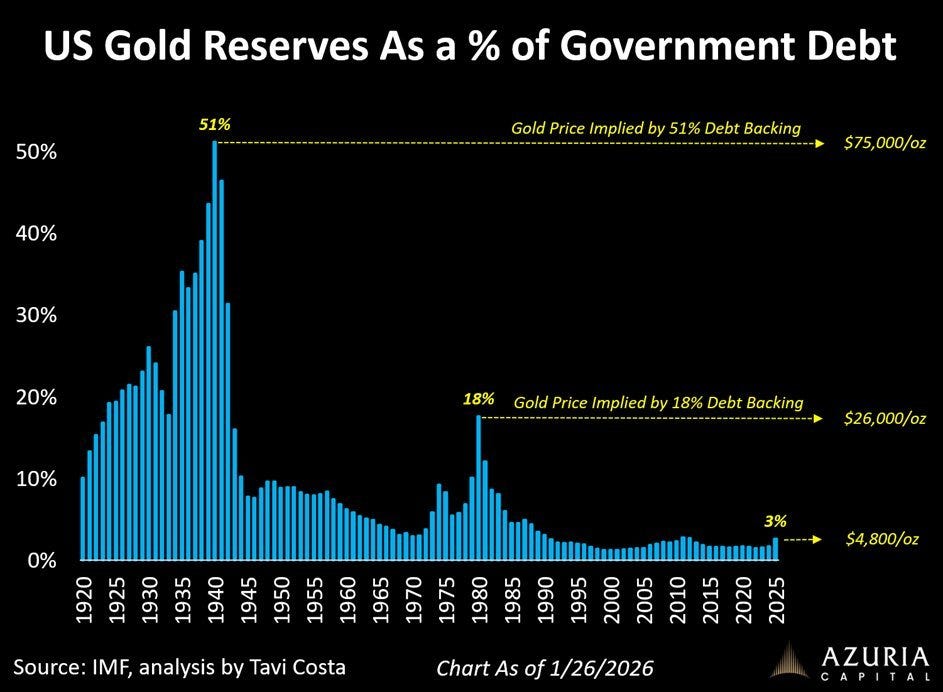
Dutch Multi Asset Investment Specialist Karel Mercx is a portfolio manager focused on trend-driven strategies across equities, commodities, and macro themes. Mr. Mercx breaks down the chart above (chart is from our colleague Tavi Costa)
Mercx writes, ”During the last period of extreme debt expansion — World War II — US government debt surged to levels comparable to today. At that time, roughly 51% of federal debt was backed by gold reserves.
Today, total debt is even larger — yet only about 3% is backed by gold. This comparison powerfully illustrates just how deeply undervalued gold is on a historical basis.
If US government debt were ever backed by gold at the same 51% level seen in the 1940s, total US gold reserves would need to be worth roughly $20 trillion. With 261.5 million ounces of gold, that implies a gold price near $75,000 per ounce.
Yes, those numbers will sound extreme to many — but they are not conjecture. They are the direct result of applying historical precedent to today’s balance-sheet realities. The gap between the size of sovereign debt and the monetary anchor that once underpinned it is now wider than at any point in modern financial history.
Now take a gold-silver ratio of 19 and the math implies silver around $3,947. No matter how you look at it, gold and silver are deeply undervalued versus the debt reality.”
If U.S. debt were ever backed 51% by gold, the math points to a gold price near $75,000 per ounce and silver around $3,947 at a 19:1 gold-silver ratio.
But we all know Washington doesn’t have the guts, discipline, or negotiating skill to even attempt that kind of hard-money reset. So let’s do what weak politicians and conflicted committees always do: split the difference.
Cut the implied gold price in half and you still get roughly $37,500 per ounce. Cut the silver target in half and you’re looking at about $1,973.50, per ounce. That’s the “compromise” scenario in a system already built on compromise, debasement, and denial.
Even after two rounds of meeting in the middle, (half of the half of 1940) the numbers still scream the same message: in a true monetary reckoning, precious metals sit orders of magnitude above today’s prices. – Jon Forrest Little
The Great American Debasement: Why Silver Is the Only Honest Trade Left
Washington has reached the end of its rope. The U.S. national debt is barreling toward $39 trillion, and there is no evidence—none—that Congress has either the courage or the discipline to rein in spending. The capital city has become the global epicenter of fiscal amnesia, where every crisis demands fresh money printing, every problem invites bigger deficits, and every politician swears they’ll fix tomorrow what they just broke today.
The truth is simple: Washington cannot stop printing. It no longer governs a functioning economy—it manages a debt spiral. The central premise of this regime’s “economic recovery” is the permanent expansion of money and debt, a scheme powered by illusion and held together by propaganda. That means more debasement, more inflation, and less real purchasing power for ordinary Americans.
They call themselves peacemakers while waging economic war on their own citizens. Behind a “Board of Peace” and a “peace president” lies a government taking a wrecking ball to the U.S. economy. The evidence is piled as high as the layoffs: corporations are slashing jobs at record levels; small businesses are drowning under costs; and consumer credit delinquencies are quietly climbing to crisis levels.
Meanwhile, Washington treats the military‑industrial complex as sacred. Defense spending has ballooned from roughly $1 trillion to $1.5 trillion, the single largest discretionary expense alongside the government’s second‑largest: servicing its own debt. In other words, America now borrows money to pay interest on money it already borrowed—to build weapons it later calls “investments in peace.”
Then come the tariffs, the latest gimmick in the imperial playbook. The doomed 15% global tariff—struck down by the Supreme Court—was always economic theater. Let’s be clear: tariffs are taxes. They don’t fall on China or Europe. They hit Americans first and hardest. Importers pay at the border, then pass those costs through the supply chain. Prices rise. Margins thin. Layoffs follow. That’s not strategy—it’s a stealth tax disguised as patriotism.
Every serious economist knows it: nations do not pay tariffs; their consumers do. Tariffs don’t “level the playing field.” They merely shift the burden of Washington’s failures onto the same working Americans who already suffer from dollar debasement and inflation. It’s distraction politics—“look here, not over there”—while deficits explode and the currency weakens.
This is the debasement economy. Printing trillions to mask insolvency, then taxing imports to pretend at strength. Washington is not restoring competitiveness—it’s cannibalizing the dollar. And what happens when a reserve currency is perpetually debased? Confidence collapses, trade partners flee, and investors rush toward real assets that can’t be printed by decree.
That’s where silver enters—not as speculation, but as preservation. In the age of synthetic money and theatrical economics, silver is the anti‑propaganda metal. It’s tangible, finite, and historically immune to political fraud. Long before central bankers learned to manipulate interest rates, silver defined honest commerce. Today, it’s the ultimate debasement hedge—a quiet rebellion against policymakers who pretend deficits don’t matter.
You can’t fix a dollar problem with tariffs. You can’t restore wages with depreciation. And you can’t print prosperity out of a $39 trillion hole. The only rational defense is to exit the illusion—to hold what governments can’t conjure out of thin air.
Silver, not Washington, represents economic reality. Its value is not dictated by political promises but scarcity and history. When the next debt-limit drama erupts or the next “temporary” printing program begins, silver will not apologize or inflate. It will weigh the same, measure the same, and anchor the same purchasing power it has for centuries.
The regime calls it “stability.” The markets call it “volatility.” But make no mistake—the only stability left is in real money. The “debasement trade” isn’t just about profit. It’s about survival.
For those interested here are 5 articles that discuss the value of Gold relative to US debt.
-
Gold-Backed U.S. Treasuries: A Path to Economic Empowerment
Description: Explains Jim Rickards, Judy Shelton, and Luke Gromen’s proposal to reintroduce partial gold backing for U.S. Treasuries as a way to restructure and support U.S. debt and restore monetary confidence.
URL: https://thesilverindustry.substack.com/p/gold-backed-us-treasuries-a-path -
TD Bank Faces Historic Settlement & Could Trigger a Precious Metals Super-Spike
Description: Cites Judy Shelton, Jim Rickards, and Luke Gromen’s argument that a portion of money supply should be backed by gold, implying very high gold revaluation levels to stabilize systemic debt risk.
URL: https://thesilverindustry.substack.com/p/td-bank-faces-historic-settlement -
Gold Price Scandal: Unmasking the Cartel Controlling Your Wealth. Celebrating Comex Collapse. Gold at $27,000
Description: Discusses Luke Gromen’s thesis of addressing the roughly 35 trillion dollar U.S. debt by revaluing official gold holdings and issuing gold‑backed Treasuries, alongside Jim Rickards’ 27,000 gold framework.
URL: https://thesilverindustry.substack.com/p/gold-price-scandal-unmasking-the -
Case for $45 Silver. Won’t Mention The Gold Forecast Unless You’re Sitting Down.
Description: Compares Jim Rickards’ money-supply based gold-backing math with Luke Gromen’s debt-and-foreign-holdings framework, showing how reintroducing substantial implicit gold backing could reset U.S. debt dynamics.
URL: https://thesilverindustry.substack.com/p/case-for-45-silver-wont-mention-the -
Sitemap – 2024 (Rickards $27,000 methodology article entry)
Description: Sitemap index lists a dedicated piece, “How Jim Rickards Arrives at 27,000 per Ounce—and His Method for Predicting…,” outlining his gold‑backing calculations that underpin the debt‑with‑gold revaluation thesis.
URL: https://thesilverindustry.substack.com/sitemap/2024 -
our opinions are not our sponsors opinions
-
the editorial department is separate from the promotions department
-
not financial advice