
First, recall our thesis: gold and silver drop like a rock when people trust the system — and they soar to the moon when they don’t (i.e. the moment as that trust evaporates.)
When people still believe in this rigged circus, gold and silver sink like rocks; when that faith shatters, they don’t just rise, they explode. That’s not magic, that’s disgust priced in.
And spare me the GOP vs DEM costume drama.
Go ask ten people in line at Home Depot—nine will tell you, without hesitation, that the country is run by crooks. They may fight over colors and slogans, but on one thing they agree: the “system” is a con, and they’re the mark.
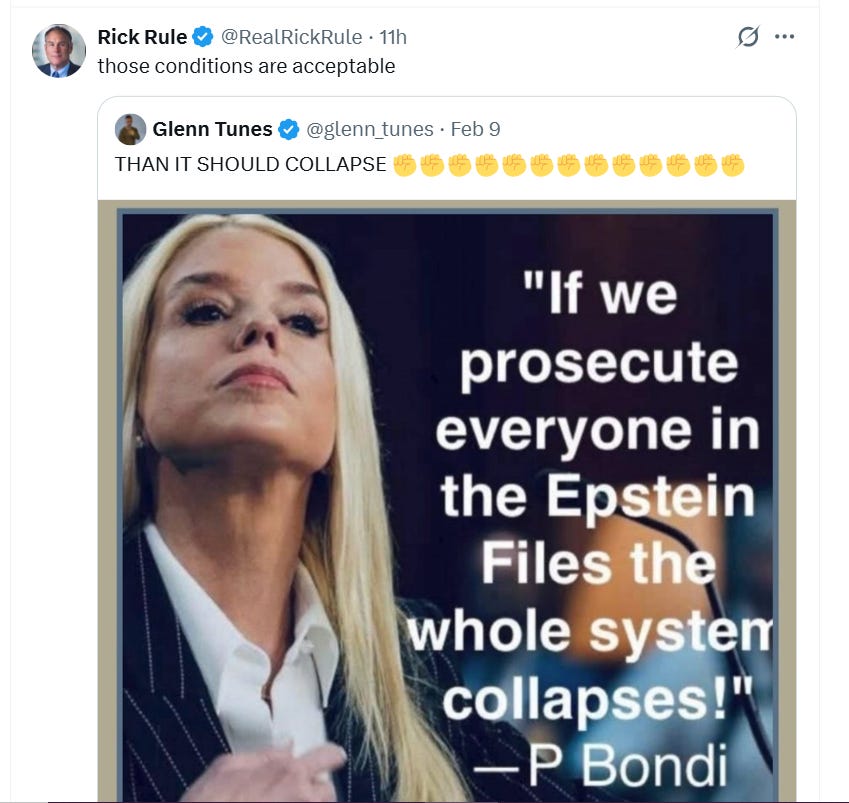
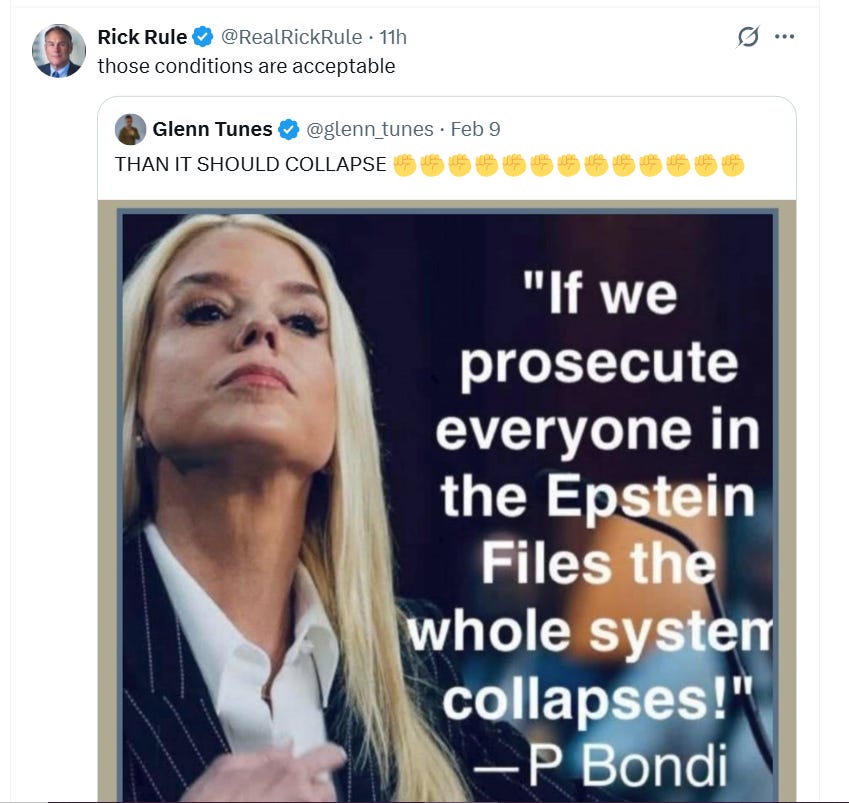
Let’s stop pretending we don’t see it. The gilded rot that ran through the Trump years wasn’t accidental—it was engineered. A cabinet of cronies, fixers, sycophants, and billionaires handpicked not for their competence, but for their silence. Every name reads like a roll call of moral bankruptcy. These were not public servants; they were liabilities turned gatekeepers, men with too much to hide and too much power to lose.
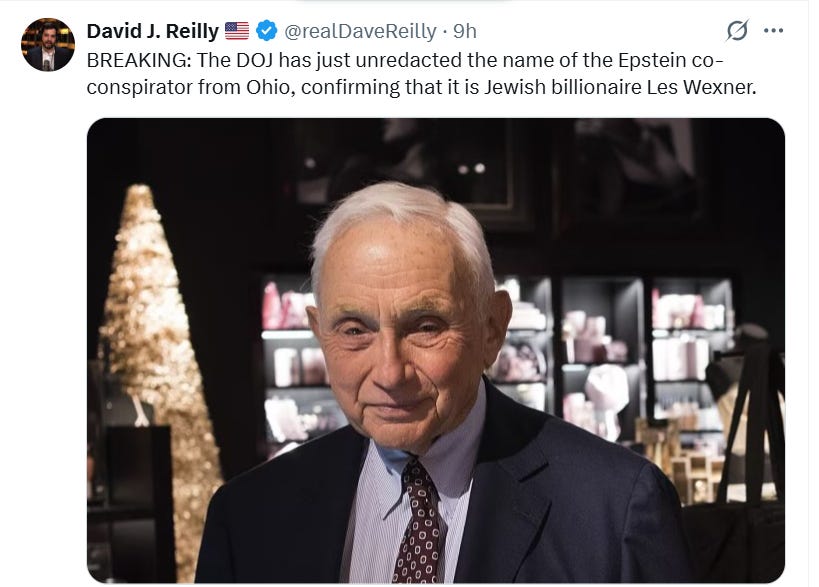
The Epstein scandal should have been the reckoning. Instead, it became a shield for the rich and connected. Steve Bannon, Les Wexner, Leon Black, Howard Lutnick—the list keeps going, and the silence from the justice system is deafening. Zero consequences. Zero accountability. The message is clear: in America, wealth doesn’t just buy influence—it buys absolution.
We were told this was democracy. What we got instead was an oligarchy draped in red, white, and blue. Institutions meant to protect us were repurposed to defend predators in designer suits. These people build foundations to polish their legacies while laundering their reputations. Meanwhile, the public remains anesthetized—distracted, divided, exhausted by the constant hum of corruption normalized.
This isn’t politics anymore; it’s moral triage. The system that shields billionaires while crushing ordinary citizens isn’t broken—it’s functioning exactly as designed. Until the architects of that machine are forced to face consequences, we remain prisoners in their illusion of justice. The time for disbelief is over. The time for reckoning is now.
The new Epstein files and related document releases show several figures tied to Trump’s orbit.
Among Trump officials and close insiders, the ones explicitly named include:
-
Donald Trump himself, whose name appears thousands of times in emails, tips, and references, though the documents so far have not provided direct evidence of him committing sex trafficking or sexual abuse.
-
Steve Bannon, former White House chief strategist, who exchanged multiple friendly emails and texts with Epstein, including discussions about a possible image-burnishing documentary.
-
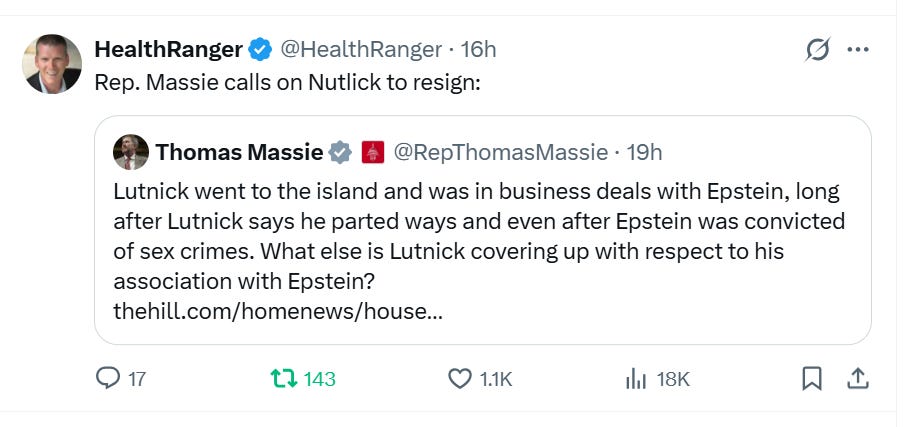
Howard Lutnick, Trump’s commerce secretary, who is described as having visited Epstein’s Caribbean island and maintained contact and business-related communications with him after Epstein’s 2008 conviction. Lutnick was still doing business with Epstein into 2014.
The files also feature numerous mentions of Trump-adjacent figures (for example Elon Musk, Brett Ratner, and other billionaires and donors) who are not formal “officials” but are part of his broader inner circle.
Crucially, across these releases, multiple outlets stress that being named in the files or appearing in emails does not, by itself, constitute proof of participation in sex trafficking or abuse, and as of now the documents have not produced such direct evidence against Trump, Bannon, Lutnick, or other Trump-world figures.
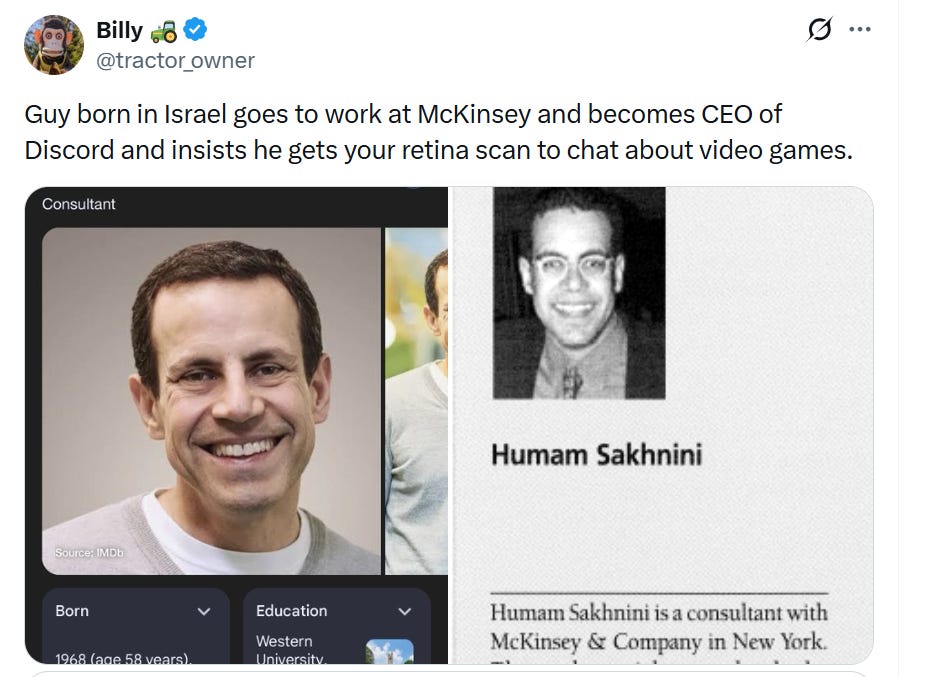
You getting it yet? The people sitting on top of tech, media, and finance aren’t “rising stars” — they’re installed hardware.
They don’t earn those thrones; they’re vetted for obedience, not brilliance. A guy like Human Sakhnini goes from McKinsey to running Discord and suddenly your casual gaming chat comes with a demand for a retina scan. That’s not innovation; that’s soft-launch authoritarianism. Meanwhile, Palantir quietly hoovers up voting records, tax data, bank trails, citizenship status, health files — a god-mode database for whoever owns the state. This isn’t a market. It’s a control grid wearing a hoodie.
// end of segment
Meanwhile, South of the Border
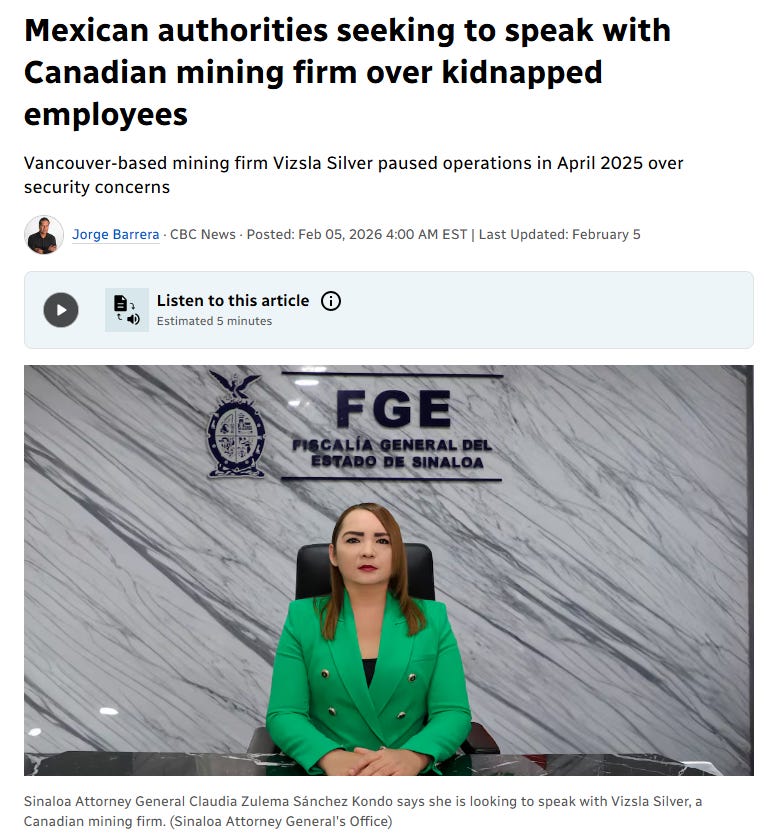
Why Didn’t Vizsla Work Directly With Sinaloa’s Attorney General After Its Workers Were Kidnapped?
The human tragedy here is paramount. The suffering of the victims and the anguish of their families must come before any discussion of markets. Our thoughts and prayers are with them, and their safety and dignity matter infinitely more than stock tickers or share prices.
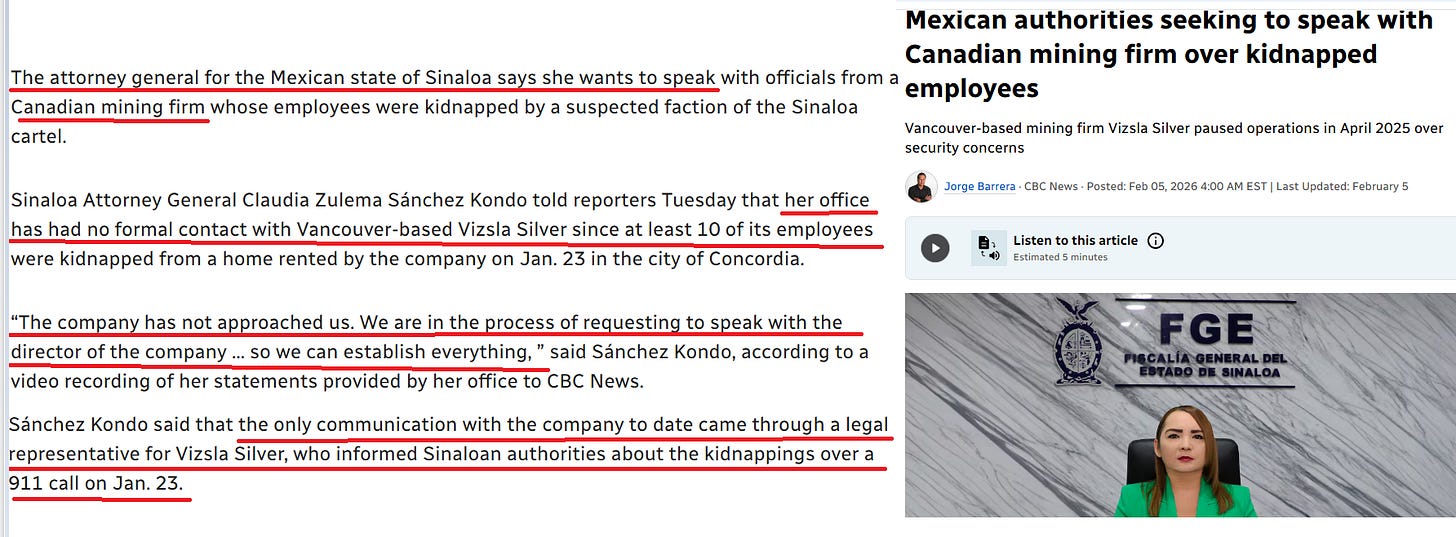
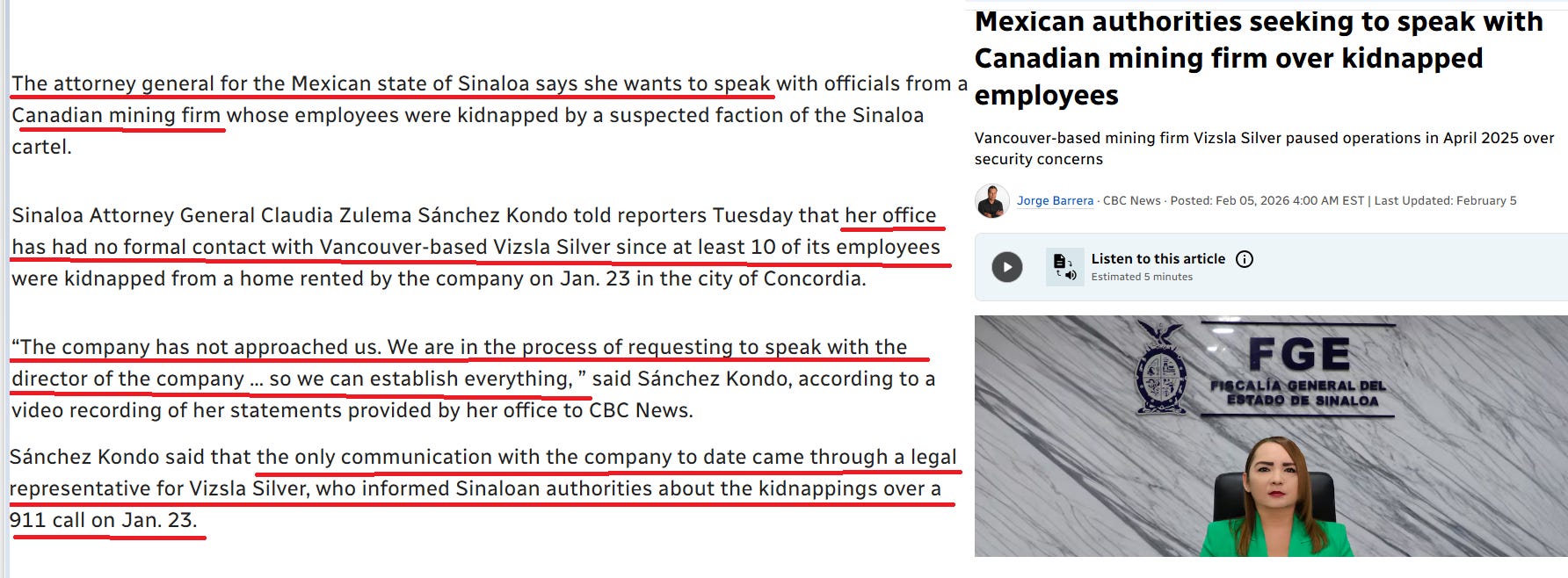
Mexican authorities say Vizsla Silver’s only direct contact after the mass kidnapping was a single 911 call from a legal representative, and that the company has not otherwise approached investigators or filed missing persons reports for its own workers. That vacuum of engagement forces the question:
“Why did Vizsla effectively hide behind an emergency call instead of engaging directly and transparently with the authorities tasked with finding its employees.”
Framing the core question
The Sinaloa attorney general has publicly stated that her office “has not had any official communication with Vizsla Silver” beyond that initial 911 report, and that they are now having to seek out the company’s leadership for basic clarifications. At the same time, relatives of the missing workers have denounced both a lack of communication and a lack of institutional support from the company, even as the state deploys hundreds of troops and aircraft to search remote areas around Concordia.
In that context, any serious examination of Vizsla’s conduct must probe whether this passivity reflects incompetence, a lack of familiarity with Mexican legal norms and crisis-response customs, or a deliberate strategy to minimize legal and reputational exposure. If the strategy was to minimize reputational exposure it is significant to note the stock is down over 30% this past month.
Authorities have noted that families, not Vizsla, filed the only formal missing persons reports on record, sharpening doubts about whether the company understands – or is willfully sidestepping – basic procedural expectations in a country grappling with widespread disappearances and cartel violence.
Lines of inquiry for an investigative news article
An investigation could explicitly pose questions such as:
-
Why did Vizsla rely on a lone 911 call instead of promptly initiating sustained, direct contact with the Sinaloa attorney general’s office and other investigative bodies?
-
Why were families, rather than the employer, left to submit missing persons reports, despite Vizsla’s public claims that worker safety is its top priority?
-
Did Vizsla’s crisis protocols, shaped in Vancouver boardrooms, fail to account for Mexican norms in cases of mass kidnapping and disappearance, where companies are expected to maintain continuous dialogue with investigators and victims’ families?
-
To what extent did prior security incidents at the Panuco project, and previous temporary shutdowns due to violence, prepare (or fail to prepare) Vizsla’s leadership for a foreseeable emergency of this kind?
By centring these questions, one can view Vizsla’s behaviour not as a minor communication lapse but as a potential symptom of deeper corporate unpreparedness for operating in a region marked by cartel conflict and a long history of disappearances.
It may be one thing for the owners of a private company to be naive or incompetent, but it is unacceptable to expose public shareholders to those same failures.
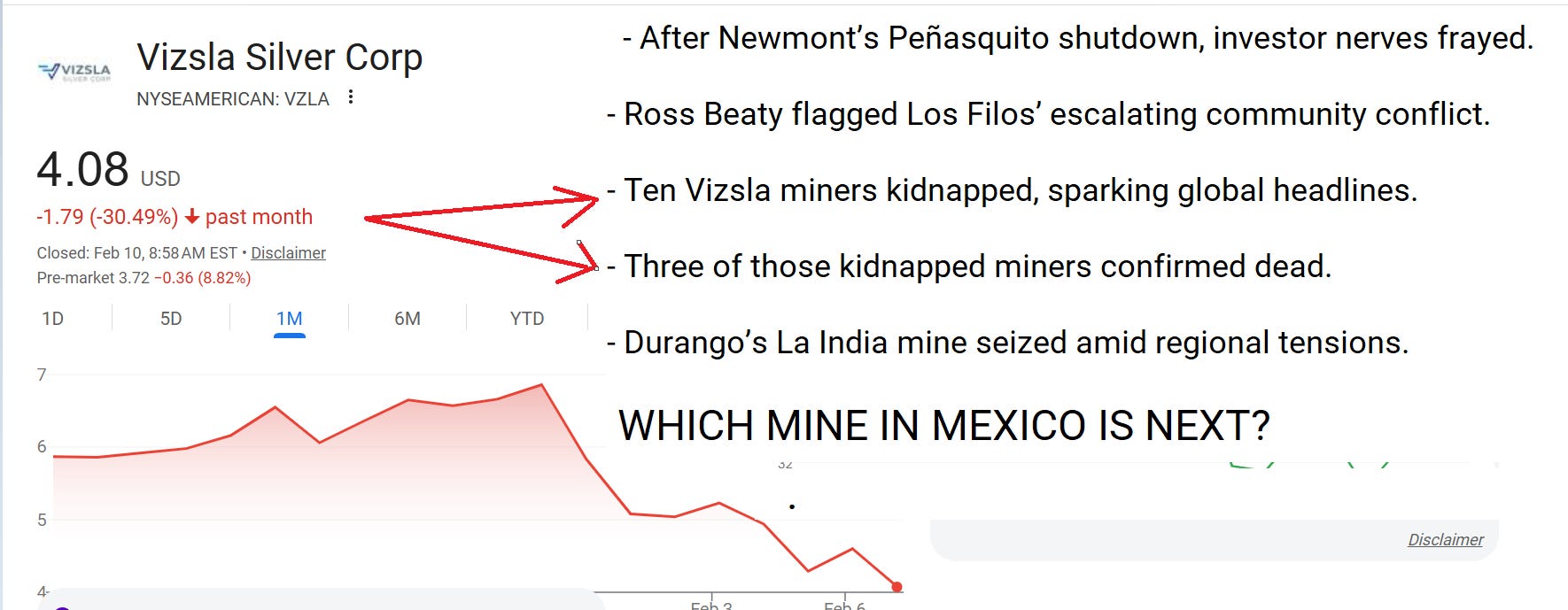
CBC’s coverage of the incident centers on 10 workers from Canadian‑owned Vizsla Silver who were kidnapped near Concordia, Sinaloa (about 50 km east of Mazatlán), with reports that some have been found dead. Here is a consolidated summary of the key details from CBC‑related reporting:
What happened
-
On January 23, 2026, 10 employees of Vizsla Silver Corp., a Vancouver‑based mining company, were abducted from its Panuco silver‑gold project near the town of Concordia, Sinaloa, as they travelled from their camp to the mine site.
-
The area is described as being under the influence of “Los Chapitos”, a faction of the Sinaloa cartel, and the kidnappings are linked to ongoing cartel‑related violence in the region.
Status of the missing miners
-
Initially, all 10 workers were reported missing; Vizsla Silver said it had notified Mexican authorities and suspended operations at the site.
-
However, the attorney general states Vizsla Silver has not contacted their office alleging they hid behind a 911 call instead – CBC source article, https://www.cbc.ca/news/world/sinaloa-vizsla-chapitos-9.7074596
-
On February 6, Mexican authorities announced that bodies and human remains were found in the search area around El Verde, Sinaloa, and that one body appeared to match one of the missing Vizsla employees, though identities were not yet fully confirmed.
-
By February 8–9, CBC‑style reporting notes that three of the 10 kidnapped miners have been identified as dead, with their names given in Mexican‑language media and mining‑sector outlets as Ignacio Aurelio Salazar, José Ángel Hernández, and José Manuel Castañeda Hernández.
-
Mexican authorities later indicated that at least five of the 10 missing workers have been found dead, but CBC‑related stories emphasize that families and the company are still awaiting official confirmation from Mexican prosecutors.
Company and government response
-
Vizsla Silver has said it is devastated by the deaths and is focused on the safe recovery of any remaining missing workers and supporting affected families.
-
The company’s Panuco project has been largely shut down since the abductions, and its shares have fallen sharply on the Toronto and U.S. exchanges.
-
Mexican federal and Sinaloa‑state authorities have arrested several suspects linked to the kidnappings and have been conducting military‑led searches in the rugged, cartel‑affected hills near Concordia.
Location and context (Mazatlán / Sinaloa)
-
The mine site is in Concordia, Sinaloa, roughly 50 km inland from Mazatlán on the Pacific coast, an area that has seen intense turf‑war violence between rival Sinaloa‑cartel factions since 2024.
-
CBC‑related reports stress that the incident underscores security risks for foreign mining firms operating in parts of Sinaloa, where criminal groups often target workers and infrastructure.
end of segment
-
our opinions are not our sponsors opinions
-
the editorial department is separate from the promotions department
-
not financial advice