
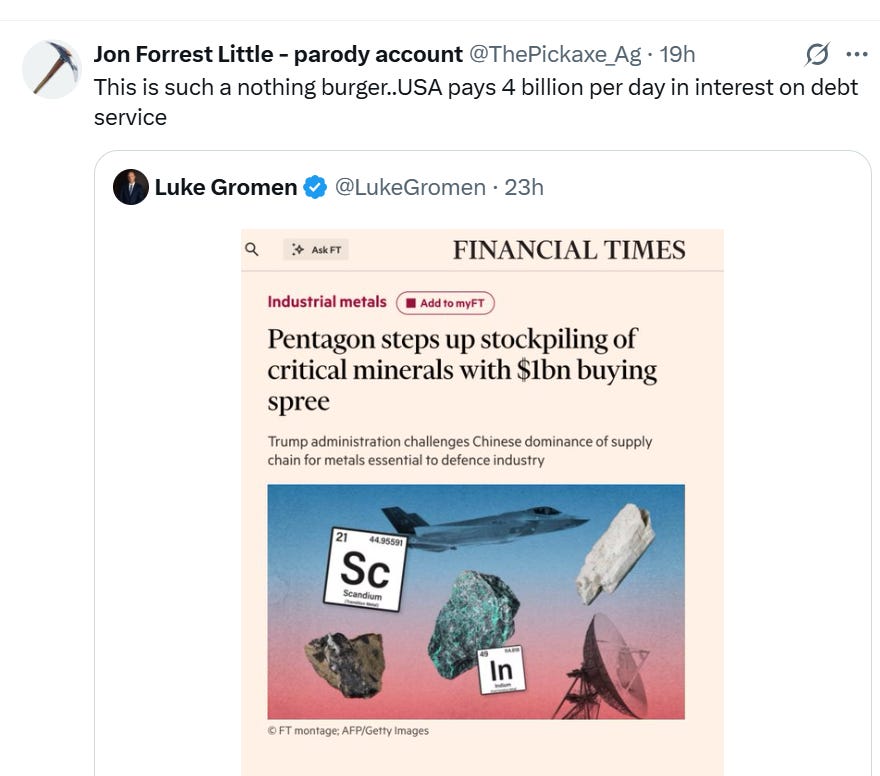
A Pentagon buying spree of $1 billion in rare earths is trivial compared to daily U.S. interest payments of $4 billion on a $37 trillion debt; the headline exaggerates its significance dramatically
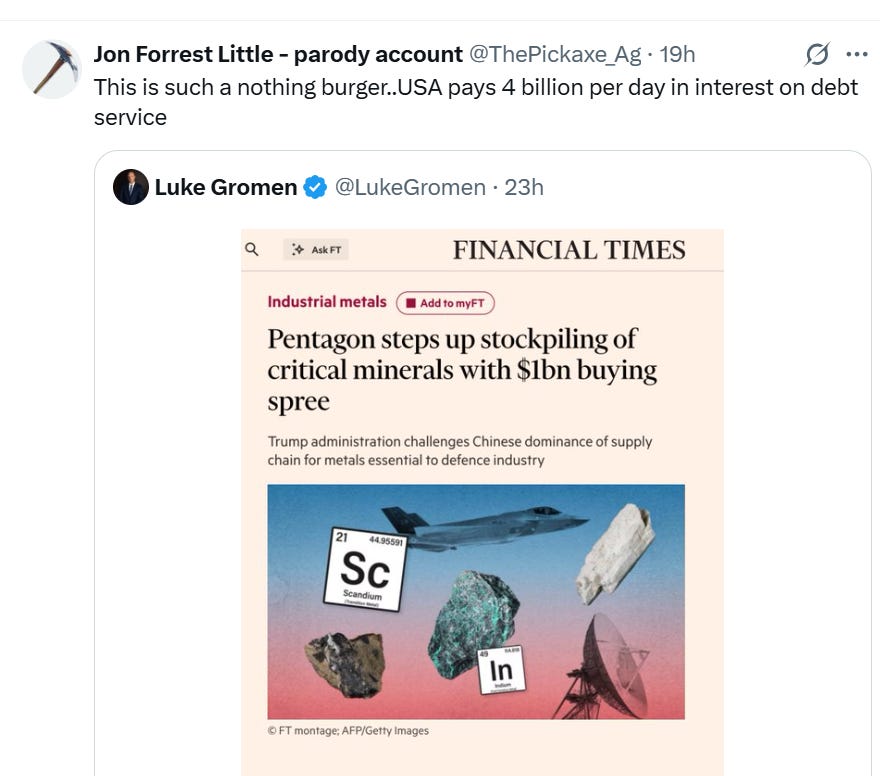
“Rare” or Just Hard to Get? The Chemistry Behind the Myth
Few catchphrases in science are as misleading as “rare earths.” The label itself evokes visions of obscure, vanishing metals, but the real twist in the story is that most of them aren’t rare at all. Back in the age of early chemistry, elements like cerium and lanthanum earned their “rare” reputation not because they hid deep within the planet, but because they never appeared alone and defied easy isolation. Today, we know that cerium is more abundant than copper, and that many other rare earths—like lanthanum and neodymium—are sprinkled generously throughout Earth’s minerals, often more so than metals we mine every day for industry and technology.
Behind the Hype: Mining’s True Challenge
For all their “scarcity,” what sets rare earths apart isn’t their geologic riddle, but a chemical one. Unlike gold or platinum, which appear in concentrated, mineable veins, rare earth elements are enmeshed together and tangled with lookalike neighbors. This resemblance, rooted in almost indistinguishable chemical properties, transforms extraction into a daunting puzzle. Mining rare earths is not a thrilling treasure hunt but a demanding chemical marathon—separations require sequences of reactions, caustic acids, and generate toxic waste, all to tease out differences so small they might be called trivial in any other context. The real bottleneck is not supply, but the process.
The Real Drama: Geopolitics, Technology, and Supply Chains
So why all the drama around rare earths in the headlines? The answer lies in supply chains and geopolitics. China, home to the majority of rare earth production—and, crucially, the chemical expertise to refine them—possesses a near-monopoly not by geological lottery, but by mastering the environmental and technical costs other countries have been reluctant to bear. Concerns over strategic vulnerability are born from this dominance, not any impending actual shortage. If investment and regulation allowed, more countries could process these metals, as nature put them everywhere. The bottleneck is in know-how and will, not natural abundance.
Fact vs. Fiction: Rethinking What We Mean by “Rare”
Unraveling the rare earths myth exposes the bigger issue: we too often confuse difficulty with scarcity. Precious metals like gold and platinum are genuinely rare by every measure, but rare earths are “rare” in name only. Their value and the current anxiety surrounding them come from the skill and industry it takes to extract them—environmentally, technically, and economically.
The Bottom Line: Ingenuity Transforms Abundance
What’s truly rare, then, is not cerium or neodymium, but the combination of human ingenuity, infrastructure, and international will to transform these plentiful elements into the backbone of modern life. “Rare earths” aren’t vanishing—what’s truly scarce are the investment, engineering, and cooperation required to unlock their potential. In the end, it isn’t nature holding these elements captive, but our ability—and willingness—to set them free.
Ranking Common Mining Metals
Let’s take a journey through ten metals—beginning with the classics (gold, silver, copper, platinum, palladium), then exploring the “rare earths.” We’ll see that rarity is often a story about extraction, not presence in Earth’s crust.
1. Gold
Gold is most chased for its value and allure, yet its abundance is just around 4 parts per billion in the Earth’s crust, making it truly scarce in absolute terms. Most is found in miniscule concentrations, requiring tons of ore for mere grams. There are only 6.8 billion ounces above ground and as we discuss on this channel (and as indicated by Exter’s pyramid) is the World’s Reserve Currency because it is a neutral asset and the US dollar is a toxic asset.
2. Silver
Silver, is equally precious. There are less Silver ounces than Gold above ground because industrial use leads to depletion. It is mined both as an ore and as a byproduct in other metal operations. Silver is now back in the monetary metal seat which will drive the Gold to Silver Ratio much lower (probably towards 50 by next year)
3. Copper
Copper is essential and becoming less common as some of the World’s largest deposits are shut down due to political and environmental restrictions (even some Natural disasters) though it was once ranked among the most heavily mined non-ferrous metals. Concentrated deposits are needed for profitable mining.
4. Platinum
Platinum is indeed rare (about 5 parts per billion), with extraction concentrated in countries like South Africa and Russia. Its uses in industry have made it critical despite low availability.
5. Palladium
Palladium is another platinum-group metal, even rarer (about 0.015 parts per million). Its demand has risen with its vital role in catalytic converters for vehicles.
6–10. Rare Earth Elements (REEs)
Now, let’s talk rare earths: cerium, lanthanum, neodymium, praseodymium, and dysprosium.
-
Cerium: The most abundant REE, with about 66.5 parts per million—more than copper!
-
Lanthanum: At 39 ppm, it’s about as common as lead.
-
Neodymium: At 41.5 ppm, it’s in the same league.
-
Praseodymium: 9.2 ppm—less than copper, but still not truly rare.
-
Dysprosium: 5.2 ppm—rarer, but not astronomically so.
Compare these with platinum, palladium, silver and gold—true scarcity!