
Rothschild’s Warning on Financial Power Remains Relevant
A historical quote attributed to Mayer Amschel Rothschild is gaining renewed attention:
“The few who understand the system will either be so interested in its profits, or so dependent on its favors, that there will be no opposition from that class.”
This perspective highlights how the architecture of modern finance enables those with insider knowledge to benefit directly from its profits or become reliant on the advantages it grants.
This creates a group whose interests are tied to maintaining and defending the established financial order. As a result, meaningful opposition to the system rarely comes from within, even if the broader population experiences disadvantages or inequities. The enduring structure of high finance thus not only concentrates wealth and privilege but also preserves itself by minimizing dissent from those closest to its core.
Economist Richard Werner, appeared on Tucker Carlson’s show to discuss the origins of central banking.
During the conversation, Werner exposed how the foundation of central banking involved influential families from both Germany and the USA, specifically the Warburg brothers.
One brother, Paul Warburg, was instrumental in establishing the Federal Reserve in the United States, while his sibling Max Warburg was a significant figure in German banking.
Werner argued that even during World War I, when the two nations were enemies, the brothers’ actions and shared interests suggested a secretive collusion that influenced international banking systems and policy outcomes, exposing connections rarely discussed publicly
watch this short video segment below:
The Federal Reserve—History’s Most Brazen Power Grab Hidden in Plain Sight
Ask yourself: Why has every major “reform” in modern America—from finance to war to education—somehow ended with you more dependent, and the elites more powerful?
Why, on the edge of every new crisis, does it seem the only constants are mounting national debt and the omnipresent hand of the Federal Reserve? Let’s rip away the mask from the so-called central bank, the single most audacious and poorly understood mechanism of power ever imposed on a democratic nation.
Is it any surprise that the Federal Reserve itself was born from secrecy, deception, and collusion? In 1912, as the Titanic slipped beneath the freezing Atlantic, some of America’s most prominent opponents to a central banking cartel—Astor, Guggenheim, Straus—vanished forever.
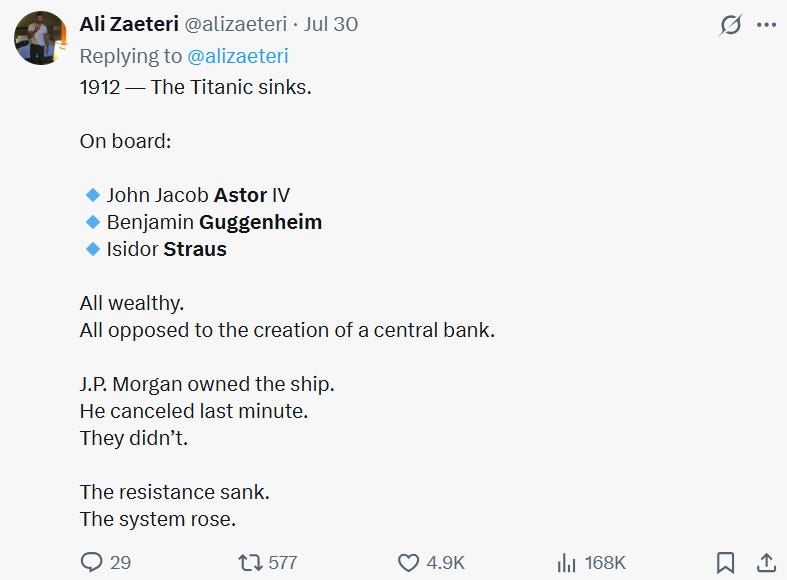
J.P. Morgan, whose banking empire most stood to profit from such a system, conveniently canceled his journey at the last minute. Coincidence, or coup? Ask yourself who benefited as resistance was silenced, and the system rose from the wreckage.
By December 23, 1913, while most of Congress headed home for Christmas, the creature from Jekyll Island was birthed—not by any populist demand, but by a cabal of Wall Street and European financiers, led by Paul Warburg. Why was this German-Jewish Rothschild proxy—an outsider—invited to design America’s money system?
Why did no press cover the clandestine meeting on Jekyll Island, where Warburg, Aldrich, Morgan, and their ilk crafted the plan to privately control public currency? What did they fear you would know?
Think about this: The new “Federal” Reserve is neither federal, nor does it possess reserves. It’s a private banking syndicate, with power to issue and lend fiat dollars at will, then collect the principal and interest from the labor of everyday Americans. They print and inflate. You work and repay. Your prosperity is their asset, your struggle their interest due. Can anything be more flagrantly backwards, more contemptibly exploitative?
But the tentacles didn’t stop at money. Ask yourself why the same year America lost her monetary sovereignty, she also birthed the IRS—the machinery to extract taxes from your very sweat. Why did the men who engineered new currency, which cost them nothing to print, immediately demand a claim on your paycheck? What is “income tax” but legalized tribute, binding you forever to a debt racket you never elected? If funding government was the goal, why must citizens bleed, while banks collect compounded interest year on year?
Why has nearly every “philanthropic” foundation founded in 1913—the Rockefeller Foundation, the American Cancer Society, the ADL—served mainly to warp medicine, silence speech, and secure new forms of dependency? Can you really not see the pattern? These “gifts” funded not the public good, but ever-tighter control over education, science, and even your basic biology. Has industrialized medicine cured disease, or just manufactured new lines of profit? Has the ADL defended civil rights, or policed dissent to insulate the very architects of your enslavement?
What followed was catastrophe dressed as progress. One year later: World War I—funded on banker credit, an industrial charnel house enriching the likes of Morgan, Rothschild, and Warburg.
With every war after, the playbook grew clearer: Problem, Reaction, Profit. Who profits from funding both sides, then collecting on the ashes? How much blood must be spilled before we see the Fed profits from chaos far more than from peace?
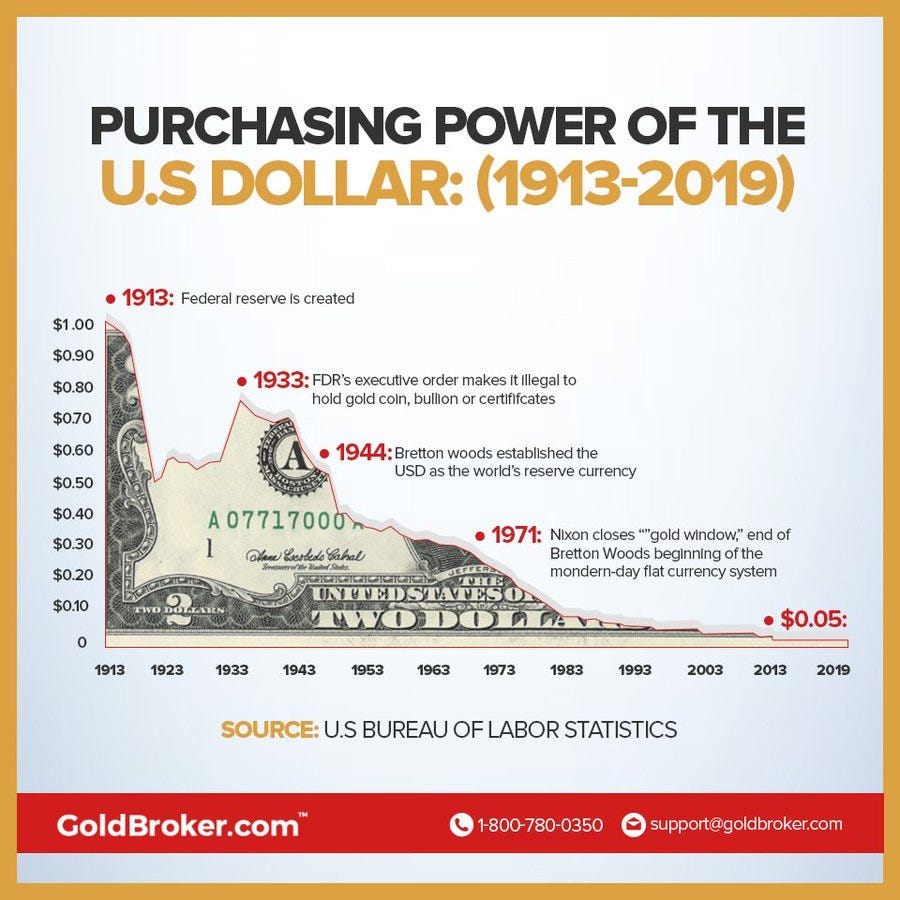
Now, stop and look around: The dollar is a pale ghost, worth less than 1% of its 1913 value—a century’s wages stolen with a printing press. The middle class, once the engine of democracy, is strangled by inflation, debt, and taxation. Endless wars, economic booms and busts, a national debt measured not in billions—but in trillions. At every hinge of history, the Fed stands unchanged, unaccountable, unchallenged.
Why do we permit it? Why does every president, every senator, every major party play along—save Ron Paul, whose lone calls to “end the Fed” are met with laughter, ridicule, or silence? Are we so enthralled by the circus of politics, so divided by bread-and-circus media, that we ignore the one true root of nearly every American ill?
Look at the record: Since 1913, every American crisis is engineered atop a banking edifice built on fraud and designed for dominance. The schools—funded by foundations, writing the narrative. The media—owned by the same interests, selling the illusion of debate. The politicians—funded and blackmailed by the very cartel they pretend to regulate.
So I ask again: When will we admit that what happened in 1913 was not progress, but occupation? When will we tear away the illusion that “the Fed” is some neutral guardian of stability, rather than the keystone of a parasitic, unaccountable elite whose entire empire is leveraged on your ignorance?
America didn’t lose her liberty in battle, but in signatures. The greatest heist in history happened in open daylight, disguised as bureaucracy. If we have any hope of reclaiming true freedom, it starts by naming and ending the Federal Reserve for what it is: the beating heart of a system built not to serve you—but to own you, forever.