
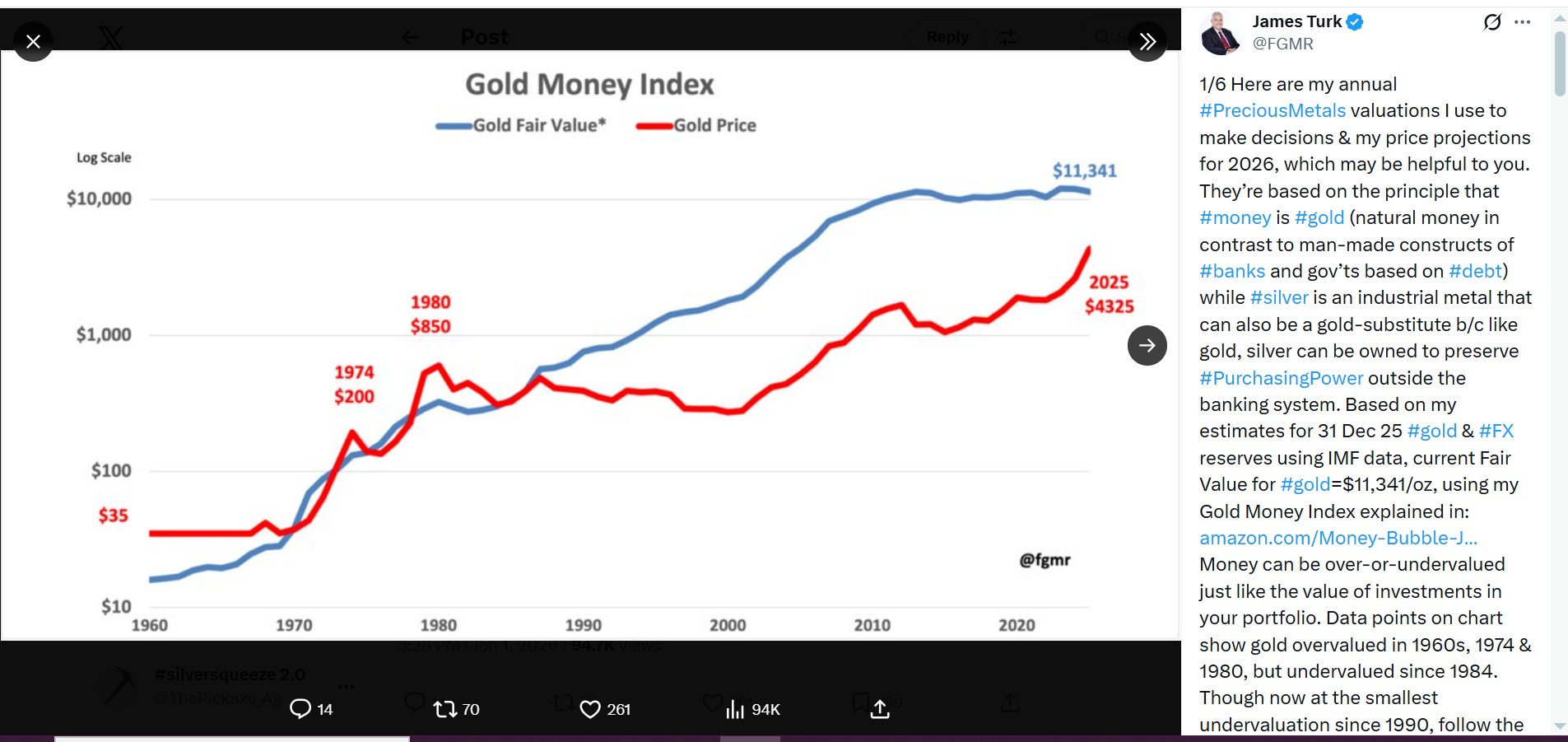
Gold and silver are not just “going up.” They are in the early stages of a structural revaluation that flows directly from how modern money is created, how fiat currencies are being destroyed, and how real assets behave in every major monetary breakdown. James Turk’s updated fair-value work simply quantifies a process that is already well underway.
Gold: natural money, systematically undervalued
The starting point is simple: money is not a government promise; it is a tangible asset with no counterparty risk, and for 5,000 years that has meant gold. Fiat currencies – dollars, euros, yen – are credit instruments, born as debt on a fractional-reserve banking balance sheet and expanded whenever governments and central banks choose to borrow and print more.
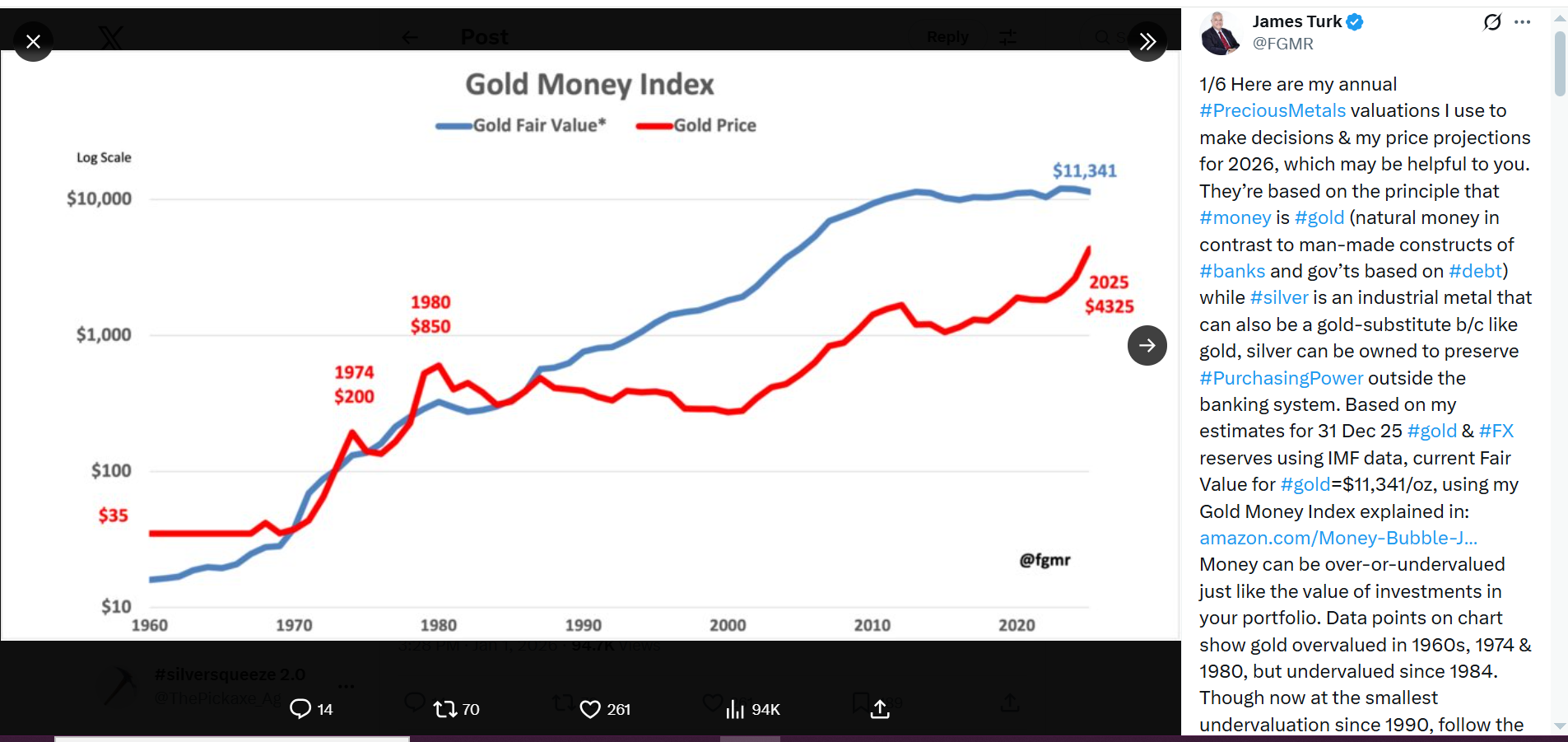
Turk’s Gold Money Index takes this monetary reality seriously by valuing gold against global foreign-exchange reserves, not against today’s manipulated spot quote. On that basis, his current fair value for gold is around $11,341 per ounce – roughly where the price would trade if it fully reflected the size of central-bank balance sheets and FX reserves. Historically, gold has not just reached fair value at major cycle peaks; it has overshot it dramatically, by 128% in 1974 and 162% in 1980, as confidence collapsed and capital fled paper into metal. Apply a similar overshoot to today’s fair value and you arrive at potential peak levels far above current prices, even before allowing for further growth in reserves and debt.
In other words, on the metrics that matter – central-bank liabilities vs. gold reserves, the Fear Index, and historical overshoot behavior – gold is not in a bubble; it is still undervalued against a fiat system that has exploded in size since 2008.
Silver: monetary kicker on top of industrial demand
Silver is doubly compelling because it is both an industrial necessity and a monetary metal that shadows gold. Geologically and in mine output, there is roughly ten times as much silver as gold by weight, yet the long-run monetary ratio has hovered closer to 16:1 because the market pays a premium for gold’s pure monetary role.
Using Turk’s gold fair value of $11,341, a conservative gold/silver ratio of 30:1 implies a silver fair value of about $378 per ounce, while a more aggressive but historically grounded 20:1 ratio yields $567 per ounce. Those levels are not pulled from the air; they are what you get when you price silver as a scarce monetary asset riding on the back of revalued gold, not as a mere byproduct of base-metal mines. In 1980, silver’s spike to nearly $50 represented a speculative overshoot to a 17:1 ratio when gold’s fair value was around $325, implying silver’s fair value back then was closer to $19. Today, by contrast, silver demand is increasingly driven by hard industrial use – solar, EVs, electronics – at the same time as monetary demand rises and China moves to treat silver as a strategic resource, tightening export controls in a replay of the rare-earths playbook.
That combination – structural industrial deficits plus an eventual compression of the gold/silver ratio toward 30:1 or even 20:1 – makes silver the high-torque play on the same monetary revaluation that is lifting gold.
Fiat decay, Fear Index, and the end of trust
The driver behind both metals is the same: systemic loss of trust in fiat promises. Turk’s Fear Index measures the value of gold backing each $100 of US M2; most of that “money” is backed not by metal, but by debts that may or may not be repaid in real terms. In the Great Depression, the Fear Index soared toward 30% as depositors questioned bank solvency and rushed into gold; in recent years it has been at historically low single digits, but is now rising again as debt loads, deficits, and banking strains mount.
Every major fiat breakdown follows the same pattern: gradual erosion of purchasing power, then a sudden repricing as people realize that what they hold are promises, not money. History’s charts – Weimar Germany, Argentina, Venezuela and others – all show the same thing: local stock markets and nominal asset prices can rise, but gold and silver, priced in that currency, rise orders of magnitude faster as capital escapes the system. Today’s patterns in Japan, the UK, the EU and the US echo those early-stage trajectories, with surging debt, negative real yields, and rising political and geopolitical risk.
Against that backdrop, moving purchasing power from bank deposits and sovereign debt into physical gold and silver is not speculation; it is risk management – an exit from a leveraged promise into an asset that settles itself.
A new regime for price discovery
Finally, the case for gold and silver strengthens as price discovery migrates away from leveraged paper markets toward physical supply and demand. For decades, futures and derivatives have allowed enormous synthetic positions to be built on thin inventories, suppressing prices relative to fundamentals. But when industrial users and sovereigns are bidding aggressively for limited physical stock – as evidenced by tight inventories, backwardation, and real-world premiums – derivatives lose their power to dictate the real clearing price.
China’s move to tighten silver export controls, reclassifying it as a strategic resource in line with rare earths, is precisely the kind of shift that forces price discovery into the physical arena. As that process accelerates, spot quotes will be dragged toward Turk’s fair-value band for gold and silver, and – as history shows – are likely to overshoot before a new equilibrium is reached.
Gold is the anchor. Silver is the leveraged expression. And the fiat system that measures them is the bubble. In that configuration, owning physical metal is not a trade; it is the rational response to a world where promises are multiplying faster than trust.
end of segment
-
our opinions are not our sponsors opinions
-
the promotion department is separate from the editorial department
-
not financial advice