
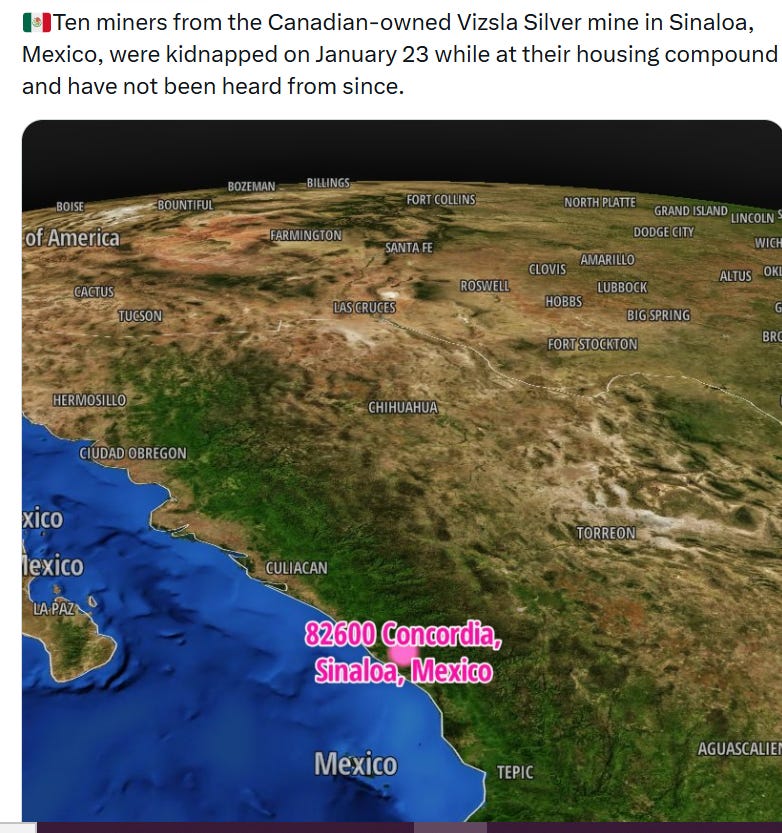
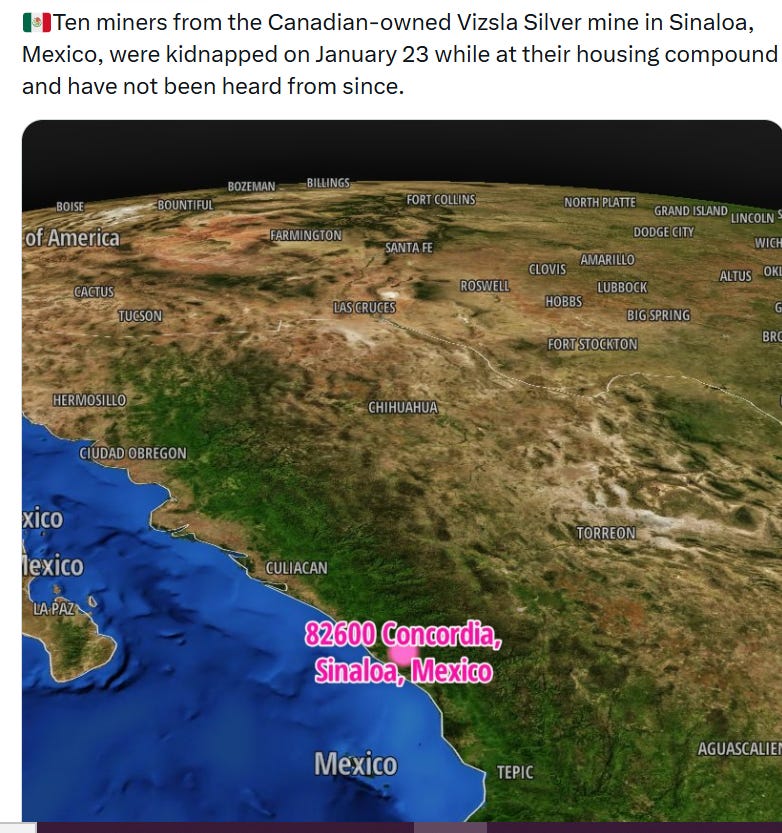
Still No Word: Ten Silver Miners Missing in Mexico
Tragedy enters Day 11
Miners like First Majestic, Their Silence is Deafening
Imagine, for a moment, the reaction if this were not ten mining engineers in rural Sinaloa, but ten familiar workers in the United States or Europe.
If ten Starbucks baristas vanished after a closing shift, cable news would break into live coverage.
Politicians would jostle for cameras, vowing justice.
If ten Amazon warehouse employees disappeared, unions and labor advocates would flood social media, nightly talk shows would demand answers.
If ten first‑grade teachers simply didn’t come home, cities would organize vigils, schools would close, and international pressure would mount until someone was found.
That level of empathy and urgency is precisely what these ten miners do not have right now. We have not heard one statement from
– It is fair to say that, as of this writing, we have not seen a single public statement from First Majestic Silver addressing the kidnapping of the ten miners in Sinaloa.
It is also fair to say that we have not seen any public statement from Pan American Silver on this abduction or on the broader security crisis it represents for Mexico‑exposed mine workers.
Likewise, we have not seen any public statement from MAG Silver acknowledging these missing workers or calling for heightened protections for personnel working in high‑risk Mexican jurisdictions
Vanished Without a Trace
According to Mexico News Daily, the ten workers employed by a subcontractor linked to a Canadian silver company disappeared while traveling in Sinaloa, a region long caught between cartel violence and mineral wealth.
As of Day 11, there is still no confirmed communication, ransom demand, or credible lead—only families growing more desperate, and a government whose public statements have been minimal.
The story has barely made a ripple in North American media. Yet these are skilled technical workers—geologists and engineers—vital not only to local livelihoods but to global silver supply chains. Their disappearance should be treated as an international crisis within the resource sector, not a local crime story.
The Broader Pattern of Risk
Mexico sits at the heart of the global silver market. It is the world’s largest producer, responsible for roughly a quarter of global mine output. But the disappearance of these miners underscores an unspoken truth: jurisdictional risk in Mexico is no longer hypothetical—it is human.
For years, mining analysts have warned that Mexico’s state policy under the Morena government has tilted toward resource nationalism. President Claudia Sheinbaum, following Andrés Manuel López Obrador’s legacy, has pledged no new mining concessions and an explicit drive to reclaim “strategic resource sovereignty.” That stance has already chilled foreign investment and complicated permitting timelines.
Yet beyond regulatory friction lies something much darker: rising physical insecurity across the mining corridor. Incidents of worker abductions, equipment theft, and community blockades have increased sharply since 2023. Companies operating in Durango, Zacatecas, and Sinaloa report escalating demands for “protection payments” and expanding cartel presence along access roads.
In this environment, even well‑funded operations with private security remain vulnerable. The disappearance of ten technically trained employees reveals a structural breakdown in law enforcement capacity—a collapse of not only contract law but of basic humanitarian protection.
A Public Issue, Not a Corporate One
This story should not be framed merely as a “mining‑sector risk.” These missing workers are fathers, sons, and neighbors—ordinary professionals who wanted to earn an honest living. Their plight is part of a national crisis that spans industries: journalists, teachers, doctors, and municipal officials have all disappeared under similar circumstances.
The silver industry simply happens to be one of the most visible mirrors reflecting that instability. The difference is that global consumers rely on Mexico’s silver every day—hidden inside solar panels, electric vehicles, circuit boards, and mirrors. The world’s transition to clean energy and advanced manufacturing literally runs through regions where workers cannot safely drive home at night.
Pressing for Accountability
There is no evidence yet of government complicity, but just weeks prior to this incident Mexican officials did seize a mine in Durango.
Meanwhile, Mexico’s federal authorities have released only brief statements acknowledging the search. International embassies have not issued strong public pressure campaigns. The families of the missing miners—left without resources or media amplification—are pleading for help in a vacuum.
This must change.
International mining associations, labor groups, and human‑rights organizations should treat this as an emergency case. Every day that passes without news is another day of normalization—another quiet reminder that disappearances in Mexico can occur without consequence.
If silver is to remain a legitimate global commodity, its supply chain must not depend on environments where professionals vanish without trace and the public shrug follows.
A National Turning Point
This tragedy arrives at a moment when Mexico’s government is reshaping its entire approach to foreign resource ownership. Moves toward joining BRICS and tightening state control over lithium, silver, and hydrocarbons suggest a broader pivot away from Western partnership models.
When that political shift coincides with rising criminal impunity on the ground, foreign investment is not merely discouraged—it is endangered. The lesson extends beyond mining to every international industry operating in Mexico’s rural states: contracts cannot protect against lawlessness.
If the government cannot secure the safety of its own technical workforce, then all its talk of resource sovereignty rings hollow. Sovereignty begins with protecting citizens, not metal reserves.
Refusing to Forget
Day 11 is not just a timestamp—it is a warning. The mining world must not let the clock run out on public attention.
These ten missing miners are more than a headline; they are proof that the global silver story includes real human costs. The least the world can do is keep asking what happened to them—loudly, persistently, and until answers come.
end of segment