
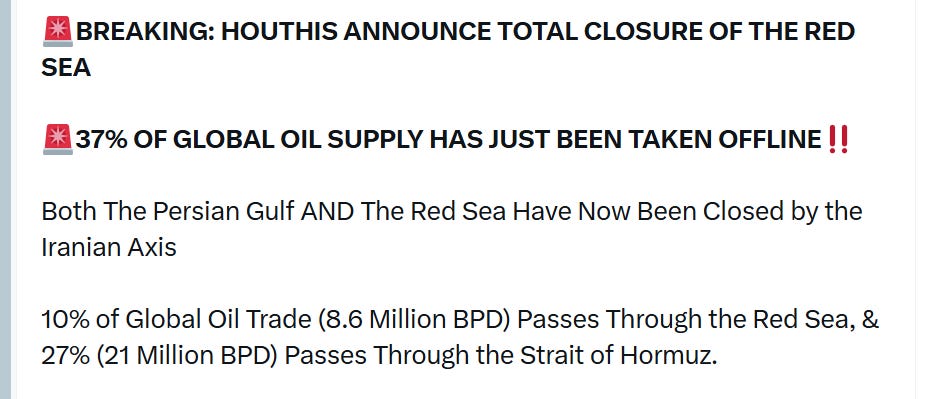
INFLATION BY DESIGN, NOT BY ACCIDENT
This war is a textbook inflation engine, a moral failure, a strategic blunder, and—crucially—a political loser. Iran has both the capacity and the incentive to hit the U.S. where it hurts most: in the wallet. Limited missile strikes on hubs like Dubai are enough to rattle tourism, real estate, and long‑term investment across the Gulf, sending a chill through the very regional economies Washington claims to be “stabilizing.” Even a symbolic barrage is enough to spook capital, freeze projects, and raise risk premiums for years. Investors hate uncertainty, and this conflict manufactures uncertainty by design.
TURNING THE STRAIT OF HORMUZ and RED SEA INTO A WEAPON
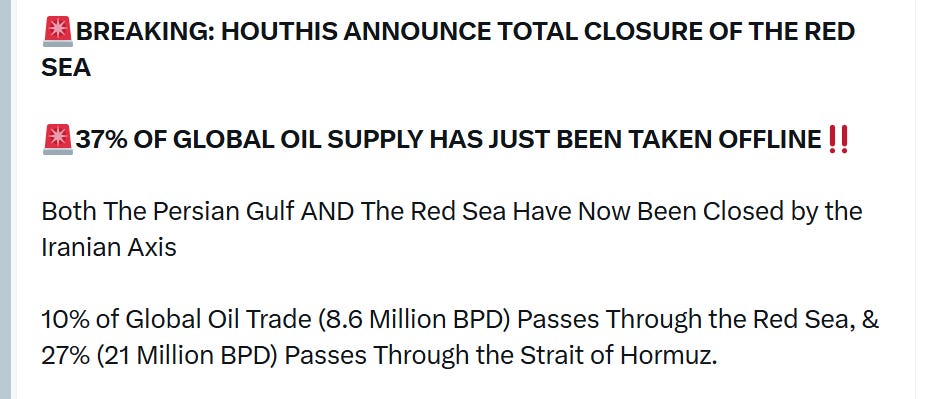
Far more dangerous is Iran’s leverage over energy flows. The Strait of Hormuz is not just a pinch point on a map; it is one of the world’s critical arteries for oil and gas. Any credible threat to shipping through Hormuz—actual attacks or even persistent risk—forces tankers to reroute, insurers to hike premiums, and buyers to bid up scarce, safe barrels. The result is mechanically inflationary: higher crude prices feed directly into gasoline, diesel, jet fuel, fertilizers, plastics, and transport costs. When you raise the price of the molecule that moves everything, you raise the price of everything.
YOUR GAS TANK, YOUR GROCERY BILL, YOUR 401(k)
In the U.S., that lands on ordinary people as higher gas prices, more expensive food, and rising costs for basic goods. It also lands on their savings. A conflict that threatens Gulf economies and Hormuz traffic will hit equities: energy‑intensive sectors, consumer discretionary, travel, shipping, and credit markets all face severe stress. Stock indices wobble or fall, 401(k)s shrink, and the illusion of painless, “cost‑free” projection of power evaporates. The very voters told that intervention would make them safer instead get slammed at the pump and in their retirement accounts.
A WAR THAT FAILS THE BASIC MORAL TEST
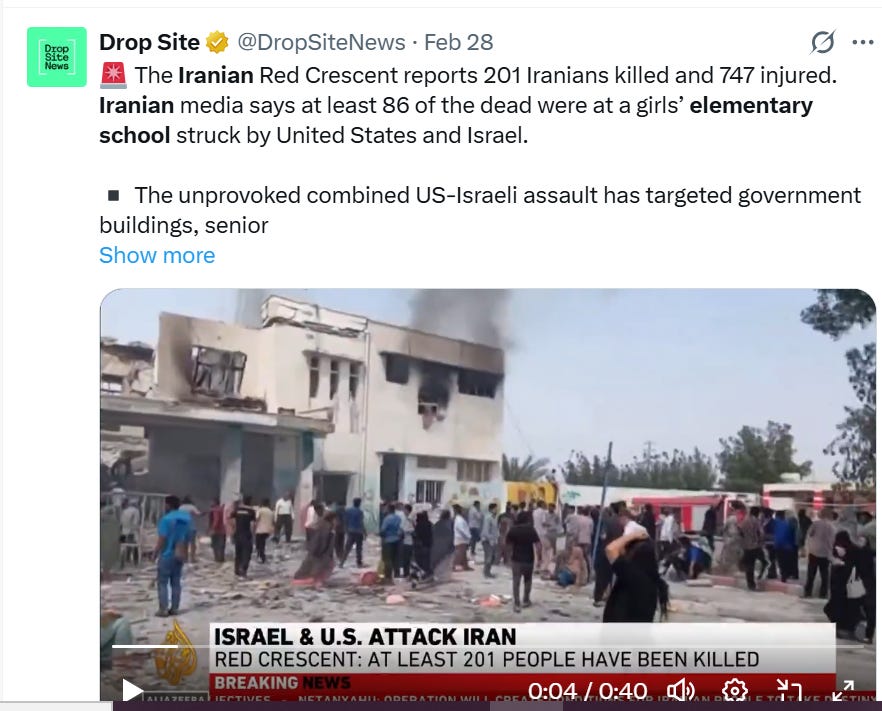
Morally, the campaign is indefensible. The path to this war is paved with regime‑change fantasies and a readiness to treat entire societies as expendable pawns. Civilian infrastructure and regional economies are knowingly placed in the crosshairs: ports, airports, tourist hubs, and financial centers become fair game in an escalation spiral everyone can see coming. The human cost—on Iranian civilians, Gulf residents, and vulnerable populations across the developing world facing higher food and fuel prices—is treated as a line item, not a central concern. A policy that deliberately courts such outcomes in pursuit of “leverage” is not just unwise; it is immoral.
IRAN PLAYS TO ITS STRENGTHS, AMERICA TO ITS WEAKNESSES
Strategically, the war is unwise because it plays directly into Iran’s strengths and America’s weaknesses. Iran does not need to match U.S. firepower; it only needs to create enough risk to energy flows and regional economies to make the war more expensive for Washington than for Tehran. Every missile near a Gulf city, every drone that raises insurance costs in Hormuz, magnifies the economic blowback on the U.S. and its allies. Meanwhile, China, Russia, and other rivals can posture as voices of restraint, deepen ties with energy producers, and position themselves as alternative partners to a region tired of being a battlefield.
THE MOST UNPOPULAR “VICTORY” MONEY CAN BUY
Politically, the war is profoundly unpopular once its true costs become clear. Voters do not rally indefinitely around an overseas adventure that produces higher gas prices, market losses, and a sense that their leaders are more interested in projection of power than in basic economic security. Americans were not clamoring for another regime‑change project; they were already weary of decades‑long wars, spiraling defense budgets, and broken promises about “quick” operations. When they watch their 401(k)s shrink and their weekly bills rise because of a conflict they never asked for, the political pressure becomes intense.
TRUMP’S “AMERICA FIRST” COLLIDES WITH REALITY
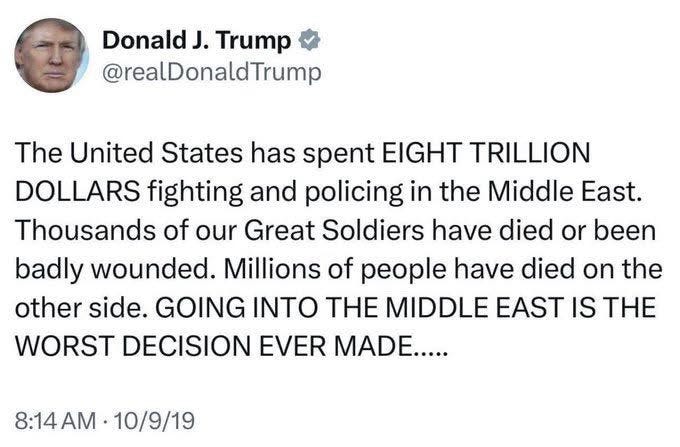
President Trump is exposed on all fronts by this dynamic. He campaigned as a critic of endless wars and a defender of the “forgotten” American worker, yet this conflict delivers the opposite: an expansion of the war footprint, a direct hit to the working and middle class through inflation, and a deepening sense that foreign policy serves Beltway contractors and foreign lobbies, not voters. As the stock market falls and gas ticks higher, his claim to economic stewardship and “America First” realism is shredded.
THIS ISN’T A MISTAKE. IT’S A BLUEPRINT FOR DISASTER.
In the end, the facts line up in only one direction: this war path is inflationary because it weaponizes energy chokepoints, immoral because it treats civilians and regional economies as expendable, unwise because it exploits Iran’s asymmetric strengths and amplifies U.S. vulnerabilities, and deeply unpopular because ordinary people bear the costs while elites reap the contracts. It is not a necessary conflict; it is a self‑inflicted disaster whose consequences are already visible in prices, portfolios, and public sentiment.
end of segment
-
our opinions are not our sponsors opinions
-
the editorial department is separate from the promotions department
-
not financial advice