
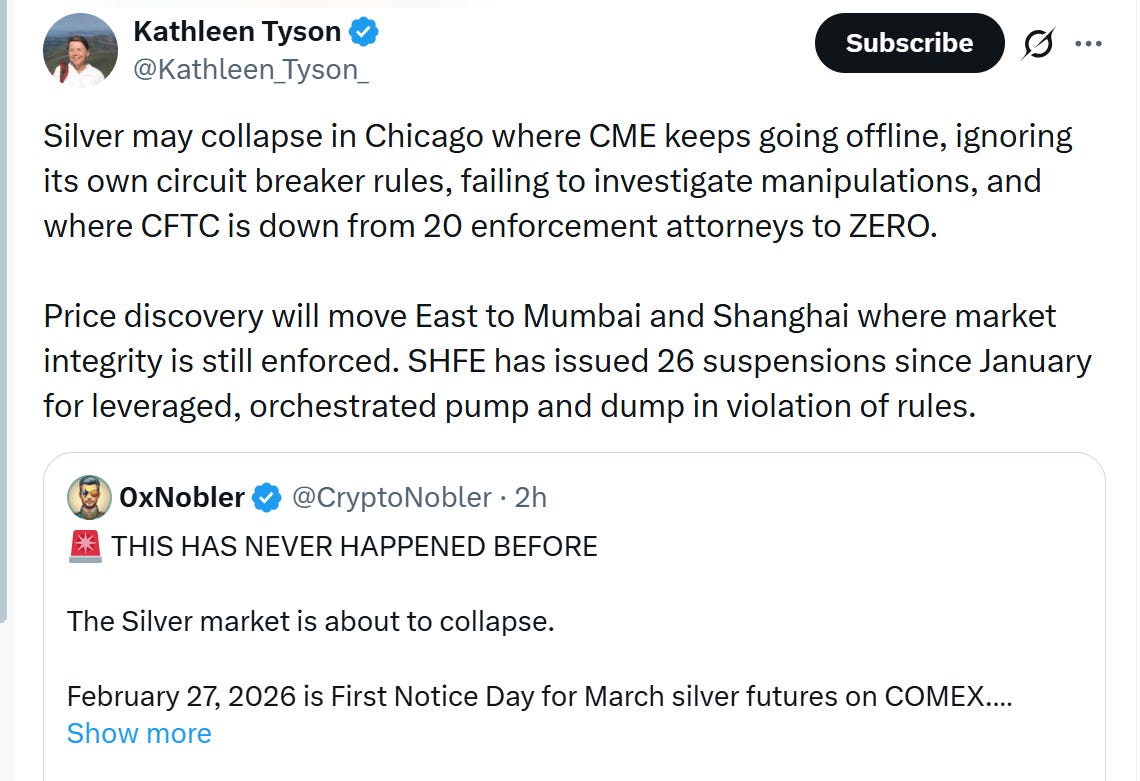
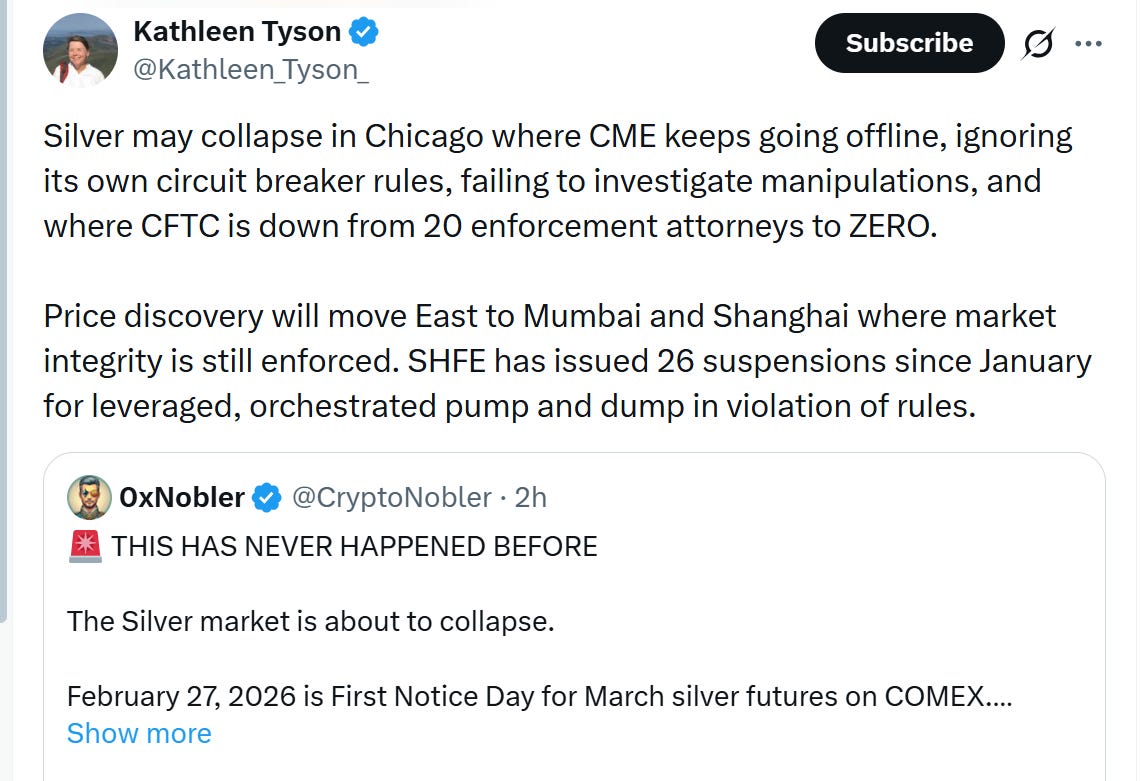
The silver market is entering an historic breaking point. The past week’s events across India, China, Mexico, and the United States have converged into a single message: the existing paper‑based silver system is no longer compatible with underlying physical reality.
India Declares Independence from London
India just fired a shot at London’s bullion dominance. SEBI, India’s securities regulator, has ditched LBMA benchmarks and will now use a local Indian average to price gold and silver. That’s not a technical tweak; it’s a geopolitical rejection of Western price‑setting and a step toward remonetizing bullion on India’s terms. At the same time, India’s roughly $384 billion in equity funds are now piling into gold and silver, unleashing an epic capital rotation from inflated financial assets into hard metal as Indian savers revert to what has always worked in crises: bullion.
Shanghai’s Silver Lifeblood Is Draining
Meanwhile, the Shanghai silver vault is visibly bleeding out. Nearly 40 metric tons (39,773 kilos) were pulled overnight, punching SHFE stocks below 10 million ounces and flashing acute physical tightness in the world’s key wholesale hub. Silver screaming toward 94 represents the last major resistance level on long‑term charts; a clean break risks a disorderly run into three‑digit pricing as shorts lose control.
Mexico’s War Zones Meet Metals Scarcity
On the supply side, narco wars in Mexico continue to threaten mining regions, transport corridors, and refining, putting a structural question mark over one of the world’s most important silver sources. Corporations are not waiting around: Samsung has already locked in a two‑year exclusive offtake from a Mexican mine, bypassing exchanges entirely in favor of guaranteed physical supply.
The West’s Financial Plumbing Is Breaking
Over in the West, the financial plumbing is cracking. COMEX has now “failed” twice in recent months, hiding behind technical excuses and trading halts that increasingly look like de facto defaults rather than harmless glitches. The macro backdrop is equally dire: U.S. Google searches for “can’t sell house” just hit an all‑time high, higher than 2008; 12.7% of all credit card debt is now 90+ days past due, the second‑worst reading ever; and America’s $38 trillion national debt now generates more interest cost than the entire defense budget. The government is borrowing simply to pay interest on prior borrowing—a textbook debt spiral.
First Notice Day: When Paper Meets Reality
All of this funnels into COMEX First Notice Day on February 27, 2026, for the March silver contract. Roughly 400 million ounces are tied to March, yet only about 82 million ounces are available for delivery. The paper‑to‑physical ratio is hovering near 360:1. For every real ounce, there are hundreds of claims. Inventories have slipped under 100 million ounces for the first time in modern history, with withdrawals running around 785,000 ounces per day. Historically, only 3–5% of longs take delivery; in February 2026, delivery demand surged toward an astonishing 98%. Even during the January 30 crash—when price was smashed from 121 to 64—vaults still lost 3.3 million ounces in a single day. Price down, metal leaving. That isn’t retail capitulation; it’s big money choosing custody over leverage.
Structural Deficit, Strategic Metal, Imminent Repricing
Zoom out further. The world is running a 40–50 million ounce monthly silver deficit, with cumulative shortfalls since 2021 approaching 820 million ounces. At the same time, China controls a dominant share of refined silver output, tightened export controls in January, and inventories in Asia are tight while short exposure remains high. This is not a transient imbalance; it’s structural. Silver isn’t just an “investment”—it is core infrastructure for solar, electronics, defense, and AI.
When Confidence Breaks, Price Explodes
If COMEX cannot meet delivery and is forced into widespread cash settlement on February 27, the message will be unmistakable: paper silver is leverage, physical silver is reality. In a 360:1 claim system, confidence is the last pillar. Once that cracks, price discovery will not adjust gently; it will lurch as the entire paper silver edifice is stress‑tested in real time. This isn’t just another contract cycle. It is the moment the world finds out how much silver actually exists for sale—and how much was always just a promise.
Now is exactly when silver miners move from “interesting” to urgent. Their behavior in this correction is the tell: instead of breaking, quality silver stocks are holding or strengthening, a clear confidence signal that the market is quietly pricing in a much higher long‑term silver floor rather than a blow‑off top. For months, miners badly lagged the metal, leaving a gaping valuation hole; that gap is now snapping shut as institutions are forced to recognize just how much free cash flow these businesses throw off at current prices.
Above this, you have a powerful macro tailwind. Major banks now publish gold targets in the 5,400–6,000 range, implying further upside that historically pulls silver higher and accelerates precious‑metal bull phases. With the Gold‑to‑Silver Ratio still miles above prior bull‑market lows and the Silver‑Miners‑to‑Silver Ratio sitting near historic troughs, you’re looking at a double‑discounted, high‑beta play on an already underpriced metal. In other words: you’re being paid to be early.
Andean Precious Metals (TSE: APM / OTC: ANPMF) has released its fourth quarter and year-end 2025 production results and provided 2026 production, cost and capital guidance (attached).
Key highlights include:
-
Q4 2025 consolidated production of 27,777 GEO and full-year 2025 production of 99,165 GEO, near the lower end of annual guidance.
-
2026 consolidated production guidance of 100K–114K GEO.
-
Golden Queen AISC: $1,850–$2,150/oz
-
San Bartolome CGOM: $20–$35/AgEq oz (35%–45% GMR)
-
2026 consolidated capital investment guidance of:
-
Golden Queen: $32M – 43M
-
San Bartolome: $6M – 11M
-
At Golden Queen, 2026 capital is primarily directed toward leach pad expansion, mine development and processing upgrades. At San Bartolome, capital spending remains focused on processing enhancements and sustaining infrastructure.
The Company will release Q4 and year-end 2025 financial results after market close on March 24, 2026, and host a conference call on March 25, 2026 at 9:00 AM ET.
Glossary
-
Gold‑equivalent ounce (GEO): A way of adding all produced metals together by converting their value into the value of gold, so production can be shown as one clear number.
-
Cash cost for gold and silver‑equivalent ounces (CGOM): The day‑to‑day cash cost to mine, buy, move, and process ore, divided by the ounces produced, after converting all metals into a single silver‑equivalent unit.
-
Gold‑to‑metal revenue mix (GMR): The share of total revenue that comes from gold versus other metals; for example, 40 percent gold‑to‑metal revenue mix means 40 percent of revenue is from gold and 60 percent from other metals like silver.
end of segment
-
our opinions are not our sponsors
-
the editorial dept is separate from promotions
-
Not financial advice