
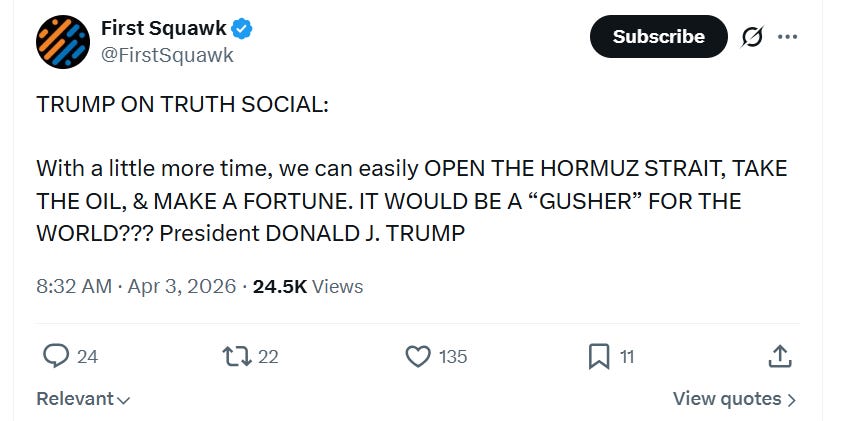
We were told this was a war to “liberate” Iran, a moral crusade to free a captive people from a brutal regime. Within weeks, that script disintegrated. The U.S. president is now on Truth Social boasting that, “with a little more time, we can easily OPEN THE HORMUZ STRAIT, TAKE THE OIL, & MAKE A FORTUNE,” turning liberation into looting in a single post. What began as rhetoric about democracy has curdled into open talk of seizing resources, confirming what the region suspected from day one: this was never about freedom, only fuel.
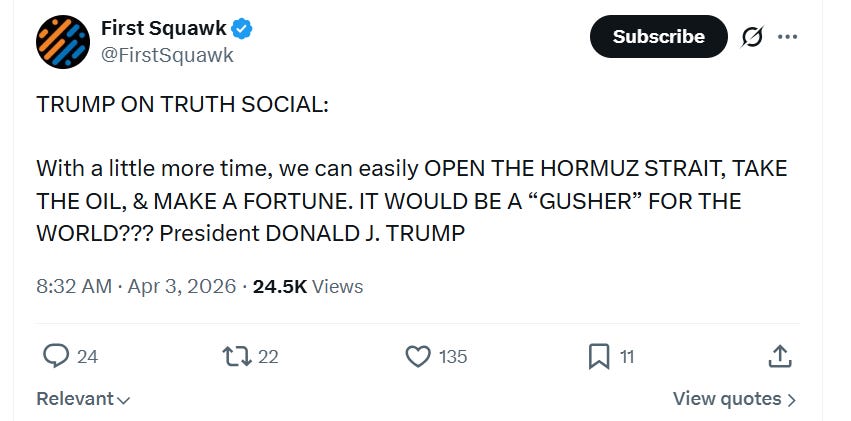
Trump and Netanyahu’s ill‑advised Iran attack now looks even worse in hindsight, as generals are fired and leaks confirm the operation was rammed through against professional military advice — no plan for boots on the ground, no occupation strategy, just a rolling air campaign that chewed through schools, hospitals, bridges, power plants, and civilian infrastructure. The recklessness crystallized in one Truth Social post in late March, when Trump boasted: “With a little more time, we can easily OPEN THE HORMUZ STRAIT, TAKE THE OIL, & MAKE A FORTUNE—IT WOULD BE A ‘GUSHER’ for the world???”
You don’t talk like that unless you think other people’s countries are slot machines and other people’s children are collateral. This wasn’t strategy; it was a casino tantrum with bombers attached. While Trump fantasized about oil “gushing,” tankers turned around, insurers pulled coverage, and traders quietly modeled a world where the throat of the global energy system never fully reopens.
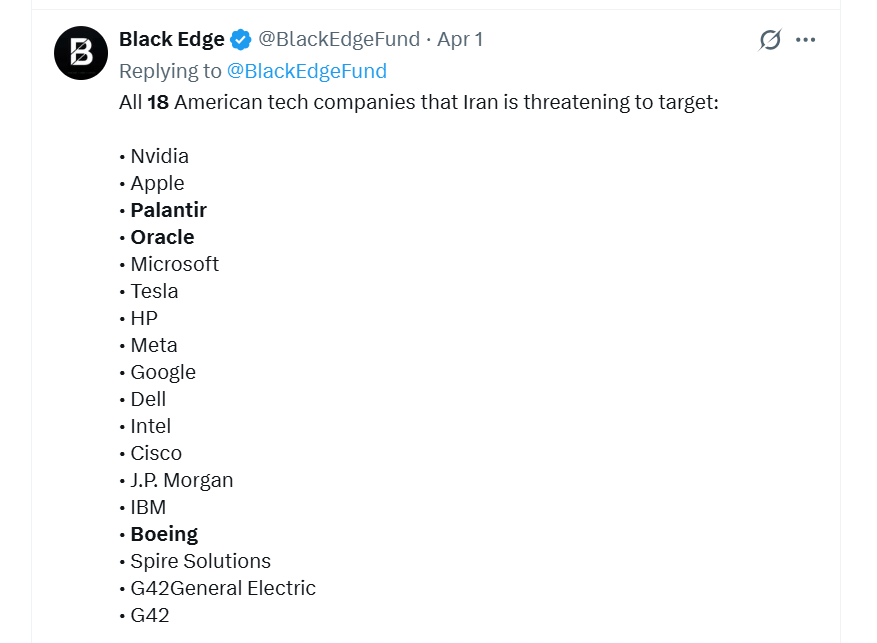
Tehran watched every syllable. Iran saw a president bragging he could crack open Hormuz like a piggy bank even as U.S. generals were shoved aside for calling it madness. So Iran did the one thing this regime never prepared for: it stopped thinking in tanks and planes, and started thinking in tickers and balance sheets. While Trump promised a “gusher,” Iran drew a bead on 18 companies that are the U.S. economy’s oxygen mask — the $15 trillion corporate nervous system running pensions, credit, cloud, and newsfeeds. Trump thought he was threatening Iran’s oil. Instead, he invited Iran to threaten America’s illusion of wealth.
If the U.S. takes down Iran’s power grid, Tehran has every incentive to retaliate against the true backbone of American power: AI infrastructure. In 2026, clusters run by OpenAI’s backers, Oracle, CoreWeave, Microsoft, and Nvidia are not “just servers” — they anchor well over $100 billion in leveraged build‑out debt and multi‑year compute contracts.
The $100‑billion‑plus Stargate complex in the UAE sits squarely within IRGC “Hidden Target” strike envelopes, making it a named, priced‑in vulnerability. If one or more of these hubs is destroyed or disabled, the collateral behind those loans is instantly repriced toward zero. Private credit funds, already facing redemption pressure and valuation disputes, would be forced to mark down flagship positions, triggering margin calls, forced selling, and fund‑level insolvencies. In a market dominated by passive flows and algos, that kind of sudden collateral shock is exactly how a flash crash starts.
In this video above:
IRAN THREATENS MASSIVE HIDDEN TARGET
“Nothing is hidden from our sight, though hidden by Google.”
Iran just released a video about STARGATE UAE, set to be the largest AI computing cluster outside the U.S. which is hidden from Google Maps.
We moved from the Gold Standard to the Oil Standard, and now we’re on the GPU Standard. If the GPUs stop humming, the money stops existing.
Silver is the new oil, but with a crucial twist: it doesn’t need a refinery. A .999 pure bar in your hand is already finished infrastructure, not feedstock. Silver has the highest electrical and thermal conductivity of any metal and exceptional reflectivity, making it the most versatile industrial metal on the periodic table
Our opinions are not our sponsors opinions. The editorial department is separate from the promotions department. Not financial advice