
Before the War:
Prior to the late‑February U.S.–Israel strikes, about 20–21 million barrels of oil and liquids moved through the Strait of Hormuz daily, roughly one‑fifth of global consumption. Around 80 percent of that trade was still priced in dollars, with perhaps 5–10 percent in yuan‑linked or yuan‑settled deals
Now US LOST ALL TRANSACTIONS IN US DOLLAR
Iran’s new rules slam the door on Western energy. No U.S. tankers, no NATO-flagged ships, no dollar trades. Only “friendly” buyers paying in yuan may transit Hormuz, turning the world’s key oil chokepoint into an explicit weapon of currency warfare and strategic alignment.
-
Assume an oil price of 100 dollars per barrel.
21 million barrels/day × 100 dollars = 2.1 billion dollars of oil per day. -
Before US and Israel attacked Iran: 80% in dollars → 2.1 billion × 0.8 = LOSS OF 1.68 billion dollars/day USD‑priced.
-
After Iran’s rule being 100% in yuan → full 2.1 billion/day now invoiced in Chinese yuan.
Now let’s run the numbers with oil at $100, $150 and $200 per barrel
Scenario 1 – 100 dollars/barrel
Total: 21m × 100 = 2.1b/day.
Before US and Israel attacked Iran (80% in USD): 2.1b × 0.8 = 1.68b USD/day.
New (0% in USD): $0.
Dollar loss: 1.68b/day.
Scenario 2 – 150 dollars/barrel
Total: 21m × 150 = 3.15b/day.
Before US and Israel attacked Iran (80% in USD): 3.15b × 0.8 = 2.52b USD/day.
New: $0.
Dollar loss: 2.52b/day.
Scenario 3 – 200 dollars/barrel
Total: 21m × 200 = 4.2b/day.
Old (80% in USD): 4.2b × 0.8 = 3.36b USD/day.
New: $0.
Dollar loss: 3.36b/day.
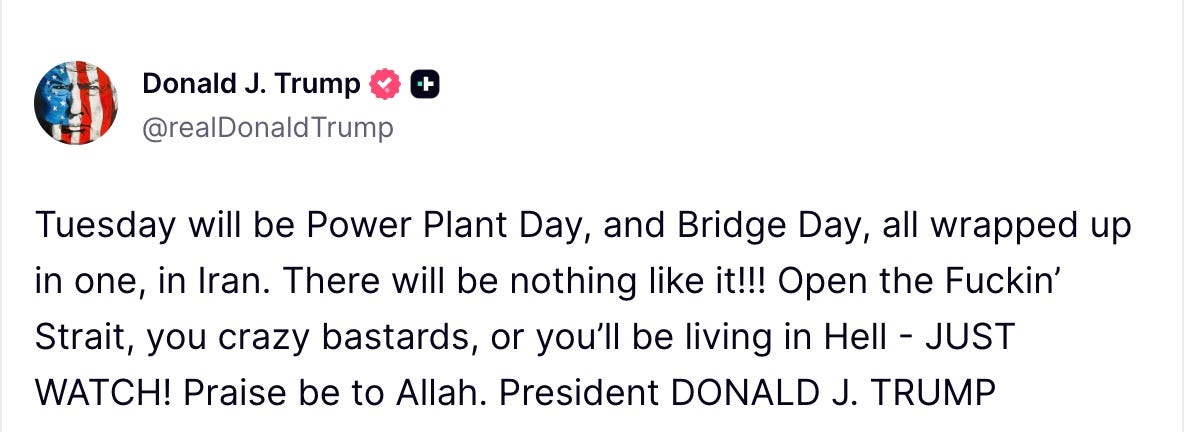
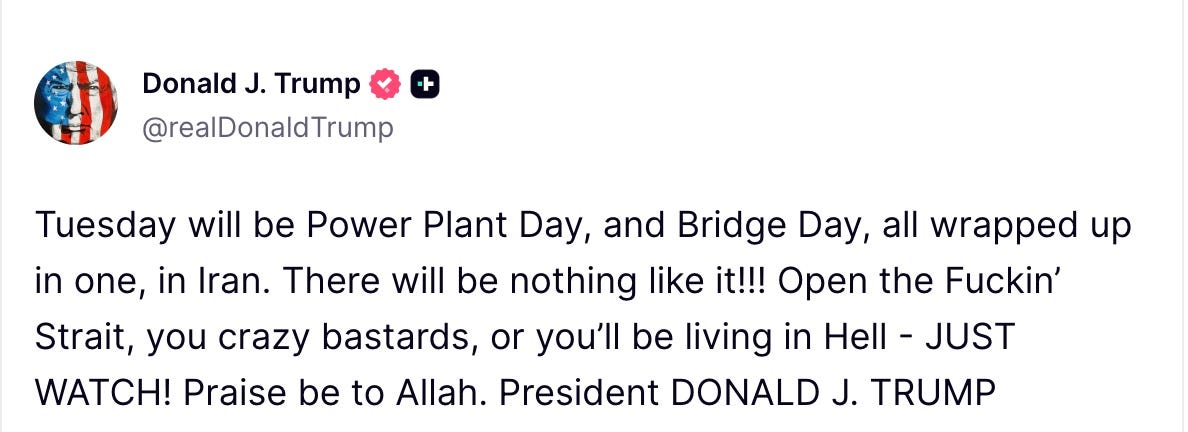
A sitting U.S. president invoking divine warfare while threatening Iran’s energy infrastructure should alarm every intelligence service on earth. These aren’t the words of a stable leader—they sound like the ravings of a man trapped in apocalyptic delusion, obsessed with forcing prophecy and concealing scandal. Insiders say Trump’s escalating fixation on the Third Temple and messianic imagery is not just theatrical—it’s a sign of psychological unraveling.
Pentagon sources are reportedly struggling to interpret his latest “Power Plant Day” statement, which could foreshadow strikes on Iran’s electricity grid, bridges, and water systems. But analysts agree: destroying those targets would trigger catastrophe across the Persian Gulf. Most Gulf states—including Saudi Arabia, the UAE, Kuwait, and Qatar—import water and rely heavily on electricity generated via desalination plants. If Iran retaliated as promised, those nations would face immediate collapse. Civilian life would vanish under desert heat, and governments dependent on American military support would dissolve within days.
Iran’s foreign minister has already warned that any such attack would be answered with the elimination of key Gulf infrastructure. “If Trump begins to annihilate Iran’s power network,” one Tehran analyst said, “then everything tied to U.S. power in West Asia will be annihilated.” European governments appear to understand the danger—France and Austria have both opened direct diplomatic channels with Iran to maintain shipping through the Strait of Hormuz, implicitly acknowledging Tehran’s control over the passage.
Inside Washington, officials describe Trump as erratic and unreachable. One defense insider put it bluntly: “He’s breaking every toy in the room.” The Cabinet’s paralysis in the face of this behavior raises an urgent constitutional question. Section 4 of the 25th Amendment exists for moments exactly like this—when a president’s instability poses an existential threat to the Republic and to global peace.
Every member of Congress, every officer sworn to protect the nation, must confront that reality now. The Strait of Hormuz may soon be the world’s flashpoint—but America’s real crisis sits in the Oval Office.
-
our opinions are not our sponsors opinions
-
the editorial department is separate from the promotions department
-
not financial advice