
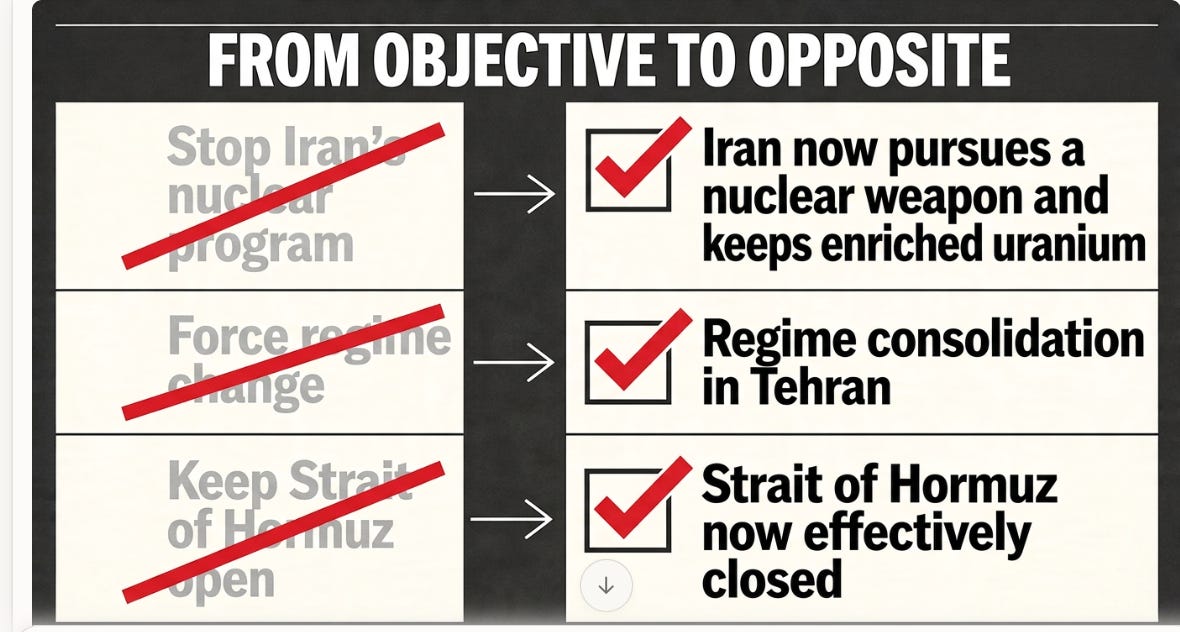
The United States has just authored the most complete strategic failures in modern foreign policy—an unambiguous, across-the-board collapse where every stated objective not only failed, but inverted.
Start with first principles. A war of aggression is illegal. It is no different, in moral structure, than breaking into a neighbor’s house because you covet what’s inside. Dressing it up in language about “security” or “stability” doesn’t change the underlying act. It remains a violation—of sovereignty, of law, and ultimately of credibility.
The case for war was always thin. We were told Iran could not be allowed to obtain a nuclear weapon. We were told it was somehow America’s role to engineer regime change inside a sovereign nation. These claims were never grounded in a coherent legal or strategic framework. They were assertions of power, not arguments of necessity.
And now, the results speak for themselves.
NONE HAVE BEEN ACHIEVED.
Not one.
Iran, rather than being deterred from nuclear capability, has been pushed decisively toward it. The policy intended to prevent proliferation has accelerated it.
Regime change? The opposite. Tehran is more consolidated, more unified, and more internally secure than before the conflict began.
Missile capability? Intact. Iran retains a deep arsenal, with the capacity to resume strikes across Israel and the broader Gulf—Saudi Arabia, the UAE, Qatar—on its own timetable.
The Strait of Hormuz—once open, functioning, and denominated in petrodollars—is now effectively controlled by Iran, with energy flows shifting toward alternative currency systems, including the Chinese yuan. That alone marks a historic fracture in the global financial order.
And the economic consequences are just beginning. With energy markets destabilized, the world now stares down a global recession—perhaps a depression—triggered not by inevitability, but by choice.
All of this, financed by billions in U.S. expenditure at a moment when domestic fiscal stability is already deteriorating.
This is not a partial failure. It is total. Strategic, economic, diplomatic—every box checked in the wrong direction.
And it was entirely avoidable.
Prior to this War on Iran miscalculation
Remember this unfortunate event when Trump promoted these unwise tariffs? ( recall that a tariff is a tax on US consumers)
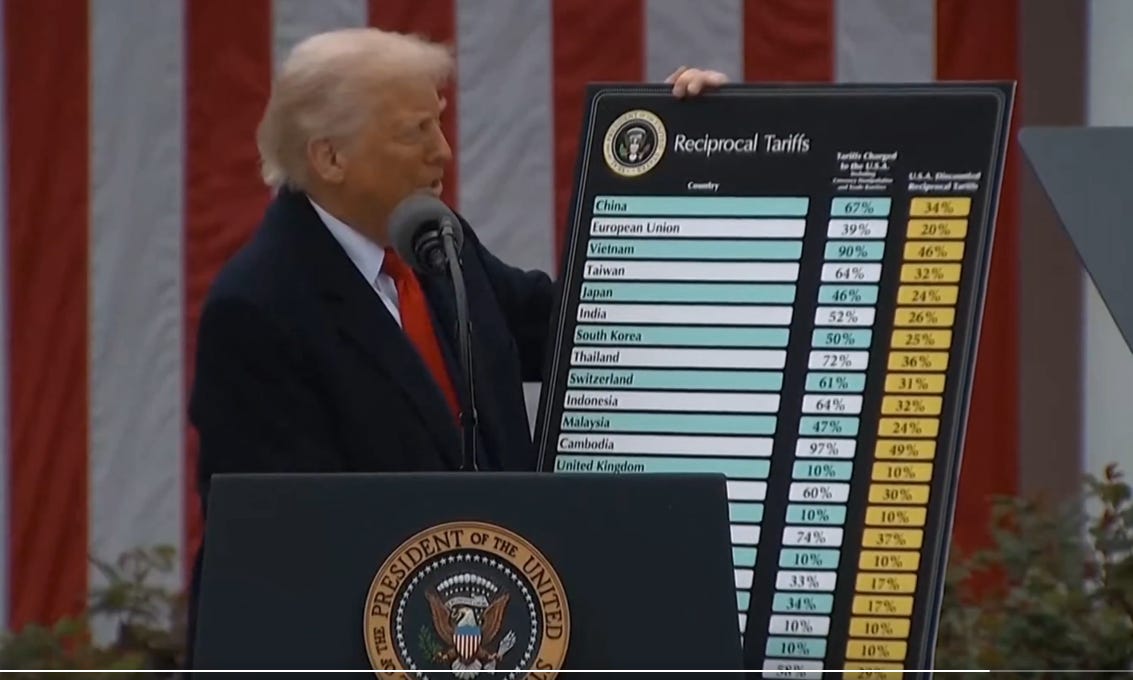
Only in Washington could a catastrophic policy failure be sold as “relief.” Trump spent years bragging tariffs were “making us rich,” only to see his flagship levies ruled unlawful and forced into a $166 billion refund plus interest. This isn’t strategy; it’s a confession of incompetence masquerading as policy. An entire trade posture was built on emergency powers the executive never lawfully possessed, and no one in the chain of command bothered to ask the most basic question: “Can we actually do this?”
At home, the White House is draining liquidity to undo its own illegal trade gimmicks; abroad, it is lighting money on fire in a war of choice with Iran—two pillars of the same reckless, unaccountable governing class stumbling from one self‑inflicted disaster to the next, and sending the bill to everyone else.
Silver wins again
War carnage, energy shock, and a petrodollar mutating into a petroyuan are rocket fuel for silver, as inflation, currency debasement, and geopolitical risk drive investors into hard assets. With Iran effectively taxing Hormuz and signaling that only non‑U.S. allies get smooth passage, countries that want oil now have to kiss Tehran’s ring and prove distance from Washington.
Spain just underlined that pivot—condemning the Iran war, then flying to Beijing to deepen economic ties and secure Chinese-backed energy and green tech flows.
end of segment
-
our opinions are not our sponsors opinions
-
the editorial department is separate from the promotions department
-
not financial advice