
Here is my thesis:
This war on Iran is not about security. It is a chase for Iran’s oil and mineral base—fresh collateral to prop up exhausted fiat, derivatives pyramids, leverage-fueled rackets, and debt-soaked Ponzi schemes that can only survive by stripping yet another resource-rich nation.
Governments cannot allow capital to move freely once confidence in the system begins to decline. A CBDC ensures capital stays inside the system and under control. This is not about modernization. It is about maintaining authority over a sovereign debt structure that is already under critical strain.
As the U.S. pushes past $39 trillion in debt and sleepwalks from one manufactured crisis to the next, the architecture of control is being built in plain sight. The war in and around Iran, the Strait of Hormuz brinkmanship, and the weaponization of oil markets are not isolated events; they are the staging ground for a new kind of monetary regime.
The 10‑Minute Market Racket
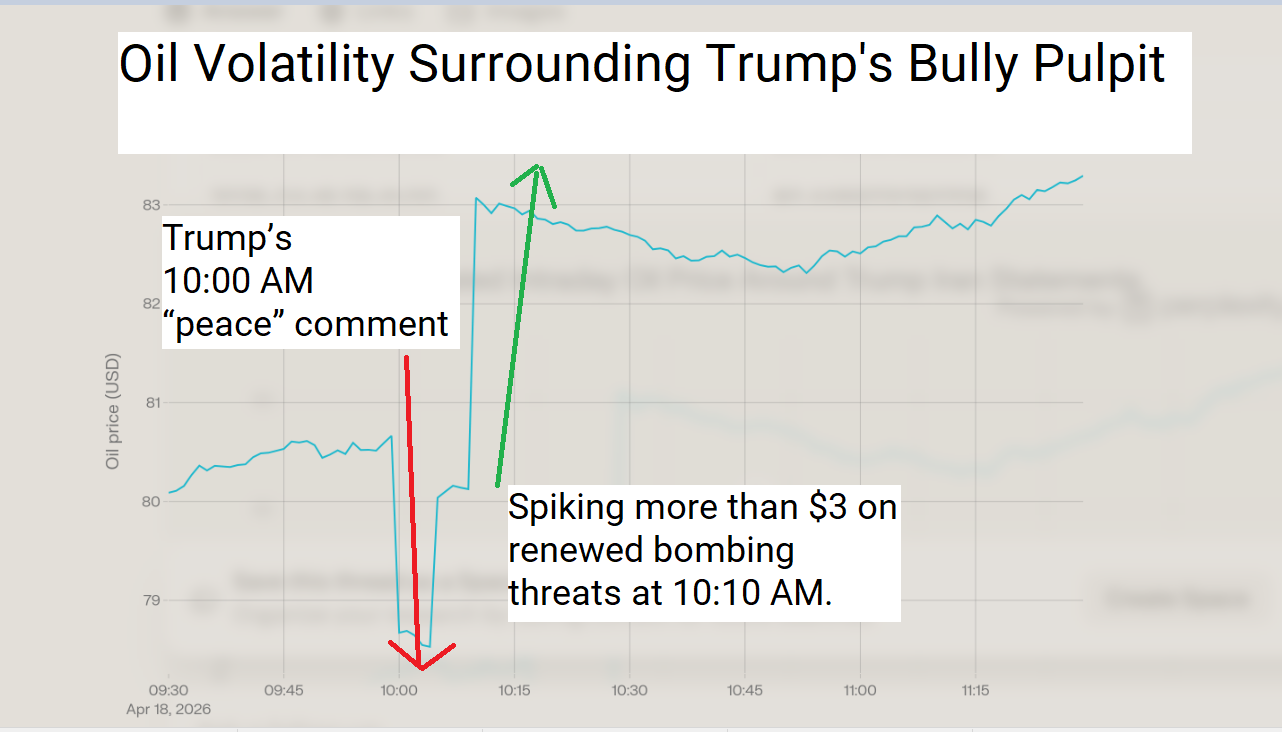
On a single morning, within a 10‑minute window, Trump delivered three mutually contradictory statements on Iran and the Strait of Hormuz:
-
10:00 AM – “We are ending this war. The deal is pretty successful.” Iran, meanwhile, insists there are no talks, no trust, and no meetings with Washington.
-
10:05 AM – “Hormuz will now always remain open to the world. We can roam there freely.”
-
10:10 AM – “We will continue to have a blockade, and we’ll have to start dropping bombs again.”
Peace, then permanent access, then renewed bombardment—announced in less time than it takes most people to commute to work.
Each pivot hits the oil market like a hammer: ceasefire talk crushes risk premia, “open Hormuz” stabilizes shipping, renewed bombing threats push prices higher. Diplomatic posture has been converted into a volatility machine.
To visualize this, here’s a simulated intraday chart of oil prices around the 10:00–10:10 window, with visible drops on “peace” headlines and spikes on renewed war talk:
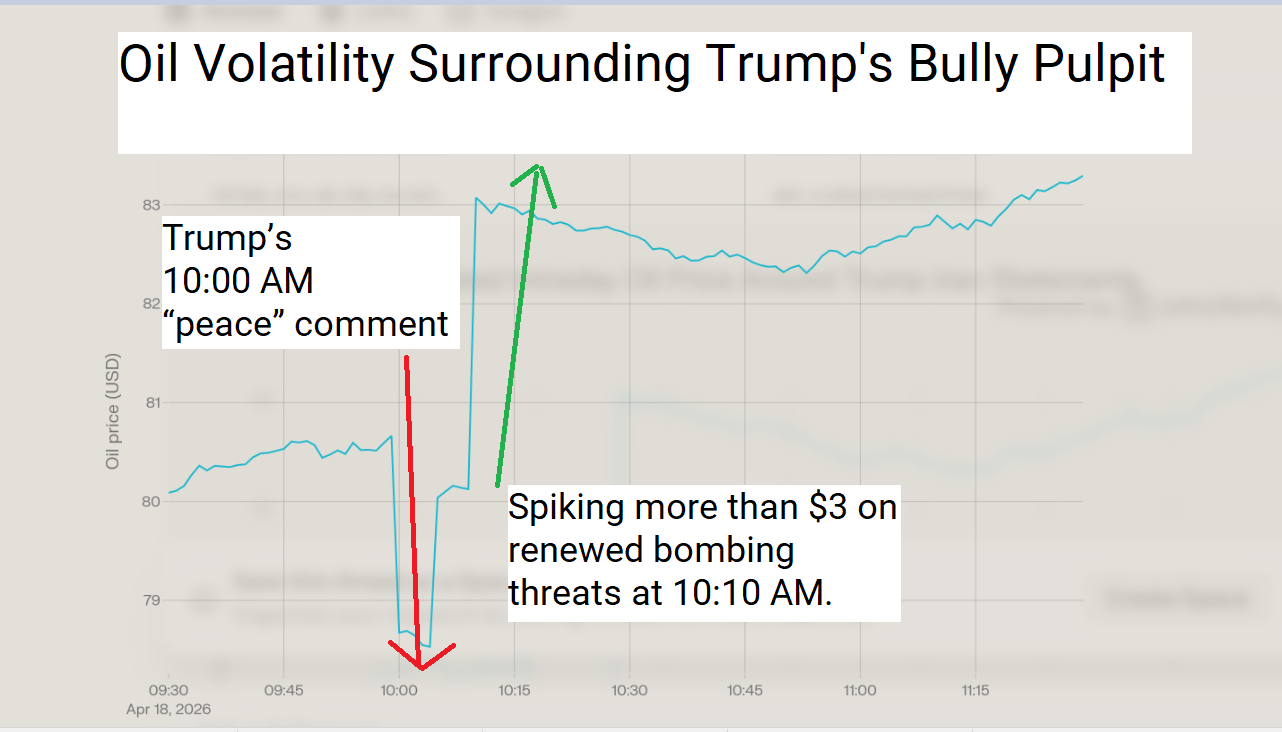
This chart illustrates simulated minute‑by‑minute oil prices dropping about 2 dollars on Trump’s 10:00 AM “peace” comment, rebounding roughly 1.5 dollars after his 10:05 AM Hormuz statement, then spiking more than 3 dollars on renewed bombing threats at 10:10 AM.
Treason in the Futures Markets
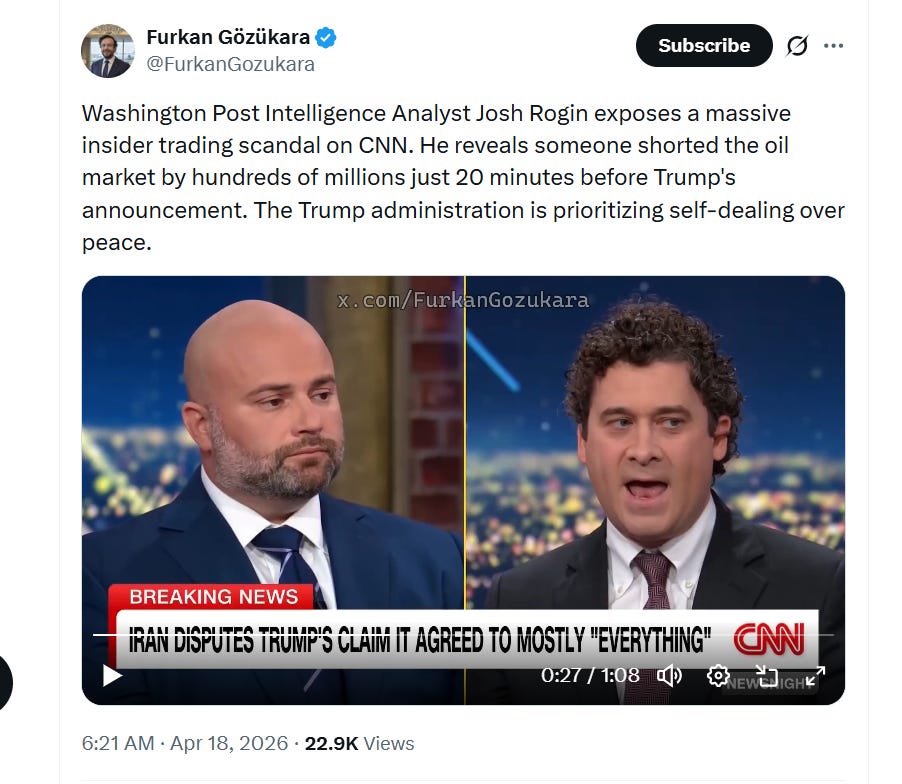
This is not an abstract worry. Washington Post analyst Josh Rogin told CNN that someone shorted the oil market by hundreds of millions just 20 minutes before a key Trump Iran announcement, then profited when prices collapsed on the surprise de‑escalation.
Fortune and others noted about $580 million notional—roughly 6,200 contracts in Brent and WTI—dumped right before Trump unexpectedly paused strikes, followed by a sharp oil selloff and equity rally. Axios detailed a “troubling trend” of suspicious trades clustering minutes before major Iran-related declarations, across oil, index futures, and prediction markets.
Nobel laureate Paul Krugman called it what it looks like: “treason in the futures markets.” The question is no longer whether someone is trading on inside information; it is whether decisions about war and peace are being shaped to serve those trades.
The Rigged Cycle: How the Few Profit from the Many
The pattern is brutally simple:
-
Threaten escalation over Hormuz; oil rips higher on supply fears.
-
Well‑connected players short futures and position in equities minutes before a “peace” pivot.
-
Announce a ceasefire, “productive talks,” or a paused strike; oil dumps, stocks jump, insiders cash out.
-
Reset deadlines, revive blockade language, talk bombing again; volatility reloads.
-
Trump is just negotiating with himself to allow his network to profit off of his very words while Iran has not agreed to any of these lies.
For workers, this is experienced as chaos: gasoline shocks, shipping costs passed into food prices, inflation that eats wages. For the ring of actors closest to power, volatility is not a risk—it is a revenue stream.
This loop has now been observed on multiple occasions, not as a one‑off fluke but as a recurring structure. The crisis is public; the cycle of profit is private.
Why a System Like This Needs a CBDC
A system that treats war headlines as trading strategies cannot tolerate uncontrolled capital flight when the public finally connects the dots. Once trust breaks, the instinct is to move: out of the currency, out of their markets, out of their rails.
That is where CBDCs, Palantir‑style surveillance, and the digital “modernization” agenda converge.
-
Containment: A CBDC keeps capital inside the perimeter. Bank runs become software parameters, not social phenomena.
-
Visibility: Every transaction becomes a data point. Palantir’s analytics turn raw flows into profiles, scores, and risk flags.
-
Control: Programmability allows category-based limits, dynamic quotas, and even expiration dates on funds in the name of “stability” and “climate” or “security” goals.
This is not about faster payments. It is about transforming money from a bearer instrument into a permissioned license—revocable at will.
Agenda 2030 language about “resilience,” “sustainability,” and “inclusion” becomes the rhetorical wrapping paper for a monetary system that no longer needs your trust because it can deny your exit.
From Free Capital to Digital Confinement
Once the next major market crack arrives—triggered by a war scare, an energy shock, a fertilizer-driven food crunch, or all three—the playbook is already written:
-
Crisis hits: markets crash, oil spikes, food prices jump, layoffs surge.
-
Public fury builds, and confidence in the old system fractures.
-
Authorities present CBDCs as the “solution”: targeted relief, instant aid, “fair” rationing.
-
Surveillance firms and asset managers supply the infrastructure; politicians supply the fear.
-
Within that new system, exit is not debated—it is disabled.
The same class that gamed the old system with leverage and insider access now installs itself as gatekeeper of the new one.
Silver: Outside Their Grid
In that environment, the distinction between assets inside the control structure and those outside of it becomes existential.
-
Bank deposits, money market funds, and most securities will live inside the programmable CBDC stack. They will be visible, categorizable, and stoppable.
-
Physical assets—especially those with deep monetary and industrial history—will not.
Silver occupies a unique position. It is essential to energy, electronics, and defense supply chains, yet it also carries a centuries‑long role as money. It does not depend on a central bank’s database to exist. It cannot be frozen by a line of code or quietly devalued through a software update.
When a system built on weaponized volatility and insider dealing tries to migrate to a digital panopticon, the quiet migration to hard assets is not speculation; it is self-defense.
-
our opinions are not our sponsors opinions
-
the editorial department is separate from the promotions department
-
not financial advice