
The world is spiraling into chaos over a six-month bottleneck in the Strait of Hormuz choking off 22% of global oil flows, sending energy markets into a tailspin. Yet, as terrifying as gas lines and geopolitical panic seem, this oil shock is peanuts compared to the catastrophic, systemic physical crunch about to hit the silver market. – Jon Forrest Little
I have spoken with Andy Schectman, Stefan Gleason of Money Metals, and other bullion dealers. They say one of the most common retail silver purchases is a single tube of coins. A standard tube commonly contains 20 one-ounce coins—whether American Silver Eagles, South African Krugerrands, Austrian Philharmonics, Australian Kangaroos, or generic rounds and bars produced by private mints such as Sunshine Minting.
Twenty ounces is not a fortune. At current prices, it is a manageable first purchase for many people who want a small amount of physical metal outside the banking system.
Now run the numbers,
The silver market is standing on the edge of a mathematical impossibility.
While the world treats silver as an abundant commodity, the underlying mechanics tell a radically different story. Silver is not just heavily suppressed; it is arguably the most grossly undervalued asset on Earth.

The Illusion: Paper Claims vs.
Reality
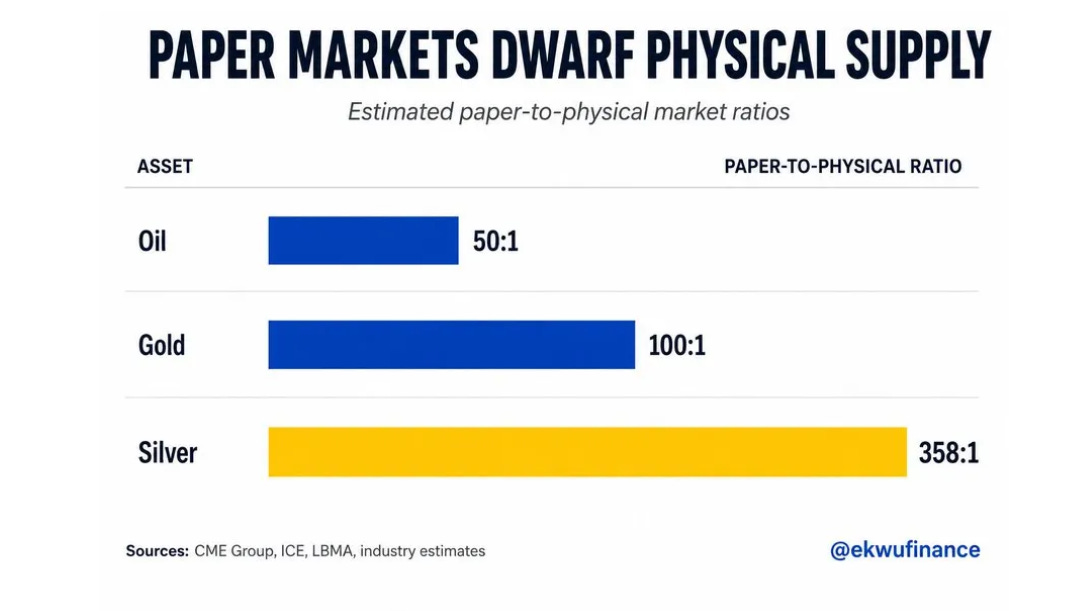
The global spot price of silver isn’t dictated by physical metal changing hands in a vault; it is dictated by derivatives. Today, an astounding 350+ paper claims exist for every single physical ounce of silver in real, deliverable reserves.
This massive fractional-reserve system functions only as long as paper holders never ask for their metal. If even a fraction of those claim holders demand physical delivery, the paper market breaks, and the price re-rates instantly.
The Indispensable Element of the Modern World
Silver is not merely a store of value—it is the supreme industrial metal. As the best electrical and thermal conductor on the periodic table, it cannot be replaced in high-tech applications without crippling performance. Four colossal growth sectors are devouring global supply at an unprecedented pace:
-
Solar Energy: Photovoltaic cells require silver paste to convert sunlight into electricity. Modern, higher-efficiency TOPCon solar panels consume up to 150% more silver per cell than previous generations.
-
Artificial Intelligence: AI datacenters and advanced microprocessors rely on silver for ultra-fast, highly efficient signal transmission and heat dissipation. Without physical silver, the AI boom grinds to a halt.
-
Aerospace: Spacecraft, satellites, and aviation electronics demand unyielding conductivity under extreme temperatures and zero-gravity environments.
-
Military & Defense: Every modern guided missile, radar system, night-vision device, and military-grade communication circuit relies heavily on physical silver. Remember lithium ion batteries don’t work in severe weather such as the heat and cold extreme of outer space nor submerged in torpedo batteries.
Unlike gold, which is hoarded in central bank vaults, industrial silver is consumed and buried in landfills. Once it goes into a circuit board or solar panel, recycling it is often economically unfeasible. We are actively burning through finite above-ground stockpiles.
The Math: 5% of the World Consumes 10 Years of Mine Supply
To understand how fragile this supply really is, look at the retail market. Global mine production sits at approximately 800 million ounces per year.
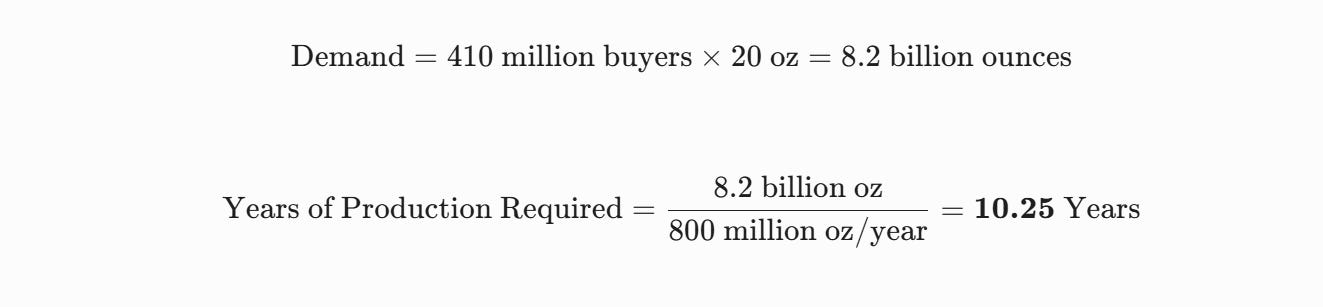
Out of an 8.2 billion global population, what happens if just 5% (410 million people) decide to protect their purchasing power with just one standard 20-ounce tube of silver coins?
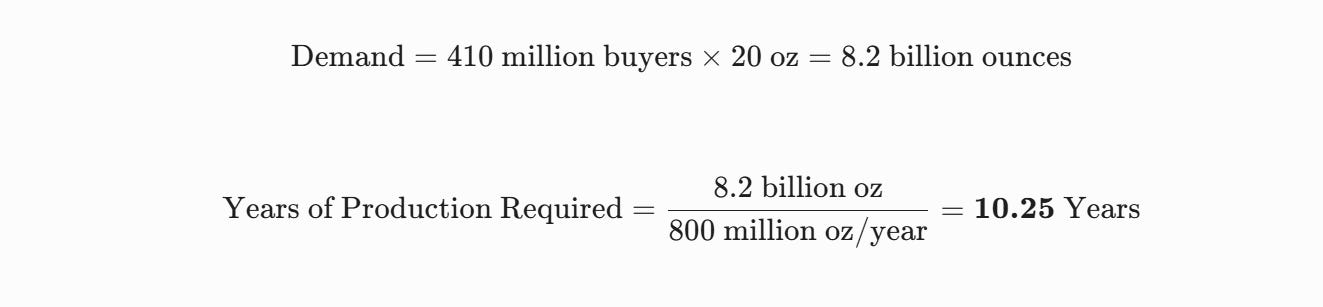
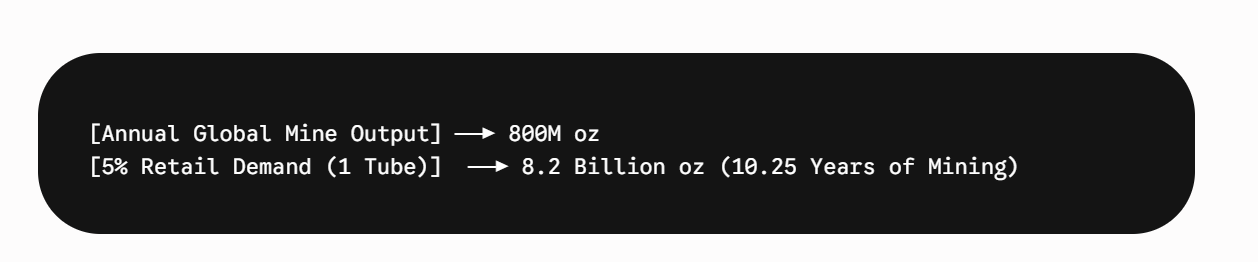
A modest purchase by just 1 in 20 people would consume more than a decade of total mine output—and that assumes zero silver goes to solar, AI, defense, or aerospace.
When physical demand collides with the 350-to-1 paper leverage, the artificial price suppression cannot hold. Silver remains the ultimate coiled spring of the financial world.
New Silver Mines Cannot Wait
The case for urgently advancing new silver deposits is becoming increasingly clear: global mine production is constrained, industrial demand is structurally large, and even a modest increase in investment demand could overwhelm the amount of metal available for delivery.
The world produces roughly 800 million ounces of silver per year from mines. But that supply is not sitting in a warehouse waiting for retail investors. Silver is essential to electronics, solar panels, electrical infrastructure, vehicles, medical applications, and a widening range of advanced technologies. At the same time, the silver market has recorded consecutive annual supply deficits, meaning total demand has exceeded newly available supply.miningvisuals+1
This leaves little margin for error. If investors, manufacturers, or governments attempt to secure greater physical inventories at the same time, the industry cannot simply switch on enough new production. Mines take years to permit, finance, construct, commission, and ramp up. By the time a physical shortage becomes obvious, the projects needed to relieve it may still be several years from commercial output.
That is why high-quality deposits already moving through the development pipeline deserve close attention.
Boumadine Case Study
Aya Gold & Silver’s (AYA)
Boumadine project in Morocco is a useful example of the kind of new, large-scale deposit that could matter in the next silver cycle. Aya owns 85% of the project and is expected to publish an updated preliminary economic assessment, or PEA, in 2026.
The prior 2025 PEA outlined a project with an after-tax net present value, discounted at 5%, of US$1.5 billion on a 100%-ownership basis. That study used US$2,800 per ounce gold and US$30 per ounce silver, with an NPV-to-initial-capital ratio of 3.3 to 1. The ratio matters because it suggests the project could generate substantial value relative to its estimated upfront construction cost.
Analysts at Desjardins now expect the updated study to demonstrate materially greater potential. Their revised model values Boumadine at US$4.6 billion NPV5%, compared with a previous US$2.9 billion estimate. The upgrade reflects a larger assumed resource base and improved assumed payabilities for the concentrates produced.
Under their scenario, the open-pit resource grows to 24.3 million tonnes from 19.4 million tonnes, while the underground component rises to 14.6 million tonnes from 11.6 million tonnes. That scale expansion is significant because it could support a longer-life, higher-throughput operation capable of supplying meaningful quantities of silver, gold, zinc, and lead into a tight metals market.
Timing Is the Constraint
Desjardins currently models Boumadine construction during 2028 and 2029, followed by a production ramp-up in 2030. The schedule could improve if Aya purchases long-lead equipment early and moves quickly through engineering, permitting, financing, and construction decisions. But even an accelerated path would underline the central issue: major new mines cannot respond overnight.
A project that looks economically attractive today may still be four or more years away from first production. Meanwhile, industrial users continue consuming silver, and investors are increasingly focused on physical ownership as insurance against currency weakness and financial-system risk.
The Investment Argument
Boumadine illustrates why investors may need to look beyond the current silver price and focus on future supply. A new large-scale mine is not merely a corporate growth story; it is part of the infrastructure required to meet future global demand.
For Aya, Desjardins raised its base-case target price to C$55 from C$38 and reiterated a Buy rating, calling the company its top pick. Its updated company-wide net asset value estimate rose to C$53.89 per share from C$39.98, while the firm calculated potential upside NAVPS of as much as C$77.95. Those are analyst estimates, not guarantees, and they depend on commodity prices, permitting, metallurgy, capital costs, financing, construction execution, and the ultimate mine plan.
But the broader conclusion is straightforward: silver supply cannot be expanded quickly enough once a shortage is already visible. Bringing deposits such as Boumadine toward production now may be essential if the world is to avoid a more severe supply crunch later this decade.
================================================
our opinions are not our sponsors opinions
the editorial department is separate from the promotions department
not financial advice