
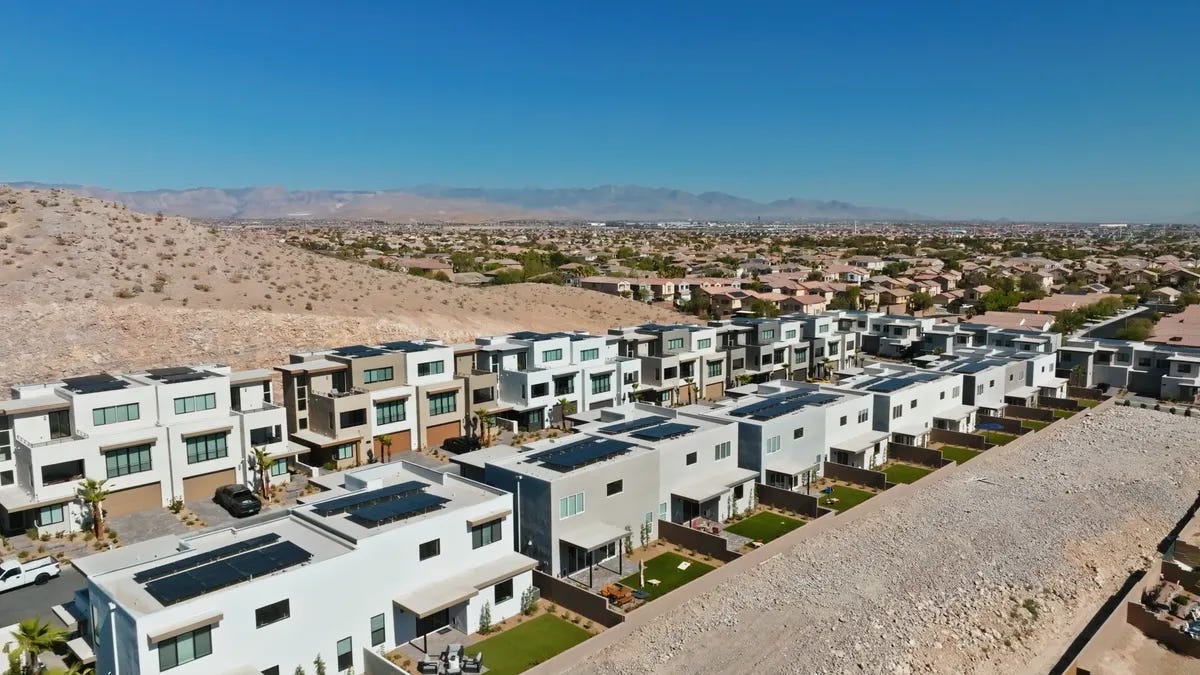
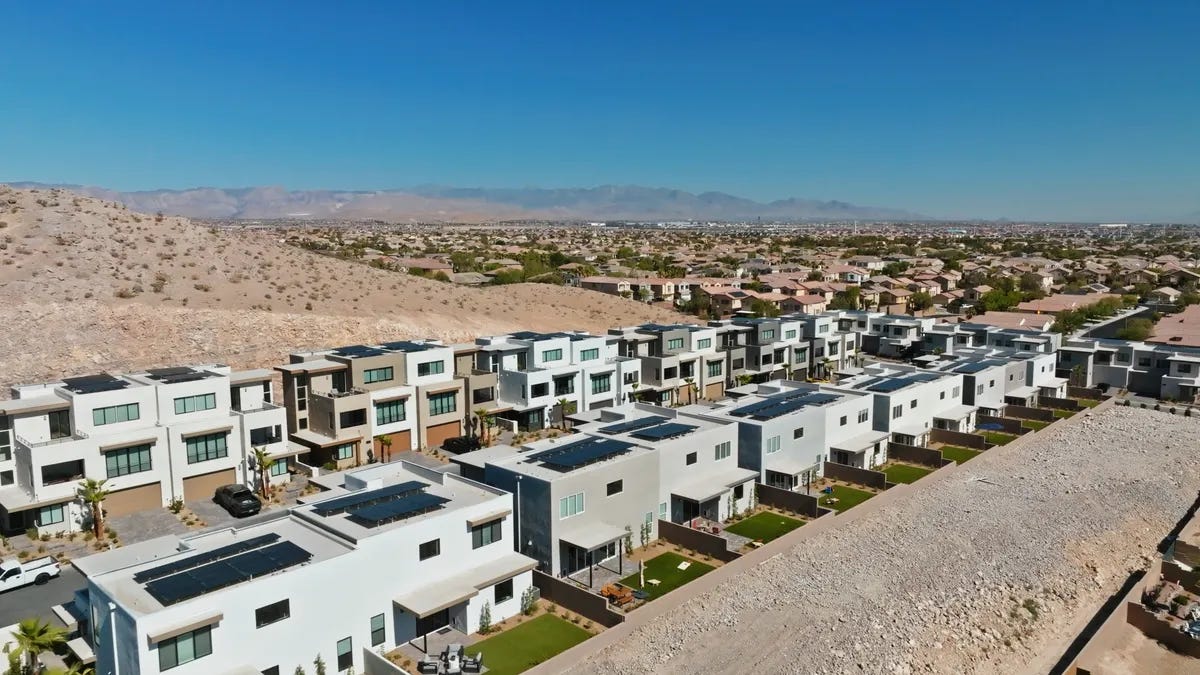
About this photo: The Seneca at South Highlands is equipped with Tesla solar panels on the residential rooftops, allowing it to operate at near net-zero carbon emissions. Tesla proposed to build a $10.1 billion solar cell manufacturing facility in Fort Bend County, Texas.
Solar’s Investment Opportunity is Silver
If you want to invest in the accelerating buildout of solar energy, one of the most direct ways may not be buying a solar-panel manufacturer. It may be owning silver.
Tesla has proposed investing $10.1 billion in a major solar-cell and module manufacturing facility near Houston—an expansion that underscores the scale of the coming U.S. solar buildout and the materials demand behind it. The project, known as Project Crystal Sun, would produce photovoltaic cells and finished modules for utility-scale, commercial, and residential markets.
According to documents filed with the Texas Comptroller, the proposed Fort Bend County facility could create 9,712 full-time jobs, plus more than 1,000 construction jobs. If Tesla reaches an incentive agreement with Texas, construction could begin this year, with operations targeted for the first quarter of 2029.
Why Solar Means Silver Demand
Every solar panel requires silver. The metal is used in photovoltaic cells to form the conductive pathways that collect and carry the electricity generated when sunlight hits the panel.
That makes silver a foundational input for solar manufacturing—not merely a financial byproduct of the energy transition. The more solar capacity the world builds, the more physical silver the industry needs.
Tesla’s proposed facility is especially notable because it would dramatically expand domestic solar-cell production. Tesla currently engineers solar products in California and assembles them in Buffalo, New York, with annual capacity above 300 megawatts. Project Crystal Sun would represent an enormous step beyond that footprint.
For investors, the key point is simple: a solar manufacturer faces competition, execution risk, changing subsidies, pricing pressure, and potential margin compression. Silver, by contrast, supplies the industrial backbone used across the solar industry—regardless of which manufacturer ultimately wins market share.
A Massive U.S. Capacity Push
Elon Musk has said Tesla and SpaceX are working toward a combined goal of producing 100 gigawatts of solar capacity annually in the United States. That is a staggering target, particularly considering that solar installations are increasingly being paired with large-scale battery storage, electric-vehicle charging, AI data centers, and broader grid electrification.
The math is astronomical
At an estimated 700,000 ounces of silver per gigawatt, Tesla and SpaceX’s stated ambition to manufacture 100 gigawatts of U.S. solar capacity annually would imply demand for roughly 70 million ounces of silver each year. That is not a minor procurement requirement—it is a major industrial draw on a metal already needed for the aforementioned electronics, vehicles, batteries, military batteries, aerospace, robotics, AI data centers, medical equipment, and grid infrastructure.
Even if manufacturers steadily reduce the amount of silver used in each photovoltaic cell, a 100-gigawatt annual buildout illustrates how rapidly expanding solar deployment can translate into large physical silver requirements.
SpaceX has also submitted permit applications for a proposed 10-gigawatt solar-cell factory in Bastrop, Texas, according to Bloomberg. The facility would reportedly support aerospace-grade infrastructure, including the company’s planned orbital data-center ambitions.
Taken together, Tesla’s proposed Houston-area facility and SpaceX’s Bastrop project point to a much larger trend: major technology companies are preparing for an era in which electricity generation becomes a strategic constraint.
Musk emphasized that point during Tesla’s July earnings call, citing rapidly rising demand from electric transportation and artificial intelligence. “There’s going to be tremendous need for electricity in the future,” he said.
The Better Solar Investment?
Investing in a single solar company is a bet on management, manufacturing execution, sales growth, financing conditions, tariff policy, competition from China, and the company’s ability to protect margins.
Investing in silver is a broader bet on the expansion of solar itself.
Whether the panels are made by Tesla, SpaceX, First Solar, Chinese manufacturers, or a future entrant, photovoltaic manufacturing depends on silver’s unique conductivity. Manufacturers may continue working to reduce silver use per panel, but surging installation volumes can still drive substantial total demand for the metal.
That is why the solar story is also a silver story.
As companies commit billions of dollars to solar factories, battery systems, AI infrastructure, semiconductor plants, and electrified transportation, investors looking for exposure to the underlying industrial trend may want to look beyond the headline-grabbing companies—and toward the metal embedded in the technology itself.
our opinions are not our sponsors opinions
the editorial department is separate from the promotions department
not financial advice