


Samsung begins mass production in 2027. Reported first here on this newsletter. We’ve been covering this story for 2.5 years. Thinking 1 kilogram of silver per battery is a lot completely ignores standard EV scale—it’s pure peanuts compared to overall pack mass.
Midsize Tesla Battery Pack Weight:
-
Tesla Model Y Battery: 1,700 pounds (771 kg)
-
Now you see why 1 kilogram is peanuts compared to the total weight of conventional EV batteries
-
The Unavoidable Math (2026–2030): Industry projections from the IEA and BloombergNEF estimate roughly 140 million EVs will be produced globally between 2026 and 2030. Multiplied by 1 kilogram of silver per pack, commercializing Samsung’s silver-carbon design across this fleet creates an absolute global demand of 140 million kilograms (140,000 metric tons / ~4.5 billion troy ounces) of silver—equating to over five full years of total global mining output absorbed by auto manufacturing alone in the near future.
-
1 Kilogram of Silver Per Pack: Outside analysis indicates a 100-kWh silver-carbon (Ag-C) solid-state battery pack requires up to 1 kilogram (32.15 troy ounces) of physical silver to construct the layer.
-
Superior Conductivity: Silver possesses the highest electrical and thermal conductivity of any metal on Earth, fundamentally eliminating internal resistance and optimizing current density across the cell structure.
-
Twice the Driving Range: By doubling energy density to roughly 500 Wh/kg via an ultrathin 5 µm silver-carbon composite anode, vehicle range jumps directly from standard limits to over 500–600 miles on a single charge.
-
Double the Lifespan: Eliminating liquid electrolytes and suppressing damaging lithium dendrites extends total battery longevity to over 1,000 cycles, doubling operational life up to 20 years.
-
Half the Charging Time: Unmatched metallic conductivity enables rapid 8% to 80% charge execution in just 9 minutes—cutting standard EV charge durations in half.
-
Half the Physical Weight: Switching to an “anode-free” silver-carbon layer occupies 50% less physical space and dramatically slashes pack weight compared to bulky graphite-anode lithium-ion equivalents.
Approaching six consecutive years of a global structural deficit, physical silver has shifted from a precious metal luxury to a non-negotiable industrial asset. Green energy and advanced technology are devouring supply, making tier-one domestic projects essential.
Enter Silver47 Exploration. Advancing over 240 million silver-equivalent ounces across Alaska, New Mexico, and now read their latest news release from Hughes Project Nevada, the company offers high-grade leverage in safe jurisdictions.
Silver47 Achieves 80% Silver and 77% Gold Extraction from Belmont Tailings
at the Hughes Project, Nevada
Conventional cyanide leach identified as potential processing pathway for 2.74 Moz AgEq inferred resource on private land
Vancouver, September 21, 2026 – Silver47 Exploration (“Silver47” or the “Company”) (TSXV: AGA) (OTCQX: AAGAF) is pleased to announce results from a metallurgical testing program evaluating the potential to reprocess the tailings pile from the historic Belmont mine at the Hughes Project, Tonopah, Nevada (the “Hughes Project”).
Key Highlights
-
Strong Metallurgical Extraction: Fine grind agitated cyanide leach testing delivered 80% silver and 77% gold extractions, suggesting low refractory content and further evaluation of conventional processing techniques.
-
Consistent Mineralization in Tailings Samplings: 21 auger samples (over an average thickness of 3.3 m) were collected across the tailings pile and composited into representative west and east master composites, with head grades of 0.27 g/t Au, 40.6 g/t Ag and 0.28 g/t Au, 45.4 g/t Ag, respectively.
-
Finer Grind Drives Recovery: Grinding from the as-received P80 of 106 µm to 53 µm increased silver extraction by approximately 13 percentage points and gold extraction by 18 percentage points, with extraction still rising at the finest size tested, highlighting further upside through grind and leach optimization.
-
Potential Processing Pathway Identified for Evaluation: Metallurgical testing indicates that agitated cyanide leaching, as opposed to heap leaching, is the leading processing approach identified for further evaluation for processing tailings associated with the inferred mineral resource of 1.8 Moz silver and 11 koz gold (44 g/t Ag and 0.3 g/t Au, or 68 g/t AgEq*) within approximately 1.26 Mt1.
-
Potential, Low Disturbance Tailings Reprocessing Opportunity on Private Land: These metallurgical results have delivered key data on extraction rates and process parameters to support further evaluation of technical and economic potential of reprocessing the tailings.
* g/t = grams per tonne; Silver equivalent is calculated using US$20/oz Ag, US$1,800/oz Au with metallurgical recoveries of Ag – 90%, Au – 95%. AgEq = (Ag grade x Ag recovery)+((Au grade x Au recovery) x (Au price / Ag price)).
Galen McNamara, CEO, stated: “Showing extraction of 80% silver and 77% gold support further evaluation of the potential to reprocess the historic Belmont tailings using modern processing techniques. With encouraging extraction results and the advantage of a private-land setting, these results provide useful data as we advance our evaluation of the technical and economic potential of reprocessing these historic materials.”
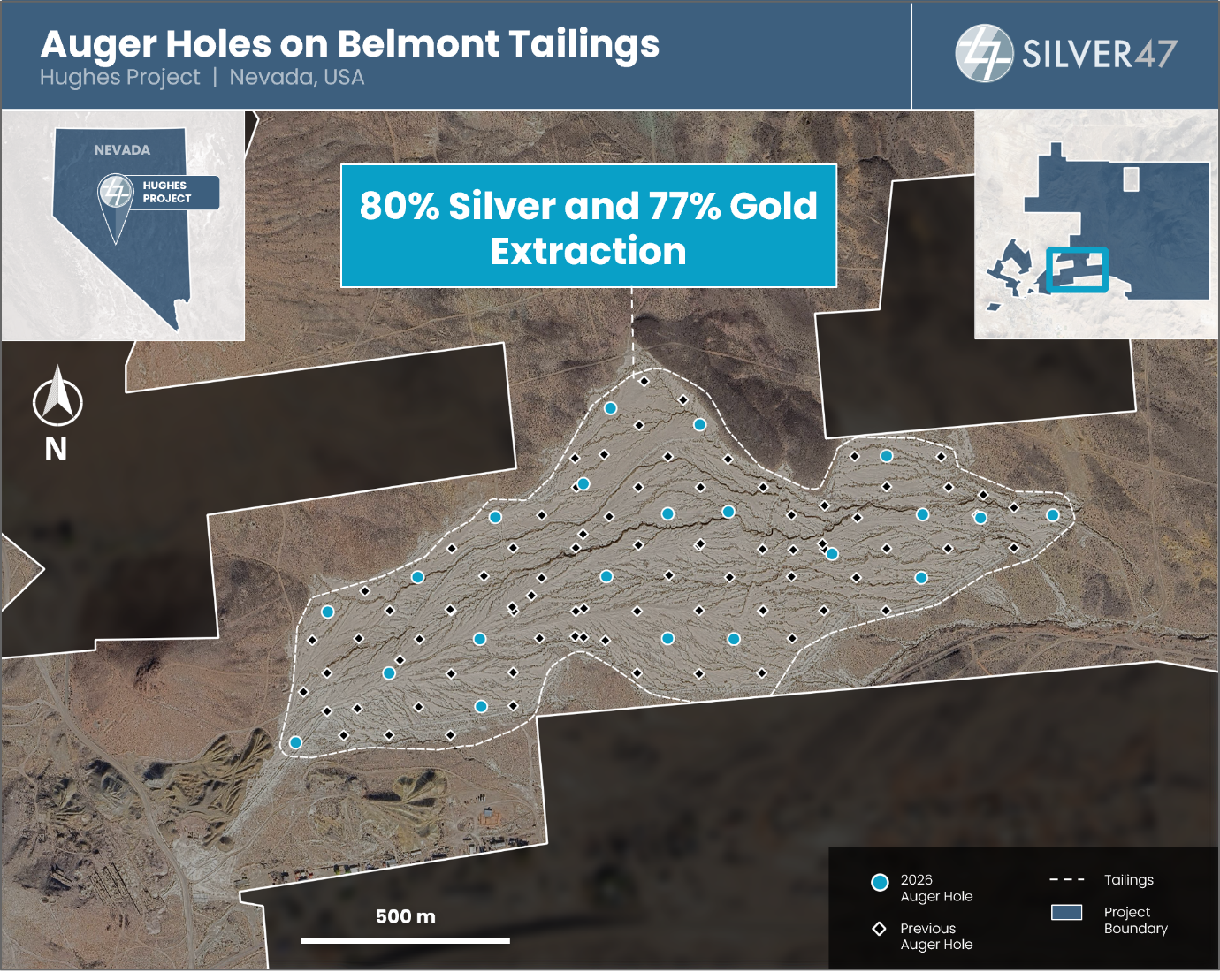
Figure 1: Belmont tailings, Hughes Project — 2026 metallurgical auger sample locations and previous MRE auger holes.
Metallurgical Test Program Summary
Forte Analytical LLC of Fort Collins, Colorado conducted a staged metallurgical program to characterize the Belmont Mill tailings, quantify gold and silver recovery as a function of grind size, and evaluate agitated leach and heap leach processing options.
Sampling and Head Characterization
Silver47 collected 21 auger samples across the tailings pile, twinning the auger holes used in the 2025 Mineral Resource Estimate¹, from surface to the base of the tailings (1–6 m, averaging 3.3 m). Each sample was assayed for gold (fire assay/AA), silver (4-acid digestion/AA), cyanide-soluble gold and silver, carbon and sulphur speciation (LECO) and multi-element ICP-OES. The 21 samples averaged 0.30 g/t Au and 36.8 g/t Ag, with cyanide-soluble gold and silver averaging approximately 85% and 90% of fire-assay head respectively. Sulphide sulphur averaged 0.50% and organic carbon 0.13%, suggesting low potential for preg-robbing or refractory behaviour.
The 21 samples were combined at Silver47’s direction into two mass-weighted master composites: a West composite (101.2 kg) grading 0.27 g/t Au and 40.6 g/t Ag, and an East composite (137.1 kg) grading 0.28 g/t Au and 45.4 g/t Ag. The as-received material has a P80 of approximately 106 µm (140 mesh).
Agitated Cyanide Leach Testing
Each composite was leached at three grind sizes — as received (P80 106 µm), P80 74 µm (200 mesh) and P80 53 µm (270 mesh) — for 48 hours at 40% solids, 1,000 ppm NaCN and pH 10.5. Both composites showed a consistent, near-linear improvement in gold and silver extraction with finer grinding. At the finest grind tested (P80 53 µm), the West composite returned 76.5% gold and 80.7% silver extraction with residues of 0.099 g/t Au and 10.4 g/t Ag, and the East composite returned 77.3% gold and 80.0% silver with residues of 0.084 g/t Au and 11.1 g/t Ag. Relative to the as-received grind, this represents an improvement of approximately 18 percentage points for gold and 11–16 percentage points for silver, with extraction still increasing at the finest size tested. Sodium cyanide consumption at P80 53 µm was 1.7–2.1 kg/t and lime addition 0.5–0.7 kg/t. Extractions are reported on a calculated-head basis; calculated heads for the agitated leach tests exceeded measured heads, and head-grade reconciliation will form part of the next phase of work.
Heap Leach Evaluation
Agglomeration and compacted permeability testing (ASTM D2434) was conducted on both composites at cement additions of 10, 15 and 20 lb/ton. The tailings are 100% fines with no coarse fraction, and the agglomerates formed were friable, broke down on saturation and consolidated into a low-permeability cake under staged compressive loading. All six tests failed to sustain permeability. Forte concluded that the tested conditions were insufficient to produce mechanically stable agglomerates and that substantial additional work on particle size distribution and binder would be required for heap leaching to be viable.
Processing Direction and Next Steps
The program supports further evaluation of agitated cyanide leaching with carbon adsorption as a potential processing route for the Belmont tailings and provides the recovery, reagent and residue data required to scope subsequent work. Priorities for a next phase of metallurgical testing have been identified and include grind-size optimization beyond P80 53 µm, trade-off between carbon-in-leach (CIL) and leach carbon-in-pulp (CIP), carbon concentration and loading kinetics, reagent consumption at optimized conditions, and head-grade reconciliation, together with preliminary process engineering to evaluate the technical and economic potential of reprocessing the tailings.
Continue reading their News Release
While our community deeply understands silver’s irreplaceable role in clean energy and high-tech manufacturing, we rarely examine its most potent catalyst: silver’s historical and emerging role as a monetary metal.
Historically, gold is the metal of kings—held by central banks and sovereign wealth funds to settle nation-state trade. Silver, however, has always been the metal of the people.
And in today’s world, there are billions more people looking for hard-asset protection than there are kings.
As global debt hits unsustainable peaks and fiat currencies face continuous debasement, monetary demand doesn’t need to capture central banks to ignite a massive repricing in silver. It only takes a tiny fraction of global retail capital shifting back to true monetary metals to overwhelm a physical supply market already running structural deficits. When the masses seek sound money, silver is where the world turns.
Silver is Money. Period.
This development with Tether in most respects is bigger news than the silver battery or silver solar story and here is why?
Tether will overcome Federal Reserve soon in legitimacy and power
The massive expansion of Tether into physical gold and silver is one of the most critical structural shifts taking place in global finance today. To understand why this move into physical silver is so game-changing, it is essential to first grasp Tether’s absolute dominance in digital finance, and then look at why they are systematically hard-backing their ecosystem with precious metals.
1. How Massive is Tether in the Shift to Stablecoins?
Tether (USDT) is not just a participant in the stablecoin movement—it is the financial infrastructure of the crypto and digital settlement economy.
-
Monopoly-Level Market Dominance: Tether controls the vast majority of the global stablecoin market, with a circulating market capitalization well over $110+ billion. It handles tens of billions of dollars in daily trading and transfer volume, rivaling—and frequently surpassing—traditional legacy payment networks like Visa or Mastercard.
-
A Shadow Central Bank: Tether yields immense financial clout. The interest earned on its dollar reserves allows Tether to generate billions of dollars in pure net profit quarterly, effectively turning it into one of the most profitable financial entities per employee on Earth.
-
The Global Settlement Layer: As central banks around the world move toward digital currencies and cross-border trade increasingly bypasses traditional SWIFT rails, stablecoins are becoming the default rails for international commerce. Tether stands as the supreme liquidity pillar in this shift.
2. Why Tether Uses Gold and Silver to Legitimize Its Offering
Despite its dominant position, Tether faces two existential, long-term vulnerabilities: relentless regulatory scrutiny over fiat dollar reserves, and the ongoing debasement/inflation of fiat currency itself. To bulletproof its enterprise and legitimize its offerings for the next decade of digital finance, Tether is aggressively pivoting into hard assets:
-
Eliminating Counterparty & Trust Risk: Fiat-backed stablecoins rely on commercial bank deposits and short-term paper (like Treasury bills), subjecting them to banking crises, freeze risks, and regulatory seize orders. Physical gold and silver, locked away in unencumbered vaults, carry zero counterparty risk. They represent absolute finality of settlement.
-
Inflation Protection & Reserve Quality: As global central banks print unprecedented amounts of debt, fiat-pegged tokens lose purchasing power over time. By building massive physical reserves in gold (via Tether Gold / XAU₮) and now expanding into physical silver storage, trading, and leasing, Tether is transforming its balance sheet into an unassailable financial fortress.
-
Creating “Hard Dollar” Synthetic Assets: Products like Alloy by Tether allow users to collateralize tokenized precious metals to mint dollar-equivalent stablecoins. This enables global market participants to hold wealth in hard, inflation-resistant metals while transacting in digital currency.
The Big Takeaway for the Silver Market
When an entity with Tether’s virtually unlimited liquidity footprint decides to move beyond gold and actively store, trade, and lease physical silver, it fundamentally changes the dynamics of the silver market.
Tether isn’t just buying paper derivatives; they are acquiring and vaulting physical bullion in major hubs like Las Vegas. By establishing an immense, deep-pocketed institutional presence in physical silver, Tether brings a massive Western anchor to the market. For physical silver investors, Tether entering the silver market provides an unprecedented new catalyst that could directly absorb real supply and absorb paper shorts in the years ahead.
end of segment
-
our opinions are not our sponsors opinions
-
the editorial department is separate from the promotions department
-
not financial advice