
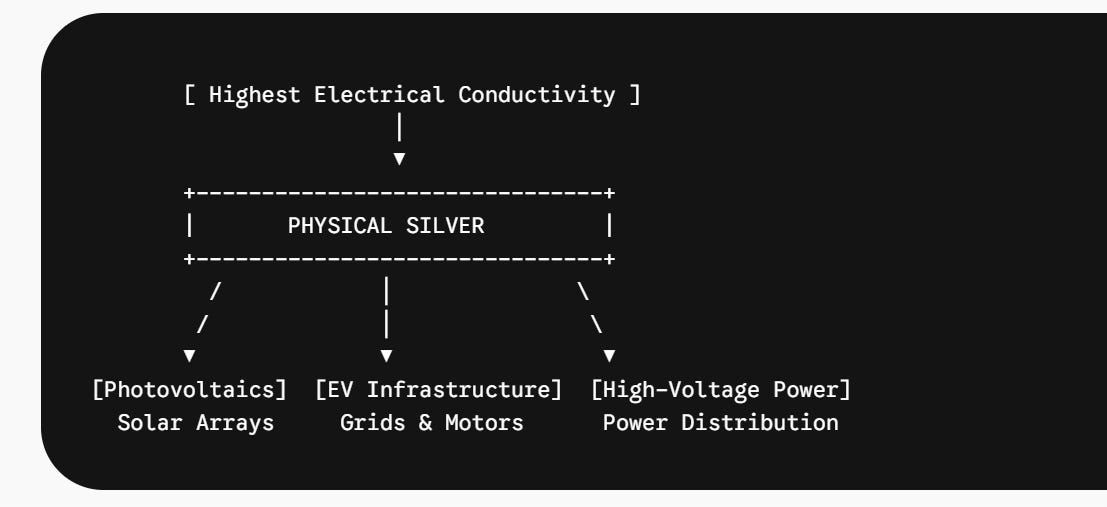
Foreword: A Brief Note for the “Gotcha” Crowd
Before my inbox explodes with smirking pedants explaining basic thermodynamics, let’s save you the typing.
Yes, we know.
We know the heavy excavators digging up silver run on diesel. We know wind turbines, solar panels, and EV chassis are manufactured using fossil fuels. And yes, coal didn’t vanish when oil took over—it still powers power grids worldwide today. Duh. Hydrocarbons will remain vital industrial feedstocks for decades. Nobody is claiming otherwise.
So before you ask, “How’d you get to work today, a solar carpet?” or “You can’t mine silver without oil!”—take a breath. Acknowledging our reliance on petroleum isn’t an argument against the future; it’s just basic reading comprehension.
Oil built the modern world and powers today’s operations. But as legacy infrastructure hits its physical limits, the raw efficiency of tomorrow’s grid demands unprecedented amounts of silver.
Oil got us here. Silver powers what comes next.
While mainstream commentary fixates on the tailspin of hydrocarbon supply chains, the debate over Strategic Petroleum Reserve (SPR) drawdown limits, political half-truths, and looming diesel shortages misses the larger macroeconomic trajectory. The panic over empty supermarket shelves and refinery run-rate collapses is real, but it marks the inevitable friction point of an energy transition.
Every dominant civilizational epoch collapses when its core fuel source runs out or becomes too expensive to extract and defend. Mourning the end of cheap oil is a backward-looking exercise. The actionable thesis lies in recognizing that the next master element of global energy is silver.
1. The Energy Transition Pattern
The economic friction visible in global diesel balances is not unprecedented. Civilizations historically hit hard resource ceilings when their primary energy architecture unravels:
-
The Roman Energy Crisis: Rome did not merely fall to political instability and unending warfare; it ran out of cheap thermal energy. The empire’s expansion relied on massive timber consumption to smelt metals for armaments, construct war chariots, heat public baths, and bake bread. As Mediterranean forests were stripped bare, the energy cost of hauling timber from hundreds of miles away dragged down their economy, debasing their currency alongside their depleted fuel base.
-
The British Industrial Depression: When the British Empire faced its economic stagnation, its near-surface, easily accessible coal seams collapsed. The empire was forced to dig deeper at exponential costs until oil superseded coal, birthing a new global monetary and industrial paradigm.
-
The Hydrocarbon Era Trap: Today, oil and gas are hitting their structural bounds. Depleting salt caverns at the SPR, soaring refined-product prices, and fragile supply chains signal that the modern world is hitting a physical energy wall.
2. The Hydrocarbon Bottleneck: Diesel & The SPR Floor
The operational mechanics of the current oil market reveal how fragile the old paradigm has become:
The Breakdown in 3 Points:
-
SPR Floor Reached: Underground salt caverns hit physical drawdown limits—the emergency buffer is spent.
-
Refining Bottleneck: Restricting exports forces refineries to cut run rates, choking off gasoline, diesel, and jet fuel production.
-
Logistics Collapse: Physical shortages trigger diesel price spikes, directly threatening supply chains and supermarket shelves.
Let’s recall that this energy shock is engineered. The ruling class understood that its war of choice on Iran would shut off strait of Hormuz. Moreover, the ruling class has intentionally underinvested in projects like refineries.
According to data from the U.S. Energy Information Administration (EIA), only one major, full-scale complex refinery with significant downstream capacity has been built in the United States over the past 50 years:
As the Strategic Petroleum Reserve reaches its structural limit—where further rapid draws risk dissolving the salt pillars and causing cavern collapse—the buffer protecting global supply chains disappears.
If governments ban distillate exports to shield domestic consumers, they inadvertently trigger run-rate reductions at complex refineries. Because a barrel of crude yields a fixed slate of products, cutting refined runs to avoid excess domestic diesel accumulation starves the market of gasoline and jet fuel, accelerating systemic inflation across the supply chain.
Logistical friction and short-term retail shortages are real risks during this transition. However, while the legacy energy grid destabilizes, the physical infrastructure of the future grid is quietly being assembled.

For strategic investors, legacy refining infrastructure presents a stark structural reality: with only one major complex refinery built in the U.S. over the past 50 years, the domestic petroleum supply chain relies on heavily aged, fully depreciated assets rather than long-term growth capital.
If institutional capital has effectively ceased expanding primary hydrocarbon processing capacity, doesn’t rational risk management dictate positioning capital toward the scalable, unconstrained physical conductors driving tomorrow’s modern energy architecture?
3. Silver: The Master Element of Future Energy
The global energy framework is shifting from combustible liquid fuels to high-efficiency electrification, generation, and storage. At the heart of this physical transition sits silver—not merely as a monetary hedge, but as an irreplaceable industrial element.
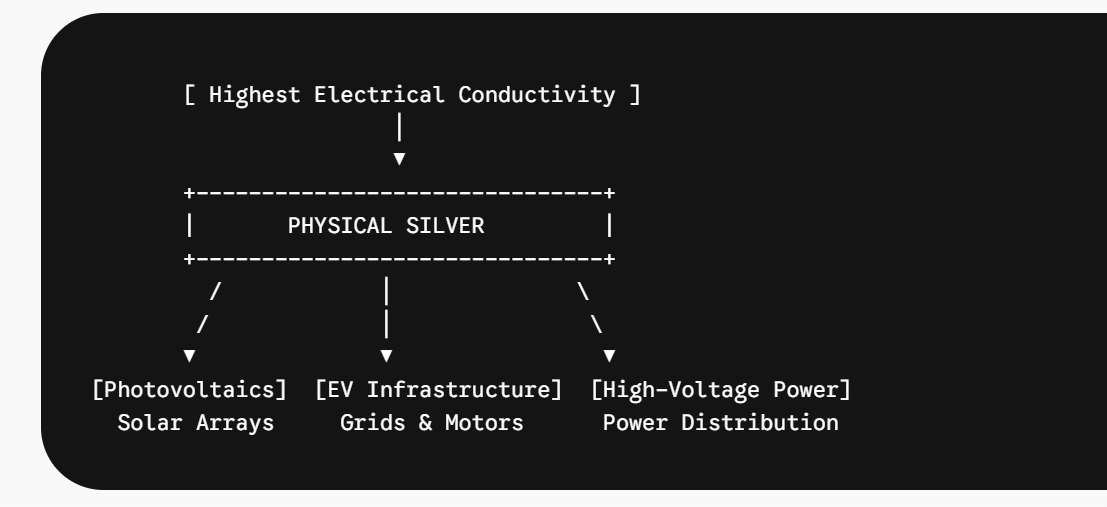
Key Technical Advantages of Silver
-
Unmatched Conductivity: Silver possesses the highest electrical and thermal conductivity of any known element on Earth. It cannot be synthesized or replaced by cheaper metals without introducing severe efficiency losses, heat accumulation, or voltage drops.
-
AI Data Centers & High-Performance Computing: Next-generation GPU clusters, high-density server backplanes, and advanced semiconductors require silver-based thermal interface materials and ultra-conductive connectors to mitigate extreme heat loads and ensure uninterrupted, high-speed data transmission.
-
Solar & Photovoltaic Infrastructure: Modern N-type solar cells (such as TOPCon and Heterojunction) demand significantly higher silver paste loading per watt than legacy solar tech, driving exponential industrial demand from the renewable generation grid.
-
Robotics & Autonomous Systems: Multi-axis robotic actuators, precise sensor arrays, and high-frequency control buses depend on silver contacts to guarantee instant signal delivery and minimal mechanical resistance under constant operation.
-
Aerospace & Defense: From high-altitude avionics and satellite power distribution to missile guidance circuitry, silver coatings and high-reliability alloys provide critical corrosion resistance and unwavering performance in extreme atmospheric and orbital environments.
-
Power Grid & Next-Gen Mobility: Solid-state battery architectures, high-voltage EV power trains, and smart grid switching gear rely on silver as the foundational conductor enabling power transfer with near-zero line loss.
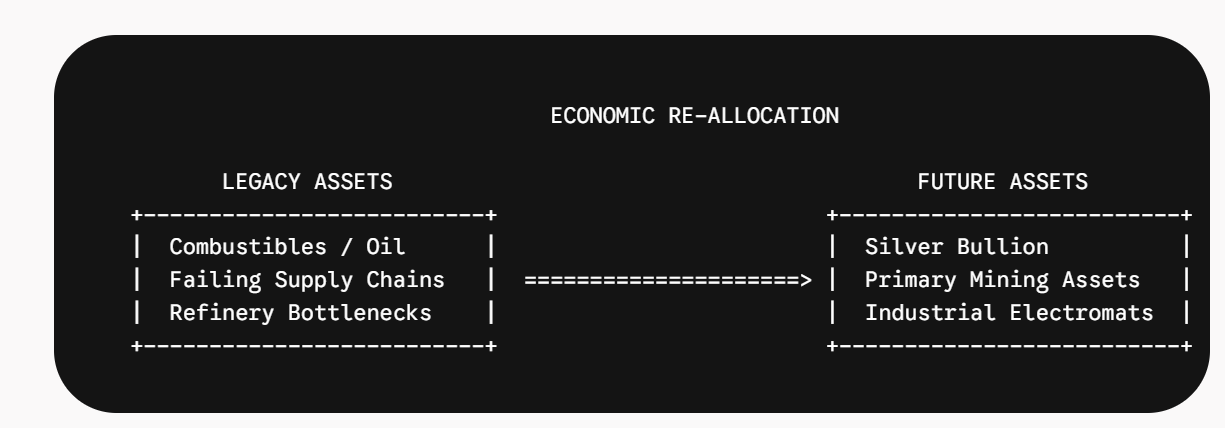
Rather than focusing solely on the structural issues facing the petroleum sector, capital allocation naturally shifts toward the physical constraints of silver mining and physical supply.
Strategic Priorities for the Energy Pivot
-
Physical Metals Allocation: Holding physical bullion decouples capital from systemic supply-chain friction, grid failure, or monetary debasement.
-
Tier-1 Silver Miners: As silver spot prices adjust to reflect its critical role in energy infrastructure, established primary silver miners—those with low AISC (All-In Sustaining Costs) and high-grade proven reserves—offer leveraged exposure to the electrification movement.
-
Avoid Mexico when investing in Silver Miners. Investing in Mexican silver miners carries severe operational and political risks. Operators face widespread cartel extortion via derecho de piso (protection fees), highlighted by tragic violence like the Vizsla Silver massacre and frequent illegal blockades that paralyze production. Politically, the ruling MORENA party has taken an increasingly hostile stance toward foreign extractive industries, reforming mining laws, lengthening permitting timelines, and enforcing a moratorium on new mining concessions. These escalating security costs and regulatory headwinds have forced established producers—such as Endeavour Silver—to pivot capital away from Mexico toward more favorable, stable jurisdictions like Peru.
-
Infrastructure Capital: Shifting focus from legacy fossil-fuel distribution to critical mineral extraction aligns investment portfolios with the physical realities of the next energy era.
The friction in the oil sector is not an end state; it is a catalyst. As the petroleum era reaches its physical limits, silver stands as the primary element driving the next phase of energy generation and storage.
end of segment
our opinions are not our sponsors opinions
the editorial department is separate from the promotions department
not financial advice