
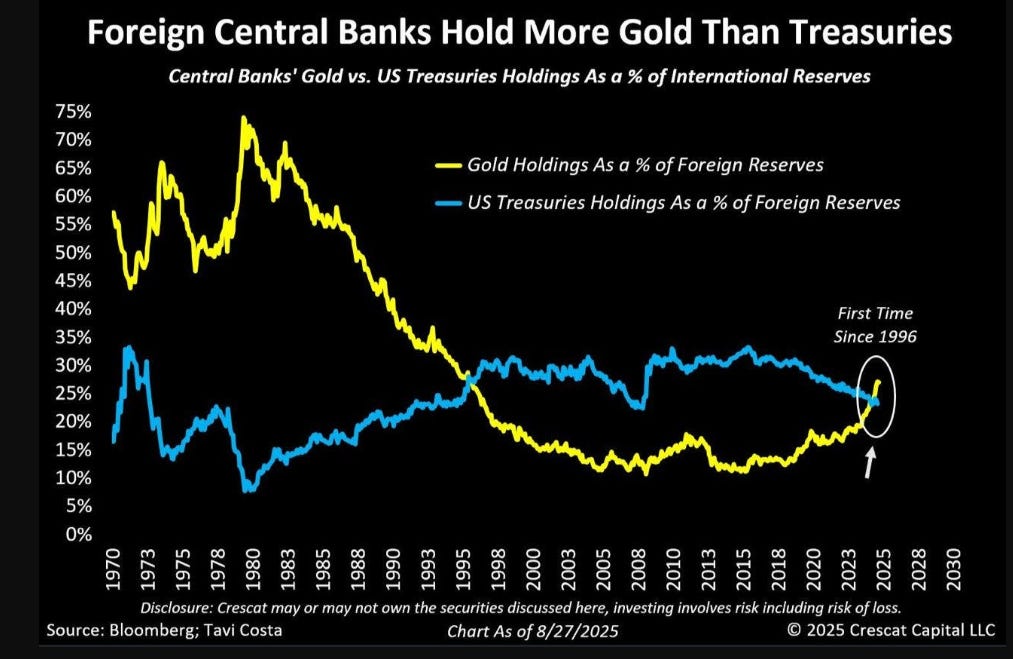
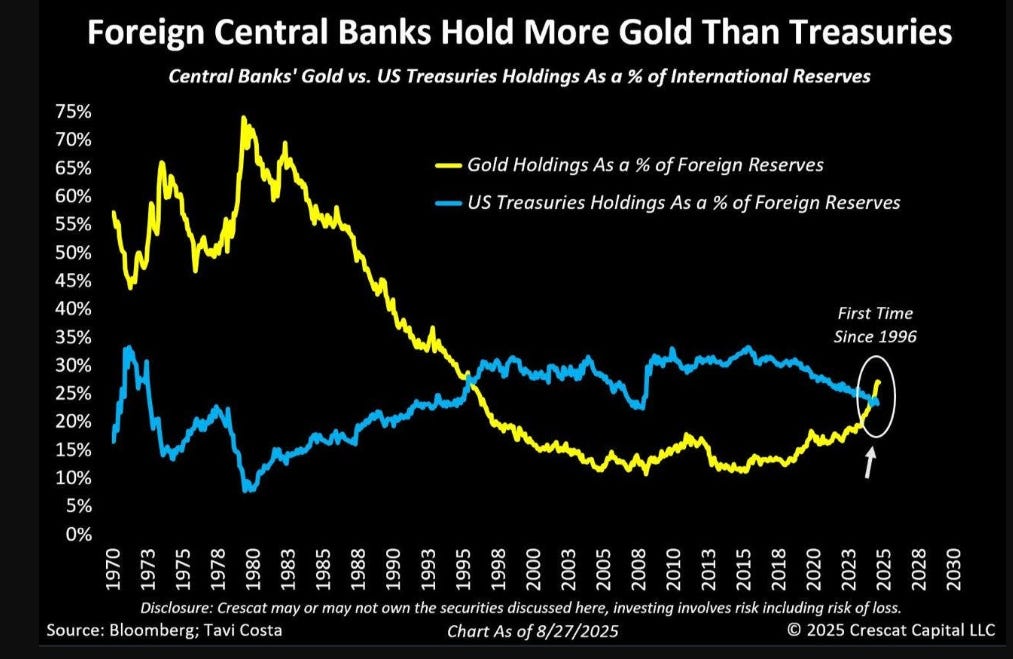
For the first time since 1996, foreign central banks now hold more gold than U.S. Treasuries as the globe continues to de-dollarize at breakneck speed.
Crescat Capital’s Tavi Costa summed it up perfectly: “likely the beginning of the most significant global rebalancings we’ve experienced in recent history.”
Record-breaking central bank gold buying marks a radical shift in the global monetary order, signaling the end of dollar dominance and a new era for gold.
The Great Gold Grab: From Dollar to Bullion
Recent years have witnessed central banks buying gold at a historic pace—2022 alone set the highest net purchase record since 1950. Fears of sanctions and wild U.S. deficits led governments to swap dollar reserves for the timeless safety of gold. With dollar reserves slipping to 57.8% of global assets, down from 72% in 2002, gold is now seen as the world’s reliable financial anchor.
Uncle Sam’s Secret Stash: Collateral Vault Explosion
The U.S. Treasury’s true gold hoard is colossal—nearly 10,000 metric tonnes, or 321,507,000 troy ounces. At a revalued price of $15,000 per ounce, that’s $4.82 trillion in new collateral, instantly restoring balance sheet strength and dollar credibility. Official vaults aren’t the whole story; quiet “recoveries” from Iraq, Syria, and Ukraine boosted the U.S. stash, adding hundreds of tonnes from conflict zones since 2003.
Fiscal Reality Check: Why Revaluation Is Inevitable
America’s debt has soared past $37 trillion, with interest gobbling up nearly a quarter of tax revenue. As the dollar’s reserve role dims, the threat of inflation and instability mounts. Gold revaluation, justified by legal precedent (think Roosevelt’s Gold Reserve Act of 1934), is the only non-inflationary lever left to reset government finances overnight.
Wall Street’s Secret Play: Hedge Funds Are Loading Up
Top hedge funds and institutional investors aren’t just watching—they’re acting, amassing gold as Comex physical deliveries surge and government insiders signal big changes. These moves reflect privileged understanding of U.S. monetary strategy, not wild guessing.
Ray Dalio recently exited his S&P 500 ETF positions, rotating Bridgewater’s capital into SPDR Gold Shares (GLD), Alibaba, and Baidu. This decisive trade underscores Dalio’s confidence in gold and Chinese tech over U.S. equities amid rising volatility and shifting macro risks in 2025.
$15,000 Makes Sense—Not Madness
A $15,000 gold price is bold, but achievable. It brings much-needed collateral to the U.S. without threatening global financial stability.
Ripple Effect: Commodities in the Crossfire
Gold’s ascent inevitably lifts silver and other commodities. As new wealth pours in, industrial and investment silver markets tighten, fueling further asset inflation in precious metals.
Conclusion: The Ironclad Case for $15,000 Gold
Relentless central bank gold buying, America’s true gold reserves, and fiscal necessity combine to make a minimum $15,000 gold revaluation virtually certain. This move is fact-based and transformative, instantly creating $4.82 trillion in collateral and ushering in a new era of monetary power.
end of segment