
by Niko Moretti
This story broke yesterday, but the article below drives home a critical point — everything happening is connected, and it’s only getting worse as this war intensifies. We can’t stay silent. It’s time to amplify one clear message: this war must end. Use the graphic below to call your members of Congress and demand action now.
South Korea just became patient zero in a new kind of global financial crisis—one detonated not by subprime mortgages or bank runs, but by war in the Gulf and the slow death of the petrodollar.
PATIENT ZERO: SEOUL’S SUDDEN MELTDOWN
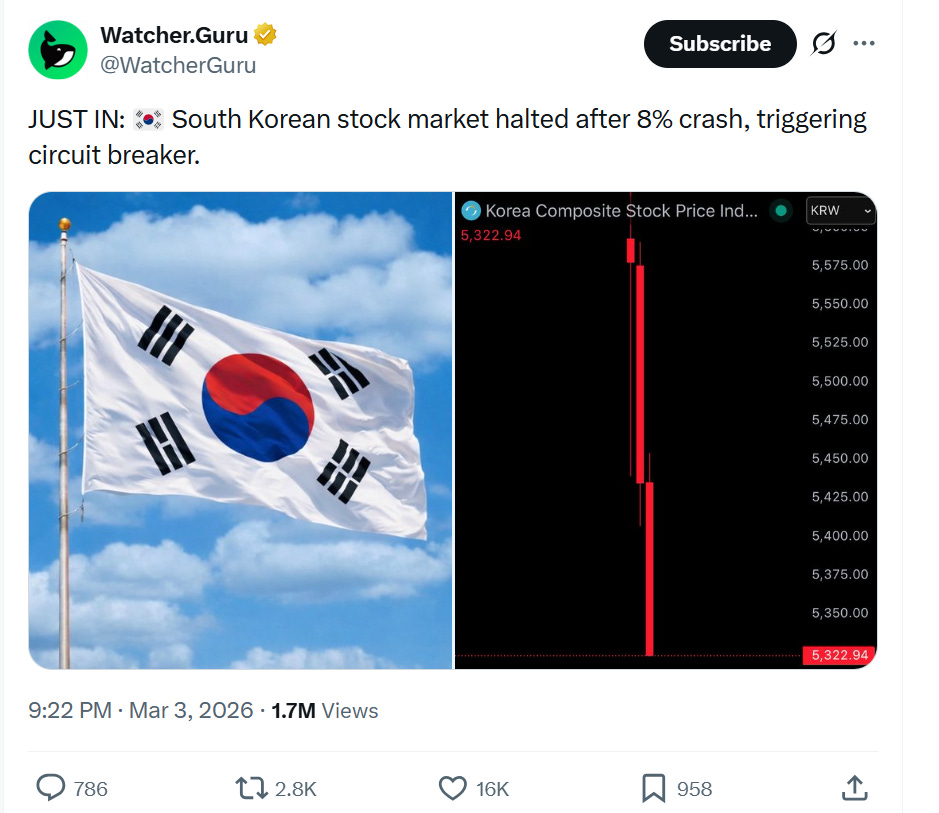
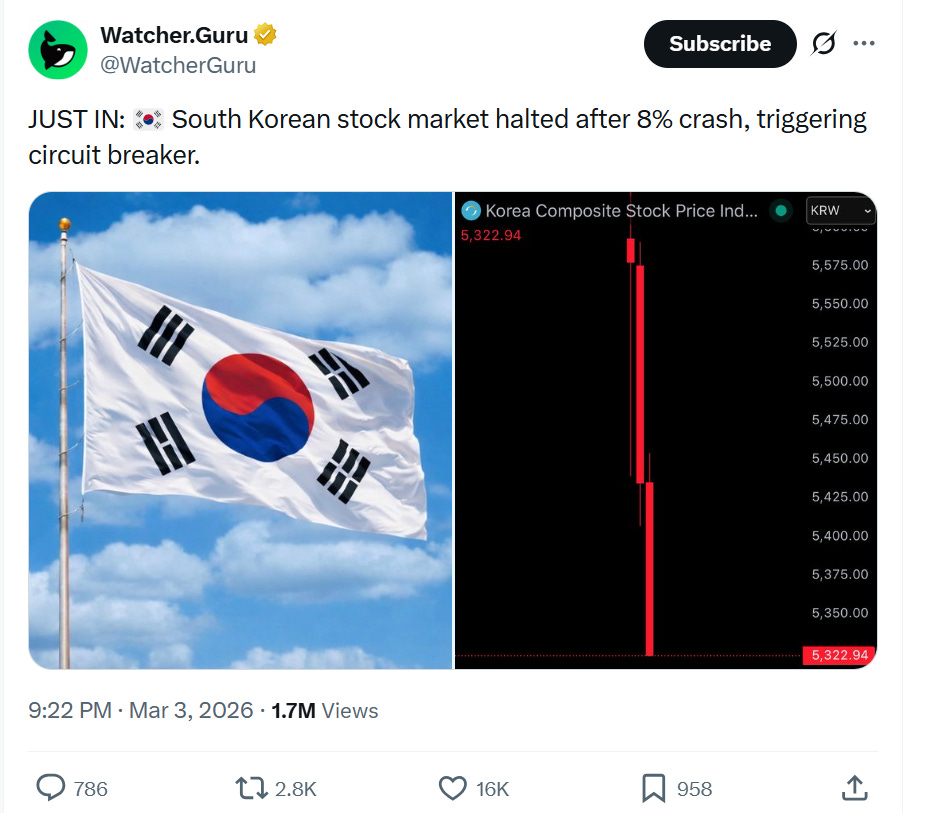
When Iran escalated its confrontation with the United States and its Gulf allies, the fallout was immediate in Seoul. South Korea’s benchmark KOSPI index plunged more than 8% in a single session, forcing the exchange to trigger a market-wide circuit breaker and halt trading. Losses deepened beyond 12% as panic selling spread, making it the worst single-day decline in the market’s history. For a highly developed, export-driven economy closely integrated with U.S.-centric supply chains and finance, this was not just a “bad day.” It was a warning shot: the old energy-and-dollar order that underpins global markets is cracking, and those tied most tightly to it will bleed first.
THE HIDDEN MACHINE: OIL, DOLLARS, AND WALL STREET
To understand why Korea is patient zero, you have to understand the core architecture Washington built—and mismanaged. For decades, the Gulf Cooperation Council (GCC) monarchies—Saudi Arabia, the UAE, Kuwait, and their neighbors—have sold oil overwhelmingly in U.S. dollars and recycled those dollars back into U.S. and allied financial markets. That arrangement does two things. First, it creates constant demand for the dollar as the world’s primary reserve and trade currency. Second, it floods Wall Street and other Western markets with surplus petrodollars seeking yield, turning GCC sovereign wealth funds into major investors in U.S. equities, bonds, real estate, and flagship technology companies, as well as in Asian and European markets aligned with Washington’s order.
This system props up valuations, compresses borrowing costs, and allows U.S. policymakers to run chronic deficits with relatively mild consequences. It is the hidden subsidy behind everything from Silicon Valley’s sky-high multiples to South Korea’s export-led model, which depends on stable energy prices, secure shipping lanes, and predictable dollar liquidity.
WASHINGTON’S FATAL MISCALCULATION
Washington’s miscalculation was to assume this structure was indestructible. By turning the Gulf into an overt staging ground for confrontation with Iran—militarizing GCC territory with bases, missile systems, and logistics hubs—the U.S. transformed its key financial partners into military targets. Iran adapted. Its attacks on GCC-linked infrastructure and U.S. assets in the region are not random acts of rage; they are precision strikes on the foundation of the Western-led financial system. Every drone that threatens a refinery, every missile that endangers shipping through the Strait of Hormuz, directly undermines the credibility of the oil-dollar pipeline.
If investors begin to believe that GCC oil flows are vulnerable and that GCC wealth is no longer safe parked in U.S.-centric assets, the petrodollar pillar weakens. That is where South Korea comes in.
SYSTEM CLIENT IN CRISIS: WHY KOREA CRACKED FIRST
Korea is a textbook case of a “system client”: a major energy importer, heavily reliant on Middle Eastern crude, plugged deeply into U.S.-led trade, tech, and capital networks. Its corporations depend on cheap, reliable energy and a functioning dollar funding system. Its stock market, like others in the developed world, has been buoyed by global liquidity cycles underwritten by dollar recycling and low U.S. rates. When war in the Gulf calls the stability of that system into question, Korea’s equity market becomes an early casualty.
Empirical work shows that oil price shocks and energy-market disruptions significantly raise stock market volatility across advanced economies, affecting both importers and exporters. The Iran–GCC confrontation is not just another “oil spike”; it is a direct threat to the institutional arrangement that keeps energy tradable, insurable, and financed in dollars. Insurers demand higher premiums. Shippers factor in war risk. Central banks and large funds reassess exposures. Markets like Korea—deeply liquid but structurally dependent—react first and most violently.
THE DOMINO TABLE: WHEN PATIENT ZERO INFECTS THE SYSTEM
From there, the contagion spreads. A sustained breakdown in GCC stability and confidence would mean fewer recycled surpluses into U.S. Treasuries and Western equities. That raises funding costs, pressures overvalued tech and growth names, and tightens global dollar liquidity. Risk assets from Seoul to Frankfurt and London are effectively derivatives on the same underlying assumption: that the petrodollar system will continue to function smoothly. If that assumption fails, so do the models, the allocations, and the political assurances.
This is why South Korea’s crash is not a local story—it is a diagnostic. It tells us that the system Washington built is acutely sensitive to its own geopolitical overreach. By escalating confrontation with Iran without securing the physical and financial resilience of the GCC core, the U.S. has endangered the very flows that sustain its empire and its partners.
In plain language: Washington shot itself in the foot, and Korea was the first to scream.
THE EMPIRE’S BILL COMES DUE
If Iran’s strategy succeeds in driving home the message that aligning closely with U.S. power makes you a financial and physical target, capital will begin to reprice risk across all “West-friendly” markets tied to this architecture. GCC assets will demand a risk premium. Asian exporters bound to dollar trade and energy dependency will see higher volatility and lower valuations. U.S. markets themselves, especially those most inflated by global liquidity—big tech, AI, and other high-duration plays—will eventually face the same brutal recognition.
Korea’s circuit breaker was not just a mechanical halt; it was a symbol. The world’s dependence on a fragile, weaponized energy-and-dollar system has entered its breaking phase. The war in Iran and the pending destabilization of the GCC are not side stories—they are the main plot. And unless Washington radically reassesses its strategy, patient zero will not be the last critical market wheeled into intensive care.
In this video, Prof. Jiang exposes a startling reality about the Gulf Cooperation Council (GCC) and its deep entanglement with American power. By trading oil exclusively in U.S. dollars and channeling vast sums into Wall Street, the GCC effectively sustains the U.S. financial system itself. But if that flow ever falters, the consequences could be devastating—triggering market crashes, capital flight, and even a global economic depression. It’s important to note that when the stock market crashes not all sectors crash. Undervalued small and mid caps exposed to natural resources will boom. Silver miners in particular.
Silver as insurance
There has never been a more urgent moment to move up the silver risk curve—from paper promises into physical metal and quality silver miners. The petrodollar order is wobbling, energy routes are in play, and dollar-denominated assets are increasingly hostage to geopolitics, sanctions, and financial repression. In that kind of environment, silver is not a trade, it is insurance.
Silver miners, meanwhile, offer leveraged upside to any repricing of real money versus paper. As capital wakes up to the fragility of the current system, those positioned early in silver and select miners will not be chasing the panic—they’ll be selling into it.
end of segment
-
our opinions are not our sponsors opinions
-
the editorial department is separate from the promotions department
-
not financial advice