
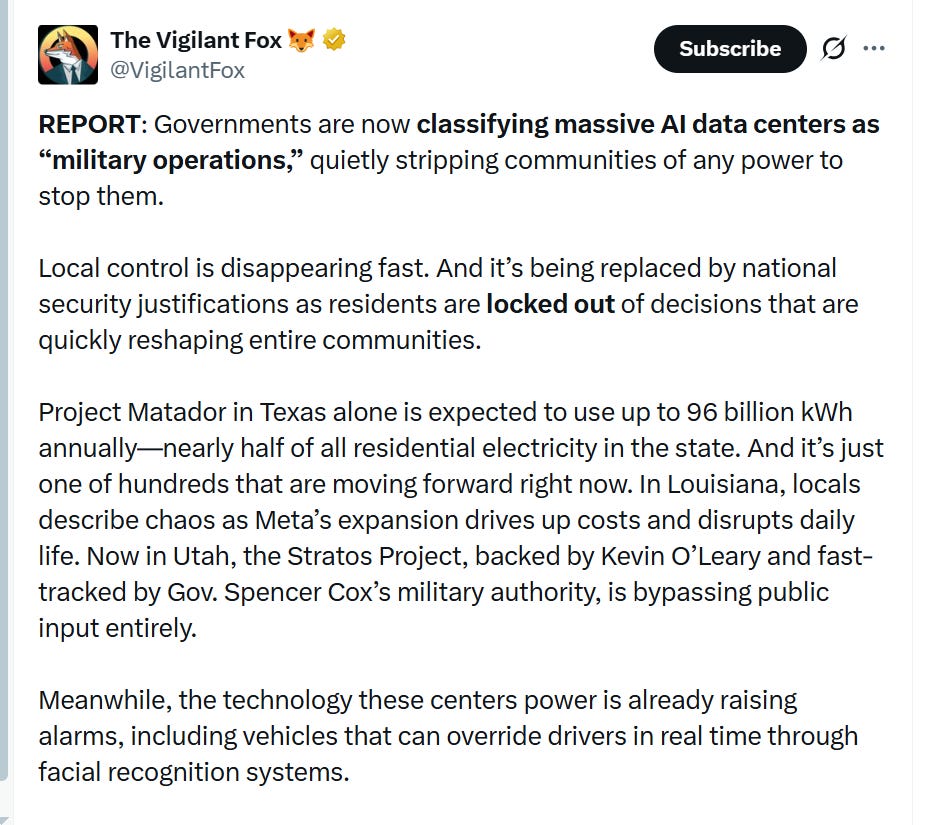
AI data centers aren’t a passing tech fad; they’re permanent, resource‑hungry infrastructure that will devour staggering amounts of electricity, water, metals, and land for decades to come. Governments are now classifying massive AI data centers as “military operations,” quietly stripping communities of any power to stop them and shielding projects from local scrutiny. At the same time, states are taking strategic stakes—directly and indirectly—in chip champions like Intel and Nvidia, fusing national security priorities with corporate profit, and ensuring that this build‑out of embodied AI and data infrastructure continues regardless of local resistance or resource constraints.
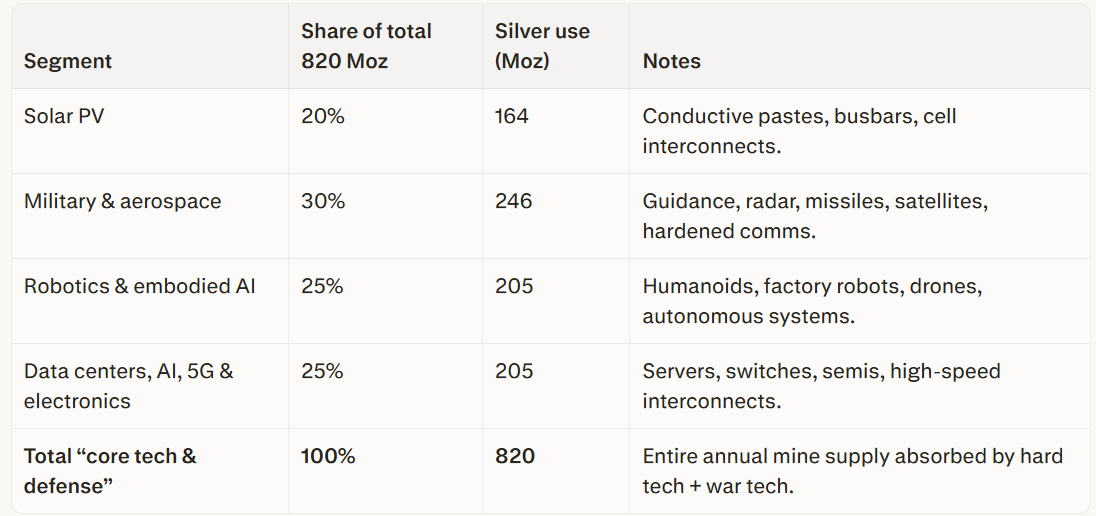
we’ve included a breakdown of projected silver use in robotics and the conclusion.
Silver isn’t just tight; it’s already gone the moment it’s dug out of the ground.
Global mine supply is roughly 820 million ounces of silver per year. In a world of embodied AI and permanent war‑tech, that entire 820 Moz gets swallowed before you even get to jewelry, coins, or “normal” industry. Solar, military, robotics, AI hardware, data centers and 5G together now form a single, integrated tech‑complex that quietly hoovers up essentially the whole annual flow.
Here’s the simple logic:
-
Solar PV: High‑efficiency solar cells still rely on silver pastes and busbars. As capacity keeps compounding, solar alone can claim a huge, non‑negotiable slice of global supply.
-
Military & aerospace: Missiles, radar, guidance systems, hardened comms, satellites and classified platforms are silver‑intensive, price‑insensitive and politically untouchable. That demand doesn’t get rationed; everything else does.
-
Robotics & embodied AI: Humanoids, industrial robots, drones, autonomous vehicles and smart munitions embed silver in connectors, sensors, power electronics and AI boards. Each unit uses approximately 15 grams of silver—but tens and then hundreds of millions of units use millions
-
AI data centers & 5G: Racks, switches, high‑speed interconnects, power conditioning, edge hardware: all layer additional silver into an infrastructure that must stay online 24/7.
Add those together and you can easily assign the full 820 Moz of annual mine supply to this “hard tech + war tech” stack. Everything else—consumer electronics, brazing alloys, legacy automotive, medical, water treatment, jewelry, coins—is effectively running on deficit metal, above‑ground stocks, and scraps shaken loose by price spikes.
That’s why the real no‑brainer isn’t trying to guess which AI chip or robot OEM wins. It’s owning the choke point: primary silver miners that actually produce silver as their core product, not as incidental by‑catch from a copper or zinc pit.
-
Aya Gold & Silver (OTC: AYASF) (Morocco): A primary, high‑grade silver producer with growing output in a mining‑friendly jurisdiction. When silver gets repriced, every incremental ounce goes straight to the bottom line.
-
Andean Precious Metals (OTC: ANPMF) (Bolivia): Near‑pure silver exposure processing historic tailings and oxide material, with operating leverage to a rising silver price and expansion upside.
-
Kuya Silver (OTCQB: KUYAF) (Peru): A junior focused on high‑grade Peruvian silver, where even modest scale can translate into big percentage moves when the metal breaks out.
By contrast, “silver as a by‑product” from big copper operations is structurally at risk. Those mines respond to copper economics and regulatory shocks—such as Chinese constraints around sulfuric‑acid‑based processing—not to silver scarcity. If copper production stalls, by‑product silver quietly disappears, tightening a market that’s already fully spoken for.
In that setup, primary silver producers are not just another mining trade. They are the only reliable way new silver enters a system where solar, war, robots and AI are already consuming the entire annual harvest.
Full Breakdown of silver use in robotics running various scenarios:
Total industrial/service robots today (all types, including factories, warehouses, service):
-
Installed base: ~4.3–4.6 million industrial robots in factories, plus several million service and logistics robots; a working round number for “all robots” today is ~5–7 million operational units.
-
Annual new installations: ~540,000 industrial robots per year, plus roughly 200,000+ professional service robots and fast‑growing warehouse/logistics units, putting current yearly shipments in the 700,000–1,000,000 range.
-
Long‑term humanoid & service robot outlook (humanoid‑style “embodied AI” platforms):
-
Additional non‑humanoid robots (industrial arms, warehouse AMRs, mobile platforms) could add hundreds of millions of units on top of the humanoid installed base by mid‑century, but for a clean estimate we treat “1 billion” as the core, humanoid‑centric robotics demand driver.
-
-
Per‑robot silver intensity assumptions (based on current electronics usage plus robotics‑specific load):
-
Benchmark: Advanced electronics currently consume hundreds of millions of ounces of silver annually for contacts, solders, and high‑speed connectivity; robotics packages these same functions into each embodied unit.
-
Engineering‑based range: 10–20 g of silver per sophisticated humanoid/service robot is a conservative range once you account for:
-
Power and signal connectors and relay contacts
-
Motor/inverter and power‑management circuitry
-
AI/CPU boards, sensors, RF modules, and comms hardware
-
High‑reliability solders and thermal interface layers
This is directionally consistent with independent metal‑intensity analyses for advanced electronics and connected devices, scaled to robot mass and complexity.
-
-
Working midpoint for estimates: 15 g of silver per humanoid/service robot.
-
-
Total silver embedded in a 1 billion–unit humanoid fleet (core headline figure):
-
Mass: 1,000,000,000 robots × 15 g silver/robot = 15,000,000,000 g silver.
-
Convert to metric tons: 15,000,000,000 g ÷ 1,000,000 g/t = 15,000 metric tons.
-
Convert to troy ounces: 15,000 t × 32,150.7 oz/t ≈ 482,260,500 troy ounces of silver.
-
Interpretation: ~482 million ounces is equivalent to roughly 4–5 years of current global electronics‑sector silver demand, and well over a half year of total global mined silver supply, permanently sequestered inside a single technology platform.
-
Silver per year at 15 g/robot:
-
40,000,000 robots/year × 15 g = 600,000,000 g/year.
-
600,000,000 g ÷ 1,000,000 g/t = 600 metric tons/year.
-
600 t × 32,150.7 oz/t ≈ 19.3 million troy ounces of silver per year at steady‑state ramp.
-
-
end of segment
-
our opinions are not our sponsors opinions
-
the editorial department is separate from the promotions department
-
not financial advice