
Last Thursday, July 30—less than a week ago—I wrote about why investors should be positioning in silver miners. At that time:
-
Aya Gold & Silver was trading at $20.44.
-
Andean Precious Metals was trading at $4.09.
-
Kuya Silver was trading at $0.51.
Today, those same stocks are trading at:
-
Aya Gold & Silver: $34.30 — up 67.8%
-
Andean Precious Metals: $4.80 — up 17.4%
-
Kuya Silver: $0.55 — up 7.8%
In just six days, Aya has delivered a nearly 68% move, while Andean and Kuya have climbed 17% and 8%, respectively. Aya Gold & Silver trades under the AYA ticker
For those who missed the article it is right below this sentence.
Is it too late to position yourself?
NOT AT ALL
-
Silver still looks remarkably inexpensive when measured against its historical purchasing-power benchmarks.
-
Silver is priced roughly 50% below its nominal all-time high of $120
-
Silver is priced 71% below its CPI-adjusted peak of $215
-
and 92% below its M2-adjusted equivalent of $780
-
today’s Silver price hardly resembles a mania.
-
By these longer-term measures, silver remains deeply discounted—not expensive—and very early in a much larger repricing.
-
CPI and money-supply adjustments offer different ways to compare historical prices in real terms.
There are interconnected pressure points in a fragile system. Energy disruptions raise costs precisely as debt-service burdens restrict fiscal flexibility. AI-driven labor displacement can weaken consumer demand and social cohesion while commercial-real-estate losses pressure regional-bank balance sheets. Meanwhile, market concentration leaves index investors exposed if a narrow group of mega-cap leaders disappoints. Escalating defense commitments and foreign conflicts increase the risk of further borrowing, inflation, and resource misallocation. None of these developments alone guarantees a crisis. Together, however, they create a feedback loop: slower growth, higher costs, tighter credit, and declining public confidence—conditions that historically favor tangible, scarce assets over financial promises.
Flight to Safety From one of the World’s most Embarrassing Governments
Nothing poses a greater systemic danger than a political class that treats arithmetic as optional. Both parties have normalized deficits, enabled debt nearing $40 trillion, and defended a foreign-policy machine whose costs routinely outrun its promises. This is not leadership; it is bipartisan fiscal negligence.
South Korea’s resumed gold purchases after a 13-year pause are a reminder that reserve managers are seeking diversification amid geopolitical and monetary risk. The Iran conflict has also exposed the chasm between military ambition and strategic results. Meanwhile, disruptions around Hormuz underscore how fragile energy markets and supply chains remain.
The warning is simple: governments can postpone consequences, but they cannot repeal them. Investors who wait for official reassurance may discover that confidence vanishes faster than capital can move. Own assets with no counterparty risk before the crowd realizes the system was never stable to begin with and starts searching for what cannot be printed.
The Iran fiasco:
-
No regime change: Iran’s ruling regime remains in power, despite the military campaign and the stated pressure for political change.
-
No verified nuclear dismantlement: Iran’s nuclear capability has not been conclusively eliminated, leaving the central proliferation concern unresolved.
-
No decisive defeat of Iran’s proxy network: Iran’s regional militias remain a destabilizing force. Claims that they are stronger require caution, but they have not been neutralized or removed as a strategic threat.
-
No secure Strait of Hormuz: Commercial passage remains severely disrupted, threatening roughly one-fifth of global petroleum flows and creating a historic energy-supply shock.
-
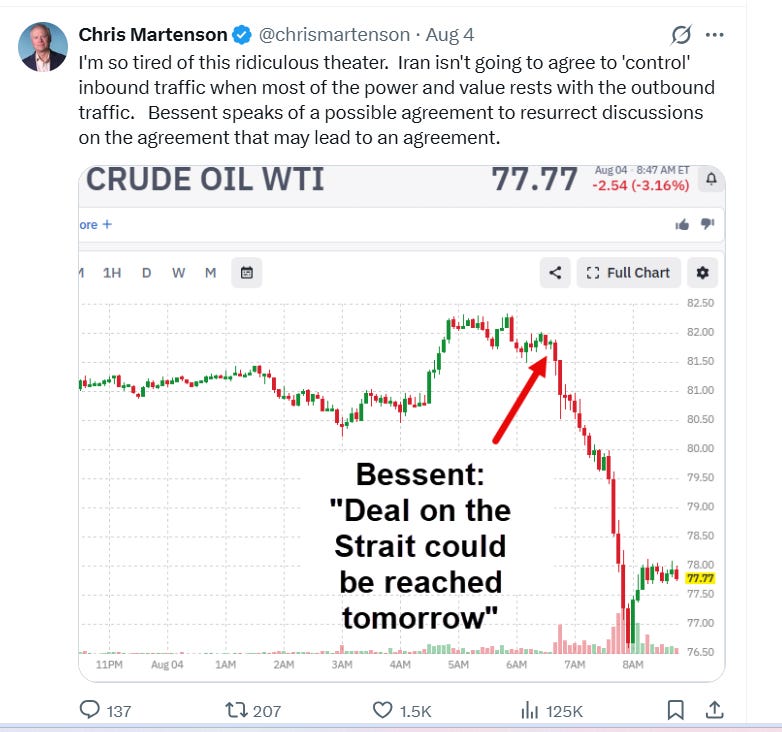
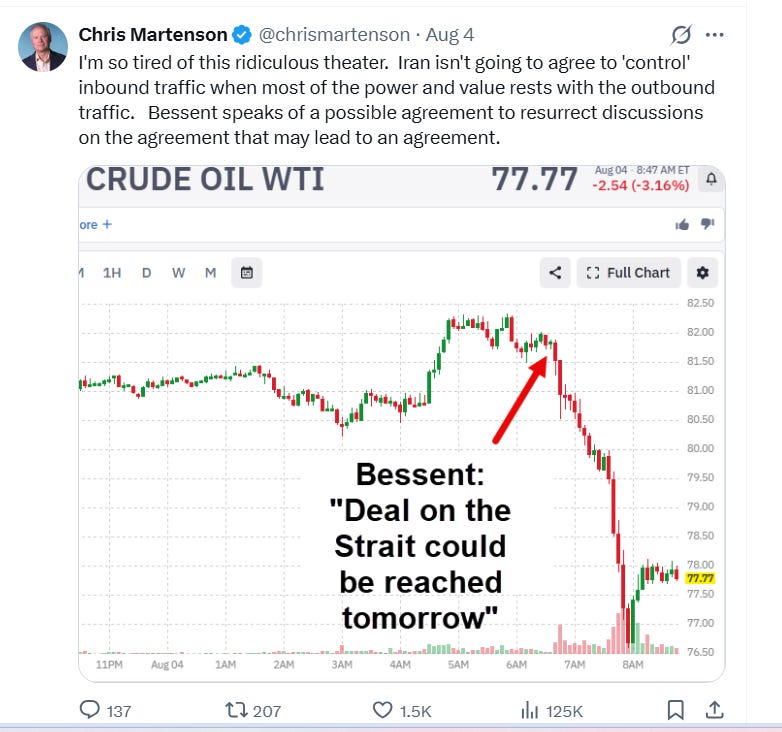
Oil rigging just like silver. How can the strait be closed for 5 months and oil down 20%
If the circus never leaves town pretty soon the people stop buying the popcorn and tickets and start begin planning for what’s next.
our opinions are not our sponsors opinions
the editorial department is separate from the promotions department
not financial advice