
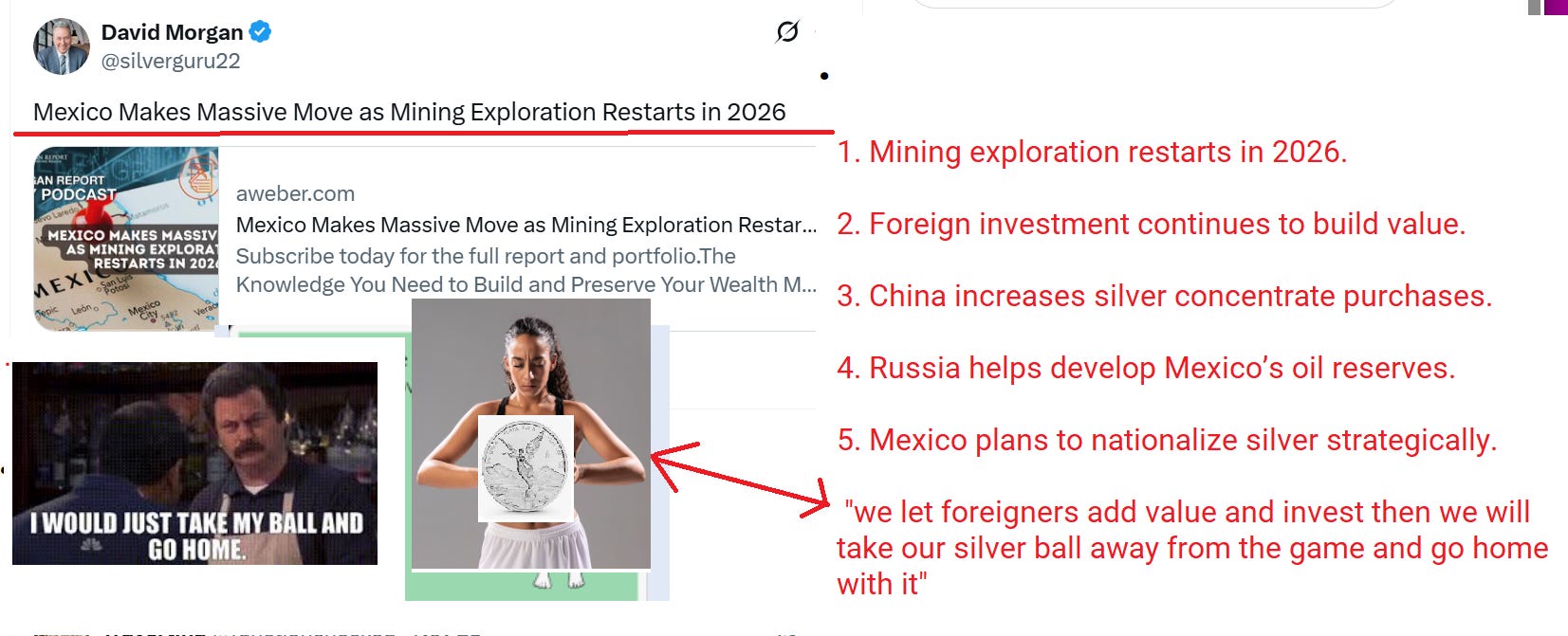
Dejamos que los extranjeros agreguen valor e inviertan, luego nos llevaremos nuestra pelota de plata y nos iremos a casa con ella.
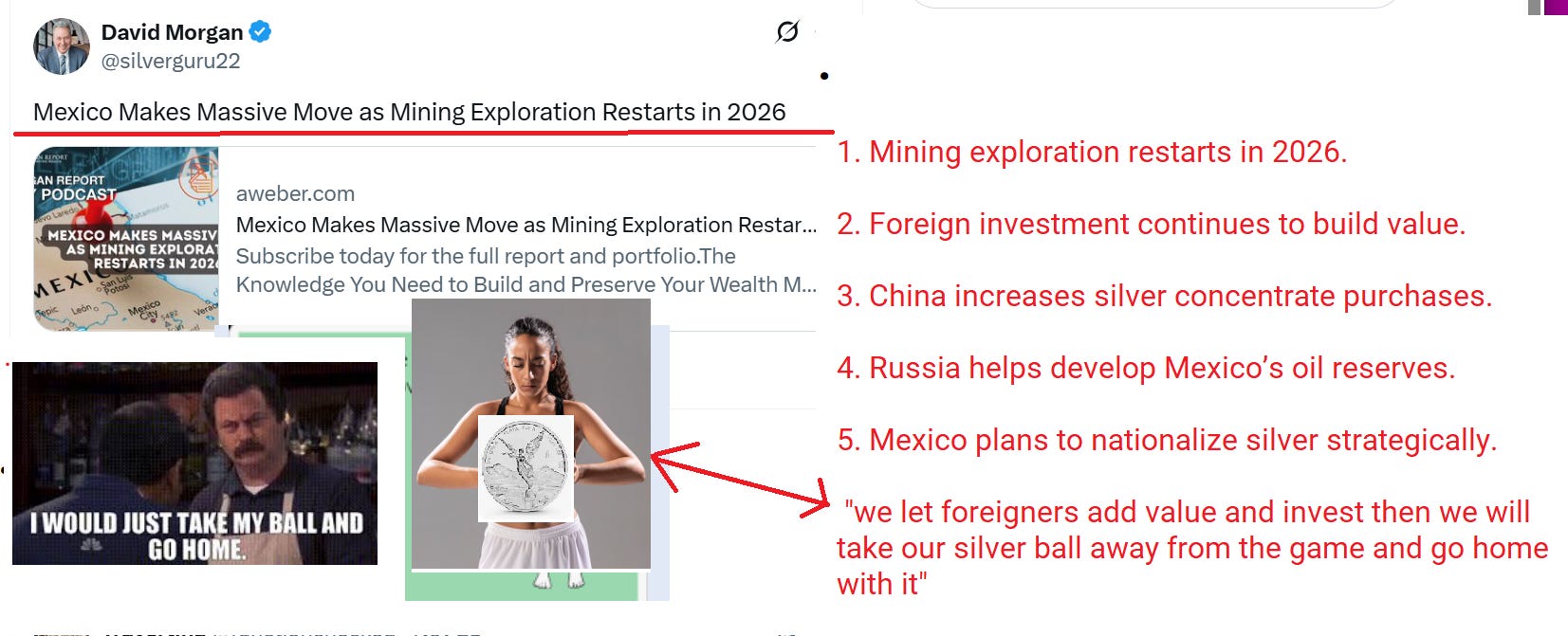
“we let foreigners add value and invest then we will take our silver ball away from the game and go home with it”
Mexico’s Mining Awakening: National Beneficiaries First
Mexico’s announcement to restart large-scale mining exploration in 2026 signals more than a bureaucratic shift — it’s a redefinition of how the nation sees ownership and benefit in its mineral wealth. When Secretary of Economy Marcelo Ebrard declared that pending permits would finally move forward after years of stagnation, he wasn’t simply celebrating administrative progress. He was unveiling a deeper pivot: Mexico intends to expand its silver, gold, and mineral portfolio, but on its own terms — not under the legacy framework that ceded profit and control to foreign corporations.
Ebrard’s remarks about “supply chain security” and “national competitiveness” point to an increasingly multipolar world in which resource-rich nations are reclaiming autonomy over their strategic inputs. For decades, Mexico’s mining wealth has flowed disproportionately northward, dominated by Canadian and U.S. firms that operated with generous concessions and limited reinvestment in local communities. The tone of the new mining reboot suggests those days are ending. As global tension grows, Mexico sees sovereignty over its resources not as rhetoric, but as an economic necessity.
The mention of collaboration with the Mining Chamber and engineers on issues like regulation, water, and sustainability also reflects a reorientation of power. Under the new model, the state and the domestic industry will set the rules, not foreign boards or investors looking to maximize extraction speed. If Mexico’s government can streamline permits while maintaining labor and environmental protections, it strengthens the argument that nationalized or majority-Mexican mining ventures can be both efficient and ethical — a model aimed at long-term community benefit rather than quarterly shareholder returns.
Ebrard’s call to develop local “engineering and processing capacity” is especially revealing. For decades, raw silver and gold left Mexico to be refined abroad, stripping the country of industrial value-add and skilled-labor growth. Building domestic processing capability would mean retaining more of the economic chain inside Mexico — from mineral recovery to refined product — fulfilling a nationalist vision akin to resource development policies seen in countries like Chile or Indonesia.
This isn’t isolationism; it’s economic rebalancing. Mexico still welcomes technology transfer, joint ventures, and investment — but only under conditions that ensure that silver, gold, and even oil truly contribute to Mexican prosperity. The symbolism of restarting after years of “stagnation” aligns with President Claudia Sheinbaum’s broader economic narrative: a modern, self-reliant Mexico that still trades globally but refuses to be anyone’s extraction ground.
Yes, silver, gold, and oil remain central to Mexico’s wealth. But under the evolving model, their ultimate function is national empowerment — to create jobs, promote technological skill, and strengthen fiscal independence. If this direction holds, the 2026 mining restart will not mark a return to business as usual; it will mark the beginning of a new era where Mexico develops its immense mineral potential not for others, but for Mexicans.
The Transformations and Silver’s Next Chapter
Mexico has experienced three prior “transformations” that reshaped its national identity and economic order: Independence (ending colonial rule), the Liberal Reform (establishing a secular republic and curbing old privileges), and the Mexican Revolution (empowering social reform and installing national control over subsoil resources). The Fourth Transformation, spearheaded by López Obrador and the Morena party, is rooted in reclaiming sovereignty and economic justice—logically extending the historic pattern that could lead to nationalizing silver to ensure national benefit and control.
Nationalization Still Likely—Even If Not in 2026
Even if a sweeping move to nationalize silver does not occur in 2026, this trajectory remains highly probable in the medium term. Mexico’s historical pattern is one of gradual but determined assertion over its natural wealth: after initial foreign control, followed by nationalization, then re-privatization, the pendulum continues to swing back toward increased state and local oversight. Changes in global demand, supply chain dynamics, nationalist sentiment, or renewed political momentum could lead the Morena party—or its political lineage—to move toward outright state control or majority-Mexican ownership in the coming years. The machinery for such a pivot remains in place, rooted in constitutional authority and the government’s ability to set ownership and concession rules.
Opening Mining Does Not Mean Abandoning Nationalization
The recent reopening of mining exploration and the acceleration of permit processes under the Secretary of Economy signals renewed dynamism—but does not signify that nationalization is off the table. In fact, the ability to attract new investment, build processing capacity, and negotiate technological transfer may serve as groundwork for a future where Mexico exerts greater control, especially if a geopolitical or economic crisis shifts priorities.
Nationalization does not necessarily mean isolation: it can involve strong state oversight, conditional partnerships, or forms of joint venture that prioritize Mexican workers, communities, and fiscal returns. Latin American precedents show a spectrum of models, from full government ownership to state-private partnerships with strict conditions favoring national interests. The current openness is arguably tactical: by building domestic capacity and leveraging foreign investment to develop value-added infrastructure, Mexico places itself in a stronger position should it decide to fully nationalize silver in the future. This approach allows flexibility—to continue welcoming investment, or pivot toward full national ownership if the U.S. or other powers adopt hostile stances, as suggested in recent policy commentary.
Historical Logic and Policy Trajectory
-
The first three “transformations” fundamentally restructured power over land, law, and labor.
-
The Fourth Transformation aims to add economic sovereignty to that list, learning from past cycles of foreign exploitation and partial reforms.
-
Mexico’s history with nationalization—most recently with lithium under the same administration—shows that state control remains a live, strategic policy tool, not just a rhetorical device.
Even as the current government reopens the sector, the push for Mexican ownership shares, royalty regimes, and supply chain control all reinforce the ongoing relevance of state sovereignty in mining. This approach threads the needle: seizing the moment for growth and investment now, while retaining the ability to move swiftly toward silver nationalization in response to political, economic, or geopolitical catalysts.
Both statements are true.
-
Mexico will encourage mining.
-
Mexico will continue moving further along, seizing control of its silver to benefit Mexico rather than providing profits for North America-owned silver mines.
The Secretary of Economy, Marcelo Ebrard Casaubón’s announcement that Mexico will restart large-scale mining exploration in 2026 is perfectly compatible with a scenario in which Mexico also reasserts sovereignty over its silver and natural resources. Accelerating mining investment can help develop new projects, upgrade technology, and build internal capabilities—yet it does not preclude future moves toward nationalization or increased state control. In fact, these steps can set the stage for reclaiming silver as a strategic asset for Mexico’s economic and energy security, ensuring that the nation—not foreign shareholders—reaps the benefits.
Mexico’s new leadership, dominated by a cadre of highly educated women with advanced degrees in energy, law, and environmental sciences, embodies a historic break from the past. Their expertise empowers Mexico to work pragmatically with Russia, China, and other partners, leveraging global relationships to serve the country’s interests. In this context, silver is no longer just a commodity; it becomes a tool for national development and for lifting people out of generational poverty tied to dependence on North American capital. Cooperation with other socialist-leaning nations, combined with policies prioritizing Mexican ownership and value-add, positions Mexico to throw off old patterns of resource exploitation and advance genuine economic sovereignty
end of segment
-
Our opinions are not our sponsors opinions
-
Editorial Department is separate from Promotions Department
-
Not financial Advice