
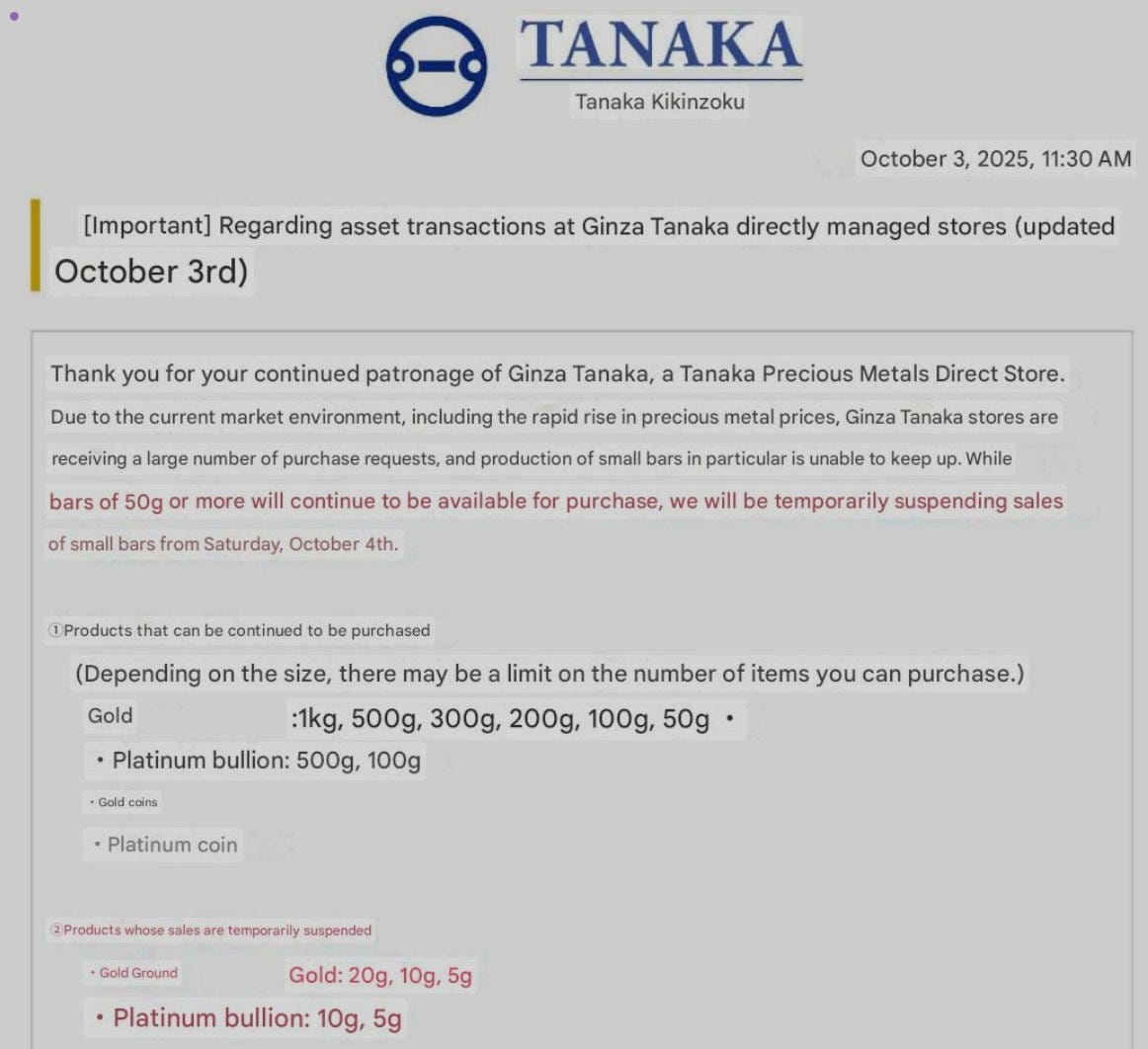
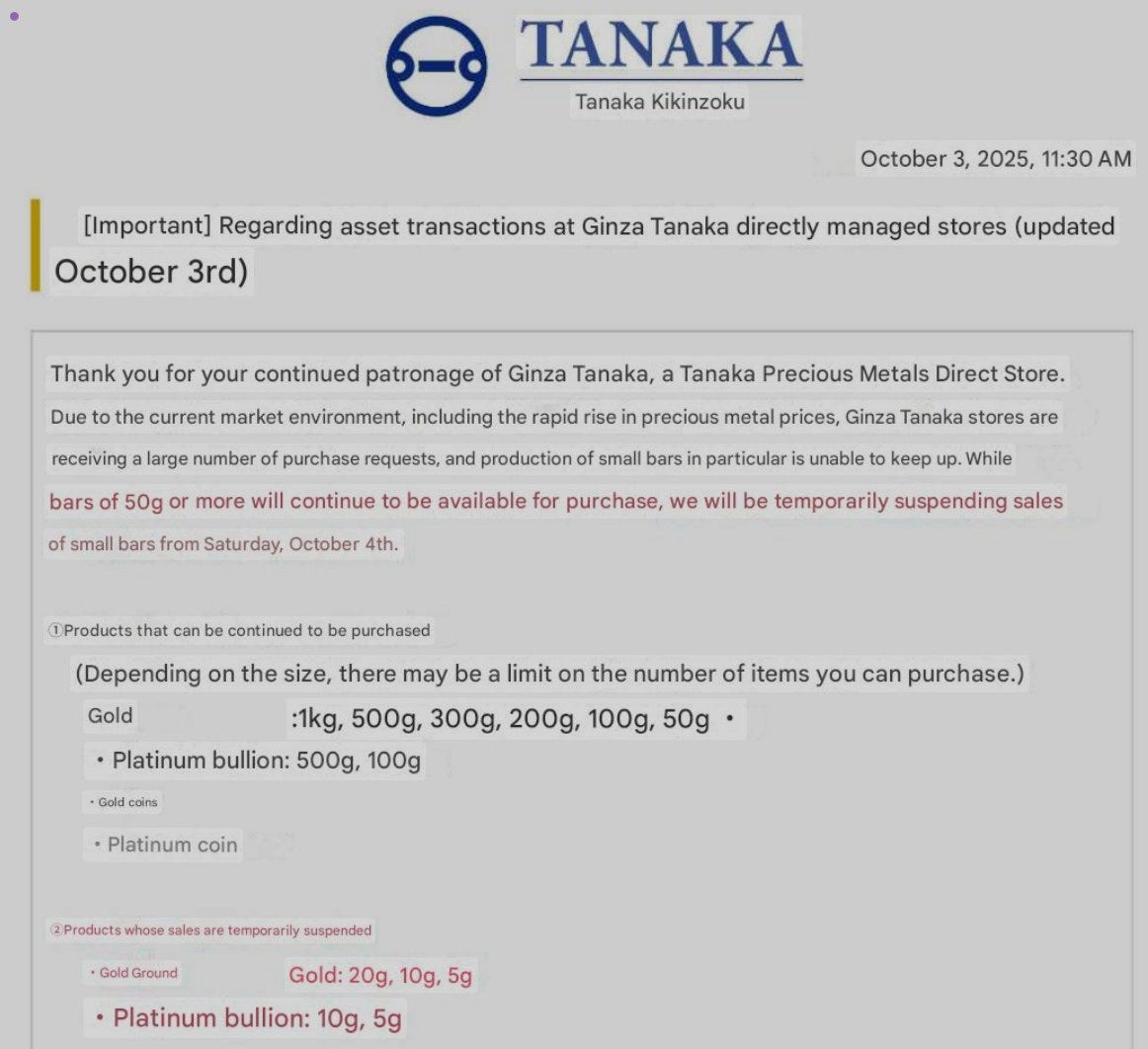
Japan’s largest bullion dealer, Tanaka Precious Metals, has announced the “temporary” suspension of sales for small gold bars (5g, 10g, and 20g) starting tomorrow due to production delays, particularly affecting bars 50g and under. This has led to significant public reaction, with long lines forming at Tokyo’s Tanaka locations as individuals rush to purchase the remaining available gold bars before the suspension takes effect.
Tanaka Precious Metals Policy Update
Tanaka is recognized as Japan’s top bullion dealer, often setting the benchmark price for retail gold sales nationwide. The company confirmed that production bottlenecks are making it difficult to meet the surging demand for smaller bar sizes, leading to a decision to halt sales of bars 50g and under until further notice, starting tomorrow.
Demand Pressures and Price Spike
The announcement comes amid a period of record-high gold prices in Japan, which have surpassed 20,000 yen per gram for the first time in history, a milestone widely reported this week. The price surge is attributed to a combination of global safe-haven demand, yen depreciation, and heightened geopolitical and economic risks, further fueling public demand for physical gold.
Public Impact: Long Lines in Tokyo
Reports from social media and financial news outlets confirm that following Tanaka’s announcement, crowds have formed at their Tokyo stores, with buyers eager to acquire gold bars before the suspension. Images and posts describe long queues and brisk trading activity, with many seeking to secure small denomination bullion as a hedge.
Market Signals and Broader Implications
Tanaka’s move highlights ongoing concerns over the transparency and availability of physical gold, especially for retail investors in Japan. The emphasis on small bar shortages suggests inventory strains at multiple levels of the supply chain, mirroring shortages and premium increases seen elsewhere in Asia in 2025. Analysts see Tanaka’s policy as both a response to surging public demand and potential disruptions in raw material sourcing or refining capacity
Editors note: In the opening paragraph above recall the word “temporary” as this was the same modifier when Nixon “temporarily” suspended gold’s convertibility.
A debt-based monetary system creates money through the issuance of new loans, meaning that most currency in circulation originates as debt owed to commercial banks. Each new loan provides the principal, but the interest owed on that loan is not simultaneously created, which forces borrowers to scramble for additional funds—typically by incurring more debt—just to pay the interest. Over time, this dynamic leads to exponentially increasing debt loads across governments, corporations, and households, while the real economy struggles to keep pace.
Exponential Debt Growth and Instability
Global debt has surged to $305 trillion, or 349% of world GDP, with interest costs diverting resources away from productive activities toward debt service. This growth outpaces average GDP increases, requiring debt expansion to sustain economic activity and creating unsustainable cycles of borrowing and default. When debt becomes too large relative to the real economy, repayment capacity erodes and risks of financial crises rise—defaults, deleveraging events, and systemic instability are inevitable when the system hits its natural limits.
Economic Inequality and Wealth Transfer
A debt-based system favors creditors, leading to greater wealth concentration among banks and bondholders at the expense of borrowers. As interest payments flow upwards, social disparities widen, resulting in a lopsided distribution of wealth—Oxfam data shows the top 1% now own almost half of global assets, partly owing to these financial structures.
Stifled Growth and Reduced Investment
High debt levels and rising interest payments reduce available capital for productive investments; this “crowding out” effect is particularly stark at the government level, where public borrowing draws resources away from private enterprise. Private investment drops, long-term economic output shrinks, and labor market woes intensify—over decades, millions of jobs are lost as GDP contracts due to the relentless rise of debt.
Cycles of Inflation and Deflation
Central banks often respond to unsustainable debt burdens by expanding the money supply to facilitate debt service (through mechanisms like quantitative easing), risking inflation. Alternately, periods of deleveraging reduce circulating money, resulting in deflation—Japan has experienced such stagnation for years.
Fragile Foundations and Alternatives
Because this system demands perpetual economic growth to finance exponentially expanding debt, it is inherently unstable—resource limitations and boom-bust cycles regularly wreak havoc, with crises erupting when underlying debt loads become unmanageable. This instability has triggered calls for alternative monetary systems and stricter regulatory controls, yet most current reforms have not solved the structural flaws embedded in debt-based money creation.
In summary, a debt-based monetary system undermines long-term prosperity by enforcing perpetual cycles of inequality, instability, reduced investment, and systemic financial risk, ultimately leading to periodic crisis and widespread social and economic havoc
Brief tour through pages of history: How we arrived here, the perilous path
The Tyranny of Paper: A Scathing Indictment of the Fiat Overlords
A tragedy in 5 Acts
I. Severus Septimius: “Take Care of the Soldiers First and Scorn All Others”
It begins with absolute clarity from an emperor whose words echo through every collapse in monetary history. Severus Septimius said, “Take care of the soldiers first and scorn all others.” In Rome, the needs of power were urgent and ceaseless. To feed the war machine and keep the soldiers loyal, the treasury resorted to the oldest trick in the ruler’s book: debasement. Silver, once the true denominator of value, was replaced, diluted, and eventually swept away by baser metal until the money itself became counterfeit in everything but name. The empire bought the loyalty of the sword at the price of betraying the trust of the people. In its desperate quest to maintain supremacy, Rome unleashed the first great wave of inflation, setting a pattern every empire has followed since: cut the money from its anchor, and drift into ruin.
II. Napoleon: “The Hand That Gives Is Above the Hand That Takes”
Centuries later, in lonely exile, Napoleon Bonaparte named the hidden ruler of the modern age: “When central bankers loan money to governments, the hand that gives is above the hand that takes.” No longer did emperors and presidents wield ultimate authority. Instead, power migrated to those who could conjure obligations from nothing. Paper, once a symbol of gold and silver, became an end in itself—issued not in the name of the people, but at the command of the issuer. Napoleon’s warning rings out today: nations have become supplicants, their sovereignty mortgaged by the limitless appetite for debt paper, and every government a marionette to unseen creditors.
III. Rothschild: “Permit Me to Issue…”
Now the mask drops completely. Mayer Amschel Rothschild, patriarch of the world’s most powerful banking dynasty, confessed—and even boasted of—the real mechanics of domination. “Permit me to issue and control the money of a nation, and I care not who makes its laws.” This single sentence is the distilled greed and cynicism of the fiat overlords, an open secret in the halls of power for centuries. Rothschild’s empire was not built on conquest or kingship but on the raw ability to create and control credit—turning nations into debtors and their rulers into little more than figureheads, “puppets who sit on the throne.” Rothschild’s “system” required only that the few at the top be interested in the profits or dependent on his favors. The rest—the great majority—would bear the burdens unknowingly. If ever there was an open admission of deliberate, greedy control over the destinies of nations, this was it. Rothschild’s desire was never the pageantry of politics, but the godlike power to manipulate the soul of the economy itself. With this grip, he and his successors could bleed a people dry while remaining cloaked in respectability and artifice.
IV. Washington: “Ambitious and Unprincipled Men…”
Across the ocean, America’s first president saw the same pattern emerging. George Washington warned of “ambitious and unprincipled men who seek to subvert the power of the people and to usurp for themselves the reins of government.” The new republic, birthed in rebellion against tyranny, was already surrendering itself to the old ways—allowing paper money, debt, and centralized issuance to erode sovereignty from within. The threat was never simply external; it was always lurking in the temptation to print, to borrow, to betray the very people in whose name the power was supposedly exercised.
V. Jefferson: “Paper Is Poverty…”
Thomas Jefferson looked upon the system’s final form and labeled it poverty itself. “Paper is poverty, it is only the ghost of money, and not money itself.” What Jefferson saw was not just the crumbling of markets, but a moral and political collapse. Every fiat note was a broken promise; every act of printing an act of theft. The people worked, saved, and trusted—and the overseers rewarded them not with the honest fruits of their labor but with depreciating tokens, ever more worthless with each passing year. The “ghost of money” replaced true prosperity, ushering in a society where honest toil was endlessly undermined by the printing press and the manipulations of those who rule by debt.
Epilogue: The Modern Fiat Overlords and the Engineered Crisis
Today, the legacy is inescapable. We possess no true money, only government IOUs—Federal Reserve Notes—conjured from nothing by an elite class for the benefit of their power and profit. Wars proliferate; debts metastasize; headlines shout prosperity while the chains grow ever heavier and more invisible. It is by design, not by accident. The old gold and silver coins—the stuff of free societies—are relics, replaced by a river of paper and digital entries in the service of endless extraction.
This regime is not an evolution; it is a deliberate plunder. All the clever terminology—“quantitative easing,” “stimulus,” “monetary accommodation”—is nothing more than Rome’s debasement, repeated with digital precision. The overlords siphon the wealth of the many, cynically reassured by Rothschild’s greedy calculus—that so long as they control the currency, it matters not who pretends to govern.
The charge is clear: fiat money is not the symptom of decay; it is the instrument, the cause, the original sin of modern civilization. It began as the tool to pay soldiers and secure armies; it ends as the chain upon the worker, the saver, the child yet unborn. Until a free people reclaim the right to honest money—and see through the paperwork and pageantry of the fiat overlords—the theft will continue, history’s warnings unheeded, and freedom only a memory in the hearts of those who still remember what real value is.
US then amplified and perfected the sinister playbook
Since the 1990s, no nation on Earth has waged as many wars or orchestrated as many foreign interventions as the United States. According to a report from the Congressional Research Service, cited by numerous researchers including Ben Norton, the U.S. conducted at least 251 military interventions, regime change operations, and covert wars abroad from 1991 to 2022—a staggering number nearly unmatched in the annals of world history.
The war in Afghanistan, emblematic of this era of unconstrained military adventurism, consumed $2.3 trillion over two decades by the most comprehensive estimates. In the end, after twenty years, thousands of lives lost, and trillions siphoned from America’s future, the result was a restoration of the very regime—the Taliban—that U.S. forces once pledged to uproot.
This scale of endless warfare and colossal waste would have been simply impossible under a monetary regime tethered to gold and silver. The Founders’ vision, echoed across history, is clear: only honest, constraint-based money restrains the ambitions of rulers and prevents ruinous, unending war. But, unconstrained by any metallic standard, the Federal Reserve and Congress have used the printing press to bankroll military adventures at a pace Rome never dreamed of. The result is a nation that borrows without limit, fights wars without justification, and loads the bill—plus interest—onto generations yet unborn. The system’s greatest fraud is not merely its cost, but that it mortgages the future to purchase only chaos and squander, cloaked in the rhetoric of national defense and democracy