
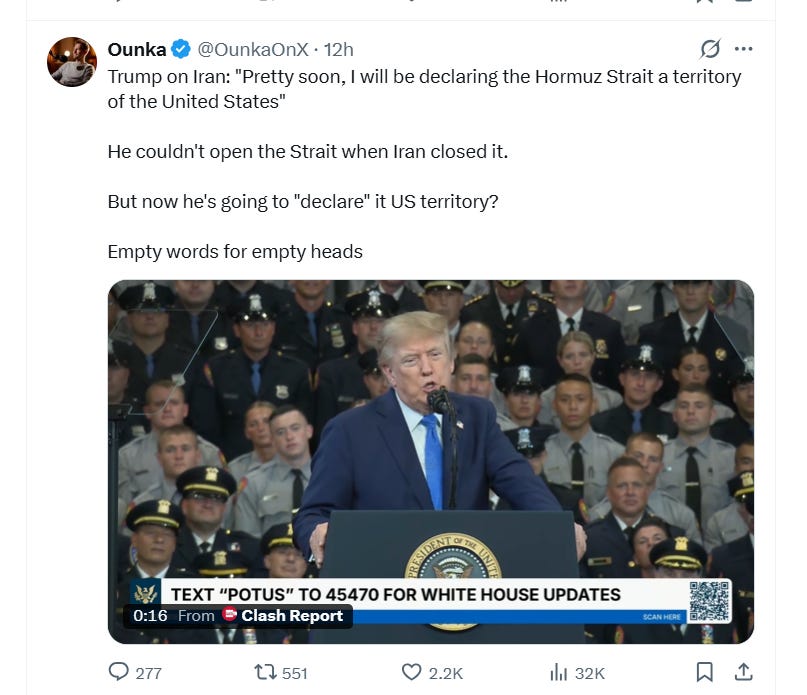
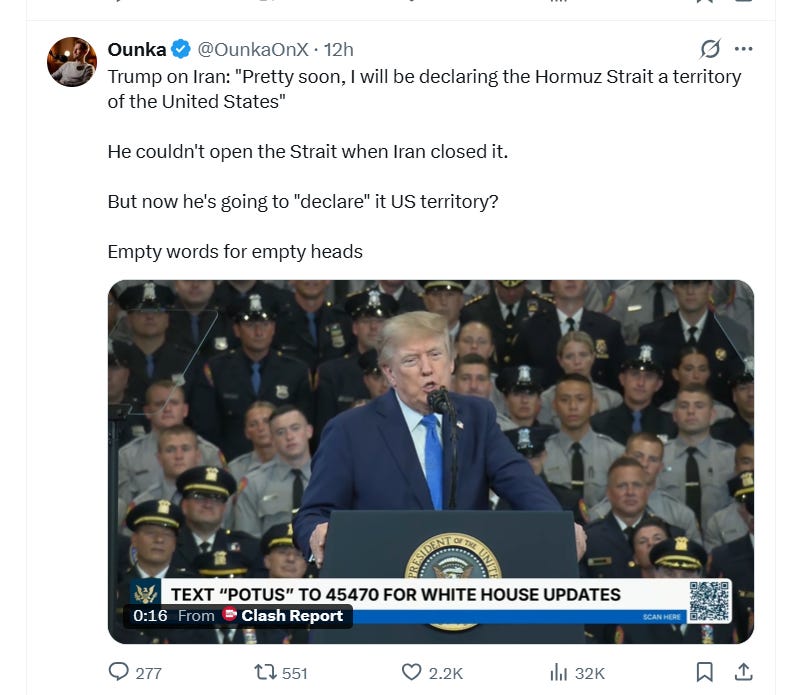
Trump declares Strait of Hormuz a US Territory
President Donald Trump also stated he was going to seize Kharg Island, a small Iranian island in the Persian Gulf that handles roughly 90% of Iran’s crude oil exports
Today’s article is about the reality not the delusional statement of any US official.
REALITY: Iran will begin asking for GOLD as payment for passing through strait of hormuz taking a page out of US history
-
The United States did not achieve its promised rapid regime-change objective: killing Iran’s supreme leader and bombing that reportedly killed 130 children appear to have galvanized support around the Iranian government.
-
It did not demonstrably weaken Hamas, Hezbollah, or the Houthis; all retain the ability to threaten U.S. and Israeli interests.
-
Iran has not surrendered its nuclear capabilities or long-range ballistic-missile program.
-
The Strait of Hormuz—previously open to world commerce—is now near standstill, disrupting about one-fifth of global oil flows and critical Gulf exports. Declaring it U.S. territory will not reverse these failures
Here is why Iran is moving towards demanding Gold as payment for passing thru Strait of Hormuz
US SETS PRECEDENT
US demanded gold as payment when Europe needed help fighting Germany
When US and allies were fighting Europe in WW2, US demanded gold as payment as it supplied Europe to fight Germany.
From 1939 until America entered the war in December 1941, the United States supplied Britain and other Allied buyers with munitions, aircraft, trucks, tanks, machinery, food, and petroleum under the cash-and-carry system.
But the cash was Europe pays GOLD FIRST, then US ships the munitions, aircraft, trucks, tanks, machinery, food and oil.
The arrangement required purchasers to pay up front—drawing on dollars, gold, and foreign assets—and transport the goods in their own ships. American industrial capacity and oil production therefore strengthened Europe’s resistance to Nazi Germany before U.S. troops joined the fighting. This trade also helped shift material resources toward the anti-German coalition, while the United States expanded factories, production capacity, and its strategic role in the Allied war effort. This move also enabled the US to stockpile the world’s largest Gold reserves then when countries wanted to convert their dollars back to their gold US closed off gold convertibility (This was the Nixon Shock)
Our colleague David Jensen writes:
”
Rapidly Heading To Gold Settlement Of Iran’s Toll, Oil And General Trade
On August 10, 2026, senior Iranian officials reported that Iran would not engage in further negotiations with the US for the remainder of President Trump’s term through January 2029 and would insist on a list of demands being met including a toll for ship transit through the Strait of Hormuz.
Iran’s toll has important ramifications for the world’s currency and financial markets. It is clear the Iran cannot use US or European currencies and banking systems to collect the toll. This leaves the Chinese RMB or yuan and China’s Cross-Border Interbank Payment System (CIPS) as a the leading candidate for collecting such a toll.
Some have extolled the virtue of using the RMB/yuan for trade settlement given that China’s currency can be converted from fiat currency to gold for export in banking centers such as Hong Kong.
However, the RMB/yuan is a merely another leveraged fiat currency that is centrally controlled by the CCP and China’s bond, banking, and financial markets have well known impairments that are heading toward crisis. CCP fiat is not a realistic medium or long term solution.
Use of RMB / ‘CCP bucks’ for toll payment can be accomplished however there is a strong practical inducement for Iran, or any other recipient of RMB, to rapidly convert these receipts into an historically stable monetary asset (gold and silver). Iran’s culture also has a very strong affinity for gold and silver.
Use of distributed warehouses and blockchain tools can today allow this physical payment form to be rapidly effected.
It appears that initial Iranian toll collection in fiat currency will likely transition into toll collection in physical specie in a very short period that will likely also start to migrate throughout the Gulf into oil payment itself in gold and perhaps also silver.
This sets Iran directly in the cross-hairs of the City of London banking center that has operated a promissory note gold and silver price fixing system for so long. The WEF Globalists aren’t likely too pleased with the direct gold/silver payment concept either – they’ve got Marxist poverty and CBDC to sell and that is tough sledding.
There are serious issues with all centrally planned fiat currencies and the math on their demise is simple.
Rand Paul’s Impeccable Timing
On Monday August 10 this past week, Kentucky Senator Rand Paul came out with an announcement saying he was at Fort Knox that day and he saw that the 147M oz. of US Treasury gold held at Fort Knox was “present and accounted for.”
Rand Paul does not likely have the strength, speed, assay skills, and statistical analysis capability to factually make such a statement after a one day visit.
The coincident August 10th statement by Iran that negotiations between Iran and Team Trump were over for the rest of Trump’s term, along with the implications for gold as bond yields ran higher that day, is interesting. “ – David Jensen
Conclusion
Trump’s declaration cannot turn the Strait of Hormuz into U.S. territory, nor can seizing Kharg Island erase Iran’s geographic leverage.
The more plausible outcome is an imposed cost for access: Iran is going to demand payment in gold taking a page from the US world war 2 playbook.
That would echo America’s own early World War II model, when Allied buyers used gold to secure vital U.S. industrial goods before Washington entered the conflict.
If Washington and its partners need Hormuz reopened, Tehran—not Washington—will dictate the toll, settlement terms, and strategic price (gold) of passage.
our opinions are not our sponsors
the editorial department is separate from the promotions department
not financial advice