
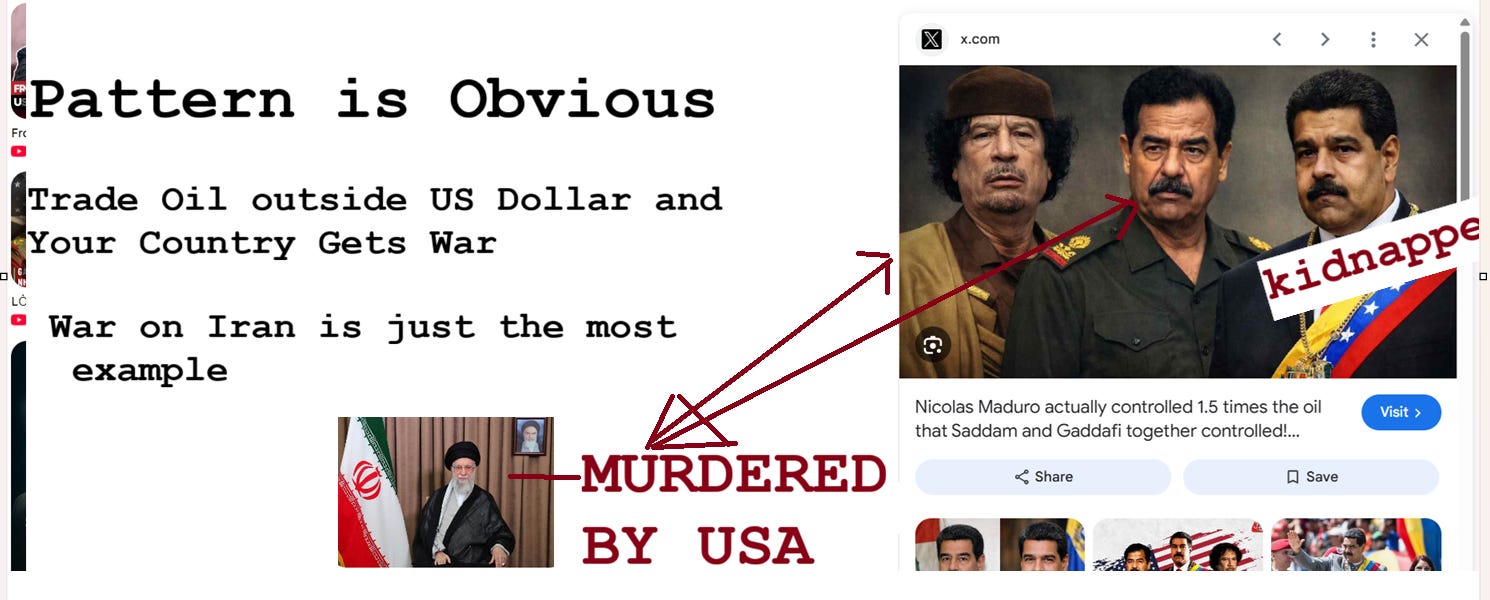
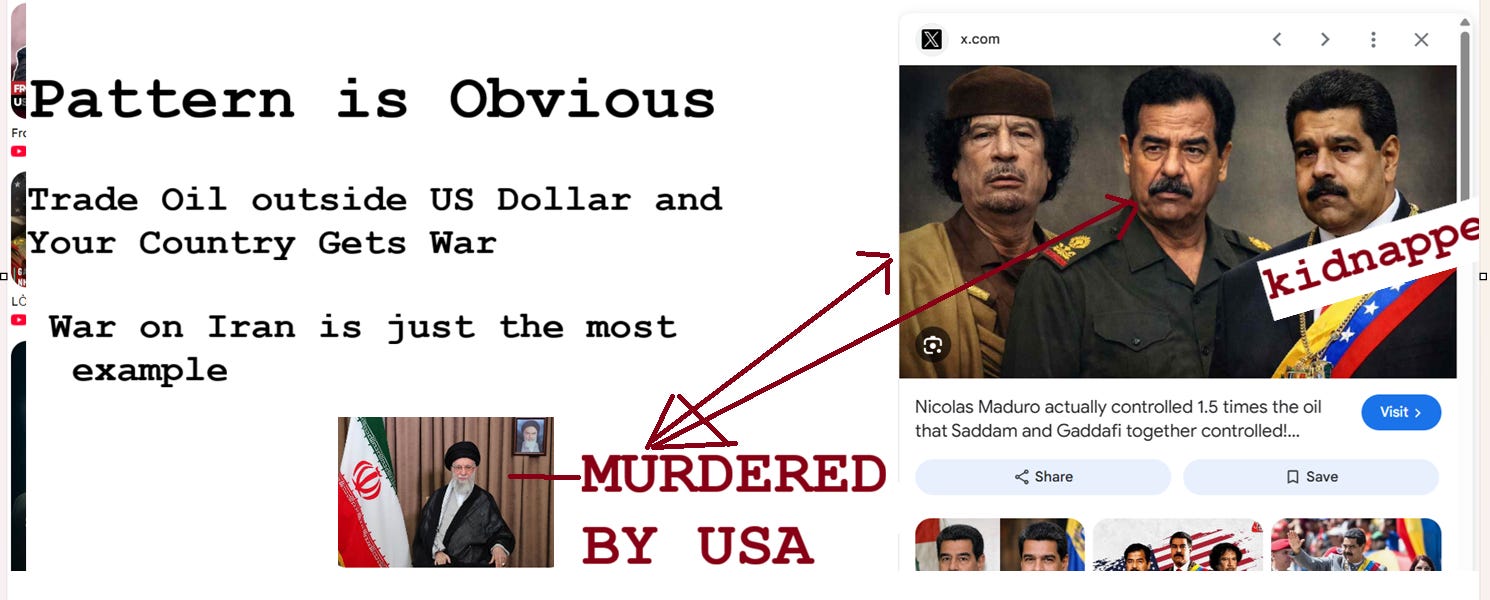
You almost have to admire the consistency. The Pattern is so blatant it’s basically policy now: price oil outside the dollar, get a visit from freedom.
-
Libya and Gaddafi flirt with a gold-backed dinar in 2011—reduced to rubble.
-
Iraq and Saddam talk euro for oil in the early 2000s—shock and awe, 2003.
-
Russia settles oil in yuan—Ukraine war in 2014/2022.
-
Venezuela moves toward yuan—Maduro sanctioned into oblivion since 2017, then kidnapped.
-
And now Iran is on deck.
The dollar is no longer anchored to gold or oil; what remains is its backing by the most expansive, interventionist military apparatus in history—and that foundation is now cracking under the weight of its own coercion.
From gold to oil to the gun
When the United States severed gold convertibility in the early 1970s, it replaced metal with muscle, rebuilding dollar demand through control of energy flows and the petrodollar system. For decades, oil priced in dollars functioned as a shadow gold standard, forcing every country that needed energy to first acquire dollars, then recycle surpluses into U.S. debt. That arrangement is now visibly failing. As Washington turned the currency into an overt weapon—via sanctions, asset seizures, and financial blockades—major energy producers began searching for lifeboats. China’s yuan-based CIPS system has quietly grown into a viable alternative, hitting record volumes and increasingly settling trade in oil and commodities. Dollar hegemony is still defended, but the defense is looking more like desperation than design.
The pattern of punishment
Look at the sequence and the message it sends. Russia settles more and more of its oil trade in yuan and non-dollar channels, and within years faces a color revolution on its border, NATO expansion, and a proxy war in Ukraine. Venezuela moves to sell oil in yuan, and is smashed with sanctions, economic strangulation, and attempts at regime change. Iran begins settling oil in yuan and is now at the center of a rapidly escalating war, with key chokepoints like the Strait of Hormuz and potentially Bab el-Mandeb turned into pressure points for global energy flows. In each case, the “crime” is the same: migrating energy away from the dollar. In each case, the response is the same: attack, destabilize, isolate. This is no longer subtle balance-of-payments management; it is naked currency enforcement by military means, visible enough that even longtime allies now talk openly about hedging their exposure. The result is paradoxical: every time Washington swings to defend the dollar, it reinforces the perception that the dollar itself is intolerably dangerous to hold.
War that accelerates the divorce
The current war in Iran was sold as a short, contained operation and has instead morphed into a grinding conflict with cascading market and geopolitical effects. Oil has already spiked into triple digits once and sits on a hair-trigger, while U.S. bond market volatility has brushed dysfunctional levels. Yet beneath the noise, something more profound is happening: the “paper” dollar world is colliding with the physical reality of energy, shipping lanes, inventory levels, and the rise of alternative payment rails. China is not being cut off from energy; its corporate profits and exports have risen during the conflict, and yuan-based settlement for trade has surged. Each missile, each sanction, each frozen reserve is another reminder to the rest of the world that doing business in dollars means putting your national survival at the mercy of U.S. domestic politics. When that realization reaches critical mass—as it is now doing across OPEC and the broader Global South—the divorce from the dollar is no longer theoretical. It becomes self-defense.
The end of hegemony
Empires rarely admit when their money has crossed the Rubicon from “neutral unit of account” to “weapon of policy.” The United States has already crossed it. Central banks have quietly shifted reserves toward gold for over a decade, while leaving holdings of U.S. Treasuries flat even as U.S. debt explodes. China has spent years building the plumbing to recycle yuan surpluses into gold in every major global hub, openly preparing for a world where energy and trade can bypass Washington altogether. The U.S. response has been to double down on military-led economic statecraft and “Hamiltonian” rhetoric that, in practice, cannot coexist with a dollar that remains the undisputed global reserve. The outcome is not the immediate collapse of the United States or the disappearance of the dollar; it is the end of U.S. hegemony—the loss of its ability to dictate terms unilaterally through its currency and its carriers. The more the dollar is enforced at gunpoint, the faster the world walks away, into gold, into yuan, into anything that is not explicitly tied to Washington’s next war. That is how hegemony ends: not with a vote, but with a quiet, steady refusal to play the old game.
Since Nixon slammed the gold window shut in 1971, the entire system flipped: discipline died and the printing press became the primary funding vehicle for the military‑industrial complex. Without the constraint of convertibility, Washington could issue unlimited claims on nothing more than future confidence, using inflation and financial repression to paper over soaring deficits and endless wars. The result has been relentless currency debasement—asset bubbles for those closest to the spigot, stagnation for everyone else, and a dollar backed less by trust than by tanks.
Stack Silver accordingly
-
our opinions are not our sponsors opinions
-
the editorial department is separate from the promotions department
-
not financial advice