
Fact 1:
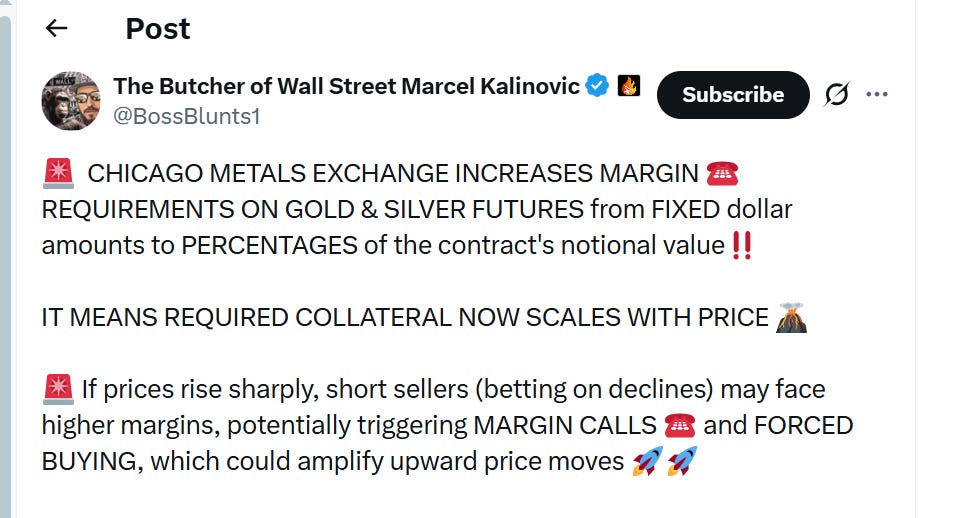
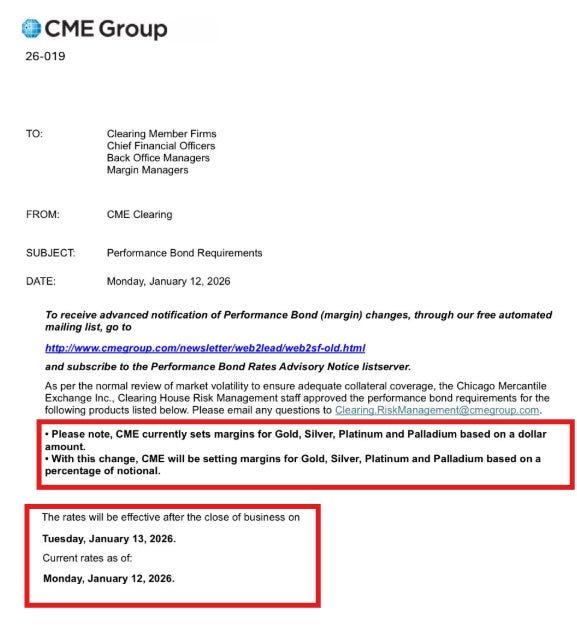
Chicago Metals Exchange increases margin requirements on gold & silver futures from fixed dollar amounts to percentages of the contract’s notional value.
Means:
Raising margins means required collateral now rises with price. If silver or gold spike, shorts suddenly owe more, triggering margin calls and forced buying that can turbocharge rallies. Recent 5% gold and 9% silver hikes intensify this effect
The CME just hiked silver margins yet again, making life tougher for shorts and signaling deep structural stress in this “paper” market.
Silver Academy,
More Than an Academy—It’s a Silver Revolution.
Download this lesson plan for your own classroom
Here is one way to explain all this. Our classroom-style swap experiment helps demystify margins, rollovers, and forced buying so readers can finally see how a broken futures system distorts silver’s true price.
Lesson Goal
Help students understand how changing margin requirements (collateral rules for trading) affect traders, prices, and market behavior — using candy and toys instead of gold and silver.
Setting the Scene
Tell the class:
“You’re all traders at the Candy & Toy Exchange of Chicago! You’re buying and selling candy futures — bets on what candy will be worth next week.”
Give each student:
-
100 pieces of candy (represents their money or cash)
-
Toy cards labeled:
-
“Silver Contract” (each worth 1 silver bar)
-
“Gold Contract” (each worth 1 gold bar)
-
Post prices on the board:
-
1 Silver Contract = $25
-
1 Gold Contract = $50
Each contract is traded using margin — a security deposit, not full price.
Phase 1: Trading with Fixed Margins
Say:
“At first, the Exchange requires a fixed margin — just a flat candy amount per contract.”
-
Silver margin = 10 candy
-
Gold margin = 20 candy
Students can trade by giving that margin candy to you (the Exchange) as collateral.
Have them buy or sell a few “futures contracts” between each other, betting on price rises or falls.
Phase 2: Prices Rise!
Announce:
“Breaking news — silver prices jumped 20%! Gold prices up 10%!”
Now, raise prices on the board:
-
Silver = $30
-
Gold = $55
Explain:
“If you bought contracts, that’s great — your bet is paying off! But if you sold (bet against it), you might be in trouble.”
Phase 3: Move to Percentage-Based Margins
Tell them:
“Now the Exchange changes the rules: instead of fixed candy amounts, you must post a percentage of the contract’s value.”
-
Silver margin = 9% of contract value
-
Gold margin = 5% of contract value
Do the math on the board:
-
Silver margin = 9% × $30 = 2.7 candy (round up to 3)
-
Gold margin = 5% × $55 = 2.75 candy (round up to 3)
Every student must recalculate how much candy they now owe per contract.
Phase 4: Margin Calls!
If a student doesn’t have enough candy left to cover the new margin, they must:
-
Sell other contracts, or
-
Borrow candy from another student.
Explain:
“That’s a margin call — the Exchange demands more collateral. If you can’t pay, you have to sell your position.”
As they scramble to cover margins, they might accidentally:
-
Push prices up (if short sellers must buy back), or
-
Push prices down (if buyers sell to raise candy).
That’s how volatility and forced buying or selling happen in real markets.
Debrief and Discussion
Ask:
-
What happened when prices rose and margins changed?
-
Who ended up forced to buy or sell?
-
How did this change the direction of prices?
Then connect it back to real life:
“This is what’s happening on the Chicago Metals Exchange with gold and silver. When margin requirements go up and scale with prices, traders must put up more collateral — and if prices rise too fast, that can cause even more upward pressure because shorts have to buy back fast!”
end of segment