
U.S. Gold Revaluation the Answer to a $37 Trillion Debt
Experts Float $10,000—and Even $40,000—Per Ounce Scenarios
With America’s federal debt topping $37 trillion and faith in conventional fiscal tools waning, talk of a radical step—revaluing U.S. gold reserves at an immensely higher price—has surged from the fringes to center stage. Policymakers, Federal Reserve researchers, and prominent economists are debating whether such a move could bolster America’s finances and even reshape the global monetary system.
Why Gold Is Back in the Policy Spotlight
Faced with rising interest costs and little political appetite for major spending cuts or tax increases, officials are seeking innovative solutions. Scott Bessent, a notable financial executive, recently suggested the U.S. could “monetize the asset side of the balance sheet,” referring to the 261.6 million troy ounces of gold that the federal government still values at just $42.22/oz—far below its actual worth.
The Numbers: Gold at $3,300, $10,000…and $40,000 per Ounce
If America’s gold were revalued from $42.22/oz to today’s market price of about $3,300/oz, its reported balance sheet value would leap from just $11 billion to $863 billion—a dramatic $852 billion gain. Some analysts advocate an even more aggressive move, revaluing gold to $10,000/oz. This would boost the accounting value of U.S. gold to $2.616 trillion, giving the Treasury a $2.605 trillion windfall and reducing net federal debt by around 7%.
But recent expert proposals have scaled up the ambition even further. Several prominent monetary thinkers—Judy Shelton, Jim Rickards, and Luke Gromen—argue that real stability may require backing a large share of the U.S. money supply with gold, echoing discussions within BRICS countries to use a 40% gold-backing model. Based on current U.S. money supply figures, these experts calculate that such a regime would require gold to be valued around $40,000 per ounce.
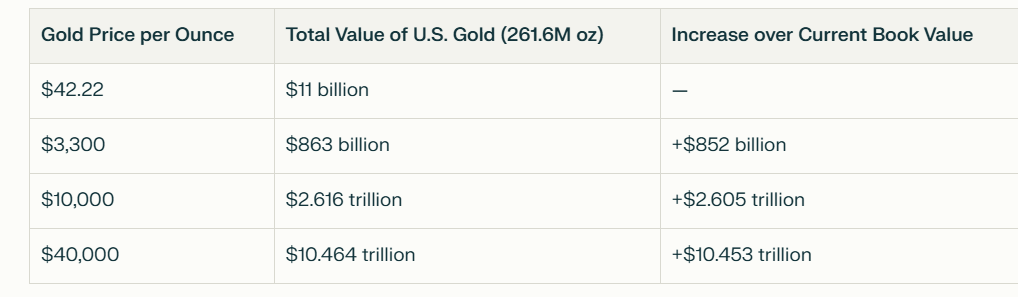
At $40,000/oz, America’s 261.6 million ounces of gold would be worth an astronomical $10.464 trillion. This would increase the federal government’s stated assets by over $10.45 trillion compared to current book value—a surge equivalent to roughly 28% of the total $37 trillion national debt.
The implications would be seismic: a $10 trillion asset boost could dramatically strengthen the government’s balance sheet, ease perceptions of U.S. fiscal fragility, and offer a buffer against future crises. However, such a revaluation would also carry vast risks, including potent inflationary effects and shockwaves throughout global finance.
Fed Research Puts the Debate on Center Stage
The Federal Reserve’s recent publication highlighting past gold revaluations as tools for fiscal rescue signals that the policy establishment is actively considering such moves. The research points to international precedents—such as South Africa—where gold was revalued to close budget gaps or reduce public debt.
Systemic Reset: Old Money Versus Modern Needs
Economic analyst Luke Gromen and colleagues stress how a persistent decline in the dollar’s gold value since 1971 reflects a deeper systemic issue. With $1 now buying just 1/3,300th of an ounce of gold—versus 1/42nd in the early 1970s—they argue that only a dramatic revaluation can restore stability and revive market trust.
The Global Context: China’s Move and the New Gold Race
This debate isn’t confined to Washington. China’s voracious gold demand, with Shanghai Futures Exchange warehouses registering record deliveries, underscores a worldwide shift toward real assets. The Chinese government, in encouraging citizens to invest in gold, signals a recognition that bullion offers a vital safety net in periods of monetary instability.
America’s Monetary History and What Comes Next
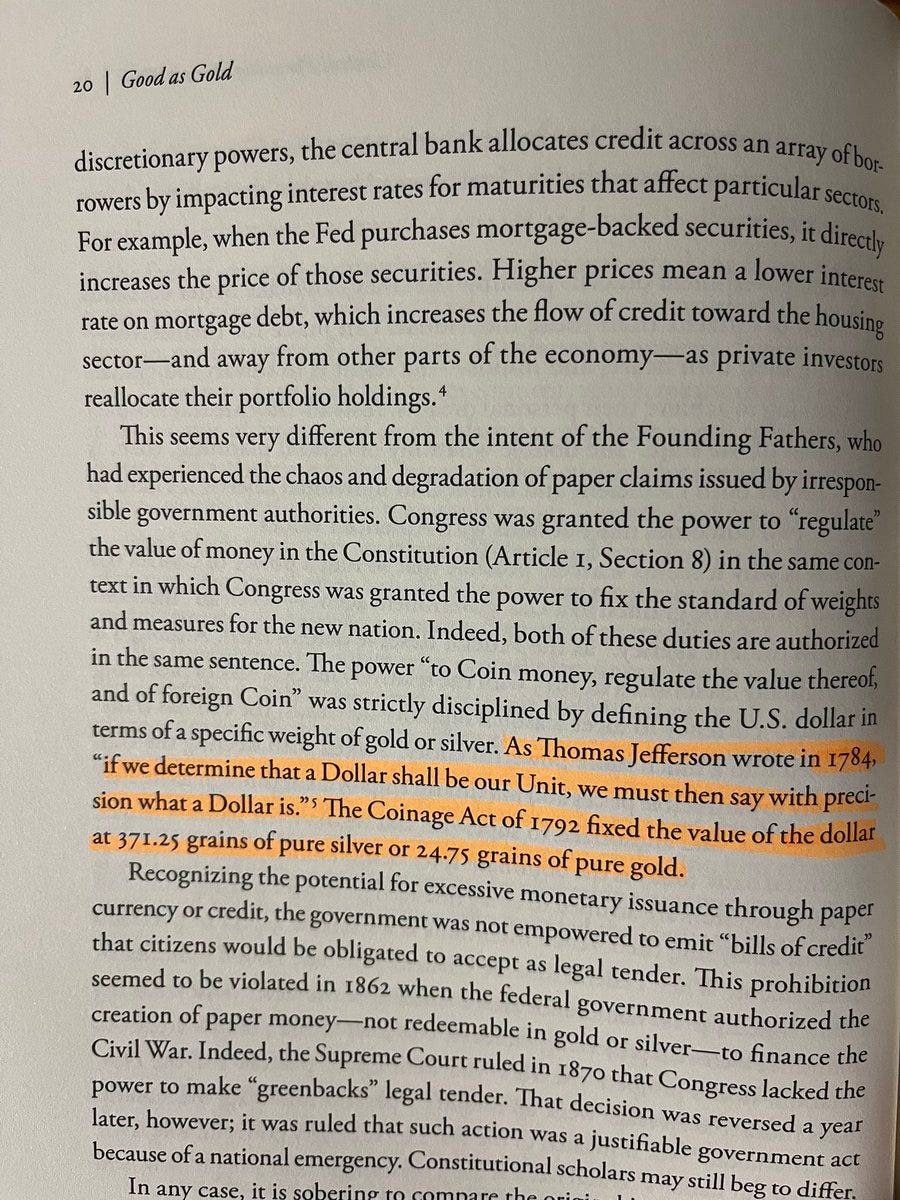
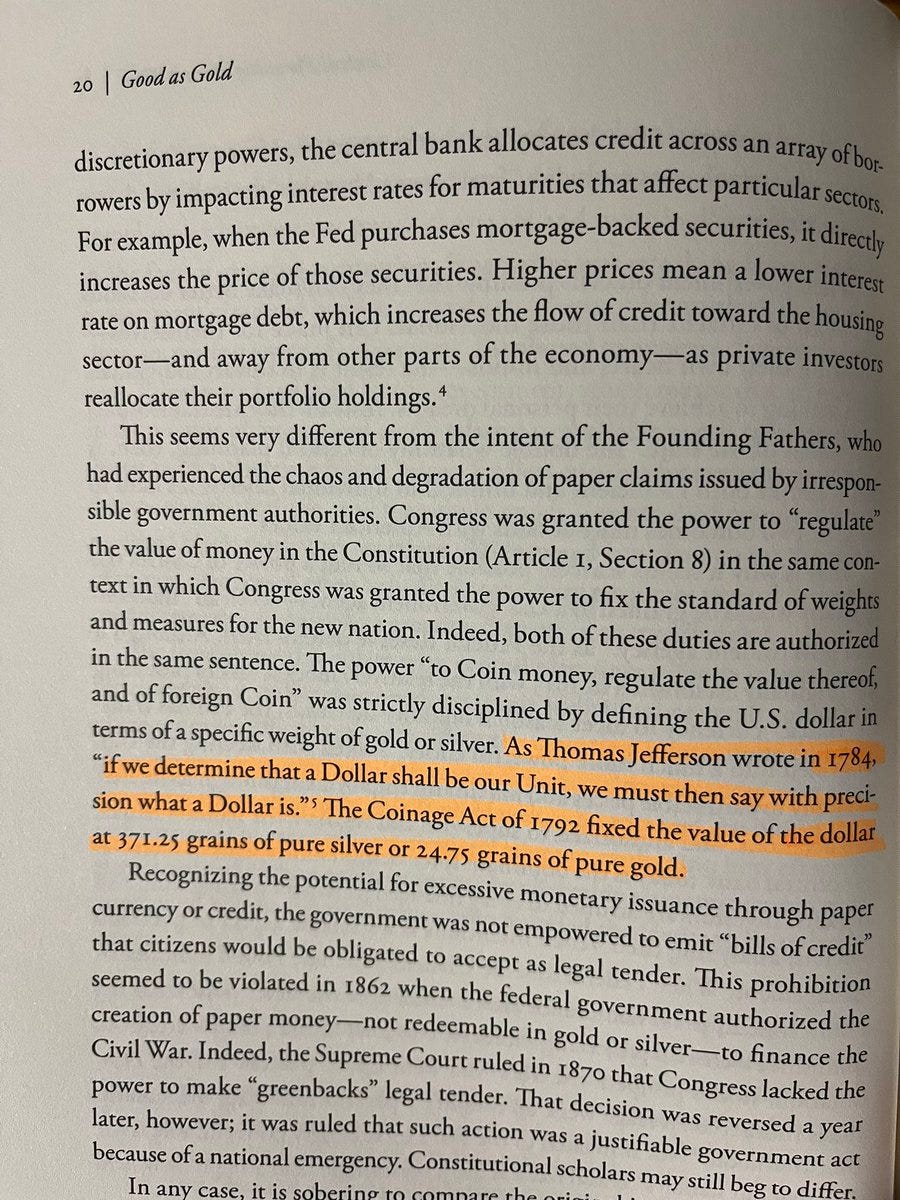
From the Coinage Act of 1792 to FDR and Nixon’s transformative gold moves, the U.S. has repeatedly reset the rules of money. Now, as expert calls for partial gold-backing gain ground—possibly necessitating a price as high as $40,000/oz—the debate over how to restore solvency and trust in the financial system is more urgent than ever.
Gold is stepping into the spotlight as global financial instability mounts, with analysts increasingly pointing to a future where the precious metal underpins the world’s monetary system once again. Unlike previous bull markets, where surging prices for gold have typically triggered speculative bubbles and sharp corrections, this time the landscape appears fundamentally altered. Recent charts circulating on financial platforms suggest that the ongoing gold rally is not just a fleeting spike, but an indication of a global monetary reset in the making.
Instead of gold simply becoming “overbought,” its rising value is seen largely as a reflection of fiat currencies losing purchasing power at an accelerating pace. As the world’s central banks and treasuries fail to bring deficit spending under control—and as national debt ceilings continue to be raised without meaningful constraint—trust is shifting away from paper currencies toward assets with intrinsic value.
Observers point to history for guidance, notably the 1930s, when the U.S. government raised the dollar’s peg to gold, creating temporary economic upheaval followed by a restoration of balance as prices and wages adjusted to the new reality. A similar process appears possible today: No dramatic price “crash” for gold is expected, but rather a period where its value outpaces that of other assets until the broader economy eventually catches up.
Overlaying trends from the gold bull market of the 1970s with the current trajectory suggests that if patterns persist, gold could climb toward record highs—potentially $9,000 an ounce or more. Throughout, financial voices stress that the fundamental driver is not so much an explosive demand for gold, as it is the steady erosion of faith in government-issued currencies.
For individuals seeking to protect—and even grow—their purchasing power, the message is clear: Holding physical gold and other precious metals stands out not just as a conservative hedge, but as a rare opportunity for significant gains in a period of systemic transition. As the prospect of a new gold-backed monetary system draws nearer, those with exposure to precious metals could be uniquely well-positioned in the next phase of global finance.
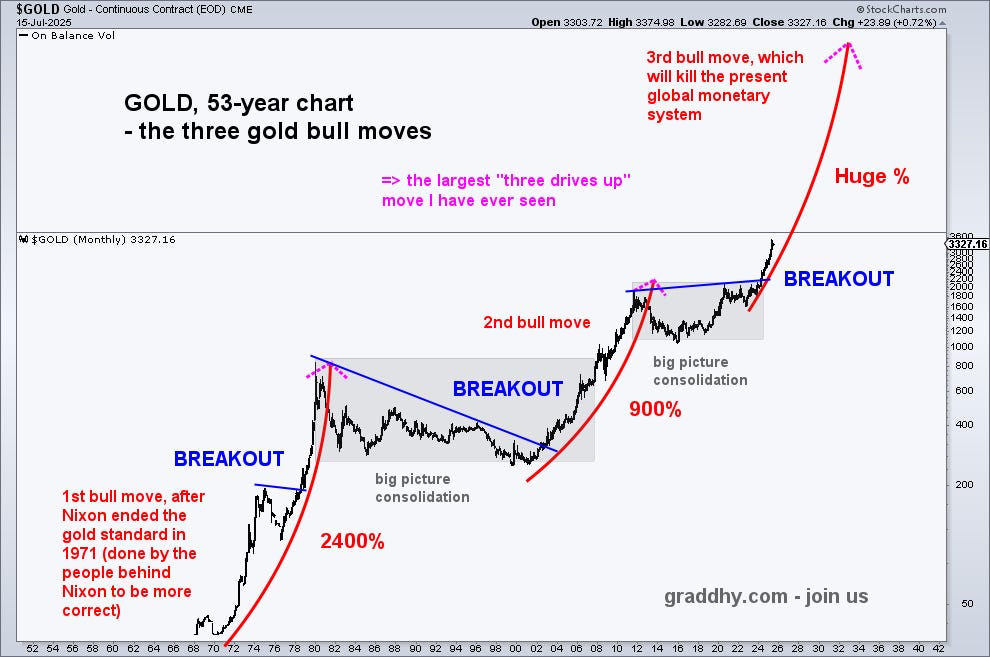
Graddhy writes, “There will be no bubble phase in this gold bull market. Because this time around, after the present final third bull move, the world will have a new monetary system backed by gold. This will pin gold at the highs value wise, meaning there is no bubble. And, that means this is not only a normal bull market, it is also a global monetary system reset. It is vital to grasp that this is not gold going up, it is mostly currencies depreciating. So for heaven’s sake, do not miss it”
Conclusion
A U.S. gold revaluation—whether to $3,300, $10,000, or even $40,000 per ounce—would fundamentally reshape the nation’s balance sheet and could redefine the dollar’s role for decades. As policymakers and markets weigh the risks and rewards of this extraordinary possibility, the world watches to see if the ultimate monetary reset is near.
end of segment