
The Silver Squeeze Is No Longer Theoretical—It Is Structural
The silver market is staring down a hard arithmetic problem—and there is no easy fix. Global mine supply sits near 820 million ounces annually, while forward demand is rapidly approaching 1.2 billion ounces. That gap is not cyclical. It is structural, and it is being driven by the most aggressive industrial expansion cycle in modern history.
Silver is now embedded at the core of every high-growth sector that matters: artificial intelligence infrastructure, robotics, advanced electronics, solar buildouts, aerospace systems, and next-generation military hardware. Each of these industries is scaling simultaneously, compounding demand pressure on a finite supply base.
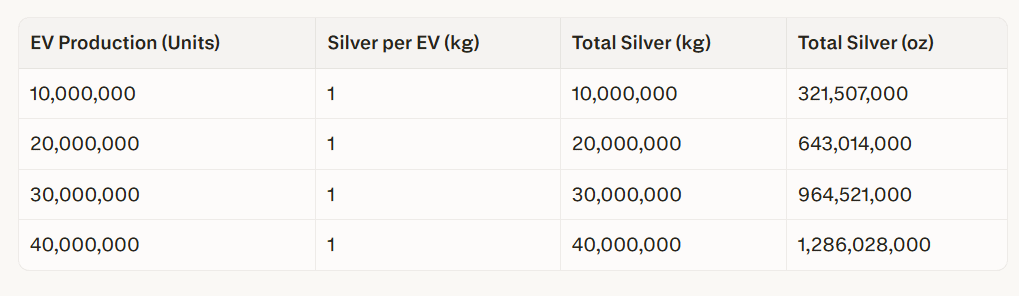
Then comes the real disruptor: solid-state silver batteries. Early breakthroughs suggest double the energy density of lithium-ion, twice the lifespan, and charging times as low as nine minutes. With global EV production already exceeding 30 million units annually—and each vehicle potentially requiring up to one kilogram of silver—this single innovation could redefine the demand curve entirely. In that scenario, silver is no longer just an industrial input. It becomes a bottleneck resource.
The table below highlights the scale of potential silver demand from electric vehicle production alone. At 30 million EVs annually, silver consumption would reach approximately 964 million ounces—already exceeding current global mine supply of roughly 820 million ounces per year. At 40 million units, demand would surge past 1.28 billion ounces, underscoring how a single technological shift could overwhelm existing supply and intensify the structural silver deficit.
Against this backdrop, the question is no longer whether silver prices rise—it is where the physical supply will come from.
Aya Gold & Silver is emerging as one of the clearest answers. Operating in Morocco—a mining-friendly jurisdiction with strong infrastructure and underexplored geology—Aya has secured a first-mover advantage in a rapidly developing district. Its flagship Zgounder mine is already a cash-flow engine, producing nearly 5 million ounces annually with low costs and scaling toward 6 million ounces per year.
At the same time, the Boumadine project represents a tier-one growth asset capable of delivering massive silver-equivalent output, fully funded by internal cash generation. With no reliance on external financing and trading at a steep discount to peers, Aya offers rare leverage to a tightening silver market.
In a world heading into deficit, ounces in the ground—and the companies that control them—will matter more than ever.
Why Aya, Why Now?
Aya Gold & Silver (Nasdaq: AYA, TSX: AYA)
Location advantage: Morocco remains a mining-friendly jurisdiction with efficient permitting, strong infrastructure, and underexplored geology.
-
Aya has secured a first-mover advantage in what is becoming a rapidly expanding mining district.
-
Zgounder cashflow engine: at 4.8Moz in 2025, guiding 5.2–5.8Moz in 2026 and ~6Moz annually through 2036. ramp-up, the mine is generating significant cash, with ~US$200M free cash expected this year and again in 2027, at low costs of $16.26/oz, alongside a strong $74M net cash position and exploration upside.
-
Boumadine growth asset: Advancing toward an updated PEA, with prior estimates showing 37.5Moz AgEq annually in early years. A tier-one asset with multiple revenue streams, including high-demand pyrite concentrate. արդեն generating $3–4M/month, with potential construction by 2027 and production by 2029.
-
GDX inclusion catalyst: inclusion in VanEck Gold Miners ETF (GDX), which could drive ~6.7M shares of demand (2.8x average volume). Key dates: May 29 (measurement), June 12 (announcement), June 19 (rebalance).
-
Deep value opportunity: Trading at ~0.73x P/NAV versus peers at 1.2–2.3x. With Zgounder funding Boumadine internally, Aya avoids dilution risk. As execution continues into 2027, a meaningful re-rating appears likely.
-
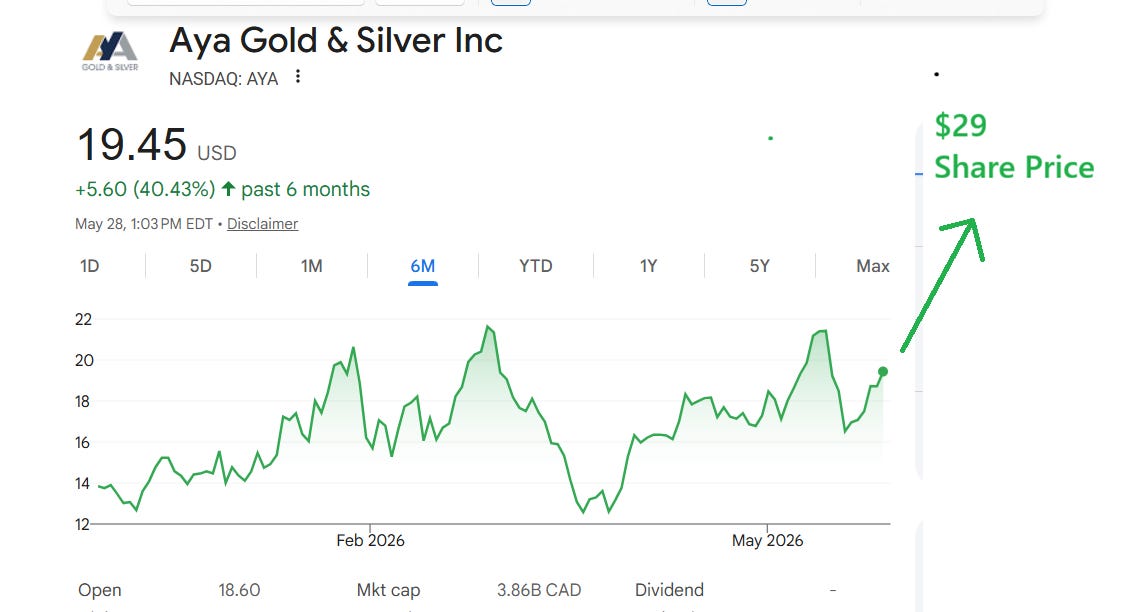
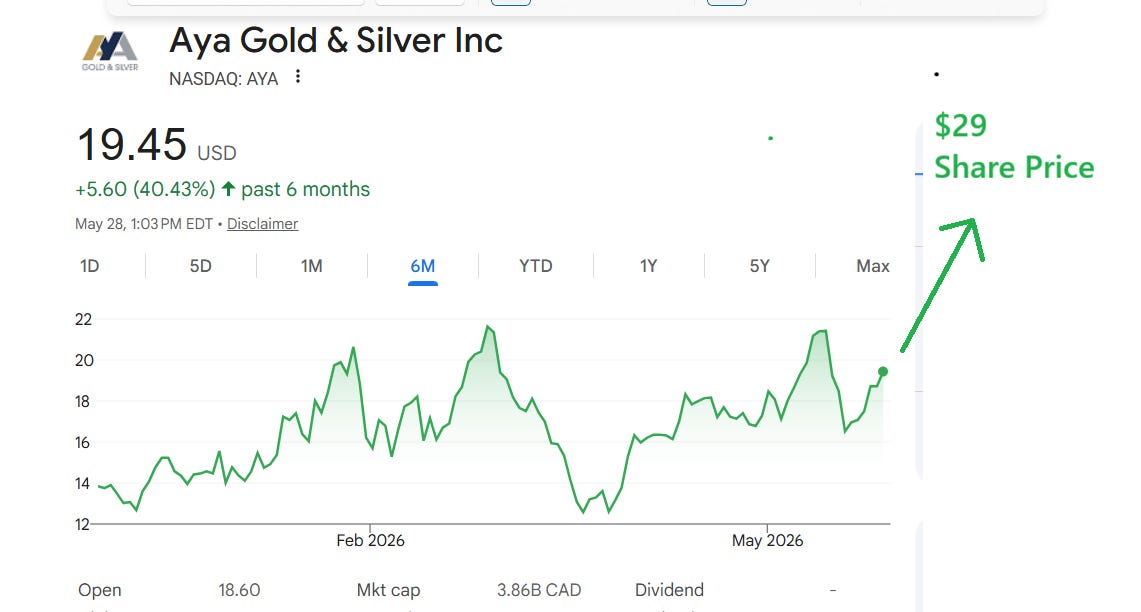
BUY rating maintained with a $29 near-term price target (50% move to the upside)
Silver Market Signals Tighten as Global Demand Surges and Institutional Buyers Step In
Silver prices faced sharp downward pressure this week, falling more than 3% alongside a 1.5% drop in gold, which briefly touched a two-month low near $4,400. The move followed geopolitical headlines surrounding a rumored Iran peace framework, triggering algorithmic selling across paper markets. However, beneath the surface, physical demand trends suggest a very different story is unfolding.
Market participants increasingly point to a widening disconnect between paper pricing and real-world metal flows. While short-term price declines tend to discourage retail sentiment, they often serve as accumulation windows for institutional buyers executing long-term strategies. According to industry insights, large buyers are using these dips to quietly increase exposure rather than exit positions.
At the same time, global silver flows are shifting rapidly. Although U.S. retail demand has softened over the past 30 to 60 days, international demand—particularly across Asia—has accelerated. Significant volumes of silver are now moving out of the United States and into key manufacturing hubs such as China, Japan, and South Korea.
Import data underscores this trend. China recently recorded its highest monthly silver imports in over two decades, signaling aggressive stockpiling tied to strategic industries. Despite narratives suggesting a slowdown in solar demand, the country continues to secure silver for use in artificial intelligence infrastructure, semiconductor manufacturing, electric vehicles, and defense technologies.
Notably, the issue is not a lack of raw silver supply within the United States. Instead, pressure is emerging in the form of refining and product bottlenecks. Premiums on LBMA Good Delivery bars—the standard required for international settlement—have risen by approximately $0.20 to $0.40 in recent weeks. Overseas refineries, heavily focused on industrial fabrication, are facing tighter availability of these deliverable forms.
Institutional adoption is also gaining momentum. In a recent example, tech firm Hyperscale Data disclosed a purchase of 10,000 ounces of physical silver as part of a broader $200 million allocation split evenly between gold and silver. The move reflects a growing trend of corporate treasury diversification into hard assets.
Companies are increasingly recognizing physical bullion as a strategic balance sheet tool. Gold and silver holdings can be leveraged as collateral for low-cost borrowing, while also offering potential tax and accounting advantages under current U.S. frameworks. Additionally, precedent set by firms like Tesla and Palantir—both of which have incorporated bullion into their asset structures—has helped normalize metals ownership within corporate bylaws.
At the state level, a parallel shift toward decentralization is taking shape.
Wyoming has quietly implemented legislation mandating state-held gold reserves and completed a $10 million physical gold purchase stored within its own jurisdiction. Rather than relying on traditional New York vaulting systems, both Wyoming and major financial institutions such as Wells Fargo are utilizing private vault facilities in Casper.
Texas is advancing a similar strategy, having established its own state-run bullion depository and signaling plans to issue gold and silver coins backed by the state.
These developments are unfolding alongside a broader global pattern in which governments are tightening control over precious metals markets. In some jurisdictions, this has taken the form of restricting citizen access while simultaneously increasing state accumulation.
India, for example, recently imposed a ban on high-purity silver bar imports after a record $12 billion surge in silver purchases. Malaysia has introduced a 10% customs duty on bullion, while Ghana now requires major mining operations to allocate 30% of output directly to its central bank. In Europe, France has reentered the sovereign gold market with the launch of a new state-issued coin, its first since World War I.
Meanwhile, the Bank for International Settlements is actively testing a new global settlement infrastructure involving major central banks and financial institutions, suggesting that precious metals may play a role in future monetary frameworks.
For investors navigating this environment, the key takeaway is strategic positioning rather than short-term timing. Gradual accumulation through dollar-cost averaging remains the most widely recommended approach, particularly given ongoing structural changes in global finance.
Storage considerations are also becoming more critical as allocations grow. While small personal holdings can be kept at home, larger positions introduce security risks and insurance limitations. Bank safety deposit boxes offer limited protection and may be subject to regulatory access, whereas private, insured vaulting solutions provide greater security, legal privacy, and potential liquidity through collateralized lending.
As price volatility continues to be driven by headline-driven trading in paper markets, the underlying physical market appears to be tightening. With rising international demand, institutional accumulation, and increasing government involvement, silver’s role as both an industrial necessity and monetary asset is becoming more pronounced.
The divergence between price and fundamentals will not continue
end of segment
-
our opinions are not our sponsors opinions
-
the editorial department is separate from the promotions department
-
not financial advice