
by Niko Moretti (disclaimer, we have not had time to double check all the metrics in this article, will do this editing on ongoing basis)
Another “Technical Issue.” Another Convenient Coincidence.
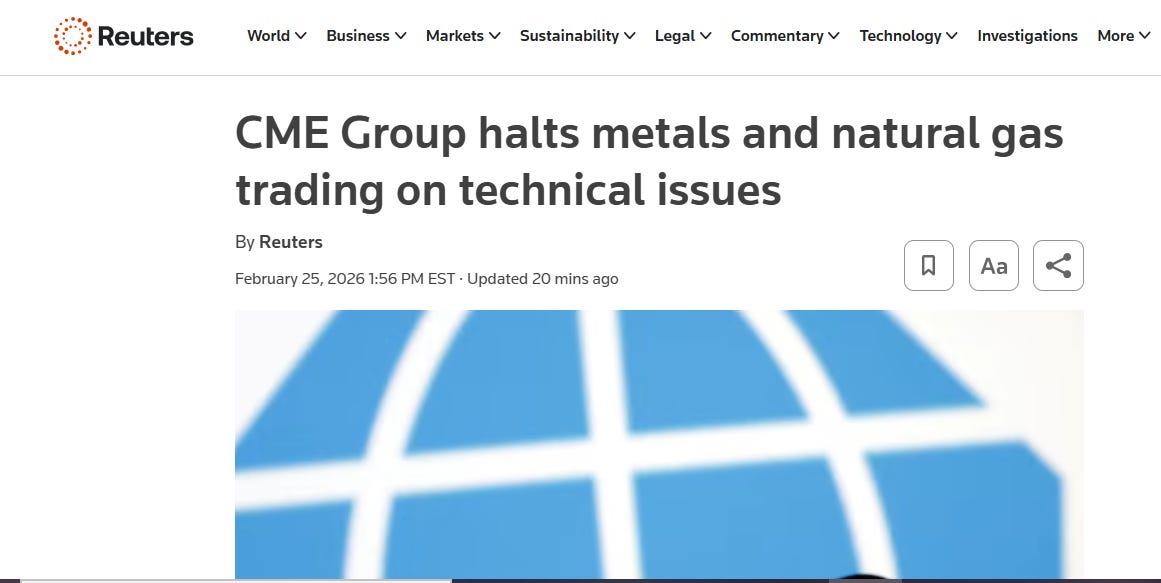
On Wednesday, February 25, 2026 — precisely 48 hours before March First Notice Day — CME Group halted all metals and natural gas futures and options trading on its Globex platform. CME’s Global Command Center first acknowledged the issue at 12:11 CT, and by 12:15 CT the exchange confirmed a full halt. Natural gas was quietly restarted by 12:50 CT, but metals — the category where the real pressure exists — remained dark with no timeline for resumption.
All day orders and good-till-date (GTD) orders placed for Wednesday were canceled. Only good-till-canceled (GTC) orders with prior confirmations survived the purge. CME’s official explanation: “technical issues.” No further detail. No elaboration. Just a status page that reads “Investigating”.
Anyone paying attention to the silver market knows the timing here is not random.
Déjà Vu: The November 2025 “Cooling Crisis”
This is not the first time CME’s infrastructure has conveniently failed at a sensitive moment. On November 27–28, 2025, CME Group suffered a catastrophic 10-hour outage that froze trillions of dollars in derivatives trading globally. The official cause: a cooling system failure at the CyrusOne CHI1 data center in Aurora, Illinois — a facility CME sold to CyrusOne in 2016 and then rented back.
Internal temperatures at the data center surged past 100°F despite freezing weather outside. CyrusOne later admitted in a December 6, 2025 statement to Bloomberg that the outage was caused by human error — onsite staff and contractors failed to follow standard procedures for draining cooling towers ahead of freezing temperatures. The cascade began at 3:40 AM CT on November 27, a full day before Globex went dark, meaning there was ample warning that was either ignored or mismanaged.
CME had a backup data center in New York ready to assume the load, but chose not to activate it because the exchange believed the outage would be brief. It lasted over ten hours. Analysts called it “a case study in how a single physical failure inside a data center can escalate into a global market disruption when governance, failover logic, and environmental engineering are not aligned”.
CyrusOne subsequently bolstered its backup cooling capacity. Evidently, not enough to prevent today’s fresh halt from raising the same uncomfortable questions.
The Shanghai Price Gap: Silver at $102 in the East, $91 in the West
While CME metals sit frozen today, physical reality continues to assert itself in Asia. Silver on the Shanghai Futures Exchange reopened after the Lunar New Year holiday and immediately surged to approximately $102 per troy ounce — a roughly 16% premium over the Western spot price. Meanwhile, Western spot silver trades around $90.96 as of this morning, up 4.19% on the day. The gold/silver ratio has compressed to 57.06.
The Shanghai morning reference price for SMM #1 Silver was 8,041 yuan/kg, with spot premiums difficult to transact because downstream buyers are cautious at these elevated levels. Yet the premium persists. Shanghai silver inventories have fallen to just 318 tons, and the Shanghai Futures Exchange has already restricted approximately 23 accounts in February alone for exceeding intraday position limits — a sign regulators see the squeeze unfolding in real time.
When physical silver costs 16% more in the world’s largest consuming nation than it does on a Western exchange that is currently not even operational, the paper pricing system is broadcasting its own irrelevance.
Why the Shorts Are in a Perilous Trap
Margin pressure hits both sides, but the structure of this market makes the short side uniquely dangerous right now.
Inventory Is Historically Tight
COMEX registered silver — the category actually deliverable against futures — sits at approximately 88 million ounces, while total exchange inventory is around 366 million ounces, with the remainder classified as “eligible” but not formally pledged to delivery. Registered stocks have fallen sharply from higher levels seen just months ago — down from roughly 346 million ounces in 2020, a drawdown of approximately 75% over five years. The depletion rate has been running at roughly 20 million ounces per month.
Paper Claims Dwarf Physical Metal
Recent data show open interest equivalent to roughly 240 million ounces, meaning paper claims exist for nearly three times the registered, deliverable silver. Some estimates place March contract commitments at over 400 million ounces against just 88 million registered. The coverage ratio — registered metal divided by open-interest ounces — sits near 0.14, historically lean.
Margin Hikes Are Forcing a Game of Musical Chairs
With an 18% margin on a rising price, shorts must devote increasing amounts of cash just to keep positions open. Well-capitalized bullion banks and producers who actually hold metal can manage this. Naked shorts — those who sold futures without owning silver — are trapped between two bad choices:
-
Rush to buy back contracts, driving the price even higher, or
-
Attempt to source physical metal in a market where registered supply is thin and being drawn down daily
Price Action Signals Short-Side Stress
After the February 6 margin hike and a violent correction from above $120 down toward the $70s, silver has rebounded from $77.18 on February 18 back toward $90.96 as of this morning — a gain of over 17% in one week. That kind of V-shaped rebound, in the face of higher margin requirements, is a classic signal that forced short covering — not carefree selling — is dominating the tape.
The Pattern No One Is Allowed to Say Out Loud
Consider the sequence:
-
Silver surges past $120 and physical delivery demand reaches unprecedented levels — January 30 crash from $121 to $64, a 47% drop in hours, widely attributed to CME hiking margin requirements.
-
Physical metal continues leaving COMEX vaults anyway — 3.3 million ounces withdrawn even on the day of the crash.
-
Silver rebounds sharply despite the margin hike, climbing back toward $91 by late February.
-
Shanghai reopens at $102, exposing a 16% premium over Western paper pricing.
-
CME halts metals trading 48 hours before First Notice Day — the exact moment when delivery demands would be filed.
JPMorgan and several large U.S. banks are widely reported to still hold significant short positions in silver. The market broadly believes these institutions suppress prices in the paper market to create conditions for accumulating physical metal on the cheap. Total COMEX silver deliveries doubled from 203 million ounces in 2024 to 474 million ounces in 2025, and the February 2026 delivery rate is running at 98% — nearly all contract holders demanding physical metal.
London silver lease rates spiked to 34.9%, with intraday peaks of 39%, indicating extreme desperation for borrowable physical silver. SLV implied volatility sits at 99–103% annualized against a 37% historical realized rate.
What Happens Next
March First Notice Day is February 27 — two days away. The arithmetic is straightforward: there is far more paper silver than physical silver, and every day that passes sees more metal leaving the vaults. CME’s “technical issue” today — whatever its true cause — buys time. Whether that time benefits the shorts, the exchange, or both, is the question the market is no longer politely ignoring.
The world’s largest derivatives exchange cannot seem to keep the lights on when silver gets interesting. Once is a cooling malfunction. Twice starts to look like a feature, not a bug.
end of segment
-
our opinions are not our sponsors opinions
-
the editorial department is separate from the promotions department
-
not financial advice