
In elementary school, a kid named Michael Horvath shoved me on the playground and swung first. Instinct took over and I swung back, and we both ended up in the principal’s office.
That night my father didn’t ask who started it. He asked, “Could you finish it if you had to?” Then he clarified: finishing meant having the strength to stand your ground, control your anger, and walk away knowing you didn’t back down or lose control.
So Trump starts a trade war with almost everyone including China. It appears China will finish this one by weaponizing silver.
What China Is Doing
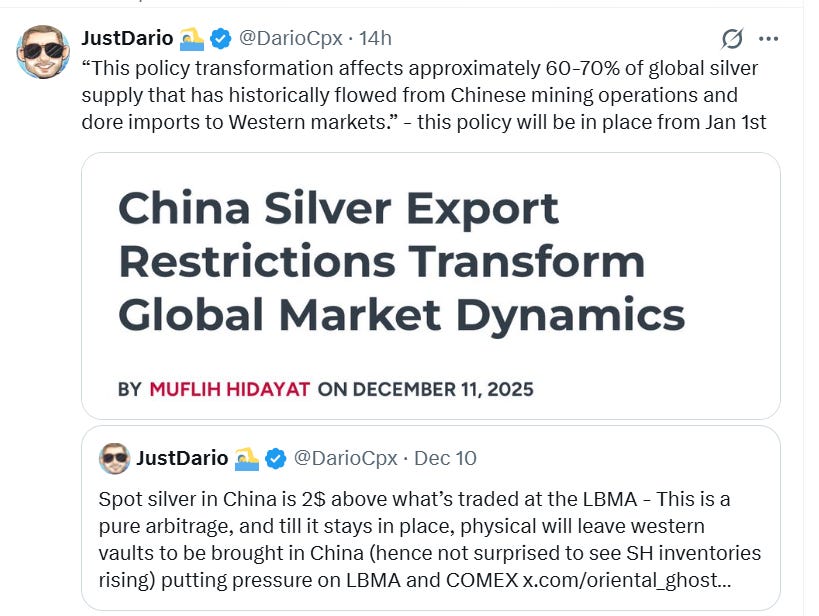
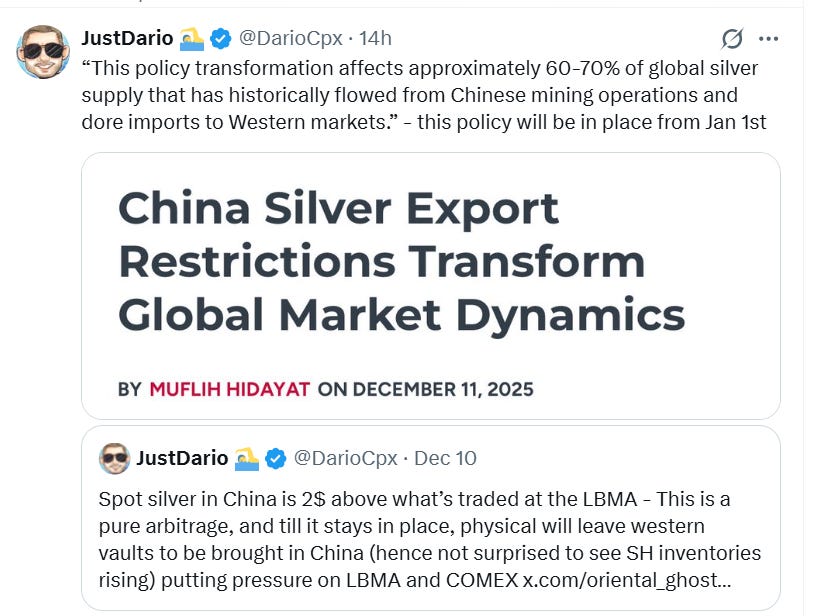
Starting in January 2026, China is imposing strict export controls on silver, requiring companies to get government licenses to ship silver abroad. Only large, state-approved firms that produce at least 80 tonnes of silver per year will qualify for these licenses, effectively cutting out smaller exporters and creating a de facto quota system. This policy will be in place at least through 2027 and is framed as protecting national resources and the environment, but it is widely seen as a strategic move to control a critical industrial metal.
Why It Matters
China is the world’s second‑largest silver miner and has historically supplied about 60–70% of the global silver that flows into Western markets. By restricting exports, China can:
-
Preserve silver for its own industries (especially solar panels and electronics).
-
Push up global silver prices and create leverage over countries that depend on Chinese silver.
-
Use silver as a geopolitical tool, similar to how it previously used rare earth export limits to pressure other countries.
Impact on Global Markets
These controls will tighten the global silver market, which has already been in deficit for several years (shortfall of 2,500+ tons annually). With less Chinese silver available, the global deficit could widen to 5,000+ tons per year, pushing prices sharply higher.
Key effects include:
-
Higher input costs for industries like solar, electronics, and semiconductors that rely heavily on silver.
-
Supply chain disruption as Western manufacturers scramble to find alternative sources or redesign products to use less silver.
-
Increased investment demand as investors treat silver more as a monetary metal and less just as an industrial commodity.
Strategic Implications
China’s move is part of a broader strategy of “resource sovereignty”: keeping critical minerals at home to support its own high‑tech industries while using export controls as economic and geopolitical leverage. For Western economies, this means they must now build strategic stockpiles, diversify supply sources (e.g., Latin America), and invest in recycling to reduce dependence on China.
Glancing around the room at the inept Western leaders (US, UK, Germany, France), all I see are losers — and the smart money is on China.
end of segment
-
our opinions are not our sponsors opinions
-
editorial department is separate from promotions department
-
not financial advice