
by Niko Moretti
”China’s silver export ban exposes the West’s hollow paper markets just as Washington prepares to call silver “essential.” Perfect timing: the nation that offshored industry now finds itself resource‑starved. The empire of IOUs meets physical reality—America can declare Silver essential… Yeah that Silver, the one thing it no longer controls.” – Jon Forrest Little
Swiss expert J. Staiger on the precious metals markets
THE WEST BUILT A SILVER EMPIRE ON PAPER—AND CHINA JUST TORCHED IT
History is turning, and the smell of smoke comes from the paper towers of London and New York. The West’s silver empire—priced, leveraged, and fantasized in digital contracts—is about to meet the oldest truth in finance: paper burns, metal endures.
China just banned silver exports. That’s not a policy tweak. That’s a declaration of economic war on a fiat order already drowning in debt and delusion. The global silver market has long balanced on Western paper promises, and now the physical foundation has been cut away. The LBMA and COMEX, those monuments to financialized make‑believe, are facing the end of the illusion.
The Empire of IOUs
For decades, the United States and its allies have “managed” silver the same way they managed their currencies—through leverage, derivatives, and deception. A few hundred million real ounces were stretched into billions of traded ounces through the miracle of fractional reserve bullion banking. Futures prices masqueraded as truth while the real metal quietly flowed East.
Western analysts called it efficiency. In reality, it was desperation—the same kind that drove the Fed to turn treasuries into toilet paper to keep the system breathing. Every ounce of real silver that left Western vaults represented five, ten, twenty or 350 paper claims waiting to be disappointed. And while the West celebrated low volatility and “market stability,” China was building the world’s largest refinery complex, its own futures exchanges, and a policy firewall around real metal.
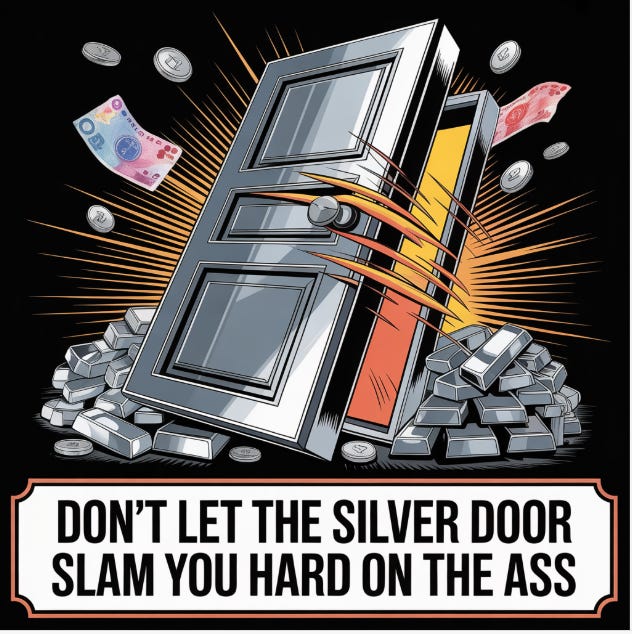
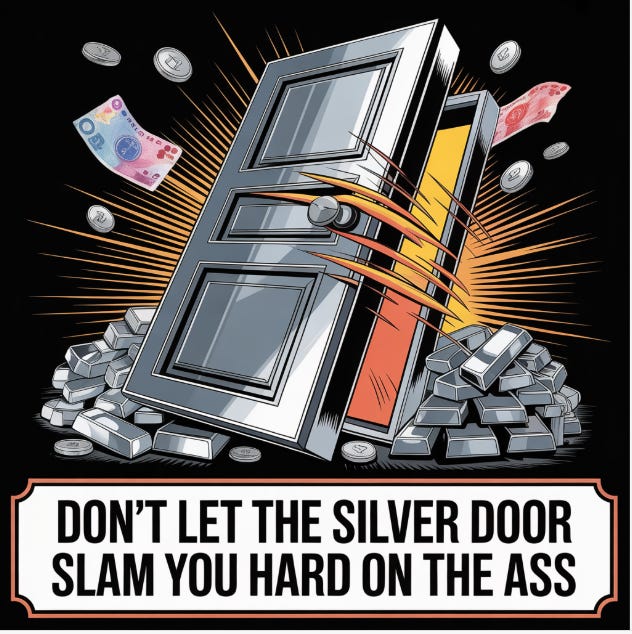
So when the Chinese authorities said, “No more deliveries,” they didn’t just close a door—they exposed the entire Western market as hollow.
The Great Disconnect
The global free float of silver—roughly 140 million ounces, give or take—is shrinking faster than any spreadsheet can keep up. Strip out Asian and Russian holdings, and the West might have half that. Maybe less. LBMA vault stockpiles have fallen for years, COMEX registered inventories have dropped to multi‑year lows, and yet the trading volume keeps rising as if nothing happened. That’s the magic trick of empire finance: create the illusion of abundance through infinite leverage, until one counterparty actually asks for delivery.
That moment has now arrived. Shipping silver from Shanghai to London might delay the inevitable a few more months, but there’s no cavalry coming. Once China’s metal stays home, the West faces a reckoning it can’t print its way out of. The entire dollar‑based system depends on confidence—and confidence evaporates the moment settlement fails.
Meanwhile in the East
While Wall Street was busy shorting the same silver five different ways, Beijing was tightening its grip on the real economy. Chinese refiners now buy silver dore directly from Latin American mines, cutting London out of the loop. The Shanghai exchange enforces real‑metal settlement for futures contracts. To trade silver there, you must deposit physical ounces. The result is a market that reflects scarcity, not illusion.
Russia showed the playbook last year when it added half a billion dollars of silver to its central bank reserves. Now BRICS nations are lining up to do the same—insurance against the collapsing tower of Western debt and devaluation. In that sense, this isn’t just about silver. It’s about the end of trust in paper money, and the return of authenticity in trade.
The West’s Final Fantasy
London’s “Good Delivery” system and COMEX’s “registered inventory” are the last defense of a crumbling fiat aristocracy. Behind every ounce promised, there are countless claims, rehypothecations, and unbacked assurances. Western managers still believe that cash settlement equals control. They don’t grasp that once credibility dies, paper contracts are as worthless as the currency they’re denominated in.
The U.S. built its dominance on promises—to pay, to deliver, to defend—and every one of those promises now rests on a printing press and a fading reputation. The West pretended silver was just another industrial commodity. The East understood it for what it has always been: money in elemental form, immune to default.
The Curtain Falls
This export ban is the rupture point between reality and fantasy. The West can keep trading paper, swapping derivatives, and marking nonexistent ounces to market. China and its partners will hoard what matters. The next phase of de‑dollarization won’t be an announcement—it will be the slow suffocation of every system that confuses digits with wealth.
When London’s vaults go dry and COMEX shifts to “cash settlement only,” remember this week. The day China said no more deliveries was the day the fiat world ran out of real metal. Call it the end of an empire measured not in gold reserves, but in counterparty risk.
Paper built the illusion. Silver will bury it.